Neurons

Neurons

Neurons Latest News

A new study (2025) has identified dendritic nanotubes (DNTs) in the brains of mice and humans, a new form of neuron-to-neuron connection.

About Neurons

  • Neurons (nerve cells) are the fundamental units of the brain and nervous system.
  • They are responsible for:
    • Receiving sensory input from the environment.
    • Sending motor commands to muscles.
    • Processing and transmitting electrical and chemical signals.
  • Structure of Neuron:
    • Dendrites → receive incoming signals.
    • Cell Body (Soma) → integrates signals.
    • Axon → carries impulses away from the cell body.
    • Axon Terminals → release neurotransmitters at synapses.

Neuronal Communication

  • Traditionally, neurons communicate via synapses where neurotransmitters cross gaps.
  • New Discovery: Neurons may also connect via nanotubes (DNTs), enabling:
    • Direct electrical signal transfer.
    • Protein transport (including amyloid-beta, linked to Alzheimer’s).

Source: AAAS

Neurons FAQs

Q1: What are neurons?

Ans: Neurons are specialized cells of the nervous system responsible for receiving, processing, and transmitting information.

Q2: What is the new discovery about neuronal communication?

Ans: Researchers found dendritic nanotubes (DNTs) that allow neurons to exchange signals and proteins directly.

Q3: Why are dendritic nanotubes significant?

Ans: They may play a key role in spreading Alzheimer’s-related proteins like amyloid-beta across neurons.

Anusandhan National Research Foundation (ANRF)

Anusandhan National Research Foundation (ANRF)

Anusandhan National Research Foundation (ANRF) Latest News

The Anusandhan National Research Foundation (ANRF) has launched a tool called SARAL (Simplified and Automated Research Amplification and Learning) to make scientific research more accessible and understandable.

About Anusandhan National Research Foundation (ANRF)

  • Established under: ANRF Act, 2023, functioning under the Department of Science & Technology (DST).
  • Subsumed body: The Science and Engineering Research Board (SERB) has been merged into ANRF.
  • Core objective: To seed, grow, and promote R&D, and foster a research and innovation culture across universities, colleges, research institutions, and R&D labs in India.
  • Strategic role: Acts as an apex body providing high-level strategic direction to research, in line with the National Education Policy (NEP), 2020.
  • Funding target: ₹50,000 crore for the period 2023–2028, with ~70% expected from private sector contributions.
  • Broader vision: Develop an AI Science & Engineering Open India Stack to revolutionize sectors like drug and chemical discovery, aerospace design, advanced materials, climate and weather studies.
  • Single-window system: Envisaged as a single-window clearance mechanism for R&D funding in academic and research institutions.
  • SARAL uses Artificial Intelligence (AI) to generate simplified summaries of complex research papers in the form of videos, podcasts, posters, and presentations for wider outreach.

Source: TH

Anusandhan National Research Foundation (ANRF) FAQs

Q1: What is ANRF?

Ans: The Anusandhan National Research Foundation (ANRF) is India’s apex research funding body established under the ANRF Act, 2023 to promote R&D and innovation.

Q2: Which body has been merged into ANRF?

Ans: The Science and Engineering Research Board (SERB) has been subsumed into ANRF.

Q3: What is the funding target of ANRF for 2023–2028?

Ans: ANRF aims to mobilize ₹50,000 crore, with about 70% expected from private sector contributions.

Thumri Music

Thumri Music

Thumri Music Latest News

Recently, Thumri lost a towering voice with the demise of Pandit Chhannulal Mishra (1936–2025), Padma Vibhushan awardee and one of the last great exponents of the Purab Ang of Banaras Gharana.

About Thumri Music

  • Thumri is a semi-classical vocal form of Hindustani music, often called the “lyric of Indian classical music”.
  • It originated in Eastern Uttar Pradesh (mainly Lucknow and Benares) during the 18th century CE, developed by Sadiq Ali Shah.
  • Themes: Primarily about love, separation, and devotion, often centered on Radha-Krishna episodes.
  • Language: Usually sung in Braj Bhasha, Awadhi, and Hindi dialects, with touches of Urdu and Sanskrit.
  • Distinct Feature: Freedom in improvisation; emphasis on bhava (emotion) over strict adherence to raga grammar.
  • Associated Dance Form: Closely linked with Kathak, enhancing its narrative expression.
  • Influences: Draws from Hori, Kajri, Dadra, Jhoola, Chaiti, etc.
  • Types of Thumri:
    • Purbi Thumri (Eastern/Slow tempo): More emotional and lyrical, usually associated with Banaras Gharana.
    • Punjabi Thumri (Fast tempo): Energetic, lively, linked with Patiala Gharana.
  • Major Gharanas of Thumri:
    • Banaras Gharana – Girija Devi, Rasoolan Bai, Siddheshwari Devi, Chhannulal Mishra.
    • Lucknow Gharana – Courtly refinement under Nawabs, Begum Akhtar.
    • Patiala Gharana – Vibrant style with rhythmic play.

Source: TH

Thumri Music FAQs

Q1: What is Thumri?

Ans: Thumri is a semi-classical vocal form of Hindustani music, emphasising lyrical expression and emotion over strict raga rules.

Q2: Where did Thumri originate?

Ans: It originated in Lucknow and Banaras (Eastern UP) in the 18th century CE.

Q3: What are the themes of Thumri?

Ans: Themes include love, separation, devotion, often portraying Radha-Krishna stories.

Sir Creek Dispute

Sir Creek

Sir Creek Latest News

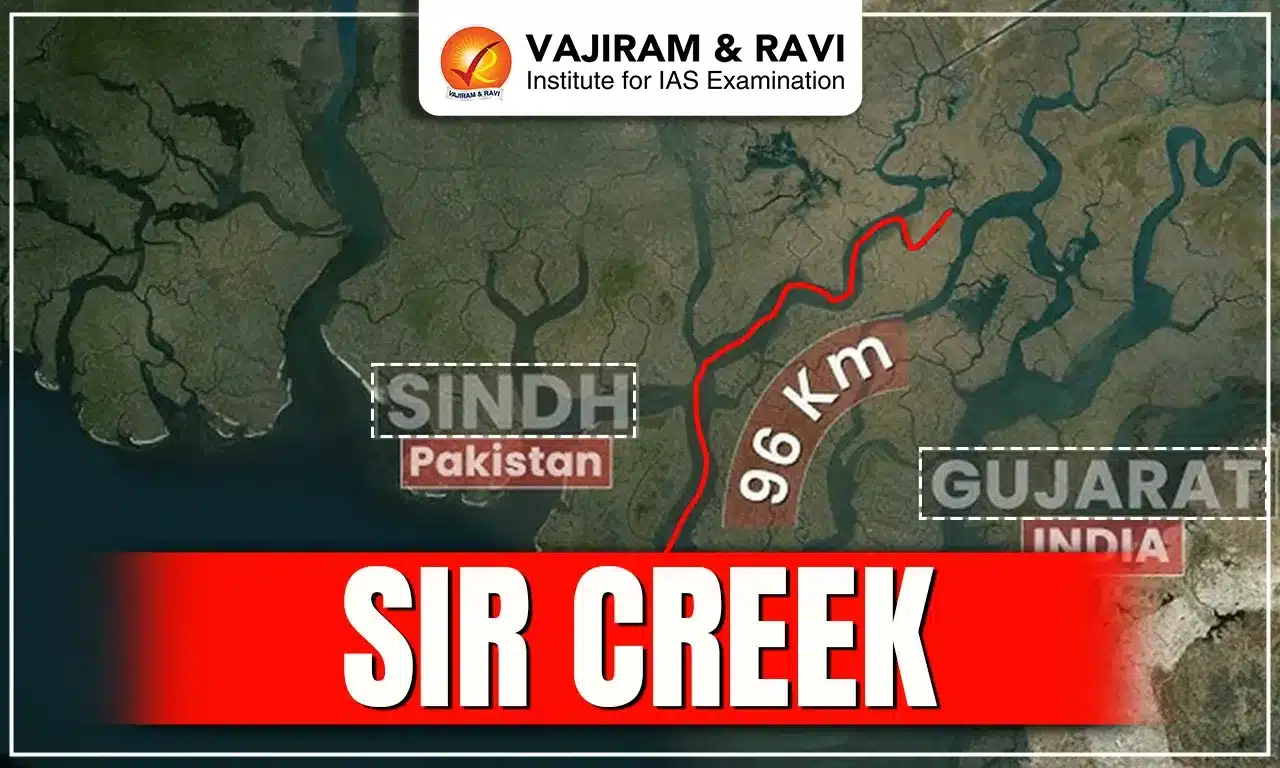
Recently, Defence Minister Rajnath Singh warned Pakistan against any aggression in the Sir Creek region, stating that India would give a “resounding and decisive response” that could alter “history and geography”.

About Sir Creek

  • Sir Creek is a 96 km long tidal estuary located in the marshy Rann of Kutch region, separating Gujarat (India) from Sindh (Pakistan).
  • It flows into the Arabian Sea and is a strategically sensitive zone due to its proximity to the international boundary.
  • The area is significant for security, fishing rights, oil and gas exploration, and Exclusive Economic Zone (EEZ) determination.

Nature of the Dispute

  • The dispute arises from differing interpretations of the 1914 Bombay Government Resolution signed between Sindh (then under British India) and the Ruler of Kutch.
  • Pakistan’s claim: The boundary lies on the eastern bank of the creek (giving the creek to Sindh).
  • India’s claim: The boundary should follow the thalweg principle (mid-channel line of navigable waters).
  • Pakistan’s counter-argument: Sir Creek is not navigable, hence the thalweg principle doesn’t apply.
  • India’s stand: The creek is navigable during high tide, so international maritime norms apply.

Source: TH

Sir Creek FAQs

Q1: What is Sir Creek?

Ans: Sir Creek is a 96-km-long disputed tidal estuary between Gujarat (India) and Sindh (Pakistan) in the Rann of Kutch, opening into the Arabian Sea.

Q2: Why is Sir Creek disputed?

Ans: The dispute arises from differing interpretations of the 1914 resolution and whether the thalweg principle applies to tidal estuaries.

Q3: Why is Sir Creek strategically important?

Ans: It inflences maritime boundary demarcation, Exclusive Economic Zones (EEZs), fishing rights, and security along the Gujarat coastline.

Exercise Drone Kavach

Exercise Drone Kavach

Exercise Drone Kavach Latest News

The Spear Corps under Eastern Command of the Indian Army recently conducted Exercise 'Drone Kavach' in the forward areas of Eastern Arunachal Pradesh.

About Exercise Drone Kavach

  • It was conducted by the Indian Army’s Spear Corps, operating under the Eastern Command, 
  • The four-day exercise was conducted in the forward areas of Eastern Arunachal Pradesh.
  • The exercise showcased the Army’s combat readiness for the next generation of drone warfare, besides validating state-of-the-art drone technologies.
  • It was also attended by personnel of the Indo-Tibetan Border Police (ITBP) deployed in forward areas. 
  • As part of it, a series of tactical manoeuvers and combat situations were exercised to validate the Army’s preparedness for operating in a multi-domain, technology-infused battlefield scenario.
  • Tactics, techniques, and procedures pertaining to target acquisition, active/passive counter-drone measures, and target neutralisation with assured success were rehearsed under simulated conditions.
  • Newly raised structures at the unit level were also exercised for developing tactics, techniques, and procedures in consonance with the overall employment philosophy and mandated operational tasks.

Source: PTI

Exercise Drone Kavach FAQs

Q1: Exercise Drone Kavach was conducted by which formation of the Indian Army?

Ans: It was conducted by the Indian Army’s Spear Corps, operating under the Eastern Command.

Q2: Where was Exercise Drone Kavach conducted?

Ans: It was conducted in the forward areas of Eastern Arunachal Pradesh.

Q3: What was the main focus of Exercise Drone Kavach?

Ans: Drone warfare readiness and counter-drone technologies.

Q4: Which paramilitary force also took part in Exercise Drone Kavach?

Ans: Indo-Tibetan Border Police (ITBP

Ichamati River

Ichamati River

Ichamati River Latest News

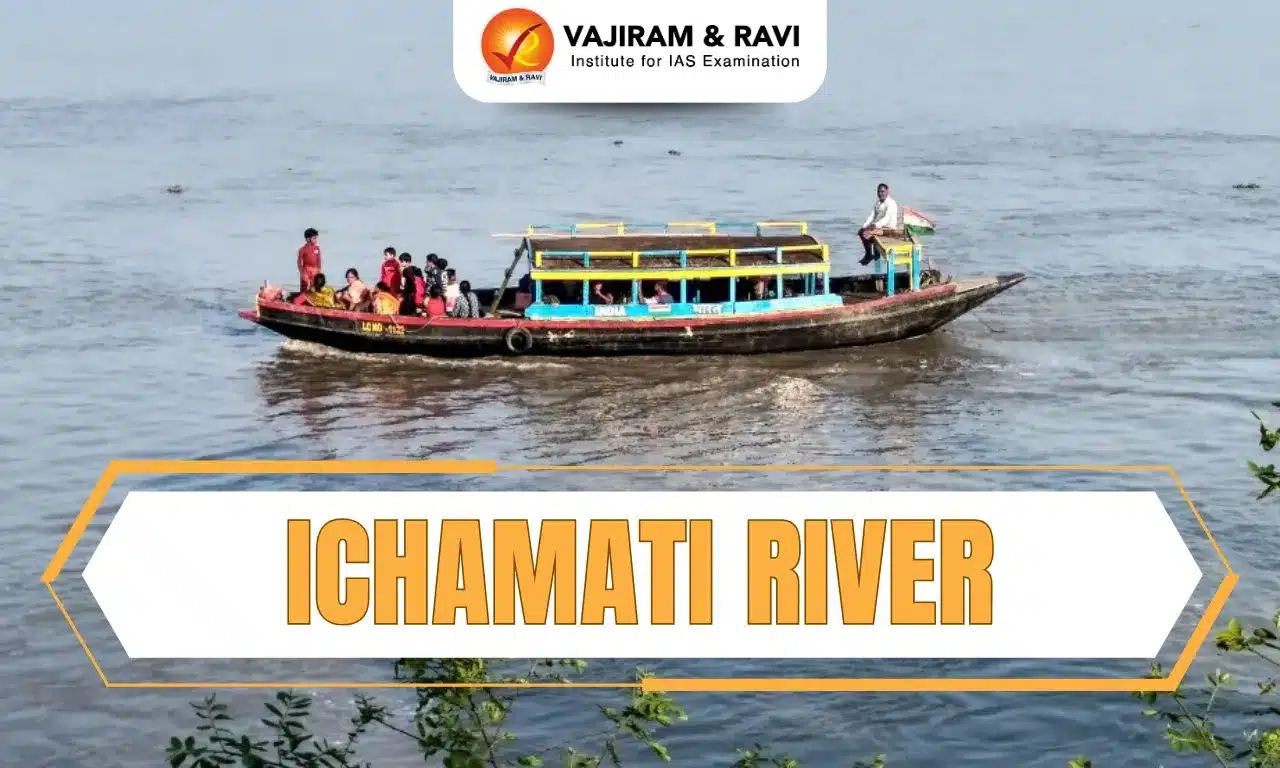
As the Durga Puja immersions commenced on the Ichamati river, a heightened security presence was initiated on the India-Bangladesh border.

About Ichamati River

  • It is a trans-boundary river which flows through India and Bangladesh.
  • It also forms part of the boundary between the two countries. 
  • Course:
    • It is one of the bifurcations of the Mathabhanga River (a distributary of the Padma) and originates at Mahjdia village in the Nadia district of West Bengal.
    • It flows through the Nadia and North 24 Parganas districts of West Bengal.
    • Then it forms part of the India–Bangladesh international border. Later, it enters Bangladesh’s Satkhira and Khulna districts.
    • It covers a distance of around 216 km before discharging into the Kalindi River at Hasnabad in North 24 Parganas District and finally outfalls into the Bay of Bengal near Moore Island.
  • Ichhamati River and its tributaries form a large oxbow lake complex in North 24-Paraganas district near Bangaon.
  • The river is facing siltation leading to thin flow of water in the dry season and floods in the rainy season.

Source: DEVD

Ichamati River FAQs

Q1: The Ichamati River is a trans-boundary river flowing between which countries?

Ans: India and Bangladesh

Q2: The Ichamati River originates as a bifurcation of which river?

Ans: Mathabhanga River

Q3: In West Bengal, through which districts does the Ichamati River mainly flow?

Ans: Nadia and North 24 Parganas

Q4: What is the approximate length of the Ichamati River?

Ans: 216 km

Trichloroethylene (TCE)

Trichloroethylene (TCE)

Trichloroethylene Latest News

Long-term exposure to the industrial solvent trichloroethylene (TCE) outdoors may be linked to an increased risk of Parkinson's disease, according to a recent study.

About Trichloroethylene

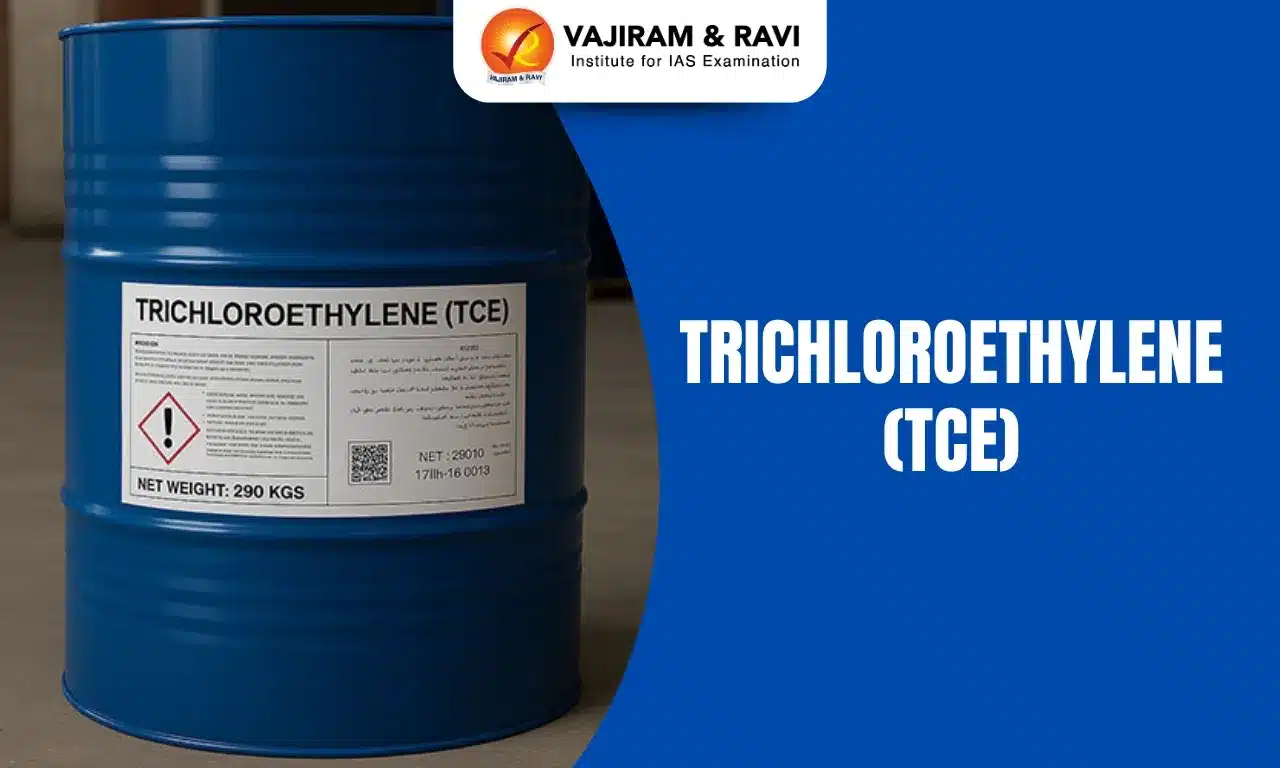
  • It is a volatile, colorless liquid organic chemical. 
  • TCE does not occur naturally and is created by chemical synthesis. 

Trichloroethylene Applications

  • It is used primarily to make refrigerants and other hydrofluorocarbons and as a degreasing solvent for metal equipment. 
  • TCE is also used in some household products, such as cleaning wipes, aerosol cleaning products, tool cleaners, paint removers, spray adhesives, and carpet cleaners and spot removers. 
  • Commercial dry cleaners also use trichloroethylene as a spot remover.

How are People Exposed to Trichloroethylene?

  • TCE may be found in the air, water, and soil at places where it is produced or used. 
  • It breaks down slowly and remains in the environment for a long time. 
  • It readily passes through soil and can accumulate in groundwater.
  • People in the general population can be exposed to TCE by inhaling it in indoor and outdoor air, drinking contaminated water, or eating foods that have been washed or processed with contaminated water.

Impact of Trichloroethylene on Human Health

  • People with prolonged or repeated exposure to TCE could experience liver problems and may have an increased risk of developing liver or kidney cancer.
  • TCE also has genotoxic and immunotoxic potential, and some studies indicate that it may be a teratogen.
  • There is also increasing evidence supporting the association between TCE exposure and non-Hodgkin lymphoma, and several reproductive and developmental toxicity endpoints, including infertility in males and females, impaired fetal growth, and cardiac teratogenesis.

Source: MEDE

Trichloroethylene FAQs

Q1: What is Trichloroethylene (TCE)?

Ans: Trichloroethylene is a volatile, colorless liquid organic chemical.

Q2: Does Trichloroethylene (TCE) occur naturally in the environment?

Ans: TCE does not occur naturally and is created by chemical synthesis.

Q3: For what primary purpose is Trichloroethylene (TCE) used in industry?

Ans: It is used primarily to make refrigerants and other hydrofluorocarbons and as a degreasing solvent for metal equipment.

Q4: Which type of cancer risk is increased with prolonged Trichloroethylene (TCE) exposure?

Ans: Liver or kidney cancer

National Pulses Mission

National Pulses Mission

National Pulses Mission Latest News

The Union Minister for Agriculture & Farmers’ Welfare, and Rural Development recently announced that the Cabinet has approved the ‘National Pulses Mission’ and simultaneously increased the Minimum Support Prices (MSP) for rabi crops.

About National Pulses Mission

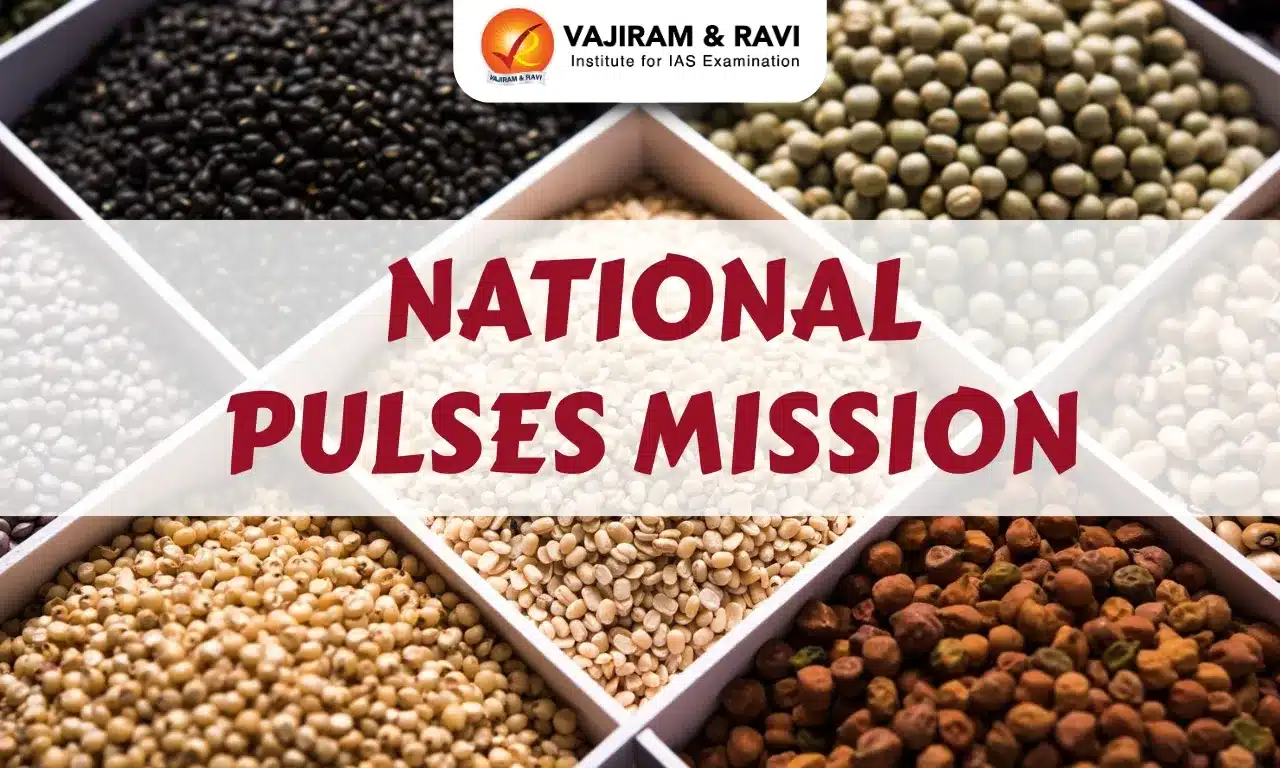
  • The "Mission for Aatmanirbharta in Pulses" is a six-year central scheme aimed at achieving self-sufficiency in pulses production, with a financial outlay of ₹11,440 crore.
  • It will be for the period from 2025-26 to 2030-31. 

National Pulses Mission Features

  • Under the mission, the Government has set a target to increase pulses production to 350 lakh tonnes by 2030-32 from 242 lakh tonnes achieved in 2023-24.
  • The area under pulses cultivation will be expanded to 310 lakh hectares from 242 lakh hectares, while yield is targeted to improve to 1,130 kg per hectare from 881 kg per hectare.
  • The mission will be implemented through a cluster-based approach across 416 focused districts.
  • About 1,000 new packaging and processing units will be set up, with a maximum subsidy of Rs 25 lakh available for establishing processing and packaging facilities.
  • To improve productivity, the emphasis will be on developing and disseminating the latest varieties of pulses that are high in productivity, pest-resistant and climate-resilient. 
  • Multi-location trials will be conducted in major pulse-growing states to ensure regional suitability.
  • The Government will distribute 126 lakh quintals of certified seeds to pulse-growing farmers, covering 370 lakh hectares by 2030-31.
  • States will prepare five-year rolling seed production plans, with breeder seed production supervised by the Indian Council of Agricultural Research (ICAR).
  • Foundation and certified seed production will be undertaken by state and central-level agencies and tracked through the Seed Authentication, Traceability & Holistic Inventory (SATHI) portal.
  • Additionally, 88 lakh seed kits will be distributed free of cost to farmers to support area expansion by an additional 35 lakh hectares, targeting rice fallow areas and promoting intercropping and crop diversification.
  • The mission will particularly focus on increasing production of tur, urad, and masur.
    • A major feature of the mission is the assured procurement of tur, urad and masur under the Price Support Scheme (PSS) of the Pradhan Mantri Annadata Aay Sanrakshan Abhiyan (PM-AASHA).
    • National Agricultural Cooperative Marketing Federation of India Ltd.(NAFED) and National Cooperative Consumers Federation (NCCF) will undertake 100 percent procurement in participating states for the next four years from farmers who register with these agencies.

Source: PIB

National Pulses Mission FAQs

Q1: The "Mission for Aatmanirbharta in Pulses" will be implemented during which period?

Ans: 2025-26 to 2030-31

Q2: What is the total financial outlay for the National Pulses Mission?

Ans: ₹11,440 crore

Q3: What is the maximum subsidy available for setting up new pulses processing and packaging units under the National Pulses Mission?

Ans: ₹25 lakh

Q4: Which digital portal will be used for tracking foundation and certified seed production under the National Pulses Mission?

Ans: Seed Authentication, Traceability & Holistic Inventory (SATHI) portal

Promotion of Research & Innovation in Pharma-MedTech Sector (PRIP) Scheme

PRIP (Promotion of Research and Innovation in Pharma MedTech Sector) Scheme

PRIP (Promotion of Research and Innovation in Pharma MedTech Sector) Scheme Latest News

The government recently invited applications for research and innovation projects under its Promotion of Research and Innovation in Pharma-MedTech Sector scheme to make it a globally competitive and innovation-driven sector.

About PRIP Scheme

  • The PRIP scheme was launched by the Department of Pharmaceuticals, Ministry of Chemicals & Fertilizers, to transform India into a global powerhouse for R&D in the Pharma MedTech sector.
  • The scheme was notified on August 17, 2023 with total financial outlay of ₹5000 crores.
  • The aim of the scheme is to promote industry-academia linkage for R&D in priority areas and to inculcate the culture of quality research and nurture our pool of scientists.
  • It focuses on two components:
    • Component A: 
      • Strengthening research infrastructure through establishment of Centres of Excellence (CoE) in the seven existing National Institutes of Pharmaceutical Education and Research (NIPERs). 
      • These CoEs would be set up in pre identified areas with a financial outlay of Rs 700 Crores.
    • Component B: 
      • Promoting research in the pharmaceutical sector by encouraging research in six priority areas wherein financial assistance will be provided for the industries, MSMEs, SMEs, startups working with government institutes, and for both in- house and academic research. 
      • The component has a financial outlay of Rs.4250 Crores.
      • Bigger companies can seek funding of up to ₹125 crore, while startups can secure up to ₹1 crore over a period of five years, based on their milestones.
  • Priority Areas: 
    • New Chemical Entity, New Biological Entity, and Phyto-pharmaceuticals 
    • Complex generics and Biosimilars
    • Precision medicine (Targeted innovative therapeutics)
    • Medical devices
    • Orphan Drugs 
    • Drug development for anti-microbial resistance (AMR)
  • An Empowered Committee under the chairmanship of CEO, NITI Aayog, with the secretary-level representation of Pharmaceuticals, Health, ICMR, DBT, CSIR, AYUSH, and DST, will provide guidance for the implementation of the scheme.

Source: ET

PRIP (Promotion of Research and Innovation in Pharma MedTech Sector) Scheme FAQs

Q1: PRIP (Promotion of Research and Innovation in Pharma MedTech Sector) Scheme was launched by which Ministry?

Ans: Ministry of Chemicals & Fertilizers

Q2: When was the PRIP (Promotion of Research and Innovation in Pharma MedTech Sector) Scheme notified?

Ans: The scheme was notified on August 17, 2023.

Q3: What is the total financial outlay of the PRIP (Promotion of Research and Innovation in Pharma MedTech Sector) Scheme?

Ans: ₹5000 crore

Snow Leopard

Snow Leopard

Snow Leopard Latest News

Himachal Pradesh has recorded 83 snow leopards (up from 51 in 2021) as per the latest survey by the Wildlife Wing of the State Forest Department in collaboration with the Nature Conservation Foundation (NCF).

About Snow Leopard (Panthera uncia)

  • Declared State Animal of Ladakh and Himachal Pradesh.
  • Found across 12 range countries – Afghanistan, Bhutan, China, India, Kazakhstan, Kyrgyzstan, Mongolia, Nepal, Pakistan, Russia, Tajikistan, Uzbekistan.
  • India is home to an estimated 500–700 snow leopards spread across the Himalayas and Trans-Himalayan region.
  • Mascot of Khelo India Winter Games 2024: named Sheen-e She (Shan) in Ladakh.
  • It is listed as Vulnerable on the IUCN Red List and is native to the mountain ranges of Central and South Asia.

Key Characteristics Snow Leopard

  • Medium-sized cat, weight 30–55 kg.
  • Height: 55–65 cm | Length: 90–115 cm.
  • Fur: Smoky-grey with black rosettes, providing camouflage in rocky terrain.
  • Paws: Large, act like natural snowshoes to prevent sinking.
  • Tail: Extra-long, used for balance and warmth.
  • Ears: Small and round, reducing heat loss.
  • Nasal cavity: Wide, short—warms cold air before inhalation.
  • Leaping ability: Can leap 10 meters (30 feet) in a single bound.
  • Vocalisation: Cannot roar, unlike most big cats.
  • Evolutionary relation: Closer to tigers than leopards.

Key Details of the Survey

  • The exercise, covering 26,000 sq km across Spiti Valley, Kinnaur, Pangi, Lahaul, and Great Himalayan National Park, involved 271 camera traps.
  • First official sighting of Pallas’s Cat in Kinnaur and rediscovery of Woolly Flying Squirrel in Lahaul also reported.
  • For the first time globally, indigenous women from Kibber contributed to data analysis, highlighting inclusive community participation in conservation.
  • Himachal Pradesh is the first state in India to complete a population estimation of snow leopards, setting a cost-effective, scalable model for monitoring.

Source: IE

Snow Leopard FAQs

Q1: What is the snow leopard also known as?

Ans: Ghost of the mountains

Q2: What is the IUCN status of the snow leopard?

Ans: Vulnerable

Q3: In which Indian states is the Snow Leopard found?

Ans: Found mainly in Ladakh, Himachal Pradesh, Uttarakhand, Arunachal Pradesh, and Sikkim.

Enquire Now