Akshar Fast Patrol Vessel

Akshar Fast Patrol Vessel

Akshar Fast Patrol Vessel Latest News

Recently, Indian Coast Guard Ship (ICGS) Akshar was commissioned at Karaikal, Puducherry.

About Akshar Fast Patrol Vessel

  • It is the second in a series of eight Adamya-class Fast Patrol Vessels (FPVs).
  • The name ‘Akshar’ meaning ‘imperishable’, symbolises the ICG’s steadfast resolve and commitment to ensuring safe, secure, and clean seas.
  • It has been designed and built indigenously by Goa Shipyard Limited and contains over 60% indigenous content.

Features of Akshar Fast Patrol Vessel

  • Capacity: The ship displaces approx. 320 tons and is propelled by two 3,000 KW diesel engines, enabling a maximum speed of 27 Knots.
  • It has an endurance of 1,500 nautical miles at an economical speed.
  • ICGS Akshar is fitted with indigenously developed two Controllable Pitch Propellers (CPP) and gearboxes, offering superior maneuverability, operational flexibility and enhanced performance at sea.
  • The vessel also features an Integrated Bridge System (IBS), Integrated Platform Management System (IPMS), and Automated Power Management System (APMS), augmenting operational efficiency and automation.
  • The ship will be based at Karaikal, Puducherry, under the administrative and operational control of Commander Coast Guard Region (East).

Source: PIB

Akshar Fast Patrol Vessel FAQs

Q1: Who built the Akshar Fast Patrol Vessel?

Ans: Goa Shipyard Limited (GSL).

Q2: What is the top speed of the Akshar Fast Patrol Vessel?

Ans: The vessel has a top speed of 27 knots
Pulicat Lake

Pulicat Lake

Pulicat Lake Latest News

Recently, Pulicat lake fishermen demand a long-term solution as silt threatens lake livelihoods.

About Pulicat Lake

  • It is a vast coastal shallow, brackish water lagoon along the coast of Bay of Bengal into which streams drain
  • It is the second largest brackish water lagoon in India after Chilika, sprawling across Andhra Pradesh and Tamil Nadu.
  • ThIS lagoon is separated from the Bay of Bengal by the Sriharikota island.
  • It is fed by the Aarani River at the southern tip and the Kalangi River from the northwest. The Buckingham Canal, a navigation channel, passes through the lagoon.
  • It was designated as a Ramsar site in 2002.
  • Biodiversity: It is a unique ecotone that supports rich biodiversity — from aquatic life such as mudskippers, seagrass beds, and oyster reefs to more than 200 avian species,
  • Flora: The green kingdom is represented with about 132 plant species like Walsura piscida; Manilkara elengi, Excoecaria agallocaha, Spinifex littoreus, Calamus viminalis, etc.
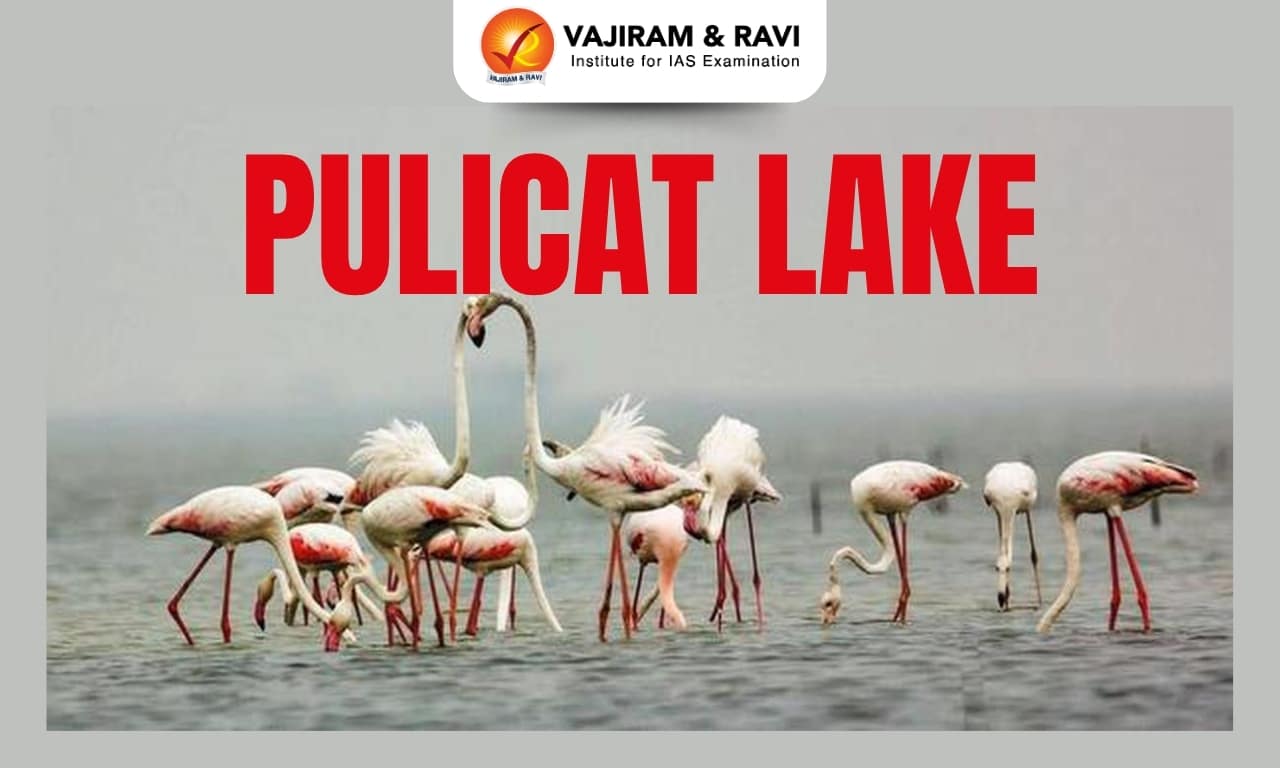
  • Fauna: It includes migratory birds such as Eurasian curlews, oystercatchers, bar-tailed godwits, sand plovers, and greater flamingos.

Source: TH

Pulicat Lake FAQs

Q1: What type of lake is Pulicat Lake?

Ans: Brackish water lagoon.

Q2: Where is Pulicat Lake located?

Ans: It is situated on the border of Andhra Pradesh and Tamil Nadu, with the majority of its area falling in Andhra Pradesh.

Painted Stork

Painted Stork

Painted stork Latest News

Recently, after a four-year hiatus, a pair of painted storks has been spotted in Kaziranga National Park and Tiger Reserve (KNPTR).

About Painted stork

  • It is a large wading bird belonging to the stork family. 
  • Distribution: These birds are found across the plains of tropical Asia, from the Indian Subcontinent extending into Southeast Asia, south of the Himalayas. 
  • Habitat: They favor freshwater wetlands, but they also frequent irrigation canals and agricultural fields, particularly during the monsoon when rice fields are flooded.
  • They are not migratory and only make short-distance movements in some parts of their range in response to changes in weather or food availability or for breeding.
  • Food: Painted storks are carnivores (piscivores). Their diet consists mainly of small fish, but also crustaceans, amphibians, insects, and reptiles. 
  • Conservation Status: It is classified as near threatened under the IUCN Red List

Painted Stork Features

  • Painted storks are the only storks within the genus Mycteria that have a black pectoral band.
  • Males and females are not sexually dimorphic; however, male painted storks tend to be slightly larger than female storks.

Source: TOI

Painted stork FAQs

Q1: Where are Painted Storks primarily found?

Ans: Wetlands of tropical Asia

Q2: What is the primary source of food for Painted Storks?

Ans: Painted Storks are fish-eating birds, using a unique sweeping technique to catch fish in shallow waters

NATO Pipeline System

NATO Pipeline System

NATO Pipeline System Latest News

Recently, the Polish government said that it will finally join the NATO Pipeline System (NPS).

About NATO Pipeline System

  • It was set up during the Cold War to supply NATO forces with fuel.
  • It is approximately 10,000 kilometres long, runs through 12 NATO countries and has a storage capacity of 4.1 million cubic metres.
  • The NPS links together storage depots, military air bases, civil airports, pumping stations, truck and rail loading stations, refineries and entry/discharge points.
  • Funding: Bulk distribution is carried out using facilities from the common-funded NATO Security Investment Programme.
  • Controlled by: The networks are controlled by national organisations, with the exception of the Central Europe Pipeline System (CEPS), which is a multinational system managed by the CEPS Programme Office under the aegis of the NATO Support and Procurement Agency.
  • Structure 
    • It is overseen by the Petroleum Committee, which is the senior advisory body in NATO on consumer logistics and, more specifically, on petroleum issues.
    • It reports to the Logistics Committee on all matters of concern to NATO in connection with military fuels and other petroleum installations.
    • The NPS consists of eight national pipeline systems and two multinational systems

Source: TH

NATO Pipeline System FAQs

Q1: Which country is recently integrating into the NATO Pipeline System?

Ans: Poland

Q2: What is the primary purpose of the NATO Pipeline System?

Ans: To ensure fuel supply for NATO's military operations.

Mono Ethylene Glycol (MEG)

What is Mono Ethylene Glycol (MEG)

Mono Ethylene Glycol Latest News

The textile industry has appealed to the government not to levy anti-dumping duty on Mono Ethylene Glycol (MEG), which is one of the main raw materials used in the production of polyester fibre and filament.

About Mono Ethylene Glycol

  • It is an organic compound with the formula C2H6O2
  • It is also called ethylene glycol or just glycol.
  • It is a slightly viscous liquid with a clear, colourless appearance and a sweet taste that emits virtually no odour.
  • It’s miscible with water, alcohols, and many other organic compounds.
  • It is produced from the reaction between water and ethylene oxide.
  • It is hygroscopic, meaning it can absorb water from its surroundings, and this property makes it useful as a dehydrating agent in various applications. 
  • MEG has a relatively low toxicity and is considered safe for many industrial and commercial uses.
  • Uses:
    • MEG is most commonly used in the manufacture of polyester fibre, fabrics, and polyethylene tereph­thalate (PET) resin used for the production of plastic bottles.
    • Other industrial uses are as a coolant, heat transfer agent, antifreeze, and hydrate inhibitor in gas pipelines.

Source: TH


Mono Ethylene Glycol FAQs

Q1: What is the chemical formula of Mono Ethylene Glycol (MEG)?

Ans: C₂H₆O₂

Q2: What is the major industrial use of Mono Ethylene Glycol?

Ans: MEG is most commonly used in the manufacture of polyester fibre, fabrics, and polyethylene tereph­thalate (PET) resin.

Q3: Mono Ethylene Glycol is produced by the reaction between which two substances?

Ans: It is produced from the reaction between water and ethylene oxide.

Q4: What is the appearance of Mono Ethylene Glycol?

Ans: Clear, colourless, and slightly viscous liquid.

Valmiki Tiger Reserve (VTR)

Valmiki Tiger Reserve (VTR)

Valmiki Tiger Reserve Latest News

A tiger claimed another life in Valmiki Tiger Reserve, West Champaran, recently.

About Valmiki Tiger Reserve

  • It is located at the India-Nepal border in the northern part of the West Champaran District of Bihar. 
  • It is spread over an area of about 880 sq. km.
  • It forms the easternmost limit of the Himalayan Terai forests in India and is the only tiger reserve of Bihar.
  • It comprises the Valmiki National Park and the Valmiki Wild Sanctuary.
  • Situated in the Gangetic Plains bio-geographic zone of the country, the forest has a combination of Bhabar and Terai tracts.
  • It is surrounded by the Royal Chitwan National Park of Nepal in the north and the river Gandak on the western side, with the Himalayan mountains as a backdrop.
  • Drainage: The rivers Gandak, Pandai, Manor, Harha, Masan, and Bhapsa flow through various parts of the reserve.
  • By and large, the reserve is spread over the lower Shivalik region with a deep water table. 
  • The tract is porous with boulders and sand deposits.
  • Vegetation: The reserve boasts a variety of vegetation types, including tropical wet deciduous forests, grasslands, savannas, and riverine forests. 
  • Flora: Sal trees dominate the forests, but the region also features species like teak, bamboo, semal, and khair.
  • Fauna: Tiger, leopard, fishing cat, leopard cat, sambar, hog deer, spotted deer, black buck, gaur, sloth bear, langur, rhesus monkey, etc.

Source: TOI

Valmiki Tiger Reserve FAQs

Q1: Valmiki Tiger Reserve is located in which Indian state?

Ans: Bihar

Q2: Valmiki Tiger Reserve lies along which international border?

Ans: India–Nepal

Q3: Valmiki Tiger Reserve forms part of which bio-geographic zone of India?

Ans: Gangetic Plains Zone

Dark Stars

Dark Stars

Dark Stars Latest News

Astronomers recently unearthed evidence that some of the earliest luminous objects in the universe may be “dark stars”, stars powered not by nuclear fusion but by dark matter annihilation.

About Dark Stars

  • Dark stars are hypothetical objects that may have inhabited the early universe.
  • Scientists believe that dark stars might be the oldest stars in the history of the universe and may represent the first phase of stellar evolution. 
  • These stars are giant, much larger than our sun or any of the other stars around today. 
  • A single dark star could be as much as 400 to 200,000 times wider than our sun and 500 to 1,000 times more massive.
  • Dark stars aren't actually dark; they just don't emit any visible light. 
  • That's because instead of nuclear fusion, which is the process that converts hydrogen into helium in the core of an ordinary star, dark stars are powered differently. 
    • Astronomers believe that dark matter heating is what powers them.
    • Because there’s no fusion happening inside them, they aren’t very hot.
    • Because dark stars don’t rely on core fusion to stave off gravitational collapse, they’re not extremely compressed like normal stars. 
    • Instead, dark stars are likely giant, puffy clouds that shine extremely bright.
    • A single dark star from the early Universe could be as bright as an early galaxy containing many more standard stars.
  • And even though they'd be massive — and potentially spewing gamma rays, neutrinos, and antimatter — so far, they've been too faint to be detected because they don't emit visible light.

Source: TH


Dark Stars FAQs

Q1: What are Dark Stars believed to be?

Ans: Hypothetical stars from the early universe powered by dark matter.

Q2: How much wider could a Dark Star be compared to the Sun?

Ans: 400–200,000 times

Q3: What type of structure are Dark Stars believed to have?

Ans: Dark stars are likely giant, puffy clouds that shine extremely bright.

Q4: Why are Dark Stars difficult to detect?

Ans: They emit radiation mostly outside the visible spectrum.

Compressive Asphyxia

Compressive Asphyxia

Compressive Asphyxia Latest News

The death toll in the stampede at Tamilaga Vetri Kazhagam’s (TVK) rally at Velusamypuram has climbed to 41, with doctors attributing most fatalities to compressive asphyxia due to crowd crush.

What is Asphyxia?

  • Asphyxia or asphyxiation occurs when the body does not get enough oxygen. 
    • Respiration is the process of air moving in and out of your lungs. 
    • Humans take in oxygen, which is circulated to all of the cells throughout the body via the blood, and carbon dioxide is then removed through the same system. 
  • When asphyxia occurs, and the body does not get the amount of oxygen it needs, it can cause a person to become unconscious or even die.

About Compressive Asphyxia

  • This type of physical asphyxia happens when an outside force keeps you from expanding your chest to breathe. 
  • Your lungs are “crushed” and can’t take in air.
  • This can happen from a crowd of people pressing against your body or a person’s weight on your chest.

Source: NIE

Compressive Asphyxia FAQs

Q1: What is Asphyxia?

Ans: A condition where the body does not get enough oxygen.

Q2: What can happen if asphyxia is not treated immediately?

Ans: Unconsciousness or death.

Q3: What is Compressive Asphyxia?

Ans: When the body cannot expand the chest to breathe due to external pressure.

Q4: What happens to the lungs during compressive asphyxia?

Ans: They are “crushed” and can’t take in air.

Baratang Island

Baratang Island

Baratang Island Latest News

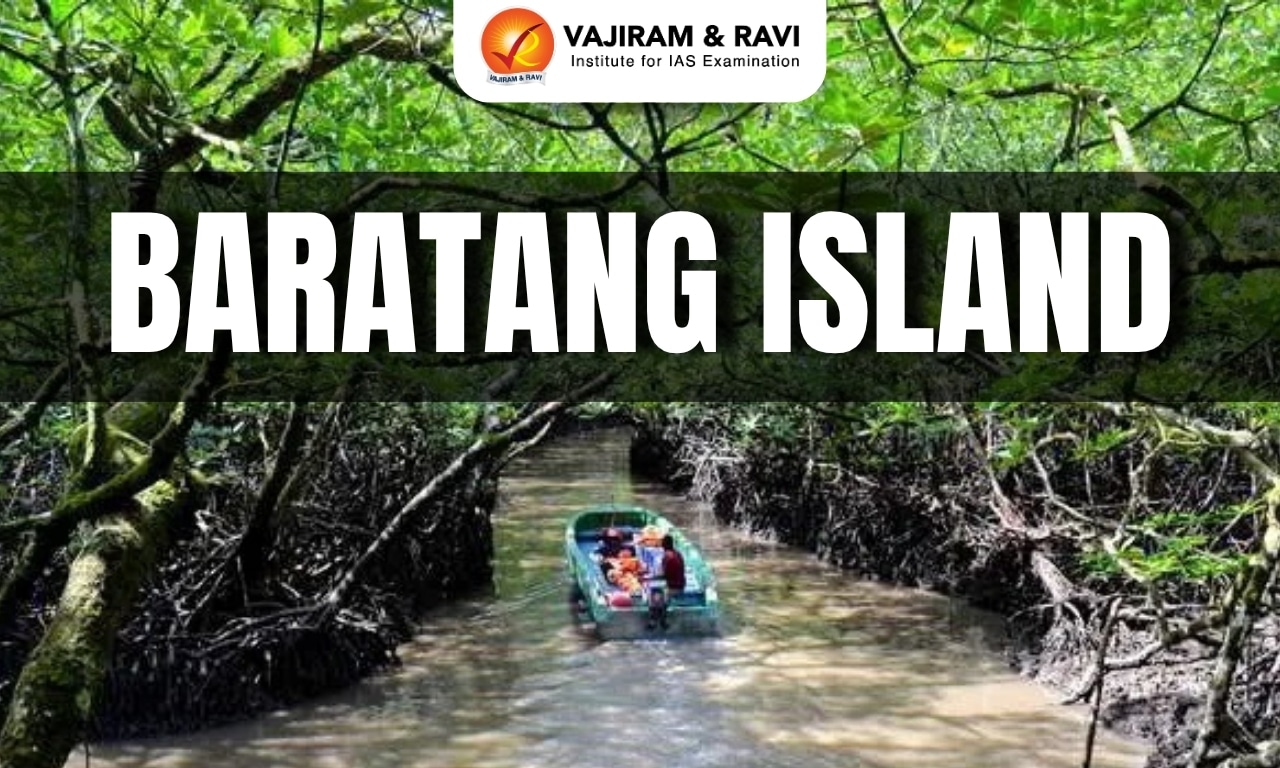
Recently, India's only mud volcano at Baratang in Andaman and Nicobar Islands has again erupted.

About Baratang Island

  • Location:  It is located in the North and Middle Andaman district, and it is nearly 150 km away from Port Blair.
  • It is a very popular tourist spot because it is India's only mud volcano.
  • It erupted recently in 2005 owing to the oceanic seismic shifts. 
  • The mud volcanoes in Baratang Islands are the only known volcanoes in the Indian sub-continent.
  • It is also home to the Jarawa tribe, one of the indigenous tribes of the Andaman and Nicobar Islands.

What is Mud Volcano?

  • Mud volcanoes, also called ‘Mud Domes,’ are formed by the eruption of mud slurries, water, and gases involving a series of geological processes.
  • Unlike actual ingenious volcanoes, mud volcanoes don’t throw out lava when they erupt.
  • It is a geological formation where a mixture of mud, water, and gases (mainly methane, sometimes carbon dioxide or nitrogen) erupts to the surface, creating cone-like structures that resemble true volcanoes without molten lava.
  • The sizes of mud volcanoes lie between one and two meters to 700 meters high and between one and two meters to 10 kilometers wide.
  • Mud volcanoes also exist on the floor of the sea and can form islands and banks that alter the topography and shape of the coastline.

Source: LM

Baratang Island FAQs

Q1: Where is Baratang Island located?

Ans: Andaman Islands

Q2: What unique geological feature is found on Baratang Island?

Ans: Mud volcanoes

MeerKAT Telescope

MeerKAT Telescope

About MeerKAT Radio Telescope:

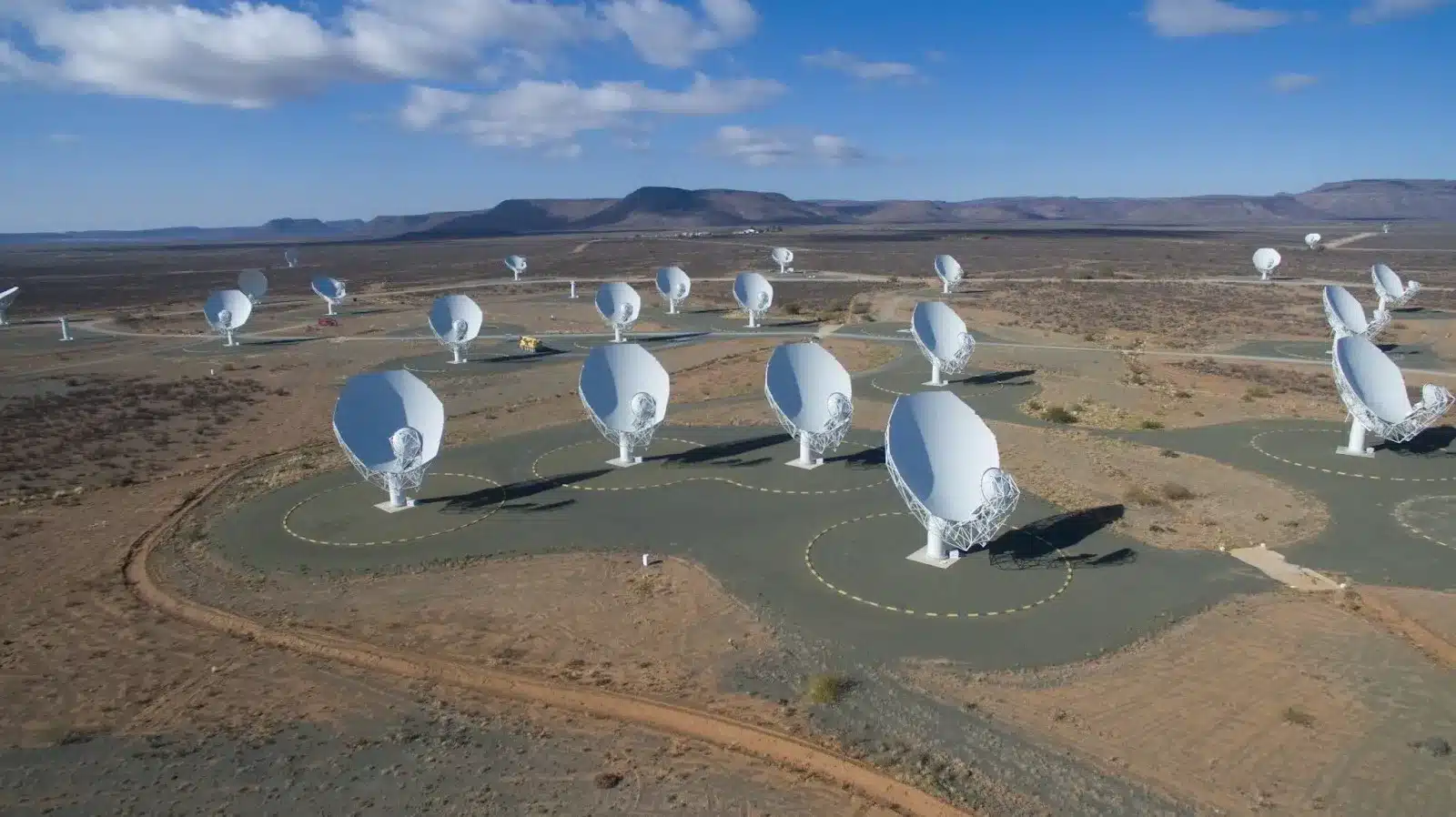
  • MeerKAT is a connected array of radio telescopes located in the Northern Cape province of South Africa.
  • It was originally known as the Karoo Array Telescope (KAT), that would consist of 20 receptors. When the South African government increased the budget to allow the building of 64 receptors, the team renamed it “MeerKAT”, – i.e., “more of KAT”. 
  • It is part of South Africa's contribution to the global Square Kilometre Array (SKA)project, which aims to build the largest and most sensitive radio telescope in the world.
  • It is a precursor instrument to the mid-frequency component of the Square Kilometre Array (SKA).
  • It uses radio signals from space to study the evolution of the universe and everything it contains.
  • It comprises64 dishes, each 13.5 metres in diameter, with maximum separations of 8 km. 
  • The received signals travel to a subterranean processor building that combines them and allows the telescopes to work together as a single instrument.
  • It is currently the most powerful radio interferometer at centimeter wavelengths

Q1: What are radio galaxies?

A radio galaxy is a galaxy that dominates the sky over Earth in radiowaves. These intense radio emissions originate from vast lobes of gas that extend well beyond the galaxy's visible structure, often spanning millions of light-years. Typically appearing in pairs, these radio lobes form when the galaxy's core contains an active galactic nucleus (AGN). This extremely luminous region is powered by a supermassive black hole, superheating and feeding on the surrounding material, causing the galaxy to radiate brightly.

News: New giant radio galaxy discovered with MeerKAT

Willingdon Island

Willingdon Island

About Willingdon Island: 

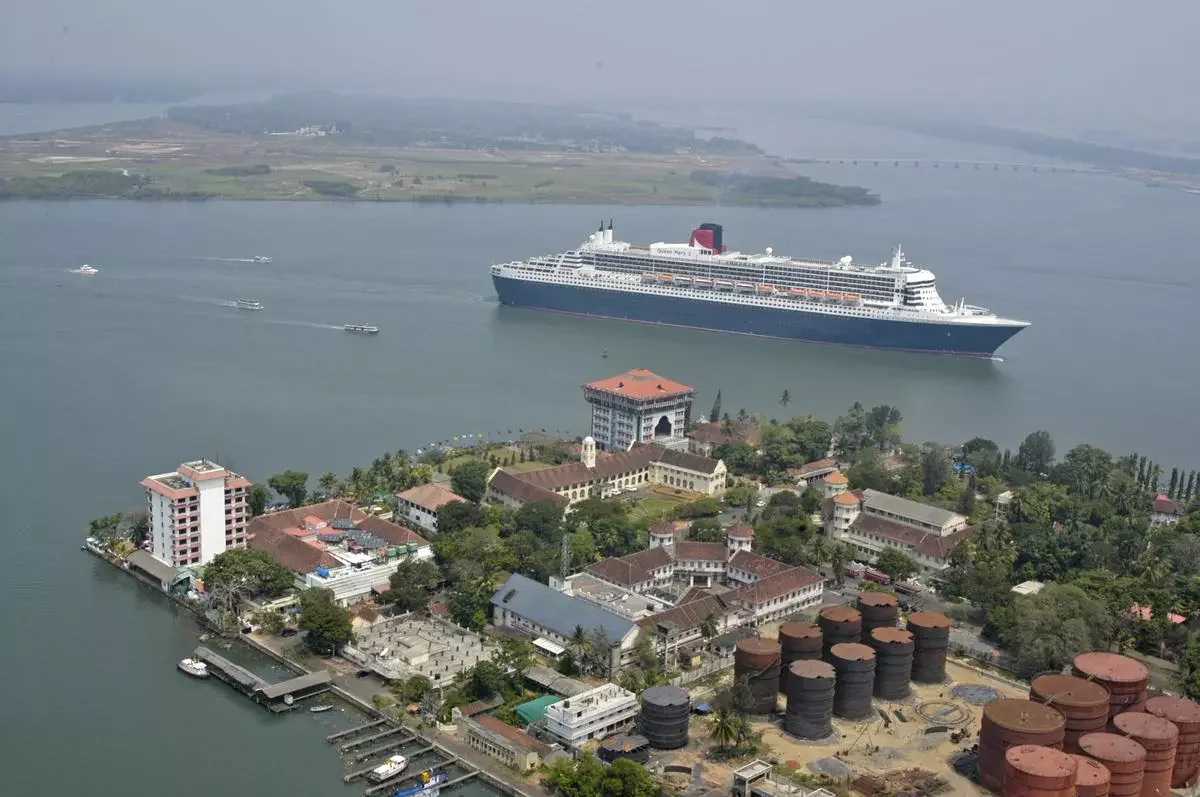
  • It is among the most beautiful locations in the Kochi area of Kerala.
  • This is a man-made island, named after Lord Willingdon who was a British Viceroy of India.
  • It is among the biggest of its kind in India.
  • It is also home to the Kochi Naval Base of the Indian Navy, the Central Institute of Fisheries Technology and the Port of Kochi.
  • The island is connected to the mainland by the Venduruthy Bridge.

Who was Lord Willingdon (1931 - 1936)?

  • He was the 22nd Viceroy and Governor-General of India.
  • Major events during his tenure
  • Introduction of the Government of India Act, 1935.
  • The Second Round Table Conference, held in 1931, saw the participation of Gandhi as a representative of the Congress. 
  • British Prime Minister Ramsay MacDonald introduced the Communal Award in 1932.
  • The Poona Pact of 1932 was reached between Gandhi and Ambedkar to address provisions related to fair representation of backward classes.
  • The Third Round Table Conference, held in 1932, failed as neither Gandhi nor Congress attended.

Q1: What is an Archipelago?

An archipelago is an area that contains a chain or group of islands scattered in lakes, rivers, or the ocean.

News: Willingdon Island: A delayed restart

Enquire Now