Manjeera River

Manjeera River

Manjeera River Latest News

In a dramatic rescue operation near Edupayala temple in Medak, two youths from Kukatpally were saved after being swept away by the swollen Manjeera river.

About Manjeera River

  • The Manjeera also spelled Manjiira is a tributary of the river Godavari. 
  • It passes through the states of Maharashtra, Karnataka and Telangana. 
  • Course:
    • It originates in the Balaghat range of hills near Ahmednagar District, Maharashtra, at an altitude of 823 metres (2,700 ft).
    • The final stretch of the River forms the border between Maharashtra to the West and Telangana to the East.
    • Ultimately, it drains into Godavari River at Basara near Nizamabad, Telangana.
  • Total Length : 724 km
  • It has a total catchment area of 30,844 sq.km.
  • Some of its notable tributaries are Haldi (Haridra), Lendi, Nalla, Manyad, Terna, Tawarja, Gharni, etc.
  • Key Projects on Manjeera:
    • Singur Dam/Singur Reservoir
    • Nizam Sagar Project

Source: TT

Manjeera River FAQs

Q1: The Manjeera River is a tributary of which major river?

Ans: Godavari River

Q2: Manjeera River flows through which state?

Ans: It passes through the states of Maharashtra, Karnataka and Telangana.

Q3: Where does the Manjeera River originate?

Ans: It originates in the Balaghat range of hills near Ahmednagar District, Maharashtra.

Q4: What is the approximate total length of the Manjeera River?

Ans: 724 km
PM-SETU Scheme

PM-SETU Scheme

PM-SETU Scheme Latest News

During the Kaushal Deekshant Samaroh which is being held at Vigyan Bhawan in New Delhi, the Prime Minister launched the  Pradhan Mantri Skilling and Employability Transformation through Upgraded ITIs- PM – SETU.

About PM-SETU Scheme

  • Pradhan Mantri Skilling and Employability Transformation through Upgraded ITIs (PM-SETU) scheme  is a centrally sponsored scheme with an investment of Rs 60,000 crore.
  • The scheme aims to transform 1,000 Government ITIs across India into modern, industry-aligned training institutions.
  • PM-SETU will follow a hub-and-spoke model, with 200 hub ITIs linked to 800 spoke ITIs. 
  • Each hub will be equipped with advanced infrastructure, innovation and incubation centres, production units, training of trainer facilities, and placement services, while the spokes will extend access and outreach. 
  • The scheme will: 
    • Introduce new, demand-driven courses and revamp existing ones in collaboration with industry;
    • Set up Special Purpose Vehicles (SPVs) with credible Anchor Industry Partners to manage clusters and ensure outcome-based training;
    • Create pathways for long-term diplomas, short-term courses, and executive programs;
    • Strengthen 5 National Skill Training Institutes in – Bhubaneswar (Odisha), Chennai (Tamil Nadu), Hyderabad (Telangana), Kanpur (Uttar Pradesh), Ludhiana (Punjab), as Centres of Excellence with global partnerships.
  • The initiative is backed by global co-financing from the World Bank and Asian Development Bank, with the first phase focusing on Patna and Darbhanga ITIs.

Source: NOA

PM-SETU Scheme FAQs

Q1: What is the objective of PM-SETU Scheme?

Ans: he scheme aims to transform 1,000 Government ITIs across India into modern, industry-aligned training institutions.

Q2: What is the total investment outlay for the PM-SETU scheme?

Ans: Rs 60,000 crore.

Q3: How many hub ITIs and spoke ITIs are planned under the PM-SETU scheme?

Ans: 200 hub ITIs linked to 800 spoke ITIs.

Ortolan Bunting

Ortolan Bunting

Ortolan Bunting Latest News

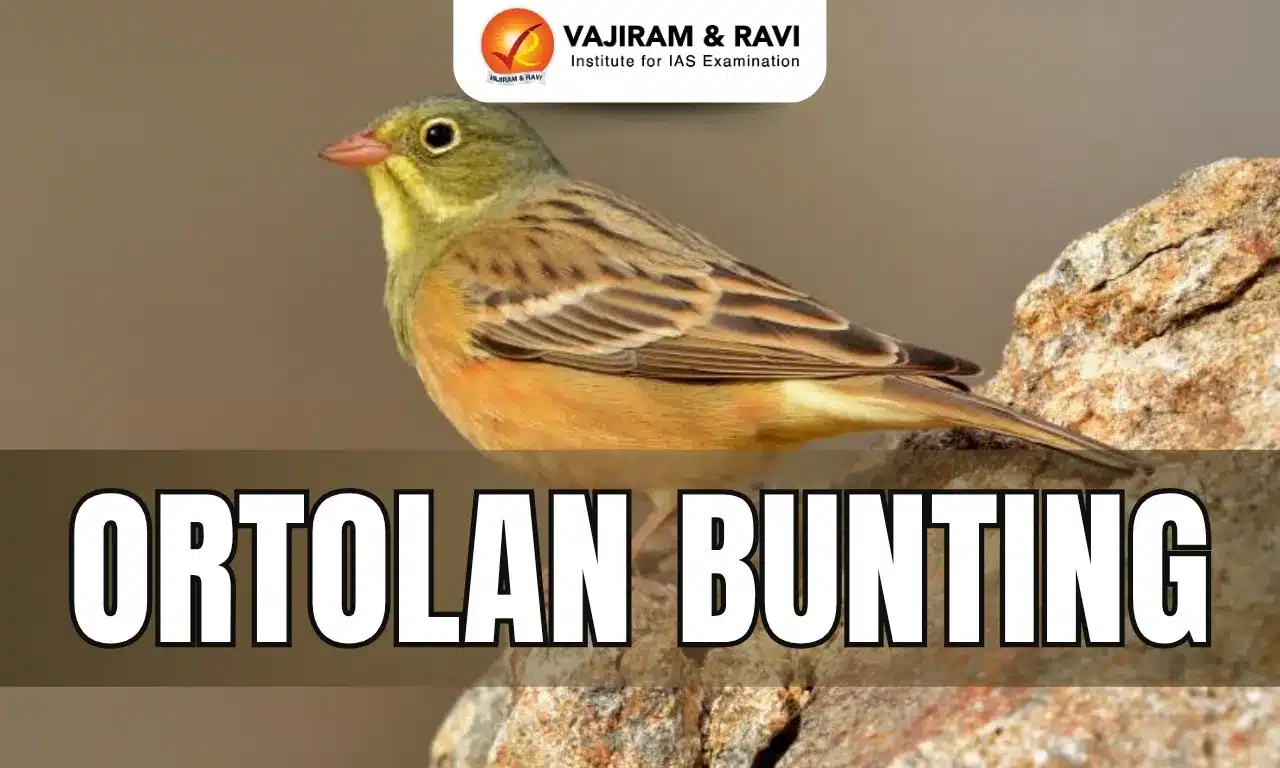
The rare European bird,  the Ortolan Bunting, with just a single recorded sighting in Bengal, was spotted at Baruipur, situated in the southern periphery of the city, recently.

About Ortolan Bunting

  • It is a small Palearctic migrant songbird.
  • Scientific Name: Emberiza hortulana
  • Distribution: The bird is found in most of Europe, with populations found as far west as Mongolia and as far north as the Arctic Circle.

Ortolan Bunting Habitat

  • Its habitat consists of open, cultivated, or uncultivated areas with sparse woody vegetation, up to an altitude of 2500 metres locally.
  • It absolutely avoids forested areas, including during migration. 
  • The oceanic climate is not suitable for it.

Ortolan Bunting Features

  • It is small, with a length of 6.3 to 6.7 inches and a wingspan of about 10 inches. 
  • The males have a greenish-gray head along with a yellow throat, swooping mustache, and ring around the eye. 
  • Its belly is brown and its back and rump are brown and streaked. 
  • The females and juveniles are smaller, have spots on the belly, and are duller overall. 
  • Like most buntings, the ortolan has a conical beak that’s good for cracking seeds.

Ortolan Bunting Conservations Status

It is classified as 'Least Concerned' under the IUCN Red List.

Source: TELE

Ortolan Bunting FAQs

Q1: What is Ortolan Bunting?

Ans: It is a small Palearctic migrant songbird.

Q2: What is the IUCN Red List status of the Ortolan Bunting?

Ans: It is classified as 'Least Concerned' under the IUCN Red List.

Q3: What is the habitat of Ortolan Bunting?

Ans: Its habitat consists of open, cultivated, or uncultivated areas with sparse woody vegetation, up to an altitude of 2500 metres locally.

Exercise KONKAN-25

Exercise KONKAN-25

Exercise KONKAN-25 Latest News

Recently, Exercise KONKAN-25 commenced on 05 Oct 2025, off the western coast of India. 

About Exercise KONKAN-25

  • It is a bilateral naval exercise between the Indian Navy and Royal Navy of UK.
  • The exercise will be conducted in two phases.
  • The harbour phase of the Exercise will include professional interactions between naval personnel, cross deck visits, sports fixtures, and cultural engagements.
  • The sea phase will encompass complex maritime operational drills focusing on anti-air, anti-surface, and anti-submarine exercises, flying operations and other seamanship evolutions.
  • Both participating nations will deploy frontline assets, including aircraft carriers, destroyers, frigates, submarines, and integral and shore based air assets.
  • The Indian side will be represented by the carrier battle group of the indigenous aircraft carrier INS Vikrant in company with other surface, sub-surface and air combatants.
  • This exercise is a reaffirmation of the shared commitment to ensuring secure, open and free seas and will exemplify the Comprehensive Strategic Partnership outlined in ‘India-UK Vision 2035’.
  • Significance: Exercise Konkan 2025 will serve as a platform to consolidate strategic ties, enhance interoperability and contribute to regional maritime stability.

Source: PIB

Exercise KONKAN-25 FAQs

Q1: Which navies are participating in Exercise KONKAN-25?

Ans: Indian Navy and Royal Navy (UK).

Q2: Where did Exercise KONKAN-25 commence?

Ans: Western coast of India.

Chlorophytum Vanapushpam

Chlorophytum Vanapushpam

Chlorophytum Vanapushpam 

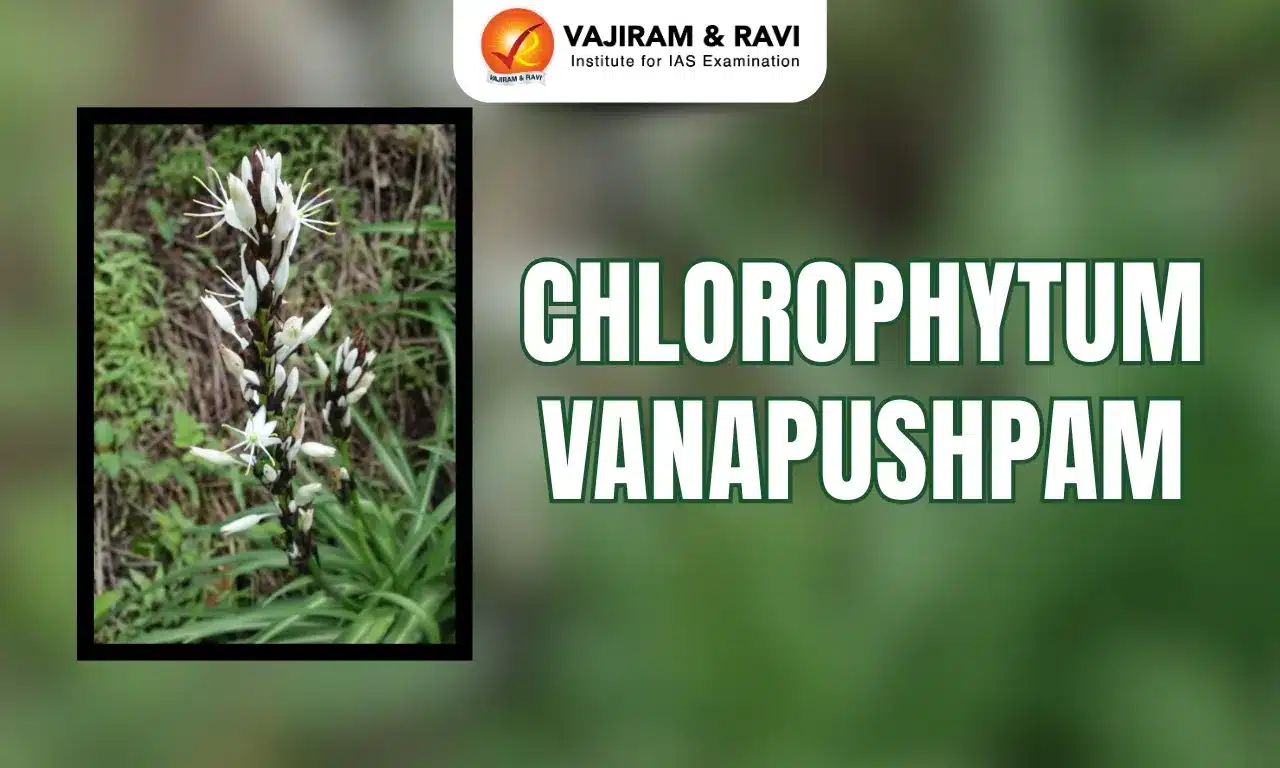
Researchers during a field exploration in Idukki district’s Vagamon hills have identified a new species of the genus Chlorophytum and named the new species as Chlorophytum vanapushpam.       

About Chlorophytum Vanapushpam

  • It is a perennial herb belonging to the genus Chlorophytum (family Asparagaceae).
  • It is a close relative of the safed musli.
  • It has been found in the rocky hills of Vagamon and Neymakkad - parts of the Western Ghats regions of Idukki district - at elevations between 700 m and 2124 m.
  • The species name vanapushpam is a composite of ‘Vanam’ and ‘Pushpam,’ the Malayalam for forest and flower respectively.
  • Features of Chlorophytum vanapushpam
    • It has white flowers in small clusters and slender leaves and grows up to 90 cm in height.
    • But unlike its more famous cousin Chlorophytum borivilianum, Chlorophytum vanapushpam lacks tubers.
    • Its seeds are about 4 to 5 mm across. Flowering and fruiting occurs from September to December.
  • The Western Ghats region is thought to be a centre of origin of the genus Chlorophytum.
  • A total of 18 species have been identified here so far, with many of them exhibiting  medicinal properties.
  • One of these is the Chlorophytum borivilianum, more familiar to Indians as the ‘safed musli,’ a herb widely used in traditional medical preparations and also popular as a leaf vegetable.

Source: TH

Chlorophytum Vanapushpam FAQs

Q1: What are the primary uses of Safed Musli?

Ans: Safed Musli is used to enhance strength, stamina, and overall well-being

Q2: What is the meaning of perennial plant?

Ans: A plant that persists for several years, usually with new herbaceous growth from a part that survives from growing season to growing season.

INS Sahyadri

INS Sahyadri

INS Sahyadri Latest News

Recently, Indian Navy's indigenous stealth frigate INS Sahyadri made a port call at Kemaman port in Malaysia.

About INS Sahyadri

  • It is the third ship of the Shivalik Class Guided Missile Stealth Frigates which was built by Mazagon Dock Ltd in Mumbai.
  • It is indigenously designed, constructed and commissioned in 2012.

Features of INS Sahyadri

  • It is equipped with cutting-edge weapons and sensors, enabling her to identify and eliminate threats from the air, the surface, and the subsurface.
  • Capacity: It has a displacement capacity of 6,800 tons and has a massive surface speed of 32 knots.
  • The vessel is a member of the Eastern Fleet of the Indian Navy, which is located in Visakhapatnam.
  • The ship is capable of carrying Barak-1 and Shtil-1 3S90M missiles, BrahMos anti-ship missiles, anti-submarine rocket launchers
  • It is equipped with a versatile array of weapons and sensors, can carry multi-role helicopters and represent the ‘coming of age’ of India’s warship building capabilities.
  • Stealth Frigates under the Shivalik class series namely INS Shivalik, INS Sahyadri, and INS Satpura are the first stealth warships built in India (by Mazagon Dock Limited).

Source: PIB

INS Sahyadri FAQs

Q1: What is INS Sahyadri?

Ans: A guided missile stealth frigate of the Indian Navy.

Q2: What class of warships does INS Sahyadri belong to?

Ans: Shivalik-class frigates.

Coral Triangle

Coral Triangle

Coral Triangle Latest News

The Philippines is preparing to host Southeast Asia’s first coral larvae cryobank which links research institutions in the Philippines, Taiwan, Indonesia, Malaysia, and Thailand to create a network of cryobanks across the Coral Triangle.

About Coral Triangle

  • It is often referred to as the ‘Amazon of the seas’, is a huge marine area spanning over 10 million square kilometres.
  • Countries of coral Triangle: It includes countries like Indonesia, Malaysia, Papua New Guinea, Singapore, the Philippines, Timor-Leste, and the Solomon Islands.
  • Significance: The Triangle is home to more than three-quarters of the world’s coral species, a third of all reef fish, the vast mangrove forests, and six of the seven marine turtle species.
  • It also sustains the food security and livelihoods of more than 120 million people.
  • Threats: Growing carbon emissions, destructive fishing, air, water, and soil pollution, and the accelerating effects of climate change are all driving coral bleaching, habitat loss, and species decline.

What are Corals?

  • Corals are essentially animals, which are sessile, meaning they permanently attach themselves to the ocean floor.
  • Corals share a symbiotic relationship with single-celled algae called zooxanthellae.
  • The algae provide the coral with food and nutrients, which they make through photosynthesis, using the sun’s light.
  • They use their tiny tentacle-like hands to catch food from the water and sweep into their mouth.
  • Each individual coral animal is known as a polyp and it lives in groups of hundreds to thousands of genetically identical polyps that form a ‘colony’.

Source: TH

Coral Triangle FAQs

Q1: What is the Coral Triangle?

Ans: The Coral Triangle is a marine region that includes the waters of Indonesia, Malaysia, the Philippines, Papua New Guinea, the Solomon Islands, and Timor-Leste

Q2: What is the primary threat to coral reefs in the Coral Triangle?

Ans: The coral reefs in the Coral Triangle face multiple threats, including overfishing, climate change, pollution, and habitat destruction

Phosphine

Phosphine

Phosphine Latest News

Recently, astronomers using the James Webb Space Telescope have detected phosphine (PH3) in the atmosphere of brown dwarf Wolf 1130C. 

About Phosphine

  • It is a chemical compound made of one phosphorus atom and three hydrogen atoms.
  • Formation: Phosphine on Earth is developed naturally by bacteria that live in very low-oxygen environments.
  • To produce phosphine, Earth bacteria take up phosphate from minerals or biological material and add hydrogen.
  • It is also found in the atmospheres of Jupiter and Saturn.
  • It is also called hydrogen phosphide.
  • Uses of Phosphine: It is used in semiconductor and plastics industries, in the production of a flame retardant, and as a pesticide in stored grain.

Properties of Phosphine

  • It is a colourless, flammable, extremely toxic gas with a disagreeable garlic like odour.
  • It is slightly soluble in water.
  • It is formed by the action of a strong base or hot water on white phosphorus or by the reaction of water with calcium phosphide (Ca3P2).
  • It is structurally similar to ammonia (NH3), but phosphine is a much poorer solvent than ammonia and is much less soluble in water.

Source: SN

Phosphine FAQs

Q1: Why is phosphine highly toxic?

Ans: Phosphine is highly toxic because it disrupts cellular respiration, leading to cellular damage and potentially fatal outcomes

Q2: What is phosphine used for?

Ans: Phosphine is used as a fumigant for stored grains and as a reducing agent in chemical synthesis.

Asola Bhatti Wildlife Sanctuary

Asola Bhatti Wildlife Sanctuary

Asola Bhatti Wildlife Sanctuary Latest News

Delhi’s Forest and Wildlife Department recently announced six days of daily bird walks at Asola Bhatti Wildlife Sanctuary as part of Wildlife Week celebration.

About Asola Bhatti Wildlife Sanctuary

  • Asola-Bhatti Wildlife Sanctuary covering 32.71 sq.km. area on the Southern Delhi Ridge of Aravalli hill range on Delhi-Haryana border lies in Southern Delhi as well as northern parts of Faridabad and Gurugram districts of Haryana state.
  • The sanctuary is part of the Southern Ridge and has biodiversity significance as it merges with the Indo-Gangetic Plain.
  • It covers an area of 32 sq.km.
  • It is an important part of the North Aravalli Leopard Wildlife Corridor, which starts from Sariska National Park in Rajasthan, passes through various districts of Haryana, and finally meets the Delhi Ridge. 
  • Vegetation:
    • As per Champion & Seth (1968), the vegetation falls under the Northern Tropical Thorn Forests type.
    • The native plants exhibit xerophytic adaptations such as thorny appendages, wax-coated, succulent, and tomentose leaves. 
  • Flora
    • The sanctuary’s flora includes trees like the Neem, Peepal, and Jamun. 
    • The sanctuary is also known for its huge collection of medicinal plantations.
  • Fauna:
    • The sanctuary is also home to mammals like the Nilgai, Indian Porcupine, Indian Hare, and Indian Grey Mongoose.
    • The sanctuary has over 200 species of birds, including the Indian Peafowl, Red Junglefowl, and the Indian Grey Hornbill.

Source: IS

Asola Bhatti Wildlife Sanctuary FAQs

Q1: In which state is Asola Bhatti Wildlife Sanctuary located?

Ans: It lies in Southern Delhi as well as northern parts of Faridabad and Gurugram districts of Haryana state.

Q2: What is the total area of Asola Bhatti Wildlife Sanctuary?

Ans: It covers an area of 32 sq.km.

Q3: What is the vegetation of Asola Bhatti Wildlife Sanctuary?

Ans: Northern Tropical Thorn Forests

Tikhir Tribe

Tikhir Tribe

Tikhir Tribe Latest News

The Tikhir Tribal Council (TTC) recently submitted a representation to the Nagaland Director General of Police, urging the inclusion of aspirants from Tikhir tribe residing in Noklak district in the now-declared Nagaland Police constable recruitment.

About Tikhir Tribe

  • The Tikhir tribe is one of the indigenous Naga tribes found in the northeastern Indian state of Nagaland.
  • According to the 2011 census, the population of the Tikhir people in Nagaland was 7,537.
  • Some live across the border in Myanmar.
  • They are listed as a Scheduled Tribe, in the official Census of India.
  • They speak a language called Naga Yimchungru, which is part of the Tibeto-Burman language family, like most Naga languages.
  • At one time, the Tikhir were headhunters and a man’s prestige depended upon the number of enemies he had killed.
  • Tikhirs are an agricultural community whose livelihood depends on agricultural cultivation.
  • Since the Tikhir are a small tribe in Nagaland, some of the larger tribes harass them. 
  • Beliefs:
    • With the coming of the Christian missionaries to Nagaland, most Tikhirs converted to Christianity.
    • Many of the Tikhir practice elements of folk religion with their Christianity.
  • Tsonglaknyi” , the main Tikhir Festival, is observed from 9th to 12th Oct. every year. It is basically a festival of the sanctification of Shield.

Source: EM

Tikhir Tribe FAQs

Q1: The Tikhir tribe is primarily found in which Indian state?

Ans: Nagaland

Q2: Which language is spoken by the Tikhir tribe?

Ans: Naga Yimchungru

Q3: What is the primary occupation of the Tikhir tribe?

Ans: Tikhirs are an agricultural community whose livelihood depends on agricultural cultivation.

Q4: What is the name of the main festival celebrated by the Tikhir tribe?

Ans: Tsonglaknyi

Enquire Now