Surrogacy (Regulation) Act, 2021

Surrogacy (Regulation) Act, 2021

Surrogacy (Regulation) Act, 2021 Latest News

The Supreme Court recently ruled that the age limits under the Surrogacy (Regulation) Act, 2021, do not apply to couples who had frozen their embryos and initiated the surrogacy process before the law came into force on January 25, 2022.

About Surrogacy (Regulation) Act, 2021

  • In India, surrogacy is regulated by the Surrogacy Regulation Act, 2021. 
  • This act prohibits commercial surrogacy. 
  • The object of this Act is to prevent the exploitation of the women who may be lured into the arrangements of the commercial surrogacy. 
  • Under the provisions of the Act altruistic surrogacy is permitted whereby the surrogate mother is required to carry the child to help another individual or couple without receiving the monetary benefit other than medical and insurance expenses.
  • It provides for the prohibition and regulation of surrogacy clinics. It states that “No Surrogacy Clinic shall conduct or associate with or assist in the performance of the activities relating to the surrogacy and surrogacy procedures unless such clinic has been registered under this Act”.
  • It prohibits any person or entity, including the surrogacy clinic, paediatrician, gynaecologist, embryologist, or even the registered medical practitioner to engage in any form of the commercial surrogacy practices.
  • It further prohibits the abortion during the period of the surrogacy without the written consent of the surrogate mother and the registered medical practitioner, including the gynaecologist, paediatrician, and embryologist.
  • Surrogacy procedures shall not be performed or initiated unless the certificate of essentiality is obtained by the intended couple.
  • It provides that a surrogate must be a woman who has been married and has at least one child of her own. 
    • She must be between the age of 25 -35 years on the date of implantation. 
    • The surrogate mother should refrain from providing her own gametes and from acting as a surrogate mother more than once.
  • It states that the intended couple must be married. 
    • The women must be between the age of 23-50 years, and the man must be between the age of 26-55 years on the date of the certification. 
    • Intended partners must have been married for the period of 5 years and must be nationals of India.
    • Further it states that the intended couple should not have any surviving children, whether biologically or through adoption or from any earlier surrogacy procedures.
  • “A child born out of the surrogacy procedure shall be deemed to be the biological child of the intended couple and shall be entitled to all the rights and privileges which are available to the natural child.

Source: TH

Surrogacy (Regulation) Act, 2021 FAQs

Q1: Which type of surrogacy is permitted under the Surrogacy (Regulation) Act, 2021?

Ans: Altruistic surrogacy.

Q2: What is the main objective of the Surrogacy (Regulation) Act, 2021?

Ans: To prevent exploitation of women in commercial surrogacy.

Q3: Under what condition can abortion be performed during surrogacy?

Ans: With written consent of the surrogate mother and the medical practitioner.

Q4: What is the age range prescribed for a surrogate mother under the Act?

Ans: 25–35 years
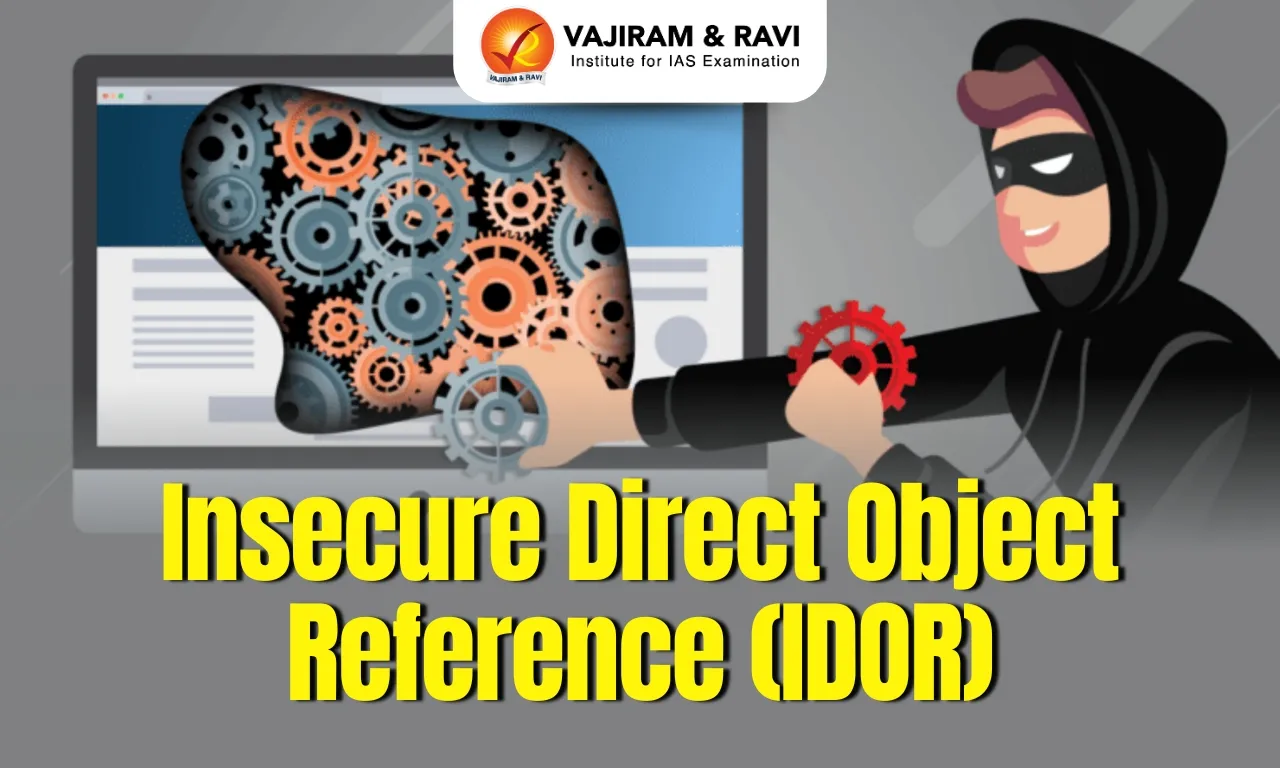
Insecure Direct Object Reference (IDOR)

Insecure Direct Object Reference

Insecure Direct Object Reference Latest News

A serious data leak was narrowly avoided after the Indian government fixed a major security flaw known as an IDOR, or “insecure direct object reference,” in its income tax e-filing portal.

About Insecure Direct Object Reference 

  • It is a web application security vulnerability that occurs when an application exposes internal object identifiers, such as database keys or file paths, to users without proper access controls.
  • It can enable attackers to manipulate these identifiers and gain unauthorized access to sensitive data or perform unauthorized actions on the system. 
  • IDOR vulnerabilities arise due to inadequate validation and authorization checks on user-supplied input, which may allow malicious users to bypass intended access restrictions.
  • How does it happen?
    • Websites often want to serve different content to different users: for example, a shopping website might let each user view their purchase history. 
    • Websites can identify users by authenticating them, using a method such as a password or a passkey. 
    • Often, once a website has authenticated a user, they will set a session cookie in that user's browser: then, when the user makes a request, the server will know that the request came from this authenticated user.
    • However, as well as checking that the request came from an authenticated user, the server must implement access control for the resources that the user requests: that is, they must check that this user is allowed to access the specific resource requested. 
    • For example, each authenticated user must only be allowed to see their own purchase history.
    • If a server does not implement access control for resources, then an attacker who is signed into the site may be able to access the resources belonging to a different user. 
    • This is called an Insecure Direct Object Reference (IDOR) attack.

Source: IT

Insecure Direct Object Reference FAQs

Q1: What kind of vulnerability is Insecure Direct Object Reference (IDOR)?

Ans: Web application security vulnerability.

Q2: What can an attacker gain through an Insecure Direct Object Reference (IDOR) vulnerability?

Ans: Unauthorized access to data or resources.

Q3: Why do Insecure Direct Object Reference (IDOR) vulnerabilities occur in web applications?

Ans: Because of improper authorization checks.

International Solar Alliance (ISA)

International Solar Alliance

International Solar Alliance Latest News

Presided over by India, the International Solar Alliance will convene its assembly later this month to assess progress and address challenges in promoting affordable solar energy globally.

About International Solar Alliance

  • It is a treaty-based international intergovernmental organization.
  • It was launched in 2015 by India and France at the COP21 summit in Paris to promote solar energy as a sustainable solution for energy access and climate change. 
  • Headquarters: National Institute of Solar Energy (NISE) in Gurugram, India.
  • It is the first international organization established in the country.
  • ISA’s objective is to scale up solar energy and reduce the cost of solar power generation through aggregation of demand for solar finance, technologies, innovation, research and development, and capacity building.
  • ISA plays a key role in advancing global solar cooperation, enhancing energy security, and supporting the transition to cleaner energy systems.
  • The ISA is guided by its ‘Towards 1000’ strategy, which aims:
    • To mobilize USD 1000 billion of investments in solar energy solutions by 2030.
    • To deliver energy access to 1000 million people using clean energy solutions.
    • To install 1000 GW of solar energy capacity.
    • To mitigate global solar emissions to the tune of 1000 million tonnes of CO2 every year.
  • ISA is partnering with multilateral development banks (MDBs), development financial institutions (DFIs), private and public sector organisations, civil society, and other international institutions to deploy cost-effective and transformational solutions through solar energy, especially in the least Developed Countries (LDCs) and the Small Island Developing States (SIDS).
  • Membership:  
    • Membership is open to those solar-resource-rich States which lie fully or partially between the Tropic of Cancer and the Tropic of Capricorn, and which are members of the United Nations. 
    • Partner country status may be granted to the States which fall outside the Tropic of Cancer and the Tropic of Capricorn, are members of the United Nations.
    • Currently, 100+ countries are signatories, with 90+ countries having ratified to become full members.
  • ISA Assembly: 
    • It is the apex decision-making body that comprises representatives from each member country. 
    • The Assembly deliberates matters of substance, such as the selection of the Director General, the functioning of ISA, approval of the operating budget, etc.
    • The first Assembly of the ISA was held in October 2018 in Greater Noida, India.

Source: ET

International Solar Alliance FAQs

Q1: The International Solar Alliance (ISA) was jointly launched by which two countries?

Ans: India and France

Q2: Where is the headquarters of the International Solar Alliance (ISA) located?

Ans: National Institute of Solar Energy (NISE) in Gurugram, India.

Q3: When and where was the first Assembly of the International Solar Alliance (ISA) held?

Ans: October 2018 in Greater Noida, India

AIM-120 AMRAAM Missile

AIM-120 AMRAAM Missile

AIM-120 AMRAAM Missile Latest News

After sending its first consignment of mineral samples to Washington under a rare earths deal, Pakistan may soon receive the AIM-120 Advanced Medium-Range Air-to-Air Missiles (AMRAAM) from the United States.

About AIM-120 AMRAAM Missile

  • The AIM-120 Advanced Medium-Range Air-to-Air Missile (AMRAAM) is an active, radar-guided, medium-range, air-to-air missile.
  • It is among the most widely used beyond-visual-range (BVR) air combat weapons in the world. 
  • Developed in the US in the late 1970s and 1980s, it became operational in 1991 with the US Air Force, replacing older radar-guided missiles.
  • The AIM-120 is employed by over 35 countries, including key U.S. allies in NATO, the Asia-Pacific region, and the Middle East. 
  • Notable users include the United States, United Kingdom, Japan, Australia, and several NATO member countries. 
  • From American F-15s, F-16s, and F-35s to European aircraft like the Typhoon and Gripen, it is installed on a wide variety of fighter jets.

AIM-120 AMRAAM Missile Features

  • It is powered by a solid-fuel rocket motor capable of propelling it to speeds exceeding Mach 4, or roughly 3,000 miles per hour.
  • The missile can be launched in all weather, day or night.
  • It has a “fire-and-forget” capability, which allows the missile to be fired over long distances and manoeuvre without a radar lock. 
  • The missile uses the onboard radar to track and follow the target, freeing the pilot from having to keep it guided.
  • It has a range exceeding 160 kilometers under optimal launch conditions.
  • It also incorporates a two-way data link, which allows real-time updates to the missile’s trajectory, enhancing its accuracy against maneuvering targets.

Source: NDTV

AIM-120 AMRAAM Missile FAQs

Q1: Which country developed AIM-120 AMRAAM Missile?

Ans: United States

Q2: Which guidance method does the AIM-120 AMRAAM Missile primarily use to home on targets?

Ans: Active radar homing with onboard radar.

Q3: Approximately what is the reported maximum range of the AIM-120 AMRAAM Missile under optimal conditions?

Ans: It has a range exceeding 160 kilometers under optimal launch conditions.

AgriEnIcs Programme

AgriEnIcs Programme

AgriEnIcs Programme Latest News

Recently, the Ministry of Electronics and Information Technology (MeitY) has announced the transfer of technology under the AgriEnIcs Programme.

About AgriEnIcs Programme

  • It is a national programme of the Ministry of Electronics and Information Technology (MeitY).
  • Objective: It involves research, development, deployment, demonstration, and commercialization of technologies in the agriculture and environment domain.
  • It serves as a national platform for R&D and technology translation in agriculture and environmental management.
  • By integrating AI, IoT, machine vision, and sensor networks, the initiative aims to bring digital precision to sectors that directly impact farmers and communities.
  • The programme’s collaborative framework—uniting research institutions, industry partners, and government agencies.
  • Nodal Agency: The programme is being implemented by the Centre for Development of Advanced Computing (C-DAC), Kolkata, as the nodal agency with participating agencies from Academic Institutes, R&D laboratories, and Industries.

What is C-DAC?

  • It is the apex research and development wing of the Ministry of Electronics and Information Technology.
  • It was established in 1988.
  • Purpose: Its main purpose was to carry out research and development in Electronics, IT and other associated areas.
  • It was set up to build Supercomputers in the context of denial of import of Supercomputers by the USA.
  • C-DAC built India’s first indigenously built supercomputer Param 8000 in 1991.

Source: PIB

AgriEnIcs Programme FAQs

Q1: Who is implementing the Agrienics Programme?

Ans: Centre for Development of Advanced Computing (C-DAC), Kolkata.

Q2: What is the objective of the Agrienics Programme?

Ans: To develop and deploy technologies in agriculture and environment domain.

DRAVYA Portal

DRAVYA Portal

DRAVYA Portal Latest News

In its first phase, the DRAVYA portal aims to catalogue information on 100 key medicinal substances.

About DRAVYA Portal

  • Digitized Retrieval Application for Versatile Yardstick of AYUSH Substances (DRAVYA) portal is the largest collection of data on Ayurvedic Ingredients and Products.
  • It is an ever growing, ever evolving database that covers classical Ayurveda textbooks as well as contemporary scientific literature and field studies.
  • It is an initiative of the Central Council for Research in Ayurvedic Sciences (CCRAS).

Features of DRAVYA Portal

  • It is AI-ready and will eventually interlink with the Ayush Grid and other Ministry initiatives on medicinal substances and drug policy.
  • The platform also features QR code integration, enabling standardised information display in medicinal plant gardens and drug repositories nationwide.
  • It serves as a comprehensive, open-access database that dynamically consolidates data from classical Ayurvedic texts and standard online research platforms.
  • It enables users to search for medicinal substances used across Ayush systems and access detailed profiles spanning Ayurvedic pharmacotherapeutics, botany, chemistry, pharmacy, pharmacology, and safety information.

Source: PIB

DRAVYA Portal FAQs

Q1: Which ministry launched DRAVYA Portal recently?

Ans: Ministry of Ayush

Q2: Where is the headquarter of Central Council for Research in Ayurvedic Sciences?

Ans: New Delhi

SAKSHAM System

SAKSHAM System

SAKSHAM System Latest News

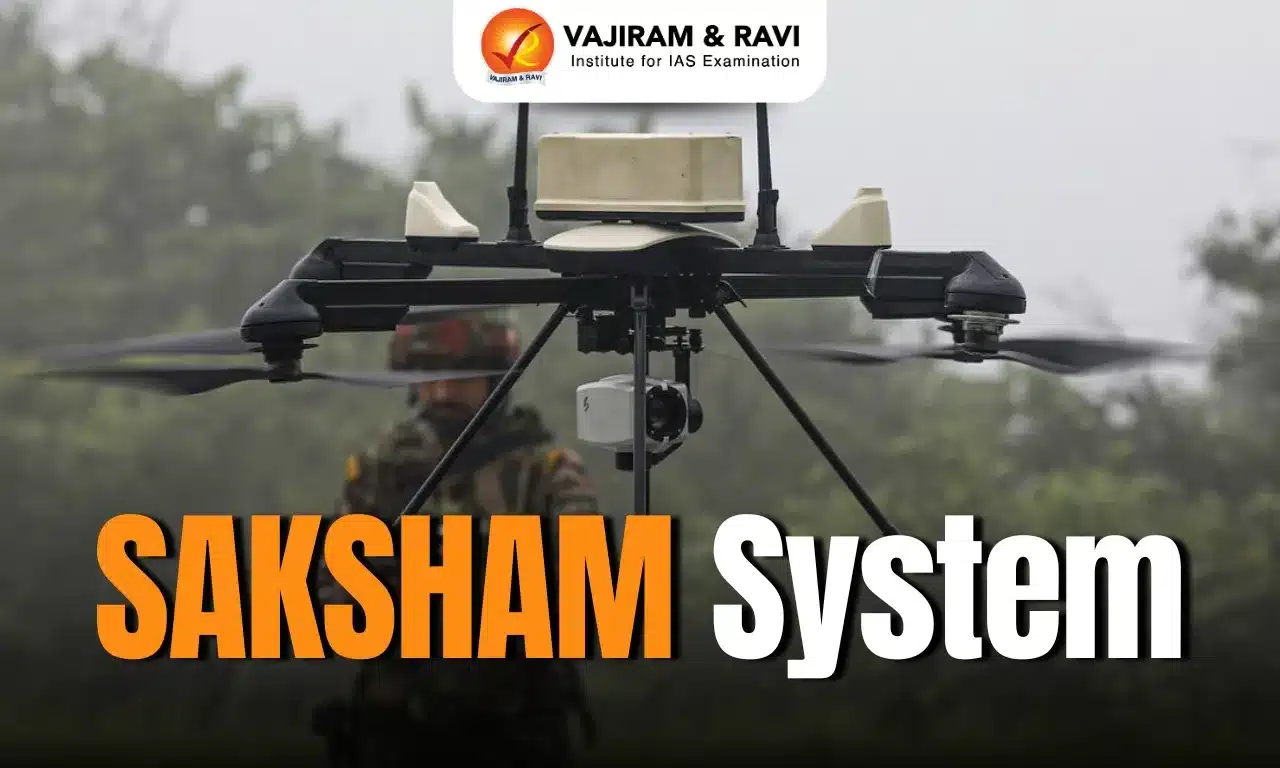
The Indian Army has initiated procurement of the indigenously developed ‘Saksham’ Counter-Unmanned Aerial System (CUAS) Grid System.

About SAKSHAM System

  • The Situational Awareness for Kinetic Soft and Hard Kill Assets Management (SAKSHAM) is an indigenously developed Counter-Unmanned Aerial System (UAS) Grid System. 
  • It is a modular, high-end Command and Control (C2) system operating on the secure Army Data Network (ADN).  
  • It ensures comprehensive airspace security across the newly defined Tactical Battlefield Space (TBS), which now includes the Air Littoral (airspace up to 3,000 metres, or 10,000 feet, above ground level).
  • It is developed by Bharat Electronics Limited (BEL).

Features of SAKSHAM System

  • Real time detection and tracking: It is designed to detect, track, identify, and neutralise hostile drones and unmanned aerial systems in real time.
  • Integrated Recognised UAS Picture: It creates a real-time, integrated Recognised UAS Picture (RUASP) for commanders, merging sensor data, counter-drone systems, and AI-driven analytics.
  • AI-enabled predictive analysis: It consists of real-time threat detection and AI-enabled predictive analysis, integration of CUAS sensors and weapons for synchronised response, automated decision support and 3D battlefield visualization.
  • It can integrate its own as well as hostile UAS data, C-UAS sensors, and soft- and hard-kill systems on a common GIS-based platform.
  • The system will also receive inputs from the Akashteer System, further enhancing situational awareness by mapping all airspace users; friendly, neutral, or hostile; within the combat zone.

Source: TH

SAKSHAM System FAQs

Q1: What is the primary purpose of the SAKSHAM System?

Ans: To detect and neutralize hostile drones

Q2: Who developed the SAKSHAM System?

Ans: Bharat Electronics Limited (BEL).

Coco Islands

Coco Islands

Coco Islands Latest News

Recently, Myanmar has assured India that there is no Chinese presence at Coco Islands in Bay of Bengal.

About Coco Islands

  • Location: They are a small group of islands located in the Bay of Bengal.
  • Great Coco Island, the largest in the group, lies just 55 km from India’s strategic Andaman and Nicobar Islands. 
  • They are part of the Yangon Region of Myanmar. 
  • Geography: It is geologically an extended division of the Arakan Mountains or Rakhine Mountains, submerges as a chain of islands in the Bay of Bengal for a long stretch and emerges again in the form of the Andaman and Nicobar Islands. 
  • They are part of the same topography as India’s Andaman & Nicobar Islands.

History of Coco Islands

  • In the early 19th century, the British government in India established a penal colony in the Andaman for the convicts in the Indian subcontinent, and the Coco Islands were a source of food for it.
  • The British government had reportedly leased out the islands to the Jadwet family of Burma.
  • The leasing of control of the Coco Islands resulted in poor governance of the islands, which made the British government in India to transfer its control to the government of Lower Burma in Rangoon.
  • In 1882, the islands officially became part of British Burma.
  • The islands became a self-governing crown colony even after Burma was separated from British India in 1937.

Source: HT

Coco Islands FAQs

Q1: Where are the Coco Islands located?

Ans: The Coco Islands are a group of islands in the northeastern part of the Bay of Bengal.

Q2: Which island group is located near the Coco Islands?

Ans: Andaman and Nicobar Islands.

Sathyamangalam Tiger Reserve

Sathyamangalam Tiger Reserve

Sathyamangalam Tiger Reserve Latest News

The Madras High Court recently ordered appropriate action against all illegal resorts and tourist lodges functioning within the prohibited zone of Sathyamangalam Tiger Reserve (STR).

About Sathyamangalam Tiger Reserve

  • It is located at the junction of the Eastern and the Western Ghats in the Nilgiri Biosphere Reserve, in the Erode District of Tamil Nadu.
  • It covers an area of over 1,400 sq.km.
  • It is contiguous with the Mudumalai Tiger Reserve, Bandipur Tiger Reserve (Karnataka), and BR Tiger Reserve and Wildlife Sanctuary (Karnataka).
  • Together, these reserves-forming the Nilgiris biosphere landscape, have the biggest tiger population in the world, at over 280 tigers.
  • The region was once part of the traditional hunting grounds of local rulers and also played a strategic role as a passage between Tamil Nadu and Karnataka, owing to its position along the historic Mysore–Tamil Nadu trade routes.
  • The terrain is hilly and undulating with altitude ranging between 750 m and 1649 m.
  • Climate:
    • It is subtropical and dry.
    • The summers are hot and dry; the monsoons are wet and cooler, with river flooding.
  • Rivers: Some of the prominent rivers in the region include the Bhavani, Moyar, and Noyyal rivers.
  • Tribal Communities: It is home to several indigenous tribal communities, including the Irula and Kurumba tribes.
  • Vegetation: It consists of southern tropical dry thorn forests, mixed deciduous forests, semi-evergreen forests, and riparian forests.
  • Flora: Prominent tree species include teak, sandalwood, bamboo, Terminalia, and Albizia, alongside medicinal plants and shrubs that support both wildlife and local communities.
  • Fauna: The major species are Elephant, Tiger, Panther, Sloth bear, Gaur, Black Buck, Spotted deer, Wild boar, Black napped hare, Common langur Nilgiri langur, Striped neck mongoose, and Bonnet macaque.

Source: TH

Sathyamangalam Tiger Reserve FAQs

Q1: Where is the Sathyamangalam Tiger Reserve located?

Ans: Erode District, Tamil Nadu

Q2: Sathyamangalam Tiger Reserve forms part of which larger biosphere reserve?

Ans: Nilgiri Biosphere Reserve

Q3: What is the total area covered by Sathyamangalam Tiger Reserve?

Ans: About 1,400 sq.km.

IUCN World Conservation Congress

IUCN World Conservation Congress

IUCN World Conservation Congress

Recently, India unveiled its National Red List Roadmap and Vision 2025-2030 at the IUCN World Conservation Congress 2025.

About IUCN World Conservation Congress

  • It is the largest gathering of nature conservation experts, leaders and decision-makers in the world.
  • It will help shape global priorities for nature conservation and climate change for the coming decade and beyond.
  • It is held once-every-four-years.
  • Theme of IUCN Congress 2025: Under the theme “Powering transformative conservation”.

Components of IUCN World Conservation Congress

  • Forum: It is the largest knowledge marketplace for conservation and sustainable development science, practice and innovation. 
  • Exhibition: In the Exhibition, IUCN Members and Commissions, businesses, partners, and academia host pavilions, booths and events. 
  • Member’s Assembly: It is IUCN’s highest decision-making body. During the Assembly, IUCN’s Member organisations vote on pressing conservation and sustainable development issues.

Key Facts about IUCN

  • The International Union for Conservation of Nature (IUCN) is a membership Union of government and civil society organisations.
  • It was created in 1948, IUCN is now the world’s largest and most diverse environmental network, harnessing the knowledge, resources. 

Governance of IUCN

  • President and Council: The council is IUCN’s principal governing body in between sessions of the World Conservation Congress. The IUCN President presides over the IUCN Council.
  • IUCN World Conservation Congress: The Members’ Assembly of the IUCN World Conservation Congress is IUCN’s highest governing body.
  • IUCN Members discuss strategic topics, adopt motions defining IUCN’s general policy, approve the IUCN programme, amend IUCN’s statutes and elect the IUCN Council.
  • IUCN Statutes: It lays out the governance of IUCN.

Source: News On Air

IUCN World Conservation Congress FAQs

Q1: Where is the IUCN World Conservation Congress 2025 being held?

Ans: Abu Dhabi, United Arab Emirates

Q2: What is the primary purpose of the IUCN World Conservation Congress?

Ans: To set priorities and drive conservation and sustainable development action.

Enquire Now