Bharat Taxi Initiative

Bharat Taxi Initiative

Bharat Taxi Initiative Latest News

The National e-Governance Division (NeGD), Digital India Corporation, Ministry of Electronics & Information Technology (MeitY), has joined hands with Sahakar Taxi Cooperative Limited to support the upcoming Bharat Taxi initiative.

About Bharat Taxi Initiative

  • It is a first-of-its-kind cooperative-driven, citizen-first national ride-hailing initiative.
  • Promoted: It is being jointly promoted by leading cooperative and financial institutions including NCDC, IFFCO, AMUL, KRIBHCO, NAFED, NABARD, NDDBand NCEL.
  • It reflects the cooperative movement’s spirit and also aligns with the vision of the Government’s flagship Digital India programme for delivering inclusive, citizen-centric, and technology-enabled public services.
  • Under this initiative NeGD provides the Bharat Taxi platform with:
    • Platform Integration & Technical Architecture: Integration of the Bharat Taxi platform with national digital platforms such as DigiLocker, UMANG, and API Setu to enable seamless identity verification and service delivery.
    • Security, Compliance & Infrastructure: Ensuring adherence to Government of India’s data protection norms and cybersecurity standards and advising on robust technical infrastructure.
    • Programme Advisory: Providing governance and programme management support leveraging NeGD’s institutional experience in designing and implementing large-scale national platforms.
    • UI/UX & Accessibility: Offering advisory inputs on user interface design, multilingual capabilities, and inclusive access features for all citizens.

Source: PIB

Bharat Taxi Initiative FAQs

Q1: What is the primary objective of the National e-Governance Division (NeGD)?

Ans: To support the implementation of e-Governance projects and provide technical and advisory support

Q2: Under which ministry was NeGD created in 2009?

Ans: Ministry of Electronics & Information Technology (MeitY)

Sugamya Bharat App

Sugamya Bharat App

Sugamya Bharat App Latest News

Recently, the Ministry of Social Justice and Empowerment, Government of India, launched the revamped ‘Sugamya Bharat App’ at the Purple Fest in Goa.

About Sugamya Bharat App

  • It was launched under the Accessible India Campaign (Sugamya Bharat Abhiyan).
  • It is a flagship initiative of the Government of India dedicated to enhancing accessibility for divyangjan and elderly citizens in India.
  • Purpose: The app served as a citizen-led platform to make India’s public spaces more inclusive.
  • Launched by: Department of Empowerment of Persons with Disabilities (DEPwD), under the Ministry of Social Justice and Empowerment.

Key Features of Sugamya Bharat App

  • Accessibility Mapping Function: It allows users to locate and rate public places on accessibility parameters, empowering community-led data collection.
  • Consolidated Directory: It provides a one-stop platform for government schemes, scholarships, benefits, and employment opportunities, eliminating the need to navigate multiple portals.
  • Curated Job and Education Listings: It also features job and education listings from government and private sectors tailored for persons with disabilities.
  • Grievance Redressal Module: It enables users to directly register complaints about inaccessible infrastructure and services, making public spaces more accountable.
  • Inclusive Design: It is compatible with assistive technologies, available in multiple Indian languages, and optimized for both Android and iOS platforms.
  • It is revamped to AI-powered chatbot support to assist users in real time.
  • It is available in 10 languages

Source: PIB

Sugamya Bharat App FAQs

Q1: Which ministry launched the Sugamya Bharat Abhiyan?

Ans: Ministry of Social Justice and Empowerment

Q2: What is the aim of the Sugamya Bharat Abhiyan?

Ans: To create a barrier-free environment for persons with disabilities.

Keratoconus

Keratoconus

Keratoconus Latest News

A recent study has revealed that the treatment of keratoconus, a condition that threatens vision, can worsen even after treatment.

About Keratoconus

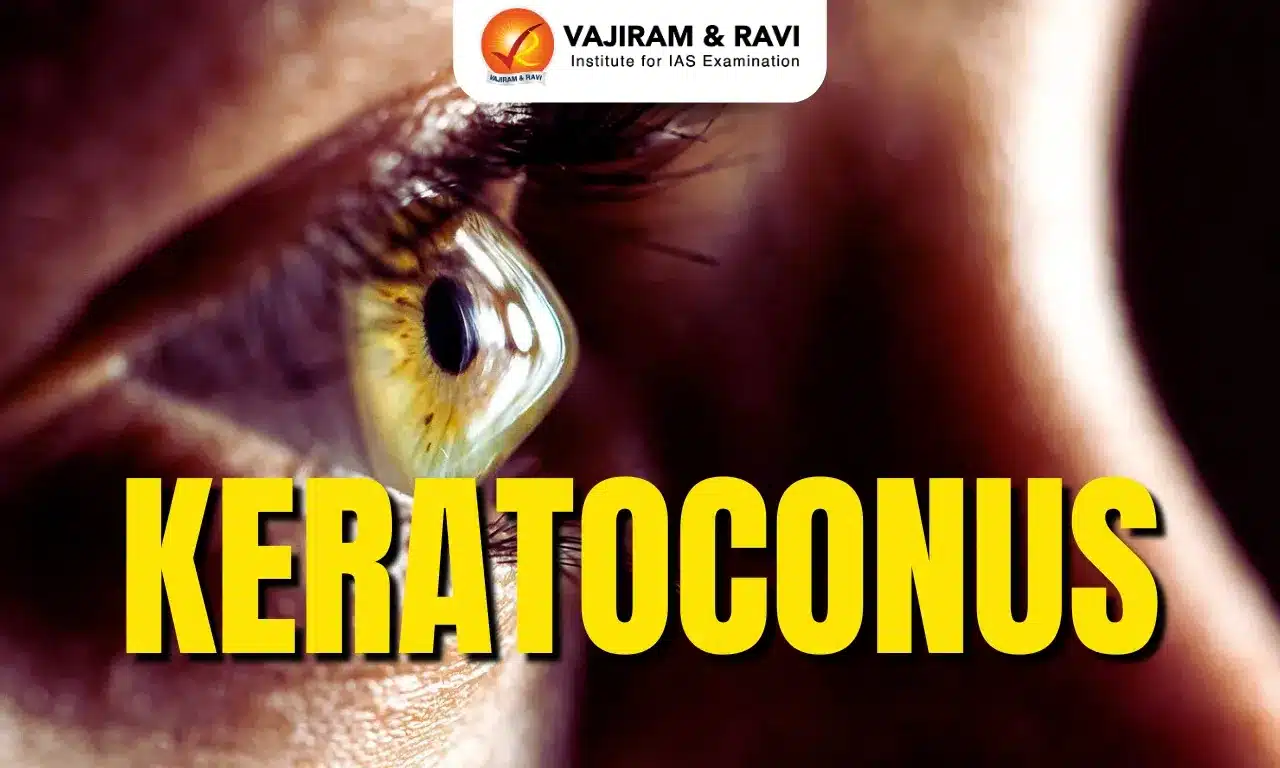
  • It is a vision disorder that occurs when the normally round cornea (the front part of the eye) becomes thin and irregular (cone) shaped. 
  • This abnormal shape prevents the light entering the eye from being focused correctly on the retina and causes distortion of vision.
  • Keratoconus often starts when people are in their late teens to early 20s. 
  • The vision symptoms slowly get worse over a period of about 10 to 20 years.
  • It often affects both eyes and can lead to very different vision between the two eyes.
  • Symptoms can differ in each eye, and they can change over time.
  • Treatment and Prevention: 
    • There is no known prevention for keratoconus.
    • Early stages can be treated with glasses, but with progression of the disease into late childhood and early adulthood, corneal transplantation may be needed to restore sight.
    • Corneal collagen cross-linking is a procedure designed to stop the progression of keratoconus or slow it down.

Source: TOI

Keratoconus FAQs

Q1: What part of the eye is primarily affected in Keratoconus?

Ans: Cornea

Q2: In which age group does Keratoconus most commonly begin?

Ans: Keratoconus often starts when people are in their late teens to early 20s.

Q3: Which treatment option is used to stop or slow down the progression of Keratoconus?

Ans: Corneal collagen cross-linking is a procedure designed to stop the progression of keratoconus or slow it down.

Pradhan Mantri Dhan Dhanya Krishi Yojana

Pradhan Mantri Dhan-Dhaanya Krishi Yojana

Pradhan Mantri Dhan-Dhaanya Krishi Yojana Latest News

The Prime Minister recently launched two new agriculture schemes, the PM Dhan Dhaanya Krishi Yojana (PMDDKY) and the Mission for Aatmanirbharta in Pulses, with a total outlay of `35,440 crore.

About Pradhan Mantri Dhan-Dhaanya Krishi Yojana 

  • It is a new scheme by the Indian government to support farmers. 
  • Under this scheme, farmers get direct financial help, new farming tools, crop insurance, and better market access. 
  • It targets 100 underperforming districts where farming faces challenges like low crop yields, water scarcity, and limited access to resources. 
  • With an annual budget of ₹24,000 crore for six years (2025-26 to 2030-31), totaling ₹1.44 lakh crore, the scheme aims to support 1.7 crore farmers, particularly small and marginal farmers owning less than 2 hectares of land, who constitute 86% of India’s farming population.
  • PMDDKY consolidates 36 existing agricultural schemes across 11 ministries, including PM-KISAN (cash transfers), PMFBY (crop insurance), PMKSY (irrigation), and Rashtriya Krishi Vikas Yojana (RKVY), into a unified program to streamline efforts and maximize impact. 
  • PMDDKY focuses on regions with low crop yields (e.g., wheat yields below 3.5 tonnes/hectare compared to the national average), moderate cropping intensity (below 155%, meaning fewer than 1.55 crop cycles per year), and limited access to credit. 
  • The scheme operates under the Ministry of Agriculture and Farmers’ Welfare, with oversight from a National Steering Committee, state-level nodal committees, and District Dhan Dhaanya Samitis led by District Collectors. 
  • PMDDKY’s Objectives:
    • Increase crop yields by 20-30% through high-quality inputs and technology.
    • Reduce reliance on monsoons with advanced irrigation systems like drip and sprinkler.
    • Provide affordable tools and mechanization to enhance efficiency.
    • Build storage infrastructure to cut post-harvest losses to under 5%.
    • Offer loans and direct market access to double farmer incomes by 2030, aligning with the government’s extended goal from 2022 due to economic disruptions like COVID-19.
    • Promote sustainable practices like organic farming to protect soil and water resources.
    • Support women, youth, and allied sectors (e.g., dairy, fisheries, poultry) to diversify income sources.
    • Achieve self-sufficiency in food grains, pulses, and oilseeds to reduce India’s dependence on imports.

Key Benefits of Pradhan Mantri Dhan-Dhaanya Krishi Yojana

  • Increased Crop Yields: Access to high-yielding seeds (e.g., hybrid wheat yielding 4 tonnes/hectare), bio-fertilizers, and mechanized tools like seed drills to boost production.
  • Higher Income: Diversifying into high-value crops like pulses (₹80-100/kg) and vegetables, and direct market access through apps to increase profits by 20-40%.
  • Sustainable Farming: Organic fertilizers, water-saving irrigation, and climate-resilient crops to maintain soil health and reduce environmental impact.
  • Irrigation Systems: Drip and sprinkler systems to ensure water availability, enabling year-round farming in dry regions.
  • Storage Facilities: Village and block-level warehouses and cold storage to prevent spoilage of 20% of perishables like fruits, vegetables, and dairy.
  • Financial Support: Subsidies (50-80% off inputs) and loans (short-term: ₹50,000–₹1 lakh; long-term: ₹1–10 lakh) through Kisan Credit Cards or NABARD.
  • Market Access: Digital platforms like e-NAM and new PMDDKY apps to connect farmers directly to buyers, reducing middlemen and boosting profits.
  • Training and Skill Development: Free workshops by Krishi Vigyan Kendras (KVKs), agricultural universities, and private partners on modern farming, drone use, and allied activities like beekeeping.
  • Women Empowerment: Support for 10,000 women producer groups with training, loans, and market linkages for activities like dairy or organic farming.
  • Global Exposure: Fully funded international training for 500 farmers in countries like Israel (expertise in drip irrigation), Japan (precision farming), or the Netherlands (greenhouse technology).

Source: IE

Pradhan Mantri Dhan-Dhaanya Krishi Yojana FAQs

Q1: What is the total financial outlay of Pradhan Mantri Dhan-Dhaanya Krishi Yojana (PMDDKY)?

Ans: Pradhan Mantri Dhan-Dhaanya Krishi Yojana (PMDDKY) has an annual budget of ₹24,000 crore for six years (2025-26 to 2030-31), totaling ₹1.44 lakh crore.

Q2: Who are the main beneficiaries of Pradhan Mantri Dhan-Dhaanya Krishi Yojana (PMDDKY)?

Ans: Small and marginal farmers owning less than 2 hectares.

Q3: What is the subsidy range offered on inputs under Pradhan Mantri Dhan-Dhaanya Krishi Yojana (PMDDKY)?

Ans: 50-80%

Green Sea Turtle

Green Sea Turtle

Green Sea Turtle Latest News

According to the International Union for Conservation of Nature (IUCN) the Red List status of the green sea turtle (Chelonia mydas) has improved from Endangered to Least Concern due to sustained conservation.

About Green Sea Turtle

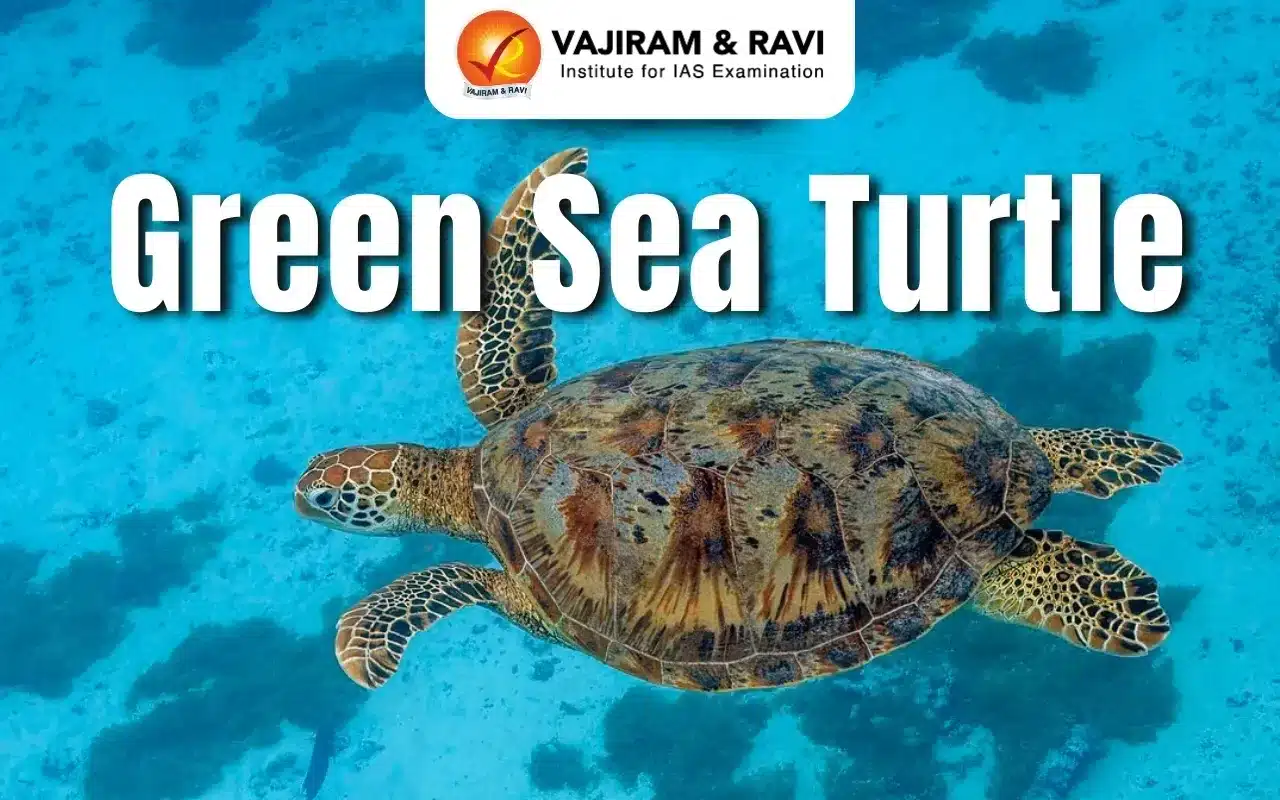
  • It is the largest hard-shelled sea turtle.
  • The common name of this species refers to the usually green fat found beneath its carapace, not to the color of its carapace, which is olive to black.
  • Food: The diet of Green sea turtles changes with age. Juveniles are carnivorous, but as they mature they become omnivorous.
  • Green turtles serve as keystone species in tropical marine ecosystems.
  • Distribution: The species is found in tropical and subtropical waters around the globe.

Features of Green Sea Turtle

  • They have a comparatively small head.
  • They do not have teeth, but their jaws have modified “beaks” suited to their particular diet.
  • They do not have visible ears but have eardrums covered by skin. They hear best at low frequencies, and their sense of smell is excellent.
  • They spend almost all their lives underwater and come out of the water only when nesting. 
  • Lifespan: Estimated to be 60-70 years.
  • Conservation Status: IUCN: Least Concern

Source: DTE

Green Sea Turtle FAQs

Q1: How long are Green Sea Turtles estimated to live?

Ans: 60-70 years.

Q2: Where are Green Sea Turtles mainly found?

Ans: Tropical and subtropical waters globally

Research Development and Innovation (RDI) Scheme

Research Development and Innovation (RDI) Scheme

Research Development and Innovation Scheme Latest News

Recently, the Executive Council of the Anusandhan National Research Foundation approved the establishment of a special purpose fund (SPF) for the Research Development and Innovation Scheme (RDI) scheme.

About Research Development and Innovation Scheme

  • It aims to provide long-term financing or refinancing with long tenors at low or nil interest rates to spur private sector investment in Research Development and Innovation.
  • Nodal Department: The Department of Science & Technology (DST)

Key Objectives of the Research Development and Innovation Scheme

  • Encourage the private sector to scale up research, development, and innovation (RDI) in sunrise domains and in other sectors relevant for economic security, strategic purpose, and self-reliance;
  • Finance transformative projects at higher levels of Technology Readiness Levels (TRL)
  • Support acquisition of technologies which are critical or of high strategic importance;
  • Facilitate setting up of a Deep-Tech Fund of Funds.
  • Governance: The Governing Board of Anusandhan National Research Foundation (ANRF), chaired by the Prime Minister, will provide overarching strategic direction to the RDI Scheme. 

Funding Mechanism of Research Development and Innovation Scheme

  • Total Budget: ₹1 Lakh crore
  • Implementation Structure
    • Special Purpose Fund (SPF): It will be established within the Anusandhan National Research Foundation (ANRF), which will serve as the custodian of the ₹1 lakh crore corpus. (Fund will not directly invest in industries and startups but will channel capital to Second-level fund managers)
    • Second-level fund managers: Who can be Alternative Investment Funds (AIF), Development Finance Institutions (DFI), Non-banking Finance Companies (NBFCs).
  • Modes of Financing
    • Long-term loan at low or nil interest rates.
    • Financing in the form of equity may also be done, especially in case of startups.

Source: PIB

Research Development and Innovation Scheme FAQ's

Q1: What is the primary objective of the Research Development and Innovation (RDI) Scheme?

Ans: To promote private sector investment in R&D.

Q2: What is the corpus of the Research Development and Innovation (RDI) Scheme?

Ans: ₹1 lakh crore

Q3: Which institution will act as the custodian of funds under the RDI Scheme?

Ans: Anusandhan National Research Foundation (ANRF).

Siddi Tribal Community

Siddi Tribal Community

Siddi Tribal Community Latest News

Recently, the President of India expressed happiness that the Siddi tribal community, a Particularly Vulnerable Tribal Group, has achieved a literacy rate of over 72 per cent.

About Siddi Tribal Community

  • The Siddi community is an Indo-African tribal community that descended from the Bantu community of Africa.
  • Origin: It is believed that they first came to India in the 7th century with Arab merchants and in the 16th century with the Portuguese and British, largely as slaves, servants, blacksmiths, carpenters and masons.
  • Distribution: In the present day, the majority of them are found in the west and southwest of India, in Gujarat, Maharashtra, Karnataka and Telangana states.
  • Present Status: In India, the Union government on January 8, 2003, classified Siddis under the list of Scheduled Tribes. They are included in the Centre’s list of Particularly Vulnerable Tribal Groups.
  • Occupation: Traditional dependence on agriculture, forest produce, and manual labor
  • Language: They speak either Konkani, Urdu or Marathi as their main language.
  • Culture: They are known for their folk music and dances, such as Dhamal and Rasda, with men performing the Dhamal dance.

Source: News On AirSiddi Tribal Community

Siddi Tribal Community FAQs

Q1: Where are the Siddis primarily concentrated in India?

Ans: Karnataka and Gujarat

Q2: What initiatives have been taken by the government for the welfare of the Siddi community?

Ans: Pradhan Mantri Janjati Adivasi Nyaya MahaAbhiyan (PM JANMAN) and Traditional Tribal Handicraft Mela Scheme.

Qubit

Qubit

Qubit Latest News

Caltech has built the world’s largest neutral-atom qubit array—6,100 qubits—pushing quantum computers closer to error correction and full-scale computation.

About Qubit

  • A qubit, or quantum bit, is the basic unit of information used to encode data in quantum computing.
  • It can be best understood as the quantum equivalent of the traditional bit used by classical computers to encode information in binary.
    • In classical computing the information is encoded in bits, where each bit can have the value zero or one. 
    • In quantum computing the information is encoded in qubits. A qubit is a two-level quantum system where the two basis qubit states are usually written as ∣0⟩ and  ∣1⟩.
    • A qubit can be in state ∣0⟩, ∣1⟩, or (unlike a classical bit) in a linear combination of both states. 
    • The name of this phenomenon is superposition.
  • The term “qubit” is attributed to American theoretical physicist Benjamin Schumacher. 
  • Qubits are generally, although not exclusively, created by manipulating and measuring quantum particles (the smallest known building blocks of the physical universe), such as photons, electrons, trapped ions, superconducting circuits and atoms.
  • Enabled by the unique properties of quantum mechanics, quantum computers use qubits to store more data than traditional bits, vastly improve cryptographic systems and perform very advanced computations that would take thousands of years (or be impossible) for even classical supercomputers to complete.

Source: STD

Qubit FAQs

Q1: What is a qubit in quantum computing?

Ans: A qubit, or quantum bit, is the basic unit of information used to encode data in quantum computing.

Q2: In classical computing, what possible values can a bit take?

Ans: 0 or 1

Q3: In quantum computing, what unique property allows a qubit to exist in multiple states at once?

Ans: Superposition

Palau

Palau

Palau Latest News

Palau recently hosted the world’s first-ever live underwater interview.

About Palau

  • It is an island nation located in the western Pacific Ocean.
  • It consists of a tightly clustered archipelago of approximately 300 islands with a total land area of 458 sq.km.
  • It is geographically positioned both in the Northern and Eastern hemispheres of the Earth.
  • Palau shares maritime borders with the Federated States of Micronesia to the east, with Indonesia to the south, with Philippines to the west, and with the international waters to the north.
  • Located on Babeldaob (the largest island of Palau) is Ngerulmud – the capital of Palau.
    • It is the world’s least populous capital city. 
  • Koror is the largest and the most populous city of Palau. It acts as the main commercial center of Palau.
  • Languages: Palauan, English, plus Japanese, Sonsorolese, and Tobian.
  • Palau became independent in 1994, after being part of a United Nations trust territory administered by the US.
  • It relies on financial aid from the US, provided under a Compact of Free Association, which gives the US responsibility for Palau's defence and the right to maintain military bases there.

Source: NOA

Palau FAQs

Q1: Where is the island nation of Palau located?

Ans: Western Pacific Ocean

Q2: Which country lies to the east of Palau?

Ans: Palau shares maritime borders with the Federated States of Micronesia to the east.

Q3: Which is the capital city of Palau?

Ans: Ngerulmud

Q4: Which is the largest and most populous city of Palau?

Ans: Koror is the largest and the most populous city of Palau.

Hwasong-20

Hwasong-20

Hwasong-20 Latest News

North Korea recently unveiled its latest and most powerful intercontinental ballistic missile Hwasong-20 at a military parade presided over by the country’s leader Kim Jong Un.

About Hwasong-20

  • It is an intercontinental ballistic missile (ICBM) developed by North Korea.
  • The engine used in the missile is a solid-fuel engine and is made up of carbon fiber composite materials. 
    • Solid-fueled rockets can be moved more easily and fired more quickly, in a matter of minutes, than liquid-fueled versions, making them harder to defend against
  • It has a range of over 15,000 km.
  • It is equipped with an advanced guidance system that combines an inertial guidance system (INS) with GPS or optical sensors for enhanced accuracy.

What is an Intercontinental Ballistic Missile (ICBM)?

  • It is a land-based, nuclear-armed ballistic missile with a range of more than 3,500 miles (5,600 km).
  • The first ICBMs were deployed by the Soviet Union in 1958; the United States followed the next year and China some 20 years later.
  • ICBMs can be launched from silos underground, mobile launchers on land, or submarines at sea. 
  • Countries having operational ICBMs: Russia, United States, China, France, India,  United Kingdom, Israel and North Korea.

Source: NOA

Hwasong-20 FAQs

Q1: What type of missile is the Hwasong-20?

Ans: Intercontinental ballistic missile (ICBM)

Q2: Which country developed the Hwasong-20 missile?

Ans: North Korea

Q3: What is the approximate range of the Hwasong-20 missile?

Ans: Over 15,000 km.

Enquire Now