Virtual Museum of Stolen Cultural Objects

Virtual Museum of Stolen Cultural Objects

Virtual Museum of Stolen Cultural Objects Latest News

Recently, UNESCO launched the Virtual Museum of Stolen Cultural Objects at UNESCO’s MONDIACULT conference.

About Virtual Museum of Stolen Cultural Objects

  • It is an innovative digital platform which reconnects communities with their stolen cultural treasures.
  • Aim: The project aims at designing the first virtual immersive reality museum of stolen cultural objects at a global scale.
  • It will contribute to raising awareness among the general public to the consequences of illicit trafficking of cultural property and contribute to the recovery of stolen objects. 
  • It was launched at the World Conference on Cultural Policies and Sustainable Development (MONDIACULT 2025).
  • The museum is financially supported by the Kingdom of Saudi Arabia, and the project was developed in collaboration with the INTERPOL.
  • The digital museum currently displays almost 240 missing objects from 46 countries.
  • Sculptures from Indian temple
    • The museum depicts two objects submitted from India: Two 9th-century sandstone sculptures from Mahadev Temple, Pali, Chhattisgarh
    • The first, a Nataraja figure, is described as showing Shiva in his cosmic dance.
    • The second figure, of Brahma, the creator, is shown seated in lalitasana with three visible faces and four arms holding sacred emblems like a rosary and the Vedas.

Source: IE

Virtual Museum of Stolen Cultural Objects FAQs

Q1: Who launched the Virtual Museum of Stolen Cultural Objects?

Ans: UNESCO

Q2: Who designed the Virtual Museum's structure?

Ans: Pritzker Prize-winning architect Francis Kéré.

LEAPS 2025

LEAPS 2025

LEAPS 2025 Latest News

Recently, the Union Minister for Commerce and Industry launched the Logistics Excellence, Advancement, and Performance Shield (LEAPS) 2025 in New Delhi.

About LEAPS 2025

  • LEAPS is a flagship initiative of the Department for Promotion of Industry and Internal Trade (DPIIT) under the Ministry of Commerce and Industry,
  • Aim: It aims to benchmark logistics excellence, strengthen India’s competitiveness, and align with the vision of the National Logistics Policy (NLP) and PM GatiShakti.
  • LEAPS 2025 has been conceptualized to acknowledge and celebrate best practices, innovation, and leadership within India’s logistics industry.
  • It covers a wide spectrum of logistics players — including air, road, sea, and rail freight operators; warehousing; multimodal transporters; MSMEs; Startups; and Academia.
  • The initiative also emphasizes sustainability, ESG (Environmental, Social, and Governance) practices, and Green Logistics, encouraging collaboration between Government, Industry, and Academia to enhance efficiency, transparency, and resilience in the logistics ecosystem.

What is PM Gati Shakti?

  • It aims to understand current gaps in logistics connectivity and facilitate the development of logistics infrastructure (creating connectivity between roadways, rail transport, waterways, and air transport) so as to reduce logistics costs.
  • The programme has an estimated cost of ₹100 trillion.

Source: PIB

LEAPS 2025 FAQs

Q1: Which Ministry has launched the Logistics Excellence, Advancement, and Performance Shield (LEAPS) initiative?

Ans: Ministry of Commerce and Industry

Q2: What is the aim of LEAPS Initiative?

Ans: It aims to benchmark logistics excellence, strengthen India's competitiveness, and align with the vision of the National Logistics Policy (NLP) and PM GatiShakti.

Indian Wolf

Indian Wolf

Indian Wolf Latest News

Recently, the International Union for Conservation of Nature (IUCN) has for the first time evaluated the Indian wolf (Canis lupus pallipes) separately.

About Indian Wolf

  • It is a subspecies of the Grey Wolf found in the Indian subcontinent and Southwest Asia.
  • Habitat: It prefers scrublands, semi-arid grasslands, and pastoral agro-ecosystems.
  • Behavior: Indian wolves generally live in smaller packs rarely exceeding 6-8 individuals.
  • They are also relatively less vocal and have rarely been known to howl and are territorial and hunt during the night.
  • Appearance: Intermediate in size between the Tibetan and Arabian wolves, but lacks a thick winter coat due to adaptation to warmer climates.
  • Distribution: Indian wolves are found in India, Pakistan, Afghanistan, Nepal, Bhutan, Israel, Turkey, Iran, and Syria.
  • Threats: It faces a steady decline driven by habitat loss, shrinking prey base, and human persecution.

Conservation Status of Indian Wolf

  • IUCN:  Vulnerable 
  • CITES: Appendix I
  • Wildlife (Protection) Act, 1972: Schedule I

Source: TOI

Indian Wolf FAQs

Q1: Where is the Bankapur Wolf Sanctuary located?

Ans: Karnataka

Q2: What is the primary threat to the Indian wolf population?

Ans: Habitat loss and human-wildlife conflict.

Key Facts about Armenia

Key Facts about Armenia

Armenia  Latest News

Recently, Armenia has become the newest State Member of the International Union for Conservation of Nature (IUCN).

About Armenia

  • Armenia is a landlocked country, located in the south of Caucasus mountain range.
  • Bordering Countries: It is bounded by Georgia in the north, Azerbaijan in the east, Iran in the southeast and Turkey in the west. 
  • Terrain: The Lesser (or Little) Caucasus Mountains dominate much of Armenia's landscape. 
  • Much of Armenia’s soil—formed partly by residues of volcanic lava—is rich in nitrogen, potash, and phosphates. 
  • Highest Peak: Mount Aragats (4,090 m) which is an extinct volcanic peak.
  • Climate: Highland continental, hot summers, cold winter climate.
  • Rivers:  Aras, Hrazdan, Arpa, and Vorotan, rivers which provide hydropower and irrigation facilities to the country.
  • Natural resources: Small deposits of gold, copper, molybdenum, zinc, bauxite
  • Lakes: Lake Sevan is the largest lake of Armenia.
  • Language: The official and national language of Armenia is Armenian, spoken by the vast majority of the country's population. 
  • Capital: Yerevan

Source: News On Air

Armenia FAQs

Q1: What is the main cause of the Armenian-Azerbaijan conflict?

Ans: Territorial disputes over Nagorno-Karabakh.

Q2: What was the role of the Minsk Group in the Armenian-Azerbaijan conflict?

Ans: Mediation and peacekeeping.

Number of Births and Deaths in India

Number of Births and Deaths in India

Number of Births and Deaths in India Latest News

India registered 2.52 crore births in 2023, around 2.32 lakh fewer than in 2022, the Vital Statistics of India based on Civil Registration System (CRS) report for the year 2023 shows.

About Number of Births and Deaths in India

  • India registered 2.52 crore births in 2023, around 2.32 lakh fewer than in 2022, according to the Vital Statistics of India based on the Civil Registration System (CRS) report for the year 2023.
  • The report, compiled by the Registrar General of India (RGI), stated that 86.6 lakh deaths were registered in 2023, a marginal increase from 86.5 lakh deaths in 2022.
    • There was no major spike in deaths in 2022 and 2023, despite the COVID-19 dashboard maintained by the Health Ministry showing that the total number of pandemic-induced deaths stood at 533,665 as on May 5, 2025.
    • However, there was a significant rise in deaths in 2021, the second year of COVID-19 lockdown, which recorded an excess of 21 lakh deaths from the 2020 count. 
  • There were 81.2 lakh deaths in 2020 and 102.2 lakh in 2021.
  • Jharkhand recorded the lowest sex ratio at birth at 899, followed by Bihar at 900, Telangana at 906, Maharashtra at 909, Gujarat at 910, Haryana at 911, and Mizoram at 911. 
  • The highest sex ratio was reported by Arunachal Pradesh at 1,085, followed by Nagaland at 1,007, Goa at 973, Ladakh and Tripura at 972, and Kerala at 967.
  • The share of institutional births in total registered births is 74. % in 2023. However, the report did not include information from Sikkim. 
    • Overall registration of births for the year 2023 stood at 98.4%.
    • 11 States/Union Territories (UTs) achieved more than 90% registration of births within the prescribed time limit of 21 days. 
      • These States are Gujarat, Puducherry, Chandigarh, Dadra and Nagar Haveli and Daman & Diu, Tamil Nadu, Lakshadweep, Andaman and Nicobar Islands, Haryana, Himachal Pradesh, Goa, and Punjab.
    • Five States — Odisha, Mizoram, Maharashtra, Chhattisgarh, and Andhra Pradesh — reported 80-90% registration.
    • In 14 States — Assam, Delhi, Madhya Pradesh, Tripura, Telangana, Kerala, Karnataka, Bihar, Rajasthan, Jammu & Kashmir, Jharkhand, West Bengal, Meghalaya, and Uttar Pradesh, the registration stood at 50-80%.

Source: TH

Number of Births and Deaths in India FAQs

Q1: How many births were registered in India in 2023 according to Civil Registration System (CRS) report?

Ans: India registered 2.52 crore births in 2023, around 2.32 lakh fewer than in 2022.

Q2: How many deaths were registered in India in 2023 according to Civil Registration System (CRS) report?

Ans: 86.6 lakh deaths were registered in 2023, a marginal increase from 86.5 lakh deaths in 2022.

Q3: In which year did India record the highest number of deaths due to the COVID-19 impact?

Ans: 2021

Q4: Which State recorded the lowest sex ratio at birth in 2023?

Ans: Jharkhand

Q5: Which State recorded the highest sex ratio at birth in 2023?

Ans: Arunachal Pradesh

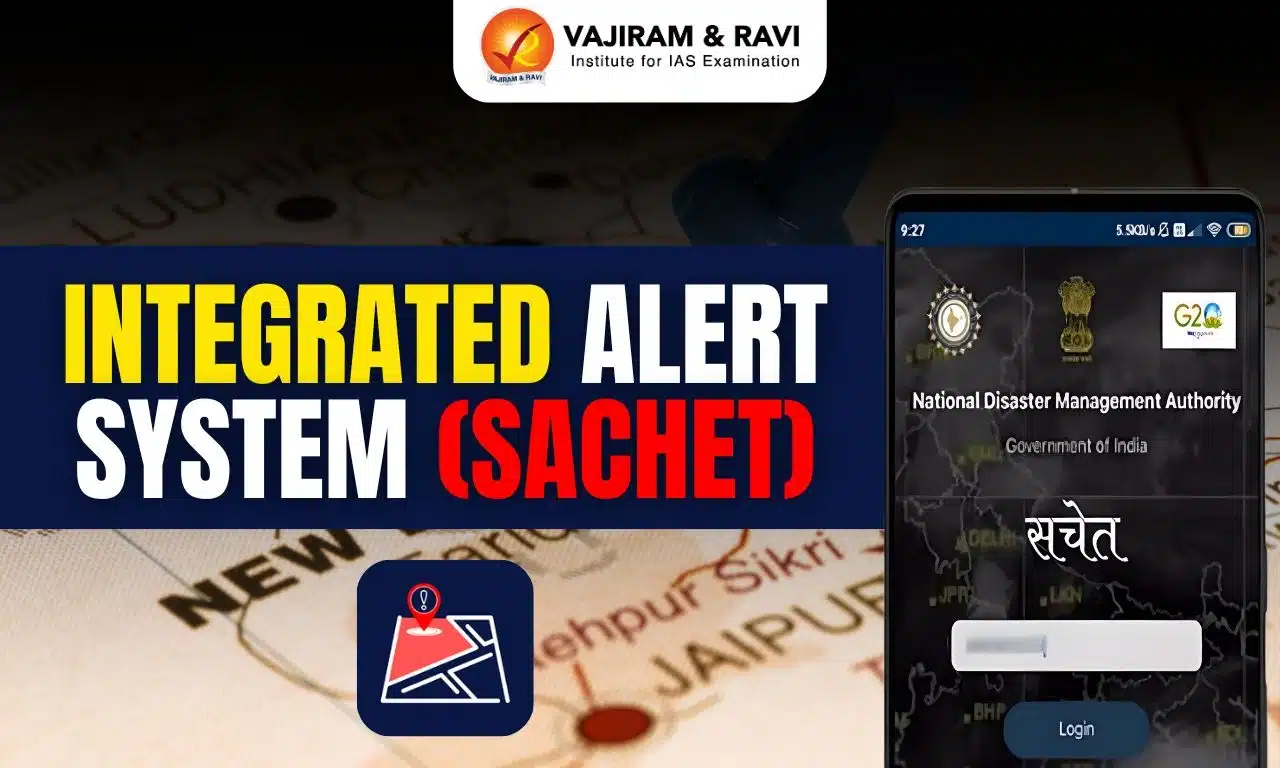
Integrated Alert System (SACHET)

Integrated Alert System (SACHET)

Integrated Alert System (SACHET) Latest News

In a session on disaster risk reduction (DRR) at the ongoing G20 ministerial meeting in Durban, India’s Principal Secretary to the Prime Minister outlined India’s multi-agency architecture integrating meteorological, hydrological, seismic, and oceanographic institutions through a Common Alert Protocol–compliant Integrated Alert System.

About Integrated Alert System (SACHET)

  • It is a disaster early warning platform envisioned by the National Disaster Management Authority (NDMA) to provide real-time geo-targeted alerts to citizens. 
  • It was developed by the Centre for Development of Telematics (C-DOT), the premier R&D center of the Department of Telecom.
  • It is based on the Common Alerting Protocol (CAP) recommended by the International Telecommunication Union (ITU).
  • It integrates multiple stakeholders to bridge communication gaps and employs multiple technologies, including SMS, Cell Broadcast, Mobile App, TV, Radio, Social Media, RSS Feed, Browser Notification, and Satellite, for enabling effective communication and ensuring last-mile reachability.
  • This system is already operational in all States and Union Territories (UTs) of India and sends various disaster- or emergency- related alerts through SMS to mobiles of citizens affected in a particular geo-targeted area. 
  • Users can receive alerts for their current location or subscribe to any state/district in India to receive alert notifications.
  • The SACHET mobile app provides warnings from authorized Government sources and authorities to warn the public of a possible disaster situation.
  • Furthermore, the app provides weather reports and forecasts from the Indian Meteorological Department (IMD) for day-to-day weather updates.

Source: TH

Integrated Alert System (SACHET) FAQs

Q1: What is the primary purpose of the Integrated Alert System (SACHET)?

Ans: To provide real-time geo-targeted disaster alerts to citizens

Q2: Who developed the Integrated Alert System (SACHET)?

Ans: It was developed by the Centre for Development of Telematics (C-DOT).

Q3: The SACHET platform is based on which international communication standard?

Ans: It is based on the Common Alerting Protocol (CAP) recommended by the International Telecommunication Union (ITU).

Q4: What is the role of SACHET in disaster management communication?

Ans: It bridges communication gaps by integrating multiple alerting technologies.

Steadfast Noon

Steadfast Noon

Steadfast Noon Latest News

NATO's annual nuclear deterrence exercise, Steadfast Noon, will be hosted by the Netherlands this year.

About Steadfast Noon

  • It is an annual nuclear exercise by NATO (North Atlantic Treaty Organization).
  • It is an important test for the alliance's nuclear deterrent.
  • It is hosted by a different NATO country each year.
  • The 2025 edition of the exercise is being hosted by the Netherlands, with Volkel Air Base serving as the main operating site. 
    • Bases at Kleine Brogel in Belgium, Lakenheath in Britain, and Skrydstrup in Denmark will also be involved.
    • Those nations, as well as Finland, Poland, the United States, and Germany, are among the participants.
    • It will involve around 70 aircraft from 14 allied nations, including both conventional and dual-capable aircraft. 
      • Dual-capable aircraft refers to aircraft that can deliver both conventional and nuclear weapons, which includes Germany’s Tornado, as well as the American and Dutch F-35 jets.
    • The exercise won’t use any actual nuclear weapons.
    • Pilots and aircraft involved in the exercise are certified for the nuclear mission, but no weapons are loaded or flown.
    • France isn’t participating in the exercise, as the country keeps its nuclear forces separate from NATO’s command-and-control structure and decision-making process.

Source:  THBL

Steadfast Noon FAQ's

Q1: What is the Steadfast Noon exercise?

Ans: It is an annual nuclear exercise by NATO (North Atlantic Treaty Organization).

Q2: Which country is hosting the 2025 edition of the Steadfast Noon exercise?

Ans: Netherlands

Q3: How many aircraft and allied nations are participating in Steadfast Noon 2025?

Ans: 70 aircraft from 14 nations

Q4: Why does France not participate in Steadfast Noon?

Ans: France keeps its nuclear forces separate from NATO’s command-and-control structure and decision-making process.

Blue Flag Certification

Blue Flag Certification

Blue Flag Certification Latest News

Recently, five beaches in Maharashtra have received the international Blue Flag certification.

About Blue Flag Certification

  • It is a globally recognized eco-label accorded by the Foundation for Environment Education in Denmark (FEE).
  • It is awarded to beaches that meet 33 criteria related to cleanliness, beauty, and environmental sustainability.
  • The Blue Flag programme was started in France in 1985 and in areas outside of Europe in 2001.
  • It is one of the world’s most recognised voluntary awards for beaches, marinas, and sustainable tourism boats.
  • It promotes sustainable development in freshwater and marine areas through four main criteria: water quality, environmental management, environmental education and safety.
  • Mission: The mission of Blue Flag is to promote sustainability in the tourism sector, through environmental education, environmental protection and other sustainable development practices.
  • The other Indian beaches in the blue list are Shivrajpur-Gujarat, Ghoghla-Diu, Kasarkod and Padubidri-Karnataka, Kappad-Kerala, Rushikonda- Andhra Pradesh, Golden-Odisha, Radhanagar- Andaman and Nicobar, Kovalam in Tamil Nadu and Eden in Puducherry beaches, Minicoy Thundi Beach, Lakshadweep, Kadmat Beach, Lakshadweep.

Source: New On Air

Blue Flag Certification FAQs

Q1: Which is the first beach in Asia to receive Blue Flag certification?

Ans: Chandrabhaga Beach, Odisha

Q2: Which organization awards the Blue Flag certification?

Ans: Foundation for Environmental Education (FEE)

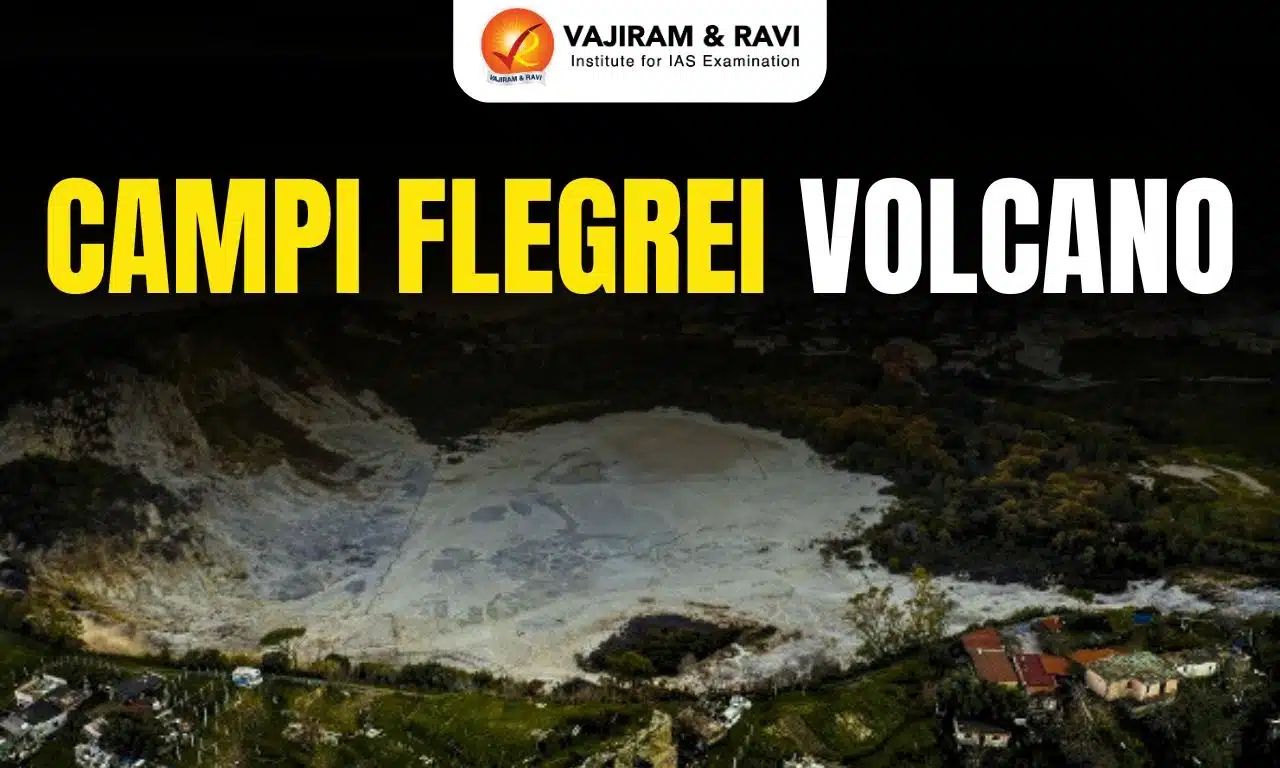
Campi Flegrei Volcano

Campi Flegrei Volcano

Campi Flegrei Volcano Latest News

An artificial intelligence (AI) model has revealed never-before-seen geological structures at Italy's Campi Flegrei volcano, including a clear "ring fault" that could unleash magnitude 5 earthquakes.

About Campi Flegrei Volcano

  • Campi Flegrei, also known as the Phlegraean Fields, is an active volcanic region situated in the densely populated Bay of Naples in Italy, which is also home to the more famous Vesuvius Volcano. 
  • It differs from traditional volcanoes like Mount Vesuvius, as it is not a single volcano but a volcanic system spread across a large caldera.
  • It is the largest active volcanic caldera in Europe, far larger and more active than Mount Vesuvius.
    • The caldera, or volcanic depression, spans approximately 12–15 km in diameter and was created due to a massive eruption around 39,000 years ago.
    • This eruption is hypothesized to have had such a climatic impact that it contributed to the decline of Neanderthals.
  • One-third of Campi Flegrei lies beneath the Tyrrhenian Sea, between the Italian mainland and the island of Sardinia.
  • The last recorded eruption was in 1538, forming Monte Nuovo and ending an interval of roughly 3000 years without eruptions.
  • Campi Flegrei is categorised as a supervolcano, implying that a large-scale eruption could have global consequences, including climate disruption.
  • The volcano has been showing signs of unrest since 2005.
    • It is characterised by intense hydrothermal activity, episodes of localised ground deformation, and earthquake swarms.

Source: LS

Campi Flegrei Volcano FAQs

Q1: Where is the Campi Flegrei volcanic region located?

Ans: Bay of Naples, Italy

Q2: What is another name for the Campi Flegrei Volcano?

Ans: Phlegraean Fields

Q3: How does Campi Flegrei differ from traditional volcanoes like Mount Vesuvius?

Ans: It is a volcanic system spread across a large caldera rather than a single volcano.

Q4: Why is Campi Flegrei categorised as a supervolcano?

Ans: Because, large-scale eruption could have global consequences, including climate disruption.

Gomti River

Gomti River

Gomti River Latest News

Uttar Pradesh Chief Minister recently launched the ‘Gomti Rejuvenation Mission’ to ensure the uninterrupted flow of the river, setting an ambitious target to intercept 95 percent of urban sewage entering the waterway.

About Gomti River

  • It is a tributary of the Ganges (Ganga) River, flowing entirely through the state of Uttar Pradesh.
  • The river is also known by the names Gumti or Gomati.
  • Course:
    • It originates from the Gomat Taal, otherwise called Fulhaar Jheel, a lake located in the Pilibhit District in Uttar Pradesh.
    • The river drains the area between the Ramganga and Sharda Rivers.
    • After flowing southwards through the districts of Lucknow, Barabhanki, Sultanpur, Faizabad, and Jaunpur, it joins with the River Ganga.
  • The river extends to about 900 km. 
  • It drains a basin of about 18,750 sq.km.
    • The entire Gomti basin is underlain by thick alluvial sediments of the Quaternary age. 
    • The alluvial sediments consist of boulders, pebbles, gravel, sand, silt, clay, and kankars.
    • The unconsolidated unit may be further subdivided into younger alluvium and older alluvium. 
    • The younger alluvium occupies the present-day flood plains, while the older group occupies elevated portions, mainly the doab portions.
    • The older alluvium is characterized by kankar nodules at depth otherwise it is similar to the younger alluvium. 
  • It is a perennial river. The river is characterised by sluggish flow throughout the year, except during the monsoon season, when heavy rainfall causes a manifold increase in the runoff.
  • Significant tributaries of the Gomti include the Sai River, Chowka River, Kathina River, and Saryu River.
  • There are various cities that are situated on the banks of River Gomti, such as Sultanpur, Lucknow, Jaunpur, and Lakhimpur Kheri.
  • Over the years, Gomti has become one of the most polluted rivers in Uttar Pradesh.

Source: SRMG

Gomti River FAQs

Q1: The Gomti River is a tributary of which major river?

Ans: Ganges (Ganga)

Q2: The Gomti River flows entirely through which Indian state?

Ans: Uttar Pradesh

Q3: From which lake does the Gomti River originate?

Ans: Gomat Taal (Fulhaar Jheel)

Q4: Approximately how long is the Gomti River?

Ans: 900 km

Enquire Now