MAM01 Monoclonal Antibody

MAM01 Monoclonal Antibody

MAM01 Monoclonal Antibody Latest News

A novel monoclonal antibody named MAM01, developed by US researchers has demonstrated strong protection against malaria in an early clinical trial.

About MAM01 Monoclonal Antibody

  • MAM01 is a monoclonal antibody developed to prevent malaria infection.
  • It's designed to target a highly conserved region of the Plasmodium falciparum circumsporozoite protein, blocking infection before the parasite reaches the bloodstream.
  • The trial found that MAM01 provided dose-dependent full protection against the malaria parasite with minimal side effects.

Key Features of MAM01 Monoclonal Antibody

  • Administration: Single injection of a long-acting antibody and provide immediate, months-long protection. 
  • It is particularly beneficial for young children and pregnant women in malaria-endemic regions.

What are Monoclonal antibodies?

  • Monoclonal antibodies (mAbs) are laboratory-made proteins that mimic the body’s natural immune defenses.
  • The word “monoclonal” refers to the fact that the antibodies created in the laboratory are clones. They are exact copies of one antibody.
  • Production:
    • They are produced by cloning a single type of immune cell, known as a B cell, to generate large quantities of identical antibodies.
    • This process creates highly specific antibodies that target a particular antigen, which could be a virus, bacteria, cancer cell, or other disease-related molecule.
    • Specificity: They can be designed to recognize and bind to a particular target molecule with great precision. This specificity reduces the risk of unintended side effects.
  • Application: They are used in a variety of medical applications, including the treatment of cancer, autoimmune diseases, and infectious diseases.

Source: DD News

MAM01 Monoclonal Antibody FAQs

Q1: What is MAM01?

Ans: A monoclonal antibody against malaria

Q2: Who could benefit from MAM01?

Ans: Young children and pregnant women in high-risk areas

Carabid Beetle

Carabid Beetle

Carabid Beetle Latest News

Recently, researchers found that carabid ground beetles act as potential bio indicators to track soil micro plastics. 

About Carabid Beetle

  • They are commonly known as ground beetles due to their habitat and behavior.
  • Ground beetles (Carabidae) are an important family of invertebrates known to strongly influence food web structure, often as key predators or prey species.
  • It belongs to the family Carabidae.
  • Habitat: Carabid beetles are found in a wide variety of habitats, including forests, grasslands, agricultural fields, wetlands, and even urban areas.
  • They are adapted to diverse climatic conditions, from temperate to tropical regions. 

Features of Carabid Beetle

  • Appearance: They are known for their long legs and powerful mandibles which enable them to be voracious predators.
  • They are infamous for their pungent smell, which they emit when they’re threatened.
  • Diet: They are mainly dependent on garden pests, including snails, caterpillars, slugs, and other small invertebrates.
  • Life cycle: Ground beetles have four distinct life stages: egg, larva, pupa, and adult. 
  • Reproduction: Reproduction in carabids is typically sexual, with internal fertilization. 
  • Ecological Role: They are important for the biological control of insect pests on farms.

Source: TH

Carabid Beetle FAQs

Q1: What is the primary characteristic of Carabid Beetles?

Ans: They are predators that feed on insects and other small invertebrates.

Q2: What is the ecological role of Carabid Beetles?

Ans: Biological control of pests

Malabar Gliding Frog

Malabar Gliding Frog

Malabar Gliding Frog Latest News

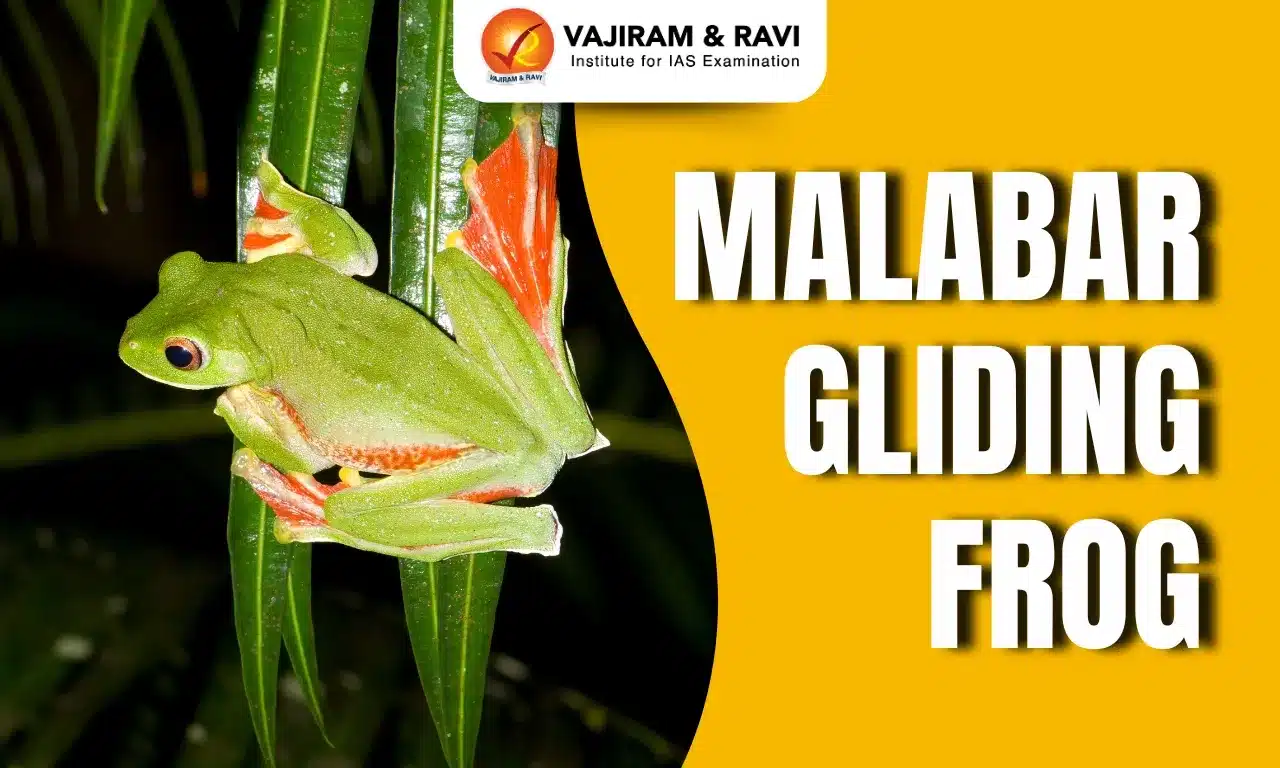
A rare species known as the Malabar Gliding Frog was sighted at Hirebagewadi near Belagavi recently.

About Malabar Gliding Frog

  • The Malabar gliding frog, or Malabar flying frog, is a special type of tree frog.
  • Scientific Name: Rhacophorus malabaricus
  • Habitat and Distribution:
    • It is endemic to the rainforests of the Western Ghats of India.
    • Typically located on tree leaves near streams or riverbanks, it migrates to overhanging trees above water bodies for breeding, where its tadpoles are released.
  • These frogs are famous for their amazing ability to "glide" through the air using the webbing between its toes. 
  • They can leap as far as 9 to 12 meters (about 30 to 40 feet). It's about 115 times their own body length.
  • Appearance
    • This frog has a body length of about 10 cm (4 in), making it one of the largest moss frogs. Males are smaller than females. 
    • Its back skin is finely granulated, and the color is vivid green without markings.
    • The frog's belly is pale yellow and feels rougher.
    • The webbing between fingers and toes is large and orange-red.
  • Conservation Status:
    • IUCN Red List: Least Concern

Source: TOI

Malabar Gliding Frog FAQs

Q1: The Malabar Gliding Frog is endemic to which region of India?

Ans: It is endemic to the rainforests of the Western Ghats.

Q2: What special ability does the Malabar Gliding Frog possess?

Ans: It can glide through the air using webbed feet.

Q3: What is the conservation status of the Malabar Gliding Frog according to the IUCN Red List?

Ans: Least Concern

Konark-Balukhand Sanctuary

Konark-Balukhand Sanctuary

Konark-Balukhand Sanctuary Latest News

The spotted deer, once the pride of the Konark-Balukhand Wildlife Sanctuary, appears to be dwindling fast in numbers. 

About Konark-Balukhand Sanctuary

  • Location: It is located in Puri district, Odisha.
  • It was declared a sanctuary on 23 April 1984.
  • It was established on the sandy tract covered by plantation of casurina and cashew trees, along the coast between Puri and Konark. 
  • Rivers: It is traversed by the rivulets such as Nuanai River, Kusabhadra River, Kadua River, and Prachi River.
  • Flora: Jamun, ficus, neem, karanj, and polang trees are also found, mostly along the course of the Kusabhadra and Nuanai rivers.
  • Fauna: It is home to herds of herbivores (spotted deer), monkeys, jungle cat, hyena, monitor lizard, snakes, etc. 
  • Olive Ridley sea turtles have been seen nesting on the beach.

Key Facts about Spotted Deer

  • It is the most common deer species in Indian forests.
  • Distribution: It is widely distributed in Asia, especially in India, Sri Lanka, Bangladesh, Bhutan, and a small group in Pakistan.
  • Conservation Status: IUCN Red List: Least Concern

Source: Telegraph

Konark-Balukhand Sanctuary FAQs

Q1: Where is the Konark-Balukhand Wildlife Sanctuary located?

Ans: Puri district, Odisha

Q2: What type of ecosystem does the sanctuary primarily consist of?

Ans: Marine ecosystem and coastal forests

Sinapic Acid

Sinapic Acid

Sinapic Acid Latest News

Nagaland University researchers have identified a naturally occurring plant compound called 'Sinapic acid' that is capable of significantly accelerating wound healing in diabetic conditions.

About Sinapic Acid

  • It is a natural phenolic acid compound, and is a derivative of cinnamic acid.
  • It has antioxidant, antitumor, anti-inflammatory, antibacterial and neuroprotective effects.
  • It is extensively found in spices, citrus and berry fruits, vegetables, cereals, and oilseed crops 
  • Mechanism: The compound works by activating the SIRT1 pathway, which plays a crucial role in tissue repair, angiogenesis and inflammation control.
  • Significance: The discovery marks a major advancement that could result in safe, natural, and effective treatments for diabetic wound management.
    • A diabetic wound is a slow-healing sore, most often a foot ulcer. Also known as diabetic foot, it raises the risk of nerve damage (neuropathy), poor blood circulation, infections, and, in severe cases, amputation.

What is Diabetes mellitus?

  • It is a metabolic disease, involving inappropriately elevated blood glucose levels
  • It remains one of the world’s most pressing chronic diseases, affecting hundreds of millions globally.

Source: TH

Sinapic Acid FAQs

Q1: What is Sinapic acid?

Ans: A naturally occurring hydroxycinnamic acid found in plants.

Q2: Where is Sinapic acid commonly found?

Ans: Edible plants such as spices, citrus fruits, and berries

Authorized Economic Operator (AEO) Programme

Authorized Economic Operator (AEO) Programme

Authorized Economic Operator (AEO) Programme Latest News

The World Trade Organization (WTO) recently praised India's liberalised Authorised Economic Operator (AEO) programme for significantly increasing the participation of micro, small, and medium enterprises (MSMEs) in international trade.

About Authorized Economic Operator (AEO) Programme

  • AEO is a programme under the aegis of the World Customs Organisation (WCO) SAFE Framework of Standards to secure and facilitate Global Trade. 
    • The WCO in June, 2005, with a view to secure the international supply chain, adopted the SAFE Framework of Standards (WCO SAFE FoS).
    • AEO is one of the three pillars on which the SAFE FoS is formed.
    • AEO helps to build a closer partnership between the customs department and the trade industry.
  • WCO SAFE FoS is the basis of the Indian AEO programme.
  • AEO is a voluntary compliance programme which enables Indian Customs to enhance and streamline cargo security through close cooperation with the principal stakeholders of the international supply chain viz. importers, exporters, logistics providers, custodians or terminal operators, custom brokers, and warehouse operators. 
  • Launched by the Central Board of Indirect Taxes and Customs (CBIC) as a pilot in 2011 and revised in 2016, the AEO programme merges India's earlier accredited client programme.
  • It is implemented by the Directorate of International Customs of CBIC. 
  • Under the AEO programme, an entity engaged in international trade is approved by Customs as compliant with supply chain security standards and granted AEO status & certain benefits.
    • An AEO is a business entity involved in the international movement of goods requiring compliance with provisions of the national customs law.
    • Once granted an AEO status, they are entitled to faster clearances, deferred duty payments, and reduced inspection frequency.
    • Thus, an entity with an AEO status can be considered a reliable trading partner and a secure trader.
  • This segmentation approach enables customs resources to focus on less noncompliant or risky businesses for control.

Source: LM

Authorized Economic Operator (AEO) Programme FAQ's

Q1: The Authorized Economic Operator (AEO) Programme operates under which international framework?

Ans: AEO is a programme under the aegis of the World Customs Organisation (WCO) SAFE Framework of Standards to secure and facilitate Global Trade.

Q2: What is the main objective of the Authorized Economic Operator (AEO) Programme?

Ans: To facilitate and secure global trade through customs–business partnership

Q3: The Authorized Economic Operator (AEO) in India was launched by which authority?

Ans: Central Board of Indirect Taxes and Customs (CBIC)

Tetrataenium Manilalianum

Tetrataenium Manilalianum

Tetrataenium manilalianum Latest News

Adding to the rich biodiversity of the Western Ghats, researchers recently discovered a new plant species named Tetrataenium manilalianum.

About Tetrataenium manilalianum

  • It is a new plant species belonging to the carrot family (Umbelliferae/Apiaceae). 
  • The plant was found in the Eravikulam National Park in Kerala’s Idukki district.
  • The species has been named in honour of renowned botanical researcher and founder president of the Indian Association for Angiosperm Taxonomy, Prof. K.S. Manilal. 
  • It grows only in grasslands bordering shola forests in high-altitude regions.
  • This is the 48th species identified within the carrot family, which includes well-known plants such as carrot, coriander, cumin, fennel, and ajwain. 
  • It is the first of its kind to be identified anywhere in the world. 
  • It has white flowers and underground rhizomes. 
  • It sprouts and flowers only during the monsoon season.

Key Facts about Eravikulam National Park

  • It is situated along the summit of the Western Ghats in the high ranges of the Idduki District of Kerala.
  • It covers an area of 97 sq.km.
  • The highest peak south of the Himalayas, the Anamudi (2695 meters), is situated on the southern side of the park.
  • This is also the land of “Neelakurinji”, the flower that blooms once every twelve years. 
  • Climate: The park receives heavy showers during the southwest (June/July) and retreating (October/November) monsoons and is one of the wettest areas of the world.
  • Vegetation: The major part of the park is covered with rolling grasslands, but several patches of shola forests are also found in the upper part of the valley. 
  • Flora:
    • Important flora includes Actinodaphne bourdilloni, Microtropis ramiflora, Pittosporum tetraspermium, Sysygium aronottianum, Chrysopogon Zelanieus, etc.
    • The shola grasslands are exceptionally rich in balsams and orchids, including the long thought extinct variety Brachycorythis wightii.
  • Fauna:
    • The Nilgiri Tahr, Gaur, Sloth Bear, Nilgiri Langur, Tiger, Leopard, Giant Squirrel, and wild dog are the common species.
    • Half the world population of the endangered Nilgiri Tahr lives here.
    • The Atlas moth, the largest of its kind in the world, is seen in this park.

Source: ETVB

Tetrataenium manilalianum FAQs

Q1: Tetrataenium manilalianum belongs to which plant family?

Ans: It is a new plant species belonging to the carrot family (Umbelliferae/Apiaceae).

Q2: Where was the plant species Tetrataenium manilalianum discovered?

Ans: Eravikulam National Park in Kerala’s Idukki district.

Q3: Tetrataenium manilalianum is known to grow in which type of habitat?

Ans: It grows only in grasslands bordering shola forests in high-altitude regions.

INS Vikrant

INS Vikrant

INS Vikrant Latest News

Recently, the Prime Minister of India celebrated Deepavali aboard INS Vikrant and hailed armed forces’ unity in Operation Sindoor. 

About INS Vikrant

  • It is India’s first indigenously designed and manufactured aircraft carrier.
  • The ship has been designed in-house by the Indian Navy’s Warship Design Bureau and constructed by M/s Cochin Shipyard Limited.
  • It was commissioned into the Indian Navy in 2022.

Features of INS Vikrant

  • With a length of 262 metres and a width of 62 metres, the massive aircraft carrier boasts 14 decks.
  • Displacement capacity: Its full-load displacement is 43,000 tonnes.
  • Propulsion: It is powered by four Gas Turbines totaling 88 MW of power and has a maximum speed of 28 knots. 
  • Endurance: 8,600 miles (13,890 kilometres) and it is capable of functioning independently for up to 45 days at sea.
  • It is capable of operating an air wing consisting of 30 aircraft comprising MIG-29K fighter jets, Kamov-31, MH-60R multi-role helicopters, in addition to indigenously manufactured Advanced Light Helicopters (ALH) and Light Combat Aircraft (LCA) (Navy). 
  • Using a novel aircraft-operation mode known as STOBAR (Short Take-Off but Arrested Landing), INS Vikrant is equipped with a ski- jump for launching aircraft and a set of ‘arrester wires’ for their recovery onboard.

Source: TH

INS Vikrant FAQ's

Q1: Where was India's first domestically built aircraft carrier INS Vikrant constructed?

Ans: Cochin Shipyard Limited (CSL)

Q2: What is the primary role of INS Vikrant in the Indian Navy?

Ans: Aircraft carrier and naval aviation

Financial Action Task Force (FATF)

Financial Action Task Force (FATF)

Financial Action Task Force (FATF) Latest News

The ongoing Financial Action Task Force (FATF) meetings in Paris are expected to deliberate on state sponsorship as a means to fund and support terrorism, including the financing of banned outfits and their proxies operating in Pakistan.

About Financial Action Task Force 

  • It is an independent intergovernmental body that develops and promotes policies to protect the global financial system against money laundering and terrorist financing.
  • The FATF Recommendations are recognised as the global anti-money laundering (AML) and counter-terrorist financing (CFT) standard.
  • Origin:
    • It was established in 1989 during the G7 Summit in Paris in response to a growing concern about money laundering.
    • In 2001, its mandate expanded to include terrorism financing.
    • Headquarters: Paris, France.
  • Members:
    • FATF members include 39 countries, including the United States, India, China, Saudi Arabia, Britain, Germany, France, and the EU as such.
    • India became a member of FATF in 2010. 
    • In addition, more than 180 countries worldwide are affiliated with the FATF through a network of FATF-style regional bodies (FSRBs).
  • The FATF researches how money is laundered and terrorism is funded, promotes global standards to mitigate the risks, and assesses whether countries are taking effective action.
  • FATF regularly publishes reports that raise awareness about the latest money laundering, terrorist financing, and proliferation financing techniques.
  • Once a member, a country or organization must endorse and support the most recent FATF recommendations and commit to being evaluated by (and evaluating) other members.
  • The FATF holds countries to account that do not comply with the FATF Standards.
  • If a country repeatedly fails to implement FATF Standards, then it can be placed under the grey and black lists.
  • What are FATF ‘grey list’ and ‘blacklist’?
    • Black List: Countries known as Non-Cooperative Countries or Territories (NCCTs) are put on the blacklist. These countries support terror funding and money laundering activities. The FATF revises the blacklist regularly, adding or deleting entries.
    • Grey List: Countries that are considered a safe haven for supporting terror funding and money laundering are put on the FATF grey list. This inclusion serves as a warning to the country that it may enter the blacklist.
    • Three countries-North Korea, Iran, and Myanmar, are currently on FATF’s blacklist.
  • Consequences of being on the FATF blacklist:
    • No financial aid is given to them by the International Monetary Fund (IMF), the World Bank, the Asian Development Bank (ADB), and the European Union (EU).
    • They also face a number of international economic and financial restrictions and sanctions.

Source: TH

Financial Action Task Force (FATF) FAQs

Q1: When was the Financial Action Task Force (FATF) established?

Ans: It was established in 1989 during the G7 Summit in Paris.

Q2: What is the primary objective of the FATF?

Ans: To prevent money laundering and terrorist financing.

Q3: Where is the headquarters of the Financial Action Task Force (FATF) located?

Ans: Paris, France

Q4: How many member countries does FATF currently have?

Ans: FATF members include 39 countries, including the United States, India, China, Saudi Arabia, Britain, Germany, France, and the EU as such.

Doctrine of Lis Pendens

Doctrine of Lis Pendens

Doctrine of Lis Pendens Latest News

The Delhi High Court has held that courts can exempt a property from the doctrine of lis pendens, to shield genuine owners from vexatious suits.

About Doctrine of Lis Pendens

  • The Doctrine of Lis Pendens, derived from Latin, translates to “pending litigation.” 
  • It is a legal principle that pertains to immovable property and is dealt with in Section 52 of the Transfer of Property Act (TPA), 1882, in India. 
    • Section 52 of the TPA, 1882, provides that if there is any transfer of any immovable property pending litigation, the same shall not affect the rights of the parties in respect to the immovable property.
    • The outcome of the litigation, passed by a court of competent jurisdiction, in the matter during the pendency of which the transfer had taken place, would be binding upon such a purchaser, who has purchased the property during the pending litigation.
  • The underlying rationale behind this doctrine is to prevent the subject matter of a lawsuit from being transferred to a third party while the case is still pending. 
    • In situations involving immovable property, any transfer of ownership must comply with the court’s decision, and the transferee is bound by the court’s judgment.
    • The effect of the rule of lis pendens is not to invalidate or avoid the transfer but to make it subject to the result of the litigation.
  • This doctrine serves to protect the rights and interests of parties involved in a pending lawsuit concerning a specific property.
  • Conditions for Applicability: 
    • There must be a pendency of a suit or proceeding.
    • The instituted suit should be filed in court with competent jurisdiction.
    • The right of title of an immovable property is directly and specifically in question.
    • The suit directly affects the rights of the other party.
    • The property in question is being transferred by either party.
    • The suit must not be collusive (a suit in which a decree is obtained by fraud or collusion) in nature.
  • Non-Applicability of Doctrine: 
    • Sale made by mortgager in exercise of his power conferred under the deed.
    • In cases where only the transferor is affected.
    • In cases where proceedings are collusive in nature.
    • When the property is not described correctly and making it unidentifiable.
    • When the right to the said property is not directly in question and alienation is permitted.

Source: LIVELAW

Doctrine of Lis Pendens FAQs

Q1: What does the term “Lis Pendens” mean in Latin?

Ans: Pending litigation.

Q2: What is the main purpose of the Doctrine of Lis Pendens?

Ans: To prevent transfer of property that may affect the outcome of a pending suit.

Q3: What happens if an immovable property is transferred during the pendency of litigation?

Ans: Any transfer of ownership must comply with the court’s decision, and the transferee is bound by the court’s judgment.

Enquire Now