Electronics Development Fund

Electronics Development Fund

Electronics Development Fund Latest News

The Electronics Development Fund has played a pivotal role in nurturing innovation and entrepreneurship in India’s electronics and IT sectors. 

About Electronics Development Fund

  • It was launched by the Government of India on 15 February 2016.
  • The Fund aims to promote research, development, and entrepreneurship in the fields of electronics, nano-electronics, and information technology.
  • It functions as a Fund of Funds, designed to invest in professionally managed Daughter Funds such as early-stage angel and venture funds.
    • Each Daughter Fund supported under the scheme is required to be registered in India and comply with all applicable laws and regulations, including the SEBI (Alternative Investment Funds) Regulations, 2012, as Category I or Category II AIFs. 

Key Objectives of Electronics Development Fund

  • Promote Innovation and R&D: To foster research and development in electronics, nano-electronics, and information technology by supporting market-driven and industry-led innovation.
  • Support Daughter Funds: To invest in professionally managed Daughter Funds such as early-stage angel and venture funds that, in turn, provide capital to startups and technology ventures.
  • Encourage Product and Technology Development: To nurture entrepreneurship by supporting companies involved in the creation of new products, processes, and technologies within the country.
  • Strengthen Domestic Design Capabilities: To enhance India’s capacity for indigenous design and development in the Electronics System Design and Manufacturing (ESDM) sector.
  • Build a National IP Resource Pool: To generate a strong base of intellectual property in key technology areas and encourage ownership of innovation within India.
  • Facilitate Strategic Acquisitions: To enable acquisition of foreign technologies and companies where such products are imported in large volumes, promoting self-reliance and reducing import dependence.

Source: PIB

Electronics Development Fund FAQs

Q1: What is the primary objective of the Electronics Development Fund (EDF)?

Ans: To promote electronics manufacturing in India.

Q2: What is an electronic development fund?

Ans: It is a Fund of Funds which will foster R&D and innovation in technology sectors like electronics, IT and nano-electronics.


Man-Portable Autonomous Underwater Vehicles

Man-Portable Autonomous Underwater Vehicles

Man-Portable Autonomous Underwater Vehicles Latest News

Recently, new generations of man-portable autonomous underwater vehicles (MP-AUVs) have been successfully developed by the Defence Research and Development Organisation.

About Man-Portable Autonomous Underwater Vehicles

  • It is developed for mine countermeasure missions.
  • It is developed by the Naval Science & Technological Laboratory (NSTL), Visakhapatnam of Defence Research and Development Organisation (DRDO).

Key Features of Man-Portable Autonomous Underwater Vehicles

  • Rapid Response: It offers rapid response capability with reduced operational risk and logistic footprint for naval mine warfare applications.
  • Autonomous Classification: It has deep learning based target recognition algorithms enabling autonomous classification, significantly reducing operator workload and mission time.
  • Advanced equipment: It comprises multiple AUVs equipped with Side Scan Sonar and Under Water cameras as primary payloads for real-time detection & classification of Mine-Like Objects.
  • Enhanced situational awareness: It has a robust underwater acoustic communication network which allows seamless data exchange between AUVs during missions and providing greater situational awareness.

Key Facts about Defence Research and Development Organisation

  • It is the R&D wing of the Ministry of Defence, Govt of India, with a vision to empower India with cutting-edge defence technologies.
  • Formation: It was formed in 1958 by merging the then-existing Technical Development Establishment (TDEs) of the Indian Army and the Directorate of Technical Development and Production (DTDP) with the Defence Science Organisation (DSO).
  • It is responsible for the indigenous design, development and production of state-of-the-art weapon systems required by the Armed Forces.
  • Headquarters: New Delhi.

Source: PIB

Man-Portable Autonomous Underwater Vehicles FAQs

Q1: Which organization developed the MP-AUV?

Ans: DRDO

Q2: What is the primary objective of MP-AUVs?

Ans: To conduct mine countermeasure operations.

Palar River

Palar River

Palar River Latest News

A 60-year-old woman was washed away in a flash flood in the Palar river near Katpadi town in Vellore, Tamil Nadu, recently.

About Palar River

  • It is a river in southern India. 
  • Course:
    • It originates from the Nandidurg hills in the Kolar district of Karnataka, flowing as an underground stream (Guptagamini) before emerging near Bethamangala town.
    • It flows 93 km in Karnataka, 33 km in Andhra Pradesh, and 222 km in Tamil Nadu before finally reaching its confluence in the Bay of Bengal at Vayalur, about 100 km south of Chennai.
  • The total area of the Palar River Basin is 17,633.19 sq.km.
  • The river has seven tributaries, with the Cheyyar River and Ponnai River being the most significant.
  • The cities of Ramanaickenpet, Vaniyambadi, Ambur, Vellore, Melvisharam, Arcot, Walajapet (Anaicut), Kanchipuram, and Chingleput are located on the banks of Palar River.
  • Many ancient temples, such as the Kolaramma Temple and Someswara Temple in Kolar and the Kanchipuram temples, are situated along its banks, making the river sacred and culturally significant.
  • The Arcot Dam, built on the river in Tamil Nadu, is historically significant and is one of the oldest irrigation dams in the region.

Source: TH

Palar River FAQs

Q1: The Palar River originates in which Indian state?

Ans: Karnataka

Q2: The Palar River finally drains into which water body?

Ans: Bay of Bengal

Q3: Which are major tributaries of the Palar River?

Ans: The river has seven tributaries, with the Cheyyar River and Ponnai River being the most significant.

RuTAG Initiative

RuTAG Initiative

RuTAG Initiative Latest News

Recently, the Principal Scientific Adviser (PSA) to the Government of India chaired the second annual review meeting of the Rural Technology Action Group (RuTAG) 2.0 initiative.

About RuTAG Initiative

  • The Rural Technology Action Group (RuTAG) is an initiative of the Office of the Principal Scientific Adviser (OPSA) which was launched in 2004.
  • It was conceptualized as a mechanism to provide a higher level of Science &Technology intervention and support for rural areas.
  • Under this initiative, the interventions are designed to be primarily demand-driven, focusing on bridging technology gaps at the grassroots level, upgrading technology, and providing training and demonstrations through innovative projects.

Objectives of RuTAG Initiative

  • Connecting Stakeholders: Collaborating with stakeholders Non-Government Organizations, Self Help Groups, Community Organizations, and Start-ups to identify sector-specific technology needs.
  • Demand-driven technologies: Developeing technologies based on socio-economic data coherent with national/regional priorities.
  • Prototype Validation: ValidatIng developed prototypes and explored commercialization with scalability aspects.
  • Commercialization: Commercializing the potentially validated technologies for national/global markets.

What is RuTAG 2.0?

  • It was launched by the Office of the PSA in April 2023.
  • Focus: With a focus on commercialization and broader dissemination of developed technologies as products, ensuring wider accessibility and socio-economic impact.
  • It will emphasize translating innovation into market-ready products reflecting its commitment to driving transformative changes in rural areas and empowering communities for sustainable development.

Source: PIB

RuTAG Initiative FAQs

Q1: What is the primary objective of the RuTAG Initiative?

Ans: To provide science and technology support for rural areas.

Q2: What is the goal of the RuTAG Smart Village Centre?

Ans: To provide technological solutions for rural challenges.

Ambaji Marble

Ambaji Marble

Ambaji Marble Latest News

Recently, the Ambaji Marble has been awarded the Geographical Indication (GI) tag for its high-quality white stone.

About Ambaji Marble

  • It is named after the town of Ambaji in the state of Gujarat, where it is predominantly quarried. 
  • It is a type of marble known for its milky white colour, durability and natural beauty.

Features of Ambaji Marble

  • Appearance: It is characterized by its pristine white color, which often features subtle gray or beige veining.
    • The veins can vary in intensity and they occur naturally due to the presence of minerals and impurities during the marble formation process.
  • Durability: It has very long-lasting shine and durability. 
  • Applications of Ambaji Marble: It has been used in the construction of Ambaji temple and many other religious places, memorials and grand buildings.

Key Facts about Marble

  • It is a metamorphic rock that forms when limestone is subjected to the heat and pressure of metamorphism.
  • Composition: It is composed primarily of the mineral calcite (CaCO3) and usually contains other minerals, such as clay minerals, micas, quartz, pyrite, iron oxides, and graphite.

Formation of Marble

  • Under the conditions of metamorphism, the calcite in the limestone recrystallizes to form a rock that is a mass of interlocking calcite crystals.
  • A related rock, dolomitic marble, is produced when dolostone is subjected to heat and pressure.
  • The transformation of limestone into marble usually occurs at convergent plate boundaries, where large areas of Earth’s crustare exposed to the heat and pressure of regional metamorphism.
  • Some marble also forms by contact metamorphism when a hot magma body heats adjacent limestone or dolostone.

Source: TH

Ambaji Marble FAQs

Q1: Where is Ambaji Marble primarily found?

Ans: Gujarat

Q2: What is the primary composition of Ambaji Marble?

Ans: Calcium carbonate

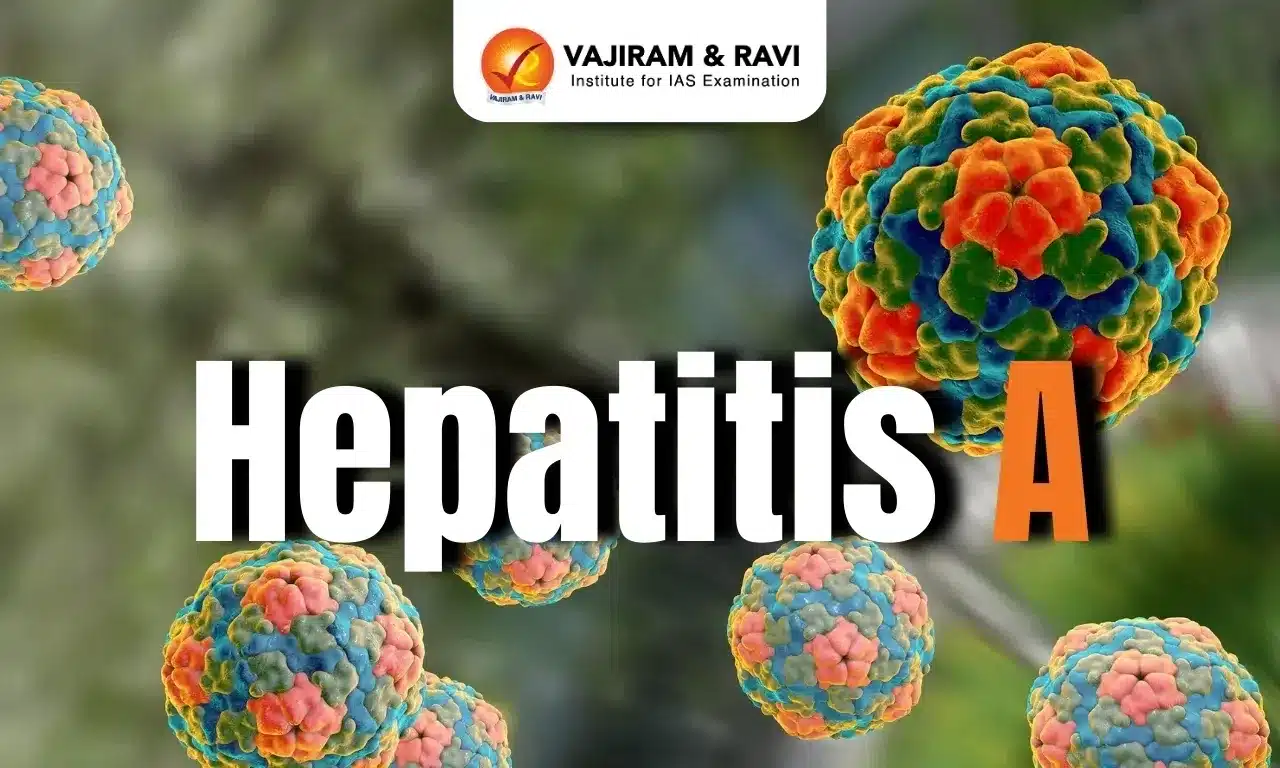
Hepatitis A

Hepatitis A

Hepatitis A Latest News

Recently, public health experts opined that Hepatitis A deserves a place in India’s universal immunisation programme  due to its multiple outbreaks across many states in India.

About Hepatitis A

  • Hepatitis A is an inflammation of the liver caused by the hepatitis A virus (HAV). 
  • It occurs throughout the world.
  • It is especially common in countries in Latin America, Africa, the Middle East, Asia, the Caribbean, and the Western Pacific.
  • Unlike hepatitis B and C, hepatitis A does not cause chronic liver disease but it can cause mild to severe symptoms and rarely fulminant hepatitis (acute liver failure).
  • Symptoms: Fever, malaise, loss of appetite, Nausea, diarrhoea, abdominal discomfort, Dark urine and jaundice.

Transmission of Hepatitis A

  • It is transmitted primarily by the faecal-oral route; that is when an uninfected person ingests food or water that has been contaminated with the faeces of an infected person. 
  • The virus can also be transmitted through close physical contact with an infectious person.

Treatment for Hepatitis A

  • There is no specific antiviral treatment for hepatitis A.
  • Its treatment mainly focuses on supportive care to relieve symptoms and ensure adequate hydration and nutrition.

Source: TH

Hepatitis A FAQs

Q1: What is the primary cause of Hepatitis A?

Ans: Hepatitis A virus (HAV)

Q2: Which of the following is a common mode of transmission for Hepatitis A?

Ans: Contaminated food and water

Enquire Now