Sujalam Bharat App

Sujalam Bharat App

Sujalam Bharat App Latest News

Recently, the Union Minister of Jal Shakti launched the Sujalam Bharat App.

About Sujalam Bharat App

  • It is a key digital initiative designed to transform rural drinking water governance.
  • It has been developed with the support of Bhaskaracharya National Institute for Space Applications and Geo-informatics (BISAG-N) 

Features of Sujalam Bharat App

  • It enables advanced geo-referencing, monitoring and management of rural water supply infrastructure under Jal Jeevan Mission.
  • It integrates critical data including water sources, asset inventories, scheme designs, operational records, water quality reports, supply metrics, and community feedback into a single platform.
  • With the introduction of the Sujal Gaon ID, every habitation will have a clear digital profile showing:
    • Its source of drinking water (local or bulk supply)
    • The nature and condition of its infrastructure
    • Supply reliability
    • Water quality status
    • O&M arrangements
  • It is integrated with PM Gati Shakti GIS  which provides up-to-date geospatial mapping of rural water networks, supporting future planning, repair, and expansion with greater precision.
  • Significance: It will ensure transparency in the performance of Gram Panchayats, Village Water and Sanitation Committees (VWSCs) and service providers, thereby promoting community participation and oversight

Source: PIB

Sujalam Bharat App FAQs

Q1: Which ministry launched the Sujalam Bharat App?

Ans: Ministry of Jal Shakti

Q2: What is the primary objective of Sujalam Bharat App?

Ans: To monitor rural drinking water supply
Key Facts about Mexico

Key Facts about Mexico

Mexico Latest News

Recently, the Mexico’s Senate approved tariffs of up to 50% on imports from Asian countries, including India.

About Mexico

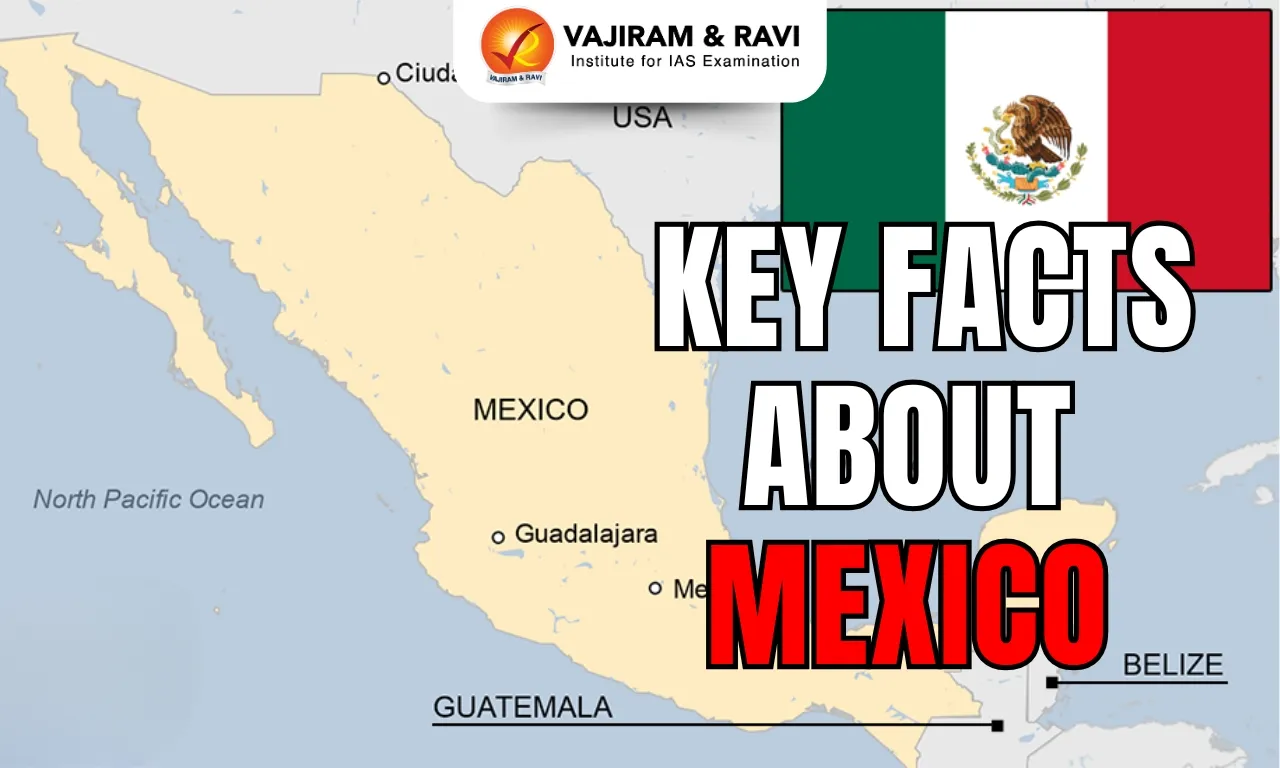
  • Location: It is located in the southern part of North America. 
  • Bordering Countries: It shares its land border with the United States of America to the north and with Guatemala and Belize to the southeast. 
  • Maritime boundaries: It is surrounded by the Pacific Ocean to the south and west; by the Gulf of Mexico and the Caribbean Sea to the east. 
  • Capital City: Mexico City

Geographical Features of Mexico

  • It is a part of the circum-Pacific “Ring of Fire”—a region of active volcanism and frequent seismic activity. 
  • Peninsulas: It consists of the Baja Peninsula and Yucatan Peninsula.
  • Major Rivers: Rio Grande river and Colorado river (which is shared with US)
  • Lakes: Lake Chapala and Lake Cuitzeo.
  • Major mountain range: Sierra Madre.
  • Natural Resources: Petroleum, silver, Antimony, Copper, Gold, Lead, zinc, natural gas.

Source: TH

Mexico FAQs

Q1: What is the capital of Mexico?

Ans: Mexico City

Q2: Which mountain range runs along the western coast of Mexico?

Ans: Sierra Madre Occidental

Hard Corals

Hard Corals

Hard Corals Latest News

A major new assessment by the Global Coral Reef Monitoring Network (GCRMN) has reported a dramatic decline in hard coral populations across the Caribbean.

About Hard Corals

  • Hard corals, also known as stony corals, are marine animals that build the limestone frameworks upon which reefs form.
  • They grow in colonies and are often referred to as “reef-building corals.”

Key Features of Hard Corals

  • They are composed of thousands of tiny polyps that secrete calcium carbonate.
  • Hard corals create skeletons out of calcium carbonate, a hard substance that eventually becomes rock.
  • Over time, this rock builds up to form the foundation of a coral reef and provides a structure upon which baby corals can settle.
  • These corals depend upon tiny algae called zooxanthellae that live inside them. 
  • They share a symbiotic relationship (the corals provide the zooxanthellae with shelter, and in return, the zooxanthellae provide the corals with food).

Threats to Hard Corals

  • Bleaching events driven by extreme heat
  • Stony Coral Tissue Loss Disease: It is spread across 30 countries which is causing unprecedented mortality of corals.
  • Losses of key herbivores such as the Diadema sea urchin have fuelled an 85% surge in macroalgae.

Source: DTE

Hard Corals FAQs

Q1: What is the primary component of hard corals?

Ans: Calcium carbonate

Q2: Where are hard coral reefs typically found?

Ans: Tropical oceans

Uchi Pillaiyar Temple

Uchi Pillaiyar Temple

Uchi Pillaiyar Temple Latest News

The Tamil Nadu government recently informed the Madurai Bench of the Madras High Court that the deepam (lamp) was lit at the Uchipillaiyar temple mandapam in Thirupparankundram hill during Karthigai Deepam this year too as it was done for over the last 150 years.

About Uchi Pillaiyar Temple

  • The Uchi Pillaiyar Temple, also known as Rockfort Temple, is located at the top of Rockfort Hill, Trichy, in Tamil Nadu.
  • It is a 7th-century-CE Hindu temple, dedicated to Lord Ganesha.
  • The temple stands 83 metres (272 ft) tall, perched atop a rock. 
    • Trichy Rockfort hill is made of granite that is estimated to be over 3.8 billion years old. 
    • It is one of the oldest rock formations in the world. 
    • In comparison, the Himalayas are much younger—they began forming only about 50 million years ago when the Indian tectonic plate collided with the Eurasian plate.
  • The smooth rock was first cut by the Pallavas, but it was the Nayaks of Madurai who completed the temples under the Vijayanagara empire. 
  • There are three temples located closely on the rock fort:
    • Maanikka Vinayakar Temple situated at the foothill, dedicated to Lord Ganesha.
    • Uchchi Pillayar Temple at the top of the hill, dedicated to Lord Ganesha.
    • Thayumanaswamy Temple, dedicated to Lord Shiva, situated close to the base of the rockfort on the way to Uchchi
  • This Rockfort Temple gives an aerial view of the entire Trichy City along with Srirangam Temple, River Kaveri, and River Kollidam.

Source: TH

Uchi Pillaiyar Temple FAQs

Q1: The Uchi Pillaiyar Temple is located at which place?

Ans: It is located at the top of Rockfort Hill, Trichy, in Tamil Nadu.

Q2: The Uchi Pillaiyar Temple is dedicated to which Hindu deity?

Ans: Lord Ganesha

Q3: The Uchi Pillaiyar Temple dates back to which period?

Ans: 7th century CE

Q4: Why is Rockfort Hill considered geologically significant?

Ans: It is one of the oldest rock formations in the world.

Supernova

Supernova

Supernova Latest News

A distant gamma-ray burst has led astronomers to a rare supernova from the Universe’s early years, revealed recently by the James Webb Space Telescope (JWST).

About Supernova

  • A supernova is the name given to the cataclysmic explosion of a massive star.
  • They are the largest explosions that take place in space.
  • A star can go supernova in one of two ways:
    • Type I Supernova: A star accumulates matter from a nearby neighbor until a runaway nuclear reaction ignites.
    • Type II Supernova: A star runs out of nuclear fuel and collapses under its own gravity.
  • It can emit more energy in a few seconds than our sun will radiate in its lifetime of billions of years.
  • These spectacular events can be so bright that they outshine their entire galaxies for a few days or even months. 
  • They can be seen across the universe.
  • They’re also the primary source of heavy elements in the universe.
  • How Common are Supernovas?
    • Astronomers believe that about two or three supernovas occur each century in galaxies like our own Milky Way. 
    • Because the universe contains so many galaxies, astronomers observe a few hundred supernovas per year outside our galaxy.

Source: MC

Supernova FAQs

Q1: What is a supernova?

Ans: A supernova is the name given to the cataclysmic explosion of a massive star.

Q2: Why are supernovae considered the largest explosions in space?

Ans: Because they release enormous amounts of energy and matter in a very short time.

Q3: How can a star go supernova?

Ans: Either by accumulating matter from a companion star (Type I) or by collapsing after exhausting nuclear fuel (Type II).

Q4: How much energy can a supernova emit compared to the Sun?

Ans: More energy in a few seconds than the Sun will emit over its entire lifetime.

Kaimur Wildlife Sanctuary

Kaimur Wildlife Sanctuary

Kaimur Wildlife Sanctuary Latest News

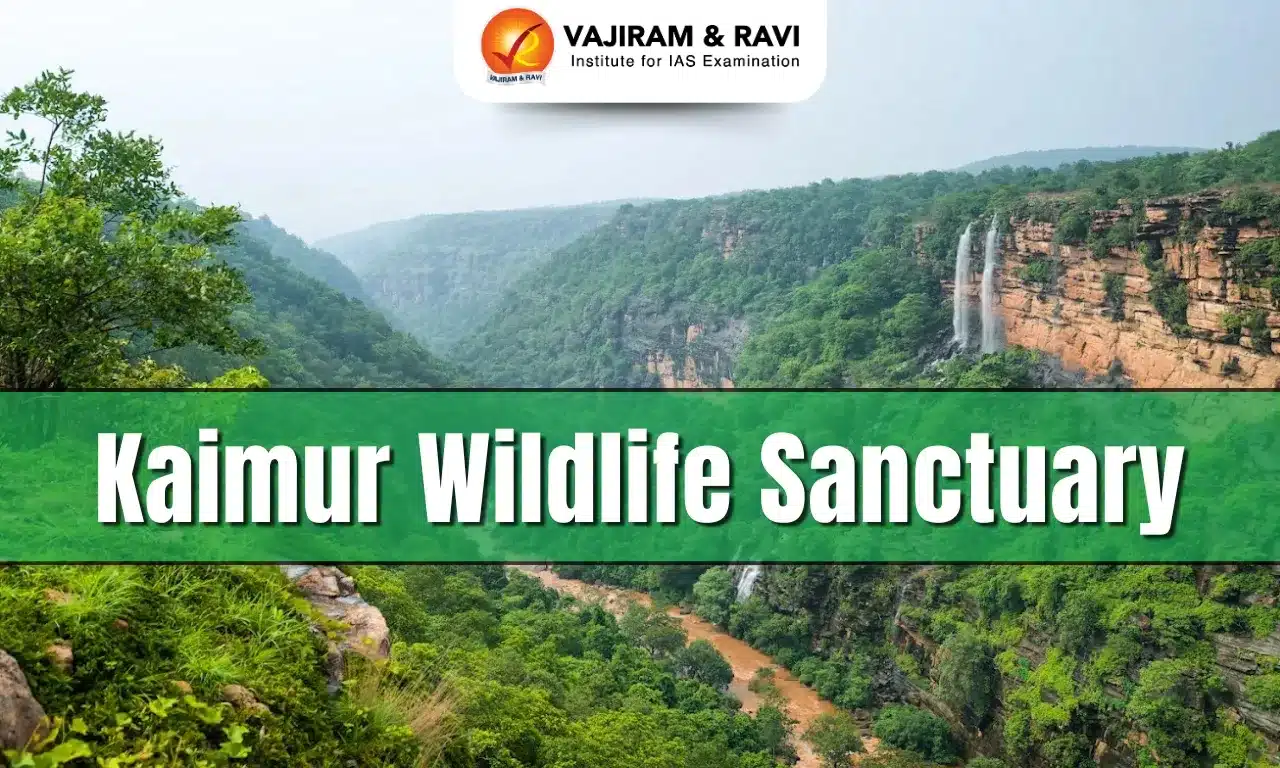
A forest department team seized a large number of deer heads, horns, and animal flesh and arrested a poacher during a raid in the Kaimur Wildlife Sanctuary recently.

About Kaimur Wildlife Sanctuary

  • It is located in the Kaimur District of Bihar.
  • It is located in the famous Kaimur Hills range. 
    • The Kaimur Hills, known for their invincibility, are home to two forts and the ancient Mundeshwari Temple, one of the oldest Hindu temples in India.
  • It is the largest sanctuary in the state and occupies an area of about 1342 sq.km.
  • It is bounded by the Son River to the north and the Karmanasa River to the south.
  • It is connected to the Bandhavgarh-Sanjay-Guru Ghasidas-Palamau tiger meta-population landscape through fragmented forest patches along the Son basin. 
  • The valley part is filled with many waterfalls such as Karkat and Telhar and various lakes such as Anupam Lake. 
  • Prehistoric rock paintings, stone inscriptions, and monuments have also been discovered here.
    • Prehistoric murals found in the "Lakhania" and other hilly regions and the prehistoric fossils of the Pre-Cambrian times in the "Salakhan" area bear testimony to the ancient origin and existence of this region.
  • The Oraon tribe is believed to have originated from this region.
  • Flora: A large variety of vegetation is found in the mixed, dry, deciduous forests that cover the area, the primary tree vegetation being Baakli, Mahua, Dhaak, and Bamboo. 
  • Fauna
    • The wildlife comprises of Black Bucks, Chinkaras, Four-Horned Deers, Blue-Bulls, Sambar, Cheetals, Bears, Leopards, etc.
    • Apart from these pythons, Gharials/Crocodiles and different species of snakes are also found.

Source: HT

Kaimur Wildlife Sanctuary FAQs

Q1: Kaimur Wildlife Sanctuary is located in which State?

Ans: Bihar

Q2: What is the total area of Kaimur Wildlife Sanctuary?

Ans: It occupies an area of about 1342 sq.km.

Q3: Anupam Lake is located in which wildlife sanctuary?

Ans: Kaimur Wildlife Sanctuary

Q4: What is the approximate area of Kaimur Wildlife Sanctuary?

Ans: About 1,342 sq.km.

Q5: Which rivers bound Kaimur Wildlife Sanctuary to the north and south?

Ans: The Son River to the north and the Karmanasa River to the south.

International Fund for Agricultural Development

International Fund for Agricultural Development

International Fund for Agricultural Development Latest News

Recently, the Government of India highlighted the country's pioneering achievements in rural transformation and development leadership at the International Fund for Agricultural Development - India Day event held in Rome.

About International Fund for Agricultural Development

  • It is an international financial institution and a specialized agency of the United Nations.
  • It was established as an international financial institution in 1977 through United Nations General Assembly Resolution.
  • Objective: It is dedicated to eradicating poverty and hunger in rural areas of developing countries.
  • IFAD seeks to empower rural people to increase their food security, improve the nutrition of their families.
    • Its projects and programmes are carried out in remote and environmentally fragile locations, including least-developed countries and Small Island developing States.
  • It is a member of the United Nations Development Group (UNDP).
  • IFAD grants support research, innovation, institutional change, and pro-poor technologies.
    • IFAD extends two types of grants, depending on the nature of the innovation and the scope of intervention: global or regional grants and country-specific grants.
  • Membership: Currently, IFAD has 180 Member States, including India. (India is a founding member of IFAD).
  • Governance: Its Governing Council is the highest decision-making body which meets every three years.
  • Headquarter: Rome, Italy.

Source: PIB

International Fund for Agricultural Development FAQs

Q1: What is the primary objective of International Fund for Agricultural Development?

Ans: To reduce poverty and hunger

Q2: Where is IFAD headquartered?

Ans: Rome, Italy

Chenchu Tribe

Chenchu Tribe

Chenchu Tribe Latest News

The National Sanskrit University (NSU) organised a symposium, panel discussion, and exhibition recently highlighting the unique privilege the Chenchu tribal community has with the Ahobilam shrine and the deity of Lord Narasimha.

About Chenchu Tribe

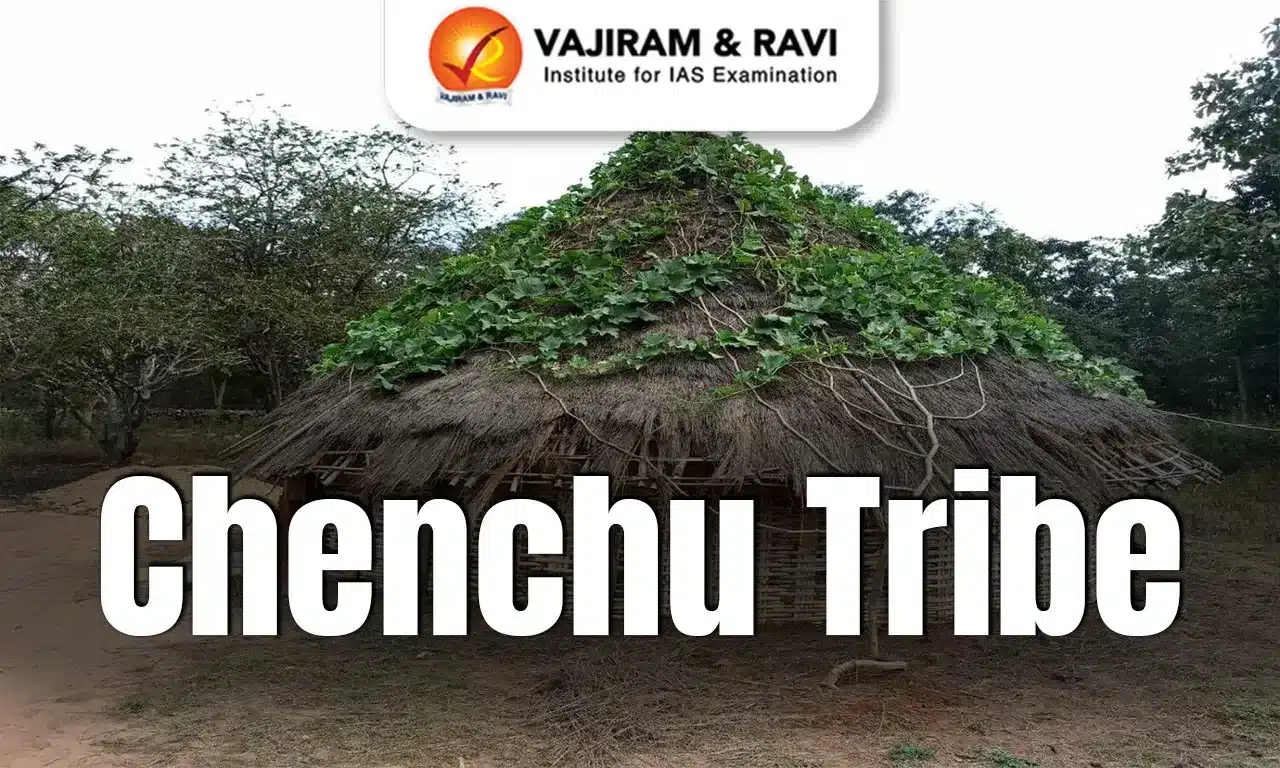
  • The Chenchus are a food-gathering tribe primarily residing in the Nallamalai forests of Andhra Pradesh.
  • They are one of the Particularly Vulnerable Tribal Groups (PVTGs) in Andhra Pradesh.
  • They are also found in Telangana, Karnataka, and Odisha.
  • Language: They speak variants of Telugu, the Dravidian language of the region.
  • A Chenchu village is known as “Penta“. 
    • Each penta consists of a few huts that are spaced apart and are grouped together based on kinship patterns. 
  • Small conjugal families predominate, women taking equal rank with men and marrying only upon maturity.
  • Peddamanishi” or the village elder, is generally the authority to maintain social harmony in a family or a village. 
  • Their rituals are few and simple; religious and political specializations are slight. 
  • Livelihood
    • The Chenchu live life with exemplary simplicity.  Most of them still gather food from the forest and roam in it to find things to meet their needs.
    • The bow and arrow and a small knife are all the Chenchus possess to hunt and live.
    • The Chenchus collect forest products like roots, fruits, tubers, beedi leaf, mohua flower, honey, gum, tamarind, and green leaves and make a meagre income from it by selling these to traders and government cooperatives.
    • Though at times they work as forest labourers, they mostly prefer to fall back on their native skills to hunt and gather food.
    • The Chenchus do not care much for money or material wealth.
  • Religion:
    • Chenchus worship a number of deities. Chenchus have also adopted certain religious practices from Hindus.
    • For ages, the Chenchus have been associated with the famous Srisailam temple (dedicated to Lord Shiva and Devi Brahmaramba) in Andhra Pradesh, situated at the heart of Chenchu land.
    • The Chenchus enjoy special privileges at Srisailam temple.

Source: TH

Chenchu Tribe FAQs

Q1: The Chenchu tribe primarily resides in which region?

Ans: Nallamalai forests of Andhra Pradesh.

Q2: What language do the Chenchus primarily speak?

Ans: They speak variants of Telugu, the Dravidian language of the region.

Q3: What is the primary livelihood of the Chenchu tribe?

Ans: Hunting and food gathering.

Q4: With which famous temple are the Chenchus historically associated?

Ans: Srisailam temple (dedicated to Lord Shiva and Devi Brahmaramba) in Andhra Pradesh.

Bar-Headed Goose

Bar-Headed Goose

Bar-Headed Goose Latest News

In a first-of-its kind study in eastern India, a bar-headed goose fitted with a GSM-GPS transmitter has revealed its migration route and flying pattern.

About Bar-Headed Goose

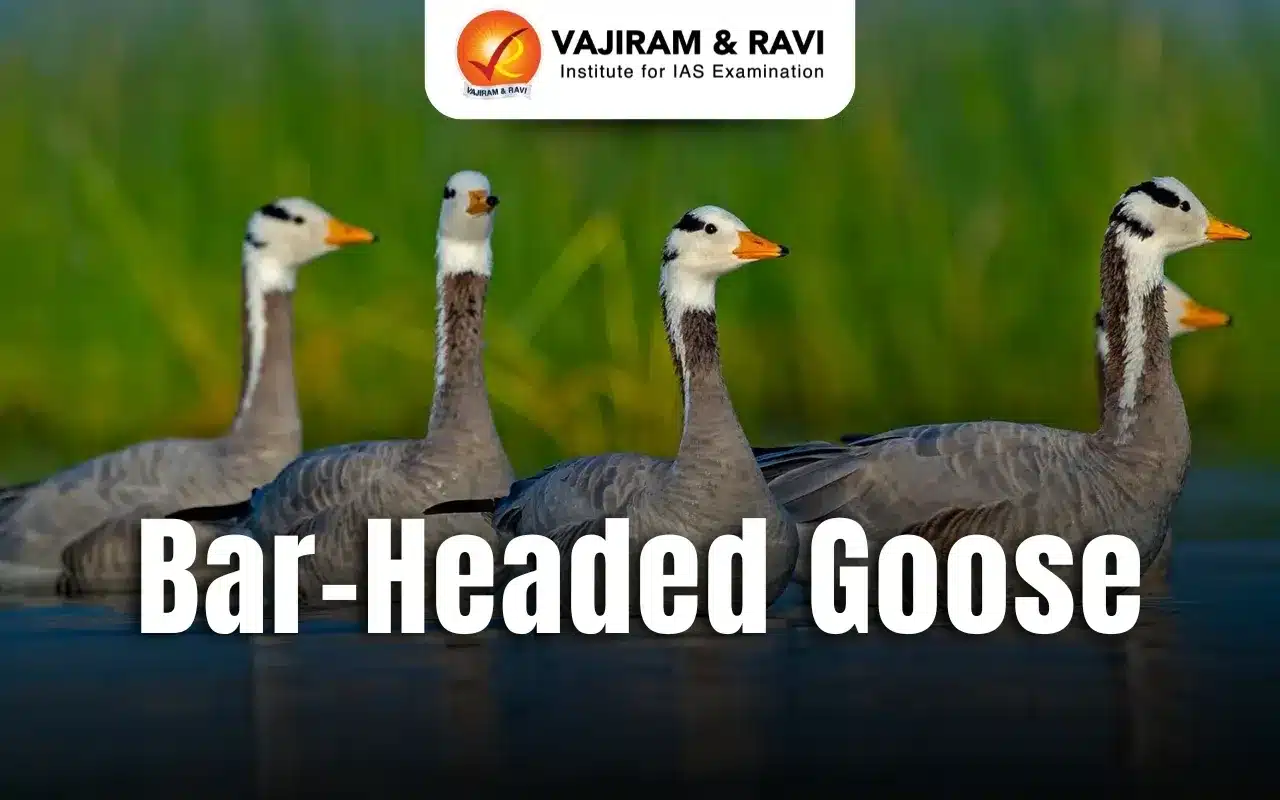
  • It is a migratory bird species which is known to be one of the highest-flying birds in the world. 
  • It can fly at altitudes of 25,000 feet, while migrating over the Himalayas, where oxygen and temperature levels are extremely low.
  • Distribution:  It is native to central Asia, where the species breeds, Bar-headed Geese, are found in countries like India, Pakistan, Nepal, Kazakhstan, Bangladesh, Myanmar, Japan, and other nearby regions. 
    • In India, their geographical range extends from the northeast to the southern parts of the country.
  • Habitat: They reside near water bodies, preferring high-altitude lakes during the breeding season and freshwater lakes, rivers, and streams in their wintering habitats. 
  • Features of Bar-Headed Goose
    • This species is gray and white with two horseshoe-shaped, brownish-black bars on the back of its white head. 
    • Although male and female birds appear similar, the male bird is slightly larger than the female.
    • They usually form monogamous pairs and are seasonal breeders.
  • Conservation Status: It is classified as ‘Least Concern’ under the IUCN Red List.

Source: DTE

Bar-Headed Goose FAQs

Q1: What is the scientific name of the Bar-Headed Goose?

Ans: Anser indicus

Q2: What is the conservation status of the Bar-Headed Goose?

Ans: Least Concern

Death Valley National Park

Death Valley National Park

Death Valley National Park Latest News

After record-breaking rains, an ancient lake in Death Valley national park that had vanished has returned to view.

About Death Valley National Park

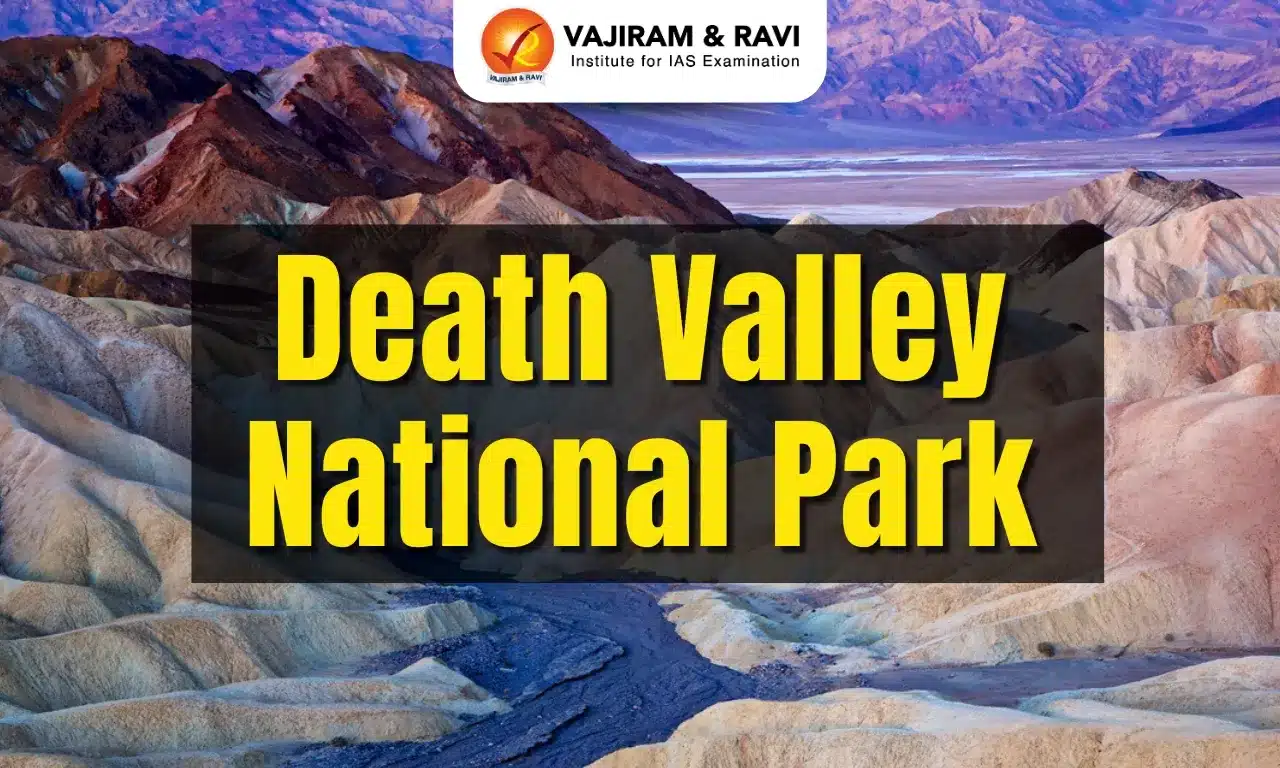
  • It is a desert valley located in the southeastern part of California, United States.
  • It is the hottest and driest place in North America, with summer temperatures peaking above 120 degrees and average rainfall a mere two inches per year.
  • It is the location of the highest temperature (134°F on July 10, 1913) ever recorded in the United States.
  • Also extreme are the park’s elevations: Badwater Basin rests at 282 feet below sea level (the lowest area in North America), while Telescope Peak soars to 11,049 feet. 
  • It is the largest national park in the continental United States.
  • It is a rift valley, or a graben, that has been formed due to the sinking of a huge expanse of rock located between major block-faulted mountains running parallelly in the east and west.
  • It lies in the Great Basin to the east of the Sierra Nevada Mountains, in the northern part of the Mojave Desert.
  • Death Valley hosts landscapes ranging from snow-covered mountains and dunes to wildflower-filled meadows and steep, rugged canyons.
  • Despite the low precipitation and extreme summer temperatures, Death Valley is home to many diverse species, several of which are endemic (found nowhere else in the world).

Source: TG

Death Valley National Park FAQs

Q1: Death Valley National Park is located in which country?

Ans: United States of America

Q2: Why is Death Valley National Park famous climatically?

Ans: It is the hottest and driest place in North America.

Q3: Which is the highest peak within Death Valley National Park?

Ans: Telescope Peak, with an elevation of 11,049 feet.

Q4: How was Death Valley formed geologically?

Ans: By the sinking of a block of land between parallel block-faulted mountain ranges.

Enquire Now