Primary Sclerosing Cholangitis (PSC)

Primary Sclerosing Cholangitis (PSC)

Primary Sclerosing Cholangitis (PSC) Latest News

A new monoclonal antibody treatment has shown promising results for a rare liver disease called primary sclerosing cholangitis (PSC).

About Primary Sclerosing Cholangitis (PSC)

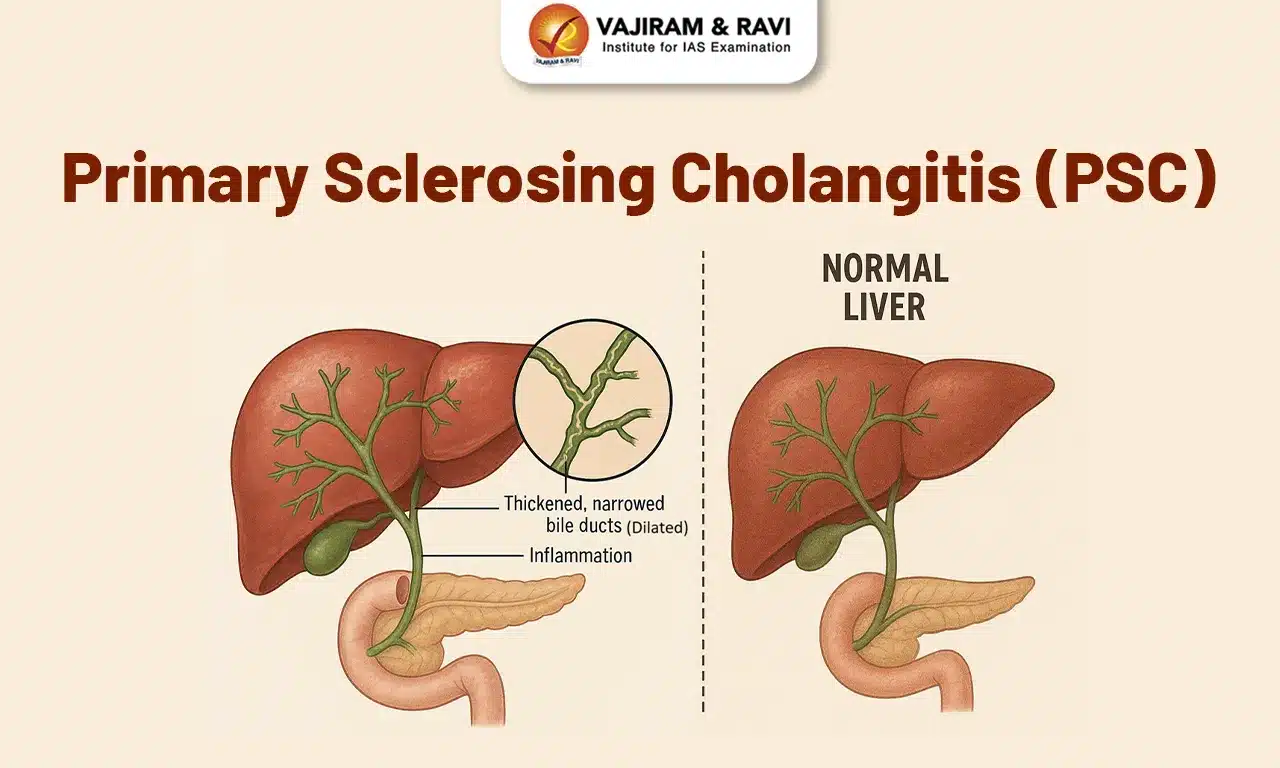
  • It is a rare, long-term disease of the liver caused by inflammation of tubes in the liver called bile ducts.
    • These ducts carry bile (a fluid that helps to digest fats) from the liver, where bile is produced, to the gallbladder, where it is stored, and to the small intestine, where it aids in digestion.
  • Scarring and narrowing of bile ducts leads to liver damage. 
  • Over time, the liver loses its ability to filter blood and support digestion.
  • People with PSC are at higher risk of liver failure and cancers of the bile ducts, gallbladder, and colon. 
  • Causes: It’s not entirely clear what causes PSC, but it appears to involve a combination of factors, including:
    • Genetics
    • Immune system problems
    • Changes to the bacteria in your gut microbiome
    • Environmental factors
  • Symptoms
    • Symptoms of PSC develop slowly. You may have PSC for many years without any symptoms. 
    • After symptoms develop, they may come and go. But they often get worse over time. 
    • Bile that backs up into your liver may over time cause a type of liver scarring known as cirrhosis. This leads to liver failure. 
    • Symptoms of PSC include:
      • Itchy skin.
      • Extreme tiredness (fatigue).
      • Belly pain.
      • Yellowing of the skin and eyes, called jaundice.
      • Chills and fever from infection of your bile ducts.
  • Treatment
    • Care focuses on monitoring liver health and managing symptoms. 
    • Procedures can temporarily open blocked ducts, but liver transplant is the only cure for advanced disease.
    • Median survival from the time of diagnosis to death without liver transplantation is around 10 years.

Source: NDTV

Primary Sclerosing Cholangitis (PSC) FAQs

Q1: What is Primary Sclerosing Cholangitis (PSC)?

Ans: It is a rare, long-term disease of the liver caused by inflammation of tubes in the liver called bile ducts.

Q2: Primary Sclerosing Cholangitis (PSC) primarily affects which structure in the body?

Ans: Bile ducts

Q3: Which complication occurs when bile backs up into the liver?

Ans: Cirrhosis

Q4: What is the only cure for advanced Primary Sclerosing Cholangitis (PSC)?

Ans: Liver transplant.
Bezymianny Volcano

Bezymianny Volcano

Bezymianny Volcano Latest News

The Bezymianny volcano that once blew itself apart in a massive explosion is now rising from the ashes—faster than scientists expected.

About Bezymianny Volcano

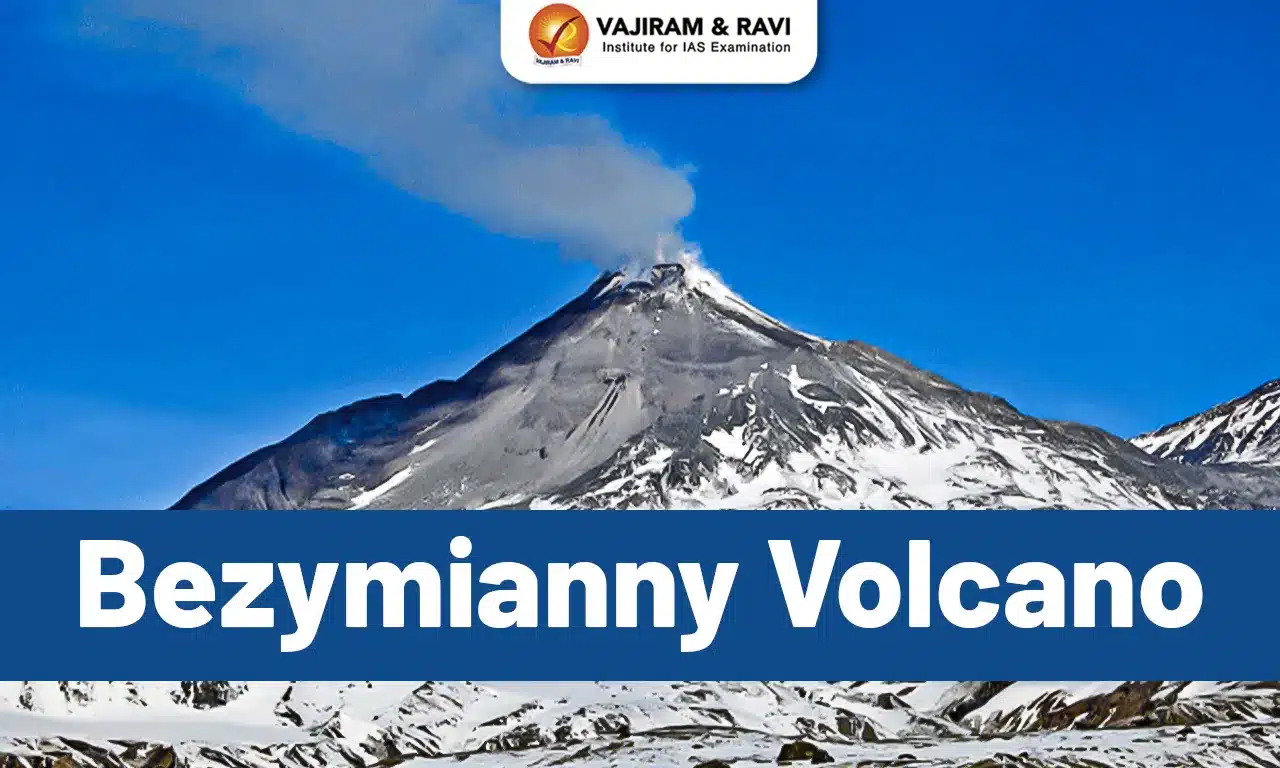
  • It is a cone-shaped stratovolcano on the Kamchatka Peninsula in the Russian Far East. 
  • It is located on the southeast slope of the extinct volcano Kamen. These two volcanoes are separated by a high, narrow saddle.
  • The east and west slopes of Bezymianny are cut by two wide and sloping valleys. 
  • Several lava flows can be found on the upper portions of its slopes. 
  • Lower in elevation, a row of domes exists along the southern and western sides of the volcano.
  • It has had eruptions since 1955 characterized by dome growth, explosions, pyroclastic flows, ash plumes, and ashfall.  
  • Bezymianny’s 1956 eruption was one of the most significant explosive events of the 20th century.
  • But instead of going quiet, the volcano began to recover almost immediately.  Since then, ongoing eruptions, mostly small to moderate in scale, have contributed to a near-continuous process of rebuilding.

Key Facts about Stratovolcano

  • It is a tall, steep, and cone-shaped type of volcano.
  • Unlike flat shield volcanoes, they have higher peaks.
  • They are typically found above subduction zones, and they are often part of large volcanically active regions, such as the Ring of Fire that frames much of the Pacific Ocean.
  • Stratovolcanoes comprise the largest percentage (~60%) of the Earth’s individual volcanoes, and most are characterized by eruptions of andesite and dacite, lavas that are cooler and more viscous than basalt.
  • These more viscous lavas allow gas pressures to build up to high levels. Therefore, these volcanoes often suffer explosive eruptions. 
  • They are usually about half-half lava and pyroclastic material, and the layering of these products gives them their other common name of composite volcanoes.
  • At the peak, stratovolcanoes usually have a small crater.

Source: IDR

Bezymianny Volcano FAQs

Q1: Where is Bezymianny Volcano located?

Ans: It is located on the Kamchatka Peninsula in the Russian Far East.

Q2: Bezymianny is situated on the southeast slope of which extinct volcano?

Ans: It is located on the southeast slope of the extinct volcano Kamen.

Q3: What type of volcano is Bezymianny?

Ans: It is a cone-shaped stratovolcano.

Q4: When did Bezymianny begin its modern eruptive activity?

Ans: 1955

Haka Dance

Haka Dance

Haka Dance Latest News

A Sikh Nagar Kirtan or religious procession in South Auckland, New Zealand, was protested in the form of a traditional tribal “haka” dance recently.

About Haka Dance

  • It is a traditional dance of the indigenous Māori people of New Zealand. 
  • It is known for its powerful energy, fierce facial expressions (pukana), and physical movements like stamping, hand gestures, and chanting. 
  • Haka varies by tribal region, with many haka telling the story of significant events in a tribe’s history. 
  • Traditionally, the haka was performed for war, to celebrate achievements, or to welcome guests. 
  • Today, it is performed at important occasions like sporting events, weddings, and funerals.
  • It symbolizes tribal pride, strength, and unity.
  • It became known to the world at large when, in the early 20th century, it was incorporated into the pregame ritual of New Zealand’s national rugby union team, the All Blacks.
  • It also made headlines globally in November 2024 when two lawmakers used Haka to protest against a bill in the New Zealand parliament.

Source: IE

Haka Dance FAQs

Q1: What is the Haka dance?

Ans: It is a traditional dance of the indigenous Māori people of New Zealand.

Q2: For what occasions was the Haka traditionally performed?

Ans: Traditionally, it was performed for war, to celebrate achievements, or to welcome guests.

Q3: What does the Haka symbolize?

Ans: The Haka symbolizes tribal pride, strength, and unity.

Q4: Which sports team popularized the Haka internationally in the early 20th century?

Ans: The New Zealand national rugby union team, the All Blacks, popularized the Haka internationally.

K-4 Missile

K-4 Missile

K-4 Missile Latest News

India tested an intermediate-range ballistic missile called K-4, which is designed to hit targets 3,500-km away, from the nuclear-powered submarine INS Arighaat in the Bay of Bengal recently.

About K-4 Missile

  • Kalam-4 or K-4 Missile, is a nuclear-capable intermediate-range submarine-launched ballistic missile (SLBM) designed mainly for deployment on Arihant-class submarines.
  • Each Arihant-class submarine can carry four K-4 missiles. 
  • K-4 was indigenously developed by the Defence Research and Development Organisation (DRDO).

K-4 Missile Features

  • The 12-metre-long missile weighing 17 tonnes has a two-stage solid-fuel system. 
  • It has a range of around 3,500 km. It is a major improvement over the older K-15 missile, which had a much shorter range of only 750 kilometers.
  • Payload: Up to 2 tons, including a nuclear warhead.
  • One of its key features is its ability to be cold-launched from underwater, which allows the missile to be ejected from the submarine before the engine ignites.
  • It is guided by an advanced inertial navigation system supported by GPS and India’s NavIC system.
  • This combination ensures high accuracy, with a reported circular error probable of less than 10 metres. 
  • The missile is also equipped with manoeuvring features that help it evade missile defence systems.

Source: TOI

K-4 Missile FAQs

Q1: What type of missile is the K-4?

Ans: The K-4 is a nuclear-capable submarine-launched ballistic missile (SLBM).

Q2: Which organisation developed the K-4 missile?

Ans: It was developed by the Defence Research and Development Organisation (DRDO).

Q3: On which class of submarines is the K-4 primarily deployed?

Ans: The K-4 is designed for deployment on Arihant-class submarines.

Q4: What is the range of the K-4 missile?

Ans: The K-4 missile has a range of approximately 3,500 km.

Thanjavur Painting

Thanjavur Painting

Thanjavur Painting Latest News

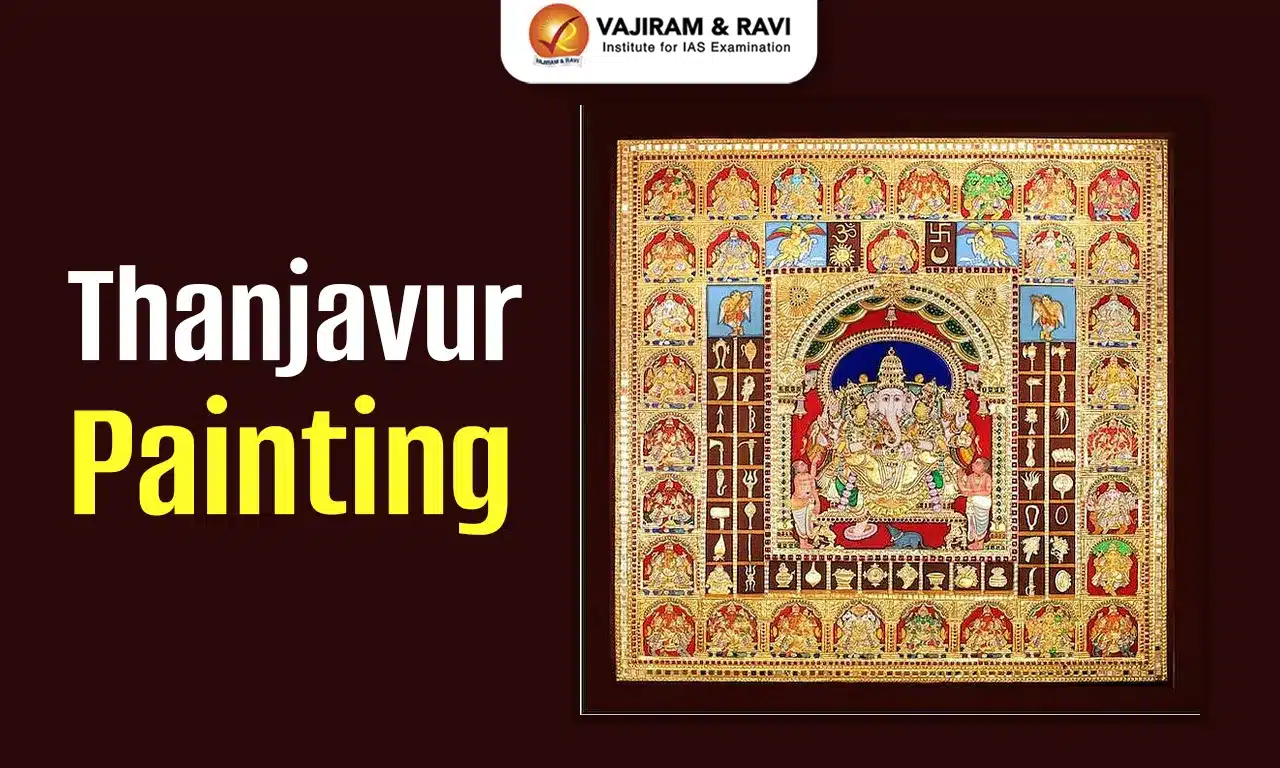
Recently, the Department of Posts successfully undertook the transmission of a priceless Thanjavur painting of the Shri Ram from Bengaluru to Ayodhya using its Logistics Post service.

About Thanjavur Painting

  • It is a classical South Indian art form originating in the town of Thanjavur (Tanjore), Tamil Nadu, around 1600 AD.
  • Tanjore or Thanjavur paintings are created on wooden panels, commonly known as palagai padam.
  • It flourished under the Nayakas of Thanjavur.
  • It has received the Geographical Indication tag.

Features of Thanjavur Painting

  • Tanjore paintings are traditionally created on canvas affixed to wooden planks, typically made from jackfruit or teak, and bound with Arabic gum.
  • Rich Colors:    These paintings are known for their vibrant colors. They often use bright shades of red, blue, green, and gold leafwork to create an opulent effect.
  • Gesso Work: One of the unique features of Tanjore paintings is the use of gesso work. Gesso is a mixture of chalk, gypsum, and glue applied to the surface to create embossed patterns and motifs.
  • Theme: Tanjore paintings typically depict Hindu gods and goddesses, especially figures like Lord Krishna, Lord Ganesha, and Goddess Lakshmi.
  • Gold Leaf: Gold foil or leaf is extensively used in Tanjore paintings to embellish the artwork.

Source: PIB

Thanjavur Painting FAQs

Q1: Thanjavur Painting is a classical art form from which state?

Ans: Tamil Nadu

Q2: What is a distinctive feature of Thanjavur Paintings?

Ans: Use of gold leaf and precious stones

Samudra Pratap

Samudra Pratap

Samudra Pratap Latest News

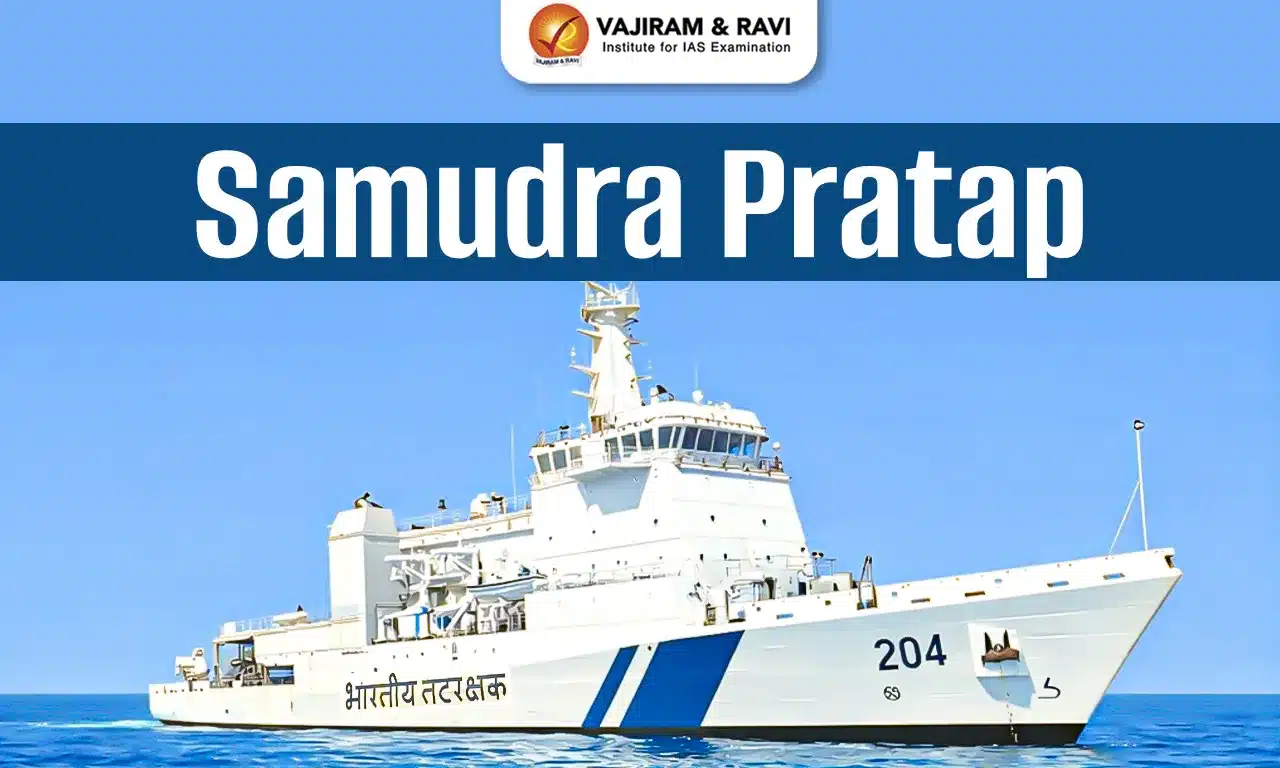
Recently, the Indian Coast Guard inducted the first in-built Pollution Control Vessel (PCV), Samudra Pratap under the 02 PCV project of Goa Shipyard Limited.

About  Samudra Pratap

  • It is the first indigenously designed and built Pollution Control Vessel of the Indian Coast Guard.
  • It is the largest ship in the ICG fleet, significantly enhancing the Coast Guard’s operational reach and capability.

Features of Samudra Pratap

  • Capacity: It has a displacement capacity of 4,170 tonnes.
  • Armament: The vessel is equipped with state-of-the-art technology, including a 30mm CRN-91 gun, two 12.7mm stabilised remote-controlled guns with integrated fire control systems.
  • Advanced Systems: It consists of Integrated Bridge System, Integrated Platform Management System, Automated Power Management System, and a high-capacity external firefighting system.
  • It is the first Indian Coast Guard ship to be equipped with Dynamic Positioning capability (DP-1), with FiFi-2 / FFV-2 notation certificate.
  • It is equipped with advanced systems to detect oil spills.
  • It is capable of high precision operations, recover pollutants from viscous oil, analyse contaminants, and separate oil from contaminated water.

Source: PIB

Samudra Pratap FAQs

Q1: What is Samudra Pratap?

Ans: A Pollution Control Vessel of the Indian Coast Guard

Q2: Where was Samudra Pratap built?

Ans: Goa Shipyard Limited, Goa

Teesta River

Teesta River

Teesta River Latest News

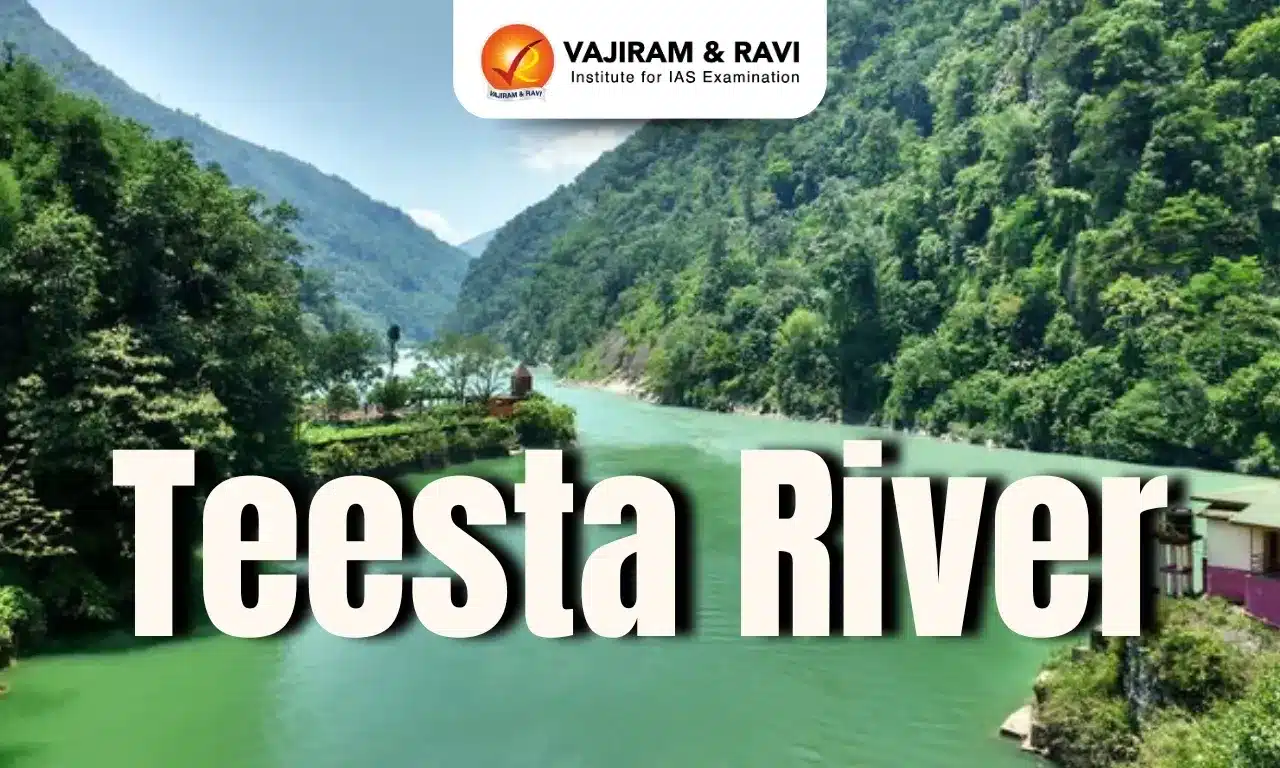
An army jawan died after a raft capsized in the Teesta River during a training exercise in Sikkim’s Pakyong district recently.

About Teesta River

  • It is a major tributary of the Brahmaputra River (known as the Jamuna in Bangladesh) and flows through India and Bangladesh.
  • Course
    • It originates from the Tso Lhamo Lake at an elevation of approximately 5,280 meters in North Sikkim, India.
    • It then flows to the south, cutting a deep gorge through the Siwalik Hills east of Darjiling (in West Bengal, India).
    • It turns southeast to run through the Sivok Khola pass onto the plains of West Bengal.
    • It then enters Bangladesh, where it joins the Brahmaputra River (known as the Jamuna River in Bangladesh). 
    • It is glacier-fed, with sources like Pahurni Glacier, Khangse Glacier, and ChhoLhamo Lake contributing to its flow.
  • Length: The river spans approximately 414 kilometers.
  • Notably, 83% of the basin lies in India, while 17% is in Bangladesh.
  • Tributaries: Major tributaries include Lachung Chhu, Dik Chhu, and Rangpo Chhu on the left bank and the Rangit River on the right bank.
  • Hydroelectric Projects and Barrages:
    • In India:
      • Teesta-V Dam: 510 MW, located in Gangtok district, Sikkim.
      • Teesta-III Dam: 1,200 MW, situated in Mangan district, Sikkim.
      • Teesta Low Dam III & IV: 132 MW and 160 MW, respectively, both in Kalimpong district, West Bengal.
      • Gajoldoba Barrage: Primarily for irrigation purposes in West Bengal.
    • In Bangladesh:
      • Duani Barrage: Used mainly for irrigation in Bangladesh.
      • Barakhata Teesta Barrage: Another significant irrigation infrastructure.
  • The Teesta River is famous for water sports like whitewater river rafting.

Source: TELE

Teesta River FAQs

Q1: The Teesta River is a major tributary of which river?

Ans: Brahmaputra

Q2: Where does Teesta River originates from?

Ans: It originates from the Tso Lhamo Lake at an elevation of approximately 5,280 meters in North Sikkim, India.

Q3: The Teesta River flows through which countries?

Ans: It flows through India and Bangladesh.

Q4: What is the total length of the Teesta River?

Ans: 414 km

PM-SETU Scheme

PM-SETU Scheme

PM-SETU Scheme Latest News

Recently, the Ministry of Skill Development and Entrepreneurship has invited industry leaders to participate in the PM-SETU scheme.

About PM-SETU Scheme

  • Pradhan Mantri Skilling and Employability Transformation through Upgraded ITIs (PM-SETU) is a Centrally Sponsored Scheme launched to strengthen India’s vocational training ecosystem.
  • It aims to modernise the ITI ecosystem by upgrading 1000 government ITIs across India into modern, industry-aligned training institutions
  • Implementation: It is implemented as a hub-and-spoke model, with 200 hub ITIs linked to 800 spoke ITIs.
  • Each hub will be equipped with advanced infrastructure, innovation and incubation centres, production units, training of trainer facilities, and placement services, while the spokes will extend access and outreach. 
  • Financial outlay:  ₹60,000 crore, over a five- year period.
  • Nodal Ministry: Ministry of Skill Development and Entrepreneurship

Components of PM-SETU Scheme

  • Introduce new, demand-driven courses and revamp existing ones in collaboration with industry;
  • Special Purpose Vehicles: Set up Special Purpose Vehicles (SPVs) with credible Anchor Industry Partners to manage clusters and ensure outcome-based training;
  • Create pathways for long-term diplomas, short-term courses, and executive programs;
  • Strengthen 5 National Skill Training Institutes in – Bhubaneswar (Odisha), Chennai (Tamil Nadu), Hyderabad (Telangana), Kanpur (Uttar Pradesh), Ludhiana (Punjab), as Centres of Excellence with global partnerships.
  • The initiative is backed by global co-financing from the World Bank and Asian Development Bank.

Source: News On Air

PM-SETU Scheme FAQs

Q1: What is the budget allocation for PM-SETU Scheme?

Ans: ₹60,000 crore

Q2: What is the full form of PM-SETU Scheme?

Ans: Pradhan Mantri Skilling and Employability Transformation through Upgraded ITIs

Long-Billed Vulture

Long-Billed Vulture

Long-Billed Vulture Latest News

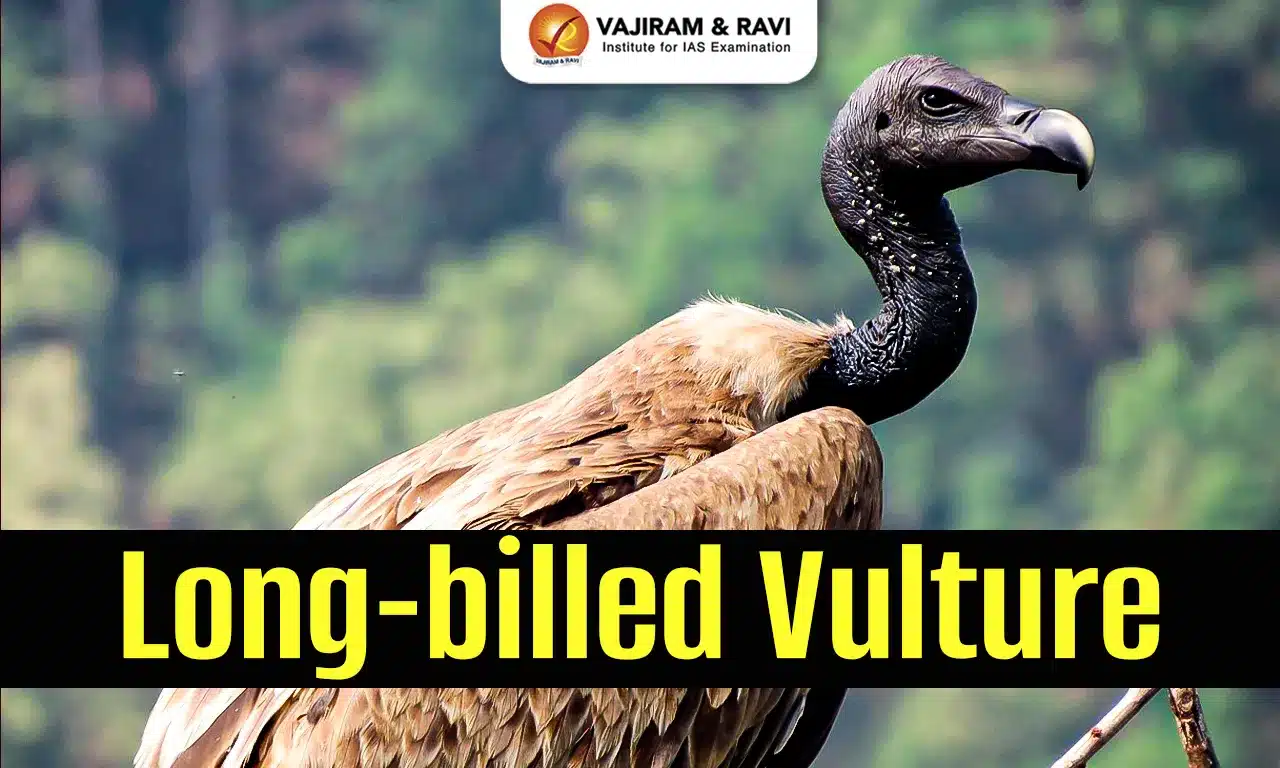
Recently, the Bombay Natural History Society (BNHS), along with the Maharashtra Forest Department, successfully carried out the tagging of 15 long-billed vultures at Melghat Tiger Reserve.

About Long-Billed Vulture

  • It is an old World vulture native to the Asian region.
  • They are also known as Indian long-billed vultures due to their comparatively longer beak. 
  • Appearance: It is a medium-sized and bulky scavenger feeding mostly on the carcasses of dead animals.
  • Females of this species are smaller than males.
  • Habitat: They are usually found in savannas and other open habitats around villages, cities, and near cultivated areas.
  • Distribution: These are native to India, Pakistan, and Nepal.
  • Conservation status: IUCN Red List: Critically Endangered

Key Facts about Melghat Tiger Reserve

  • Location: It is located in the Amaravati district of Maharashtra, specifically on the Gavilgarh Hill, a southern offshoot of the Satpura Hill Range in Central India.
  • Vegetation: The forest is tropical dry deciduous in nature, dominated by teak.
  • Rivers: The reserve is a catchment area for five major rivers: the Khandu, Khapra, Sipna, Gadga, and Dolar, all of which are tributaries of the river Tapti.
  • The Tapti River and the Gawilgadh ridge of the Satpura Range form the boundaries of the reserve.
  • Tribes: The Korkus are the largest tribal community in Melghat. Other communities include the Gawli community and the Gond tribe etc.
  • Flora: Some of the common species are teak, Lagerstroemia Parviflora, Terminalia Tomentosa, Ougeinia Oojeinensis, Emblica Officinalis, Bamboo, etc.
  • Fauna: It includes Sloth Bear, Indian Gaur, Sambar deer, Leopard, Nilgais, dhole, hyena, jungle cat, langur, etc.

Source: DH

Long-billed Vulture FAQs

Q1: What is the scientific name of the Long-billed Vulture?

Ans: Gyps indicus

Q2: What is the main threat to Long-billed Vulture populations?

Ans: Diclofenac poisoning

Pradhan Mantri Rashtriya Bal Purask

Pradhan Mantri Rashtriya Bal Purask

Pradhan Mantri Rashtriya Bal Puraskar Latest News

President of India to confer the Pradhan Mantri Rashtriya Bal Puraskar (PMRBP) to children who have demonstrated outstanding achievements in diverse fields on 'Veer Bal Diwas'.

About Pradhan Mantri Rashtriya Bal Puraskar

  • It is a prestigious national honour conferred annually by the Government of India.
  • It is awarded to children for exceptional excellence in Bravery, Art & Culture, Environment, Social Service, Science & Technology, and Sports.
  • The Pradhan Mantri Rashtriya Bal Puraskar organized by the Ministry of Women and Child Development Government of India.

Eligibility for Pradhan Mantri Rashtriya Bal Puraskar

  • A child should be an Indian Citizen.
  • Age: A child above the age of 5 years and not exceeding 18 years (as of 31st July of respective year).
  • The act/incident/achievement should have been within 2 years of the last date of receipt of application/nomination for the year of consideration.
  • The number of Awards will be 25, however, any relaxation to this maximum number may be permitted at the discretion of the National Selection Committee.
  • Each awardee will receive a medal, certificate and citation booklet.

Source: PIB

Pradhan Mantri Rashtriya Bal Puraskar FAQs

Q1: What is Pradhan Mantri Rashtriya Bal Puraskar?

Ans: India's highest civilian honor for children

Q2: Who is eligible for Pradhan Mantri Rashtriya Bal Puraskar?

Ans: Children aged 5-18 years

Enquire Now