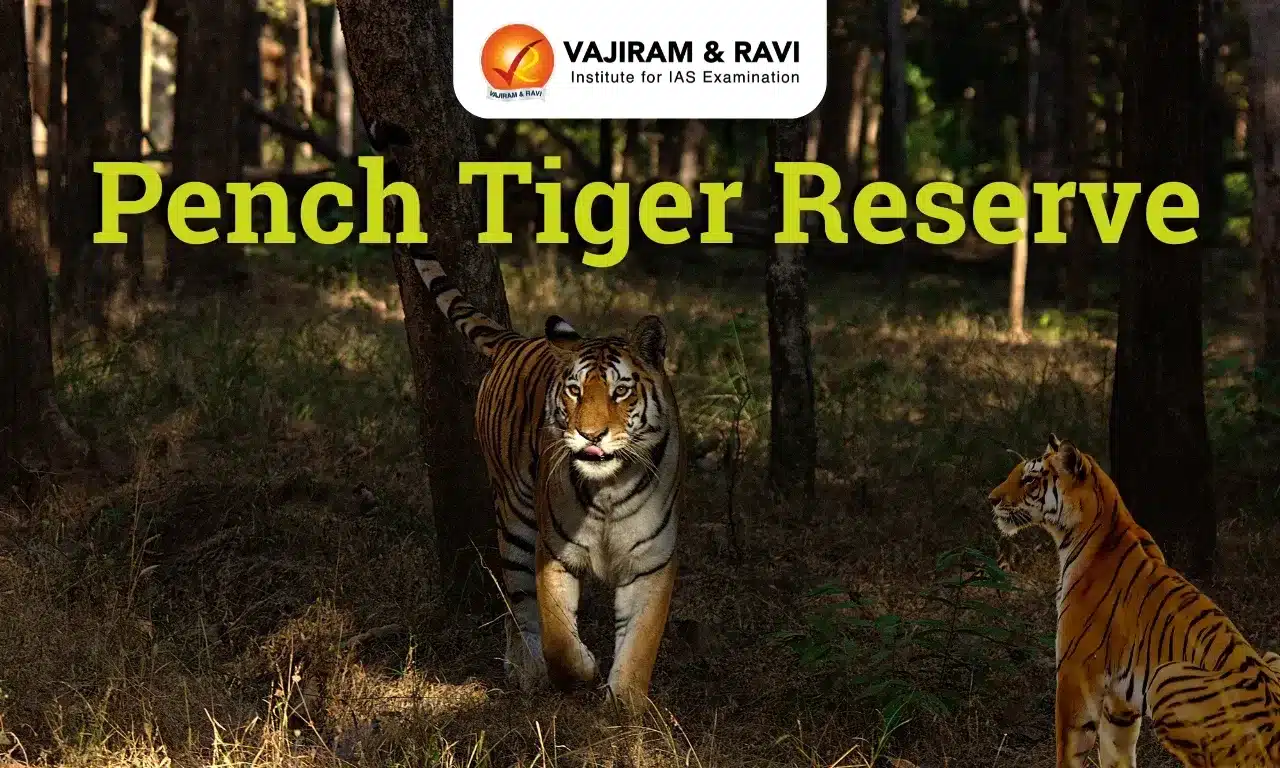
Pench Tiger Reserve

Pench Tiger Reserve (UPSC)

Pench Tiger Reserve Latest News

Recently, researchers released the long-billed vulture named J132 in the Pench Tiger Reserve in Maharashtra.

About Pench Tiger Reserve

  • Location: It is located in the southern reaches of the Satpura hills in the Seoni and Chhindwara districts in Madhya Pradesh and shares the southern boundary with Maharashtra.
  • In 1983, it was declared a National Park, and in 1992, a tiger reserve.
  • It derives its name from its life line-the River Pench which flows from North to South.
  • It comprises the Indira Priyadarshini Pench National Park, the Pench Mowgli Sanctuary, and a buffer.
  • Vegetation: The forests in Pench tiger reserve are classified into three types:
    • South Indian Tropical Moist Deciduous (slightly moist)
    • Southern Tropical Dry Deciduous Teak Forests and
    • Southern Dry Mixed Deciduous Forest
  • Flora: The reserve boasts a diverse range of flora, including teak, saag, mahua, and various grasses and shrubs.
  • Fauna: The area is especially famous for large herds of Chital, Sambar, Nilgai, Gaur (Indian Bison), and wild boar.

Source: IE

Pench Tiger Reserve FAQs

Q1: Pench Tiger Reserve is named after which river?

Ans: Pench River

Q2: Which famous fictional character is associated with Pench Tiger Reserve?

Ans: Mowgli

YJ-20 Hypersonic Missile

YJ-20 Hypersonic Missile

YJ-20 Hypersonic Missile Latest News

China recently released a rare footage of a YJ-20 hypersonic anti-ship missile fired from a Type 055 warship.

About YJ-20 Hypersonic Missile

  • The YJ-20, also known as the Eagle Strike-20, is a hypersonic anti-ship missile developed by China.
  • It was first publicly displayed during China’s Victory Day military parade on September 3, 2025.
  • It is designed to target high-value naval assets at extended ranges.

YJ-20 Hypersonic Missile Features

  • It has a distinctive biconic aerodynamic form, a configuration that supports controlled glide at sustained hypersonic speeds after the initial rocket boost. 
  • This shape is essential for generating protective shockwaves that shield the control surfaces from heat during high-velocity flight.
  • Regional military assessments place the missile’s range between 1,000 and 1,500 km with cruising speeds above Mach 6. 
  • The terminal flight path appears designed to allow a near-vertical descent combined with sharp lateral manoeuvres, a profile intended to compress defender reaction times and disrupt prediction models used by shipborne interceptors.
  • It is capable of being launched from multiple platforms, including the Type 055 Renhai-class destroyers and H-6K strategic bombers, offering operational flexibility across maritime and continental strike missions.

Source: TOI

YJ-20 Hypersonic Missile FAQs

Q1: Which country developed the YJ-20 hypersonic missile?

Ans: China

Q2: What is the primary role of the YJ-20 hypersonic missile?

Ans: It is designed as a hypersonic anti-ship missile targeting high-value naval assets.

Q3: What type of aerodynamic form does the YJ-20 hypersonic missile use?

Ans: A biconic aerodynamic form.

Q4: What is the estimated range of the YJ-20 hypersonic missile?

Ans: Between 1,000 and 1,500 km.

Rohtasgarh Fort

Rohtasgarh Fort

Rohtasgarh Fort Latest News

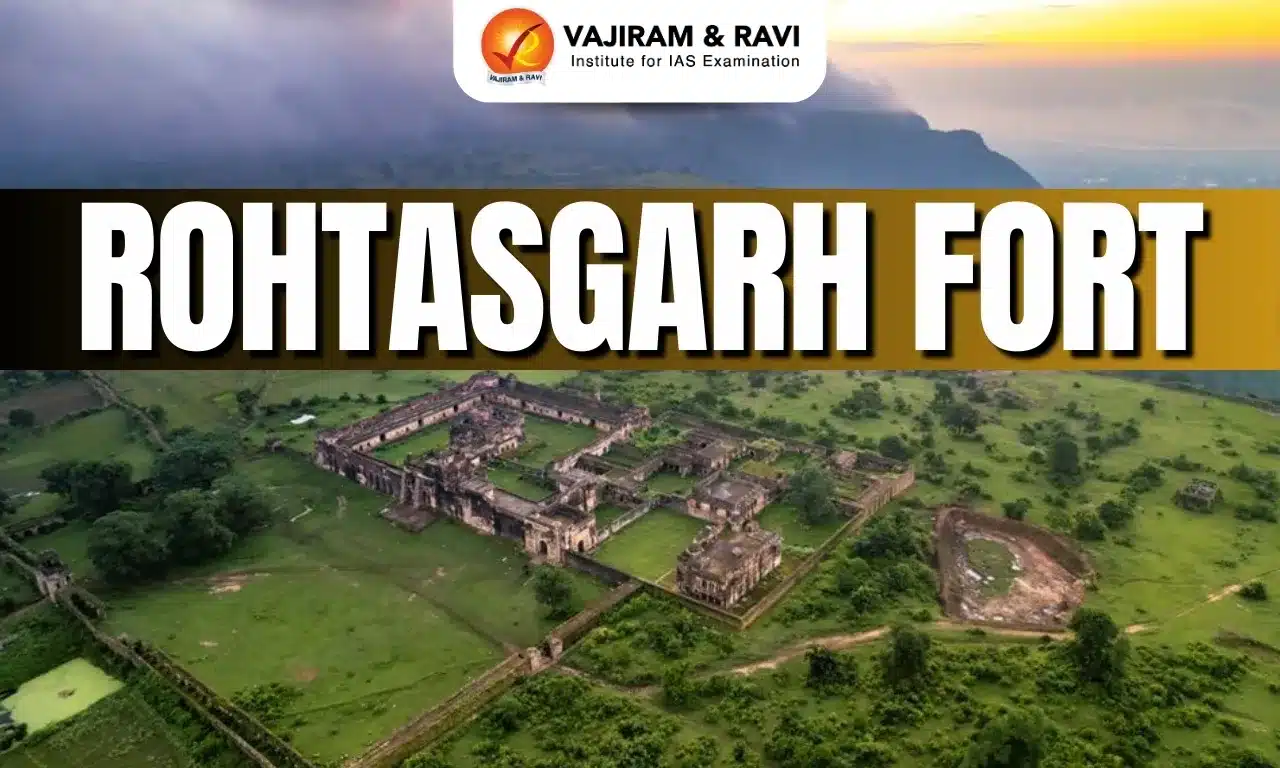
An under-construction ropeway being built to improve access to the historic Rohtasgarh Fort in Bihar’s Rohtas district collapsed during a trial run recently.

About Rohtasgarh Fort

  • The Rohtasgarh Fort, also known as Rohtas Fort, is located in the city of Rohtas on the banks of the Sone River in Bihar. 
  • It is one of the largest forts not only in India but in the whole world and is spread over a radius of 26 miles. 
  • It is situated on the top of a hill and is one of the most ancient forts in India, known for its large defensive walls and impressive architecture.
  • The hill on which the fort is situated has a height of 1500 m. 
  • The fort complex includes gates, palaces, temples, and reservoirs, showcasing Indo-Afghan architectural styles.

Rohtasgarh Fort History

  • The fort was built by the 36th ruler of the Solar dynasty, Raja Harishchandra. It was named after his son, Rohitashva.
  • Inscriptions at the fort suggest that the fort has passed through the hands of several empires, including the Hindu Shahis, the Ghurids, the Mughals, and eventually the British Raj.
  • Sher Shah Suri conquered the fort in 1539 after losing the Fort of Chunar to Humayun, a Mughal ruler. 
  • The fort, in its present form, was significantly strengthened by Sher Shah Suri. During his rule, the fort was guarded by 10,000 armed soldiers.
  • The Jama Masjid, built to the west of the fort by Haibat Khan (a close aide of Sher Shah), is made of white sandstone and completed in 1543.
  • Akbar acquired the fort in 1587 and gave it to Raja Maan Singh, who was appointed the Governor of Bihar. 
  • In the 16th century, Jahangir’s son, Prince Khurram, sought refuge at the fort. 
  • In the 17th century, Mir Kasim, the Nawab of Bengal, sought refuge at the fort after losing a battle against the British. 
  • However, the fort was handed over to British Captain Goddard by the Diwan of Rohtas, and the fort’s defenses were destroyed. 
  • The fort remained abandoned until 1857, during the First War of Independence, when Babu Kunwar Singh’s younger brother, Amar Singh, sought refuge there.
  • Finally, the British recaptured Rohtasgarh and soon abandoned it.

Source: IE

Rohtasgarh Fort FAQs

Q1: Where is the Rohtasgarh Fort located?

Ans: It is located in Rohtas district on the banks of the Sone River in Bihar.

Q2: After whom was the Rohtasgarh Fort named?

Ans: It was named after Rohitashva, the son of Raja Harishchandra.

Q3: Which architectural styles are reflected in the structures of Rohtasgarh Fort?

Ans: Indo-Afghan architectural styles.

Q4: Which ruler significantly strengthened the fort in its present form?

Ans: Sher Shah Suri.

Q5: Which Mughal prince sought refuge in Rohtasgarh Fort in the 16th century?

Ans: Prince Khurram (later Emperor Shah Jahan).

Legionnaire’s Disease

Legionnaire’s Disease

Legionnaires' Disease Latest News

A Legionnaires’ disease outbreak has prompted a health alert in Sydney’s central business district recently, with authorities urging people to remain vigilant for symptoms.

About Legionnaires' Disease

  • It is a severe form of a lung infection (pneumonia) caused by a bacterium known as legionella.
  • The disease got its name when a group of people at an American Legion convention became ill with this type of pneumonia in 1976.

Legionnaires' Disease Transmission

  • Legionella is found naturally in freshwater, such as lakes and rivers. It can also be found in soil. 
  • Most people who catch Legionnaires’ disease breathe in the bacteria from water or soil. 
  • You usually can’t get infected by drinking water that contains the bacteria unless you aspirate it (accidentally breathe the water into your lungs).
  • It is not contagious, meaning it is not spread from person to person.
  • Older adults, people with weakened immune systems, and people who smoke have a higher risk of getting Legionnaires’ disease.

Legionnaires' Disease Symptoms

  • Legionnaires’ disease causes pneumonia-like symptoms that start two to 14 days after exposure to Legionella. 
  • Patients usually present with fever, cough, shortness of breath, tiredness, headache, muscle pain, and may have gastrointestinal symptoms such as abdominal pain and diarrhoea. 
  • In severe cases, neurological symptoms (e.g., confusion) and respiratory failure may occur, and some cases may result in death.

Legionnaires' Disease Treatment

  • Treating right away with antibiotics most often cures Legionnaires’ disease.
  • But some people still have problems after treatment.
  • Currently, there is no vaccine available for LD.

Source: ET

Legionnaires' Disease FAQs

Q1: What is the Legionnaires' Disease?

Ans: It is a severe form of a lung infection (pneumonia).

Q2: What causes Legionnaires’ disease?

Ans: A bacterium called Legionella.

Q3: Where is Legionella commonly found in nature?

Ans: In freshwater sources such as lakes and rivers, and also in soil.

Q4: How do most people get infected with Legionnaires’ disease?

Ans: By breathing in Legionella-contaminated water droplets or soil particles.

Q5: Can Legionnaires’ disease spread from person to person?

Ans: No, it is not contagious.

Gas Hydrates

Gas Hydrates

Gas Hydrates Latest News

A reserve of natural gas bubbling from a cage of ice discovered on the ocean floor to the west of Greenland may be the deepest gas hydrate cold seep on record, and it happens to be teeming with animal life.

About Gas Hydrates

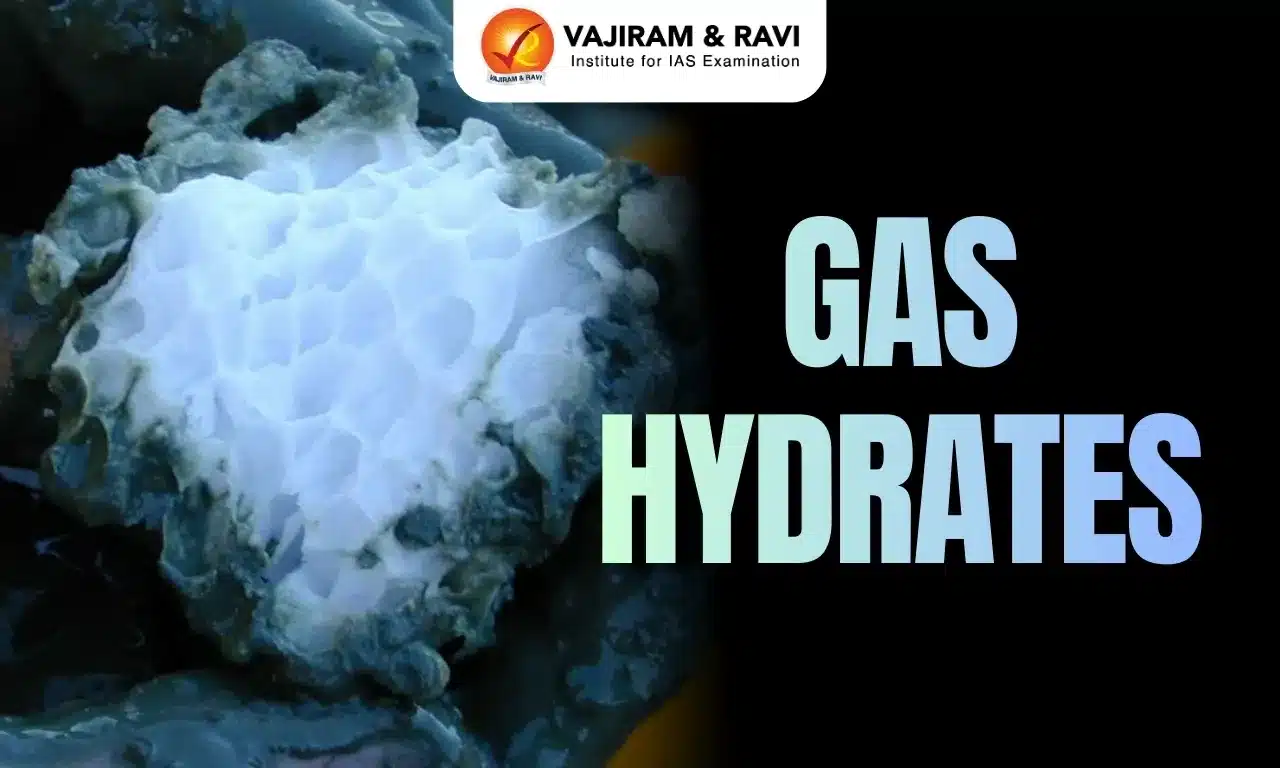
  • Gas hydrates are ice-like crystalline structures that form when a low-density gas, like methane, ethane, or carbon dioxide, combines but does not chemically bond with water and freezes into a solid under low temperature and moderate pressure conditions. 
  • Most gas hydrates are formed from methane (CH4), which has led to the terms “gas hydrate” and “methane hydrate” often being used interchangeably.
  • They are classified as clathrates, compounds formed by the inclusion of one molecule within cavities in the crystal lattice of another.  
    • A unique property of clathrates is the absence of chemical bonding, which makes it possible to separate them relatively easily. 
  • For example, when methane hydrates are warmed or depressurized, it will revert back to water and natural gas.
  • On Earth, gas hydrates occur naturally in some marine sediments and within and beneath permafrost. 
  • They are also speculated to form on other planets.
  • Gas Hydrates are important for a variety of reasons:
    • Gas hydrate deposits may contain roughly twice the carbon contained in all reserves of coal, oil, and conventional natural gas combined, making them a potentially valuable energy resource.
    • Their decomposition can release large amounts of methane, which is a greenhouse gas that could impact Earth’s climate.
    • Sudden release of pressurized methane gas may cause submarine landslides, which in turn can trigger tsunamis.
    • Gas hydrates in the ocean can be associated with unusual and possibly unique biological communities that use hydrocarbons or hydrogen sulfide for carbon and energy via a process known as chemosynthesis.

Source: SA

Gas Hydrates FAQs

Q1: What are gas hydrates?

Ans: Gas hydrate is a crystalline solid, its building blocks consist of a gas molecule surrounded by a cage of water molecules.

Q2: Which gas is most commonly involved in the formation of gas hydrates?

Ans: Methane is the most common gas involved in the formation of gas hydrates.

Q3: Where do gas hydrates occur naturally on Earth?

Ans: Gas hydrates occur naturally in some marine sediments and within or beneath permafrost regions.

Q4: Why are gas hydrates considered a potential energy resource?

Ans: Because gas hydrate deposits may contain roughly twice the carbon found in all reserves of coal, oil, and conventional natural gas combined.

Q5: How can gas hydrates influence Earth’s climate?

Ans: Gas hydrates can influence the climate because their decomposition releases methane, a potent greenhouse gas.

Pinaka Long Range Guided Rocket

Pinaka Long Range Guided Rocket

Pinaka Long Range Guided Rocket Latest News

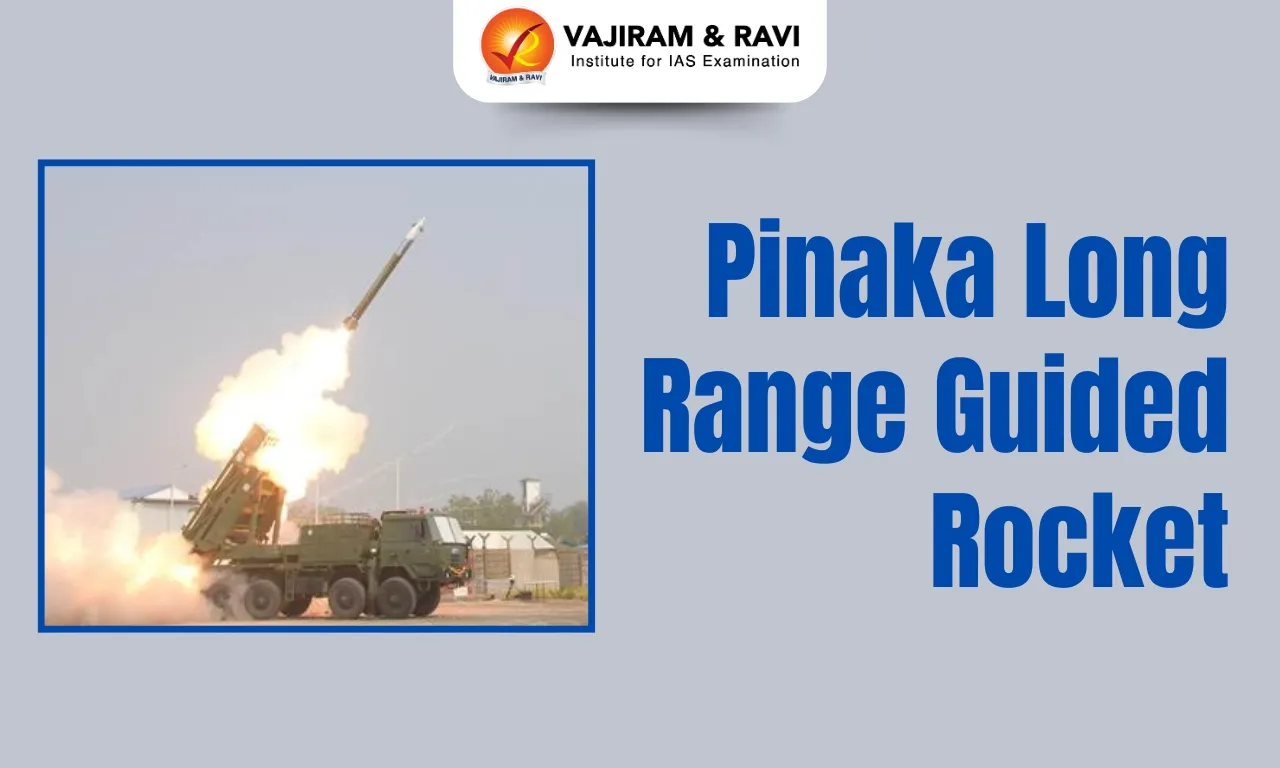
Recently, the Defence Research and Development Organisation (DRDO)successfully conducted the maiden flight test of the Pinaka Long Range Guided Rocket (LRGR–120) at the Integrated Test Range (ITR), Chandipur. 

About Pinaka Long Range Guided Rocket

  • It is an extended-range, precision-guided rocket developed for the Indian Army’s Pinaka Multiple Launch Rocket System (MLRS).
  • It has been developed by the Armament Research and Development Establishment (ARDE) in association with the High Energy Materials Research Laboratory, Hyderabad-based Research Centre Imarat (RCI) and Defence Research and Development Laboratory (DRDL).

Features of Pinaka Long Range Guided Rocket

  • Range: Its maximum strike range of around 120 kilometres. 
  • Backward compatibility: The rockets are backward compatible, meaning they can fit into existing launch systems without any significant structural changes.
  • Guidance system for improved accuracy: It makes it highly effective in mountainous terrain, where precision is critical. 
    • In the Guided Pinaka system, launchers carry eight guided rockets due to additional electronic components.
  • It is equipped with a guidance system that significantly improves accuracy, enabling it to engage targets such as enemy artillery positions, command nodes and logistics installations at long distances.

Source: PIB

Pinaka Long Range Guided Rocket FAQs

Q1: What is the range of the Pinaka Long Range Guided Rocket (LRGR 120)?

Ans: 120 km

Q2: What guidance system does the Pinaka LRGR 120 use?

Ans: Combination of inertial navigation and GPS

Ol Chiki Script

Ol Chiki Script

Ol Chiki Script Latest News

Recently, the President of India attended the Centenary celebrations of the Ol Chiki script of the Santhali Language in Jamshedpur, Jharkhand.

About Ol Chiki Script

  • It was invented in 1925 by Pandit Raghunath Murmu, a writer and teacher from what is Mayurbhanj State (now part of Odisha) in India.
  • Other names: Ol Chiki is also known as Ol Cemet’, Ol Ciki, Ol or the Santali alphabet.
  • It was created as a way to promote Santali culture.
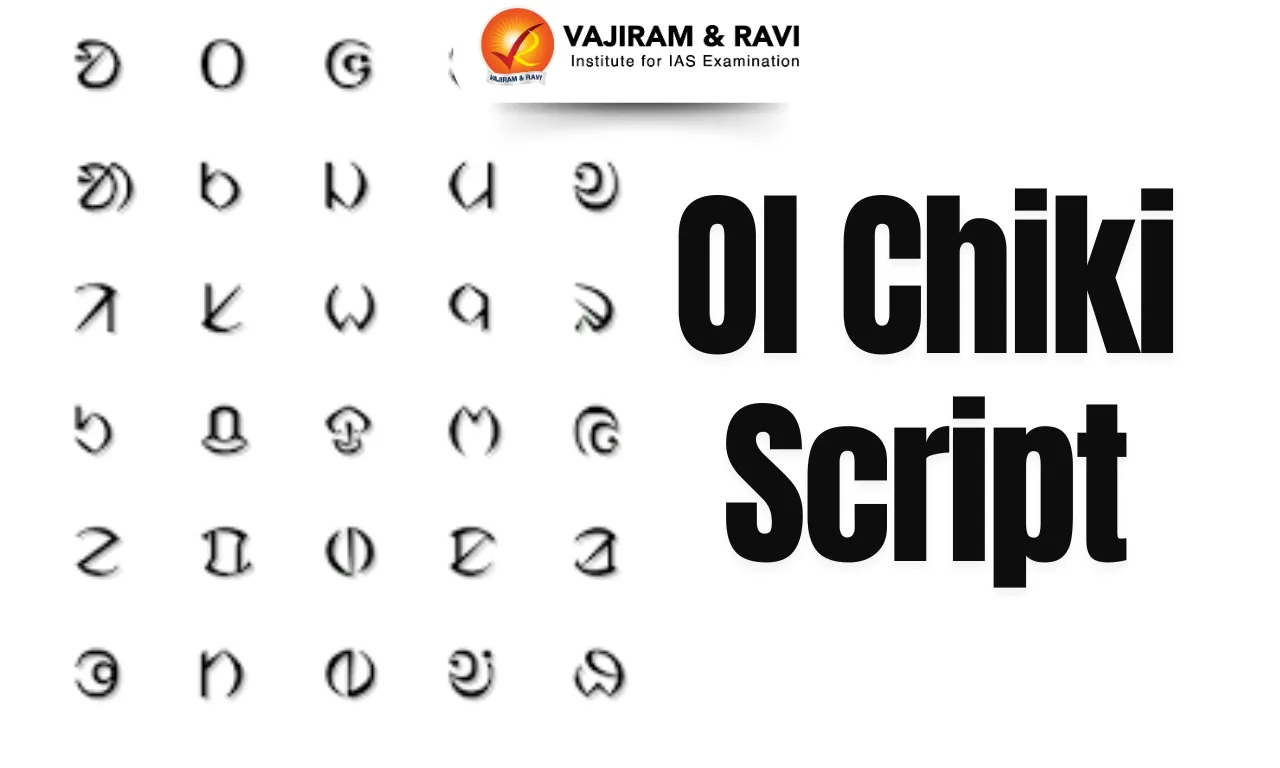
  • The Ol Chiki script itself is uniquely structured to suit the Santali language.
  • It consists of 30 letters and is fully phonetic, with each letter corresponding to a distinct sound.
  • The script was first publicized in 1939 at the Mayurbhanj State exhibition.
  • Murmu published over 150 books in Santali in the Ol Chiki script, including novels, poetry, drama, grammars, dictionaries and other information about the language and script.

Key Facts about Santali Language

  • It is a member of the Munda branch of the Austroasiatic language family, which is an ancient family of languages spoken across parts of South and Southeast Asia.
  • It is spoken mainly in Jharkhand and West Bengal states in northern India, and also in northwestern Bangladesh, eastern Nepal and Bhutan.
  • It was included in the Eighth Schedule of the Indian Constitution in 2003, with Ol Chiki recognised as its official script, giving the language constitutional status.

Source: News On Air

Ol Chiki Script FAQs

Q1: What is the Ol Chiki script associated with?

Ans: Santali language

Q2: In which year was the Ol Chiki script developed?

Ans: 1925

Magnetic Levitation (Maglev) Technology

Maglev Technology

Magnetic Levitation Technology Latest News

Recently, Chinese scientists have achieved a milestone in magnetic levitation (Maglev) technology by successfully propelling a one-tonne vehicle to 700 kilometers per hour in just two seconds.

About Magnetic Levitation Technology

  • It is a transportation technology which uses electromagnets to lift, guide and propel trains without wheels, allowing the cars to levitate slightly above the tracks.
  • It is achieved through magnets in the guideway walls interacting with magnets on the train, move the train forward in an almost frictionless environment.

Working of Magnetic Levitation Technology

  • Maglev trains operate using two key electromagnetic principles: magnetic attraction and repulsion. 
  • The system typically consists of three main components:
    • Levitation: Magnets lift the train above the track, ensuring there is no physical contact. This minimizes wear and tear while providing a smooth ride.
    • Guidance: Electromagnets stabilize the train laterally, keeping it centered on the track.
    • Propulsion: Linear motors generate magnetic fields that push and pull the train along the track. This replaces the need for traditional engines or fuel.
  • The tracks, known as guideways, are embedded with powerful electromagnets, while the trains themselves contain superconducting magnets or electromagnets. 
  • By carefully controlling the magnetic fields, maglev trains achieve levitation and propulsion with minimal energy loss.

Benefits of Magnetic Levitation Technology

  • Reduced Friction: With no physical contact between train and track, maglev systems have significantly lower maintenance costs and higher energy efficiency.
  • Eco-Friendly: Maglev trains produce zero direct emissions and can be powered by renewable energy sources, making them a sustainable alternative to fossil fuel-based transport.

Source: TOI

Magnetic Levitation Technology FAQs

Q1: What is Magnetic Levitation (Maglev) Technology primarily used for?

Ans: Transportation systems

Q2: What is the first commercial high-speed maglev?

Ans: The Shanghai maglev

Banded Krait, Scientific Name, Distribution, Habitat, Conservation, Latest News

Banded Krait

Banded Krait Latest News

An Indian Forest Service officer has drawn widespread attention on social media after sharing a striking video of a highly venomous Banded Krait encountered during a night patrol.

About Banded Krait

  • It is a highly venomous snake native to South and Southeast Asia.
  • Scientific Name: Bungarus fasciatus
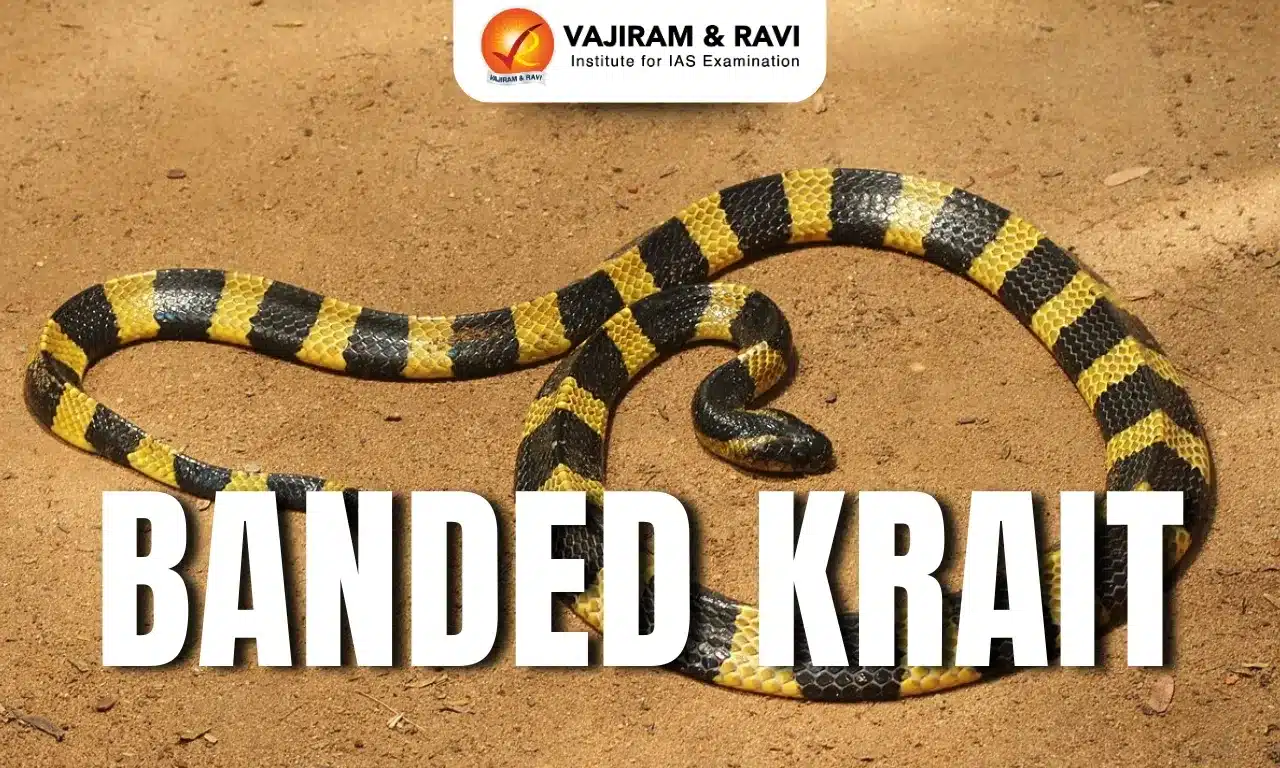
  • Part of the elapid family, which includes cobras and mambas, the Banded Krait is easily recognizable by its vibrant yellow and black crossbands, giving it a distinctive appearance.
  • Distribution: These snakes have been recorded eastwards from central India through Bangladesh, Myanmar, Cambodia, Thailand, Laos, Vietnam, and southern China (including Hong Kong) to Malaysia and the main Indonesian islands of Borneo (Java and Sumatra), as well as Singapore.

Banded Krait Habitat

  • It primarily inhabits wetlands, forests, and areas near water bodies.
  • They inhabit termite mounds and rodent holes close to water and often live near human settlements, especially villages, because of their supply of rodents and water.

Banded Krait Features

  • It is a large snake, typically growing between 5 to 7 feet.
  • It has a slender, cylindrical body with smooth scales. 
  • The alternating bands of yellow and black encircle its body entirely, making it one of the most visually striking snakes in the region.
  • The head is slightly broader than its neck, with a rounded snout and small eyes.
  • Though its venom is highly potent, it is known to be shy and nonaggressive, often avoiding human contact unless provoked.
  • Banded kraits are carnivores and feed mainly on other snakes.

Banded Krait Conservation Status

It is classified as 'Least Concern' under the IUCN Red List.

Source: HT

Banded Krait FAQs

Q1: To which family does the Banded Krait belong?

Ans: It belongs to the elapid family, which includes cobras and mambas.

Q2: How can the Banded Krait be visually identified?

Ans: By its alternating yellow and black crossbands encircling its entire body.

Q3: Is the banded krait venomous?

Ans: It is a highly venomous snake.

Q4: Banded Krait is native to which regions?

Ans: It is native to South and Southeast Asia.

Q5: What is the conservation status of the Banded Krait on the IUCN Red List?

Ans: Least Concern.

Spinal Muscular Atrophy

Spinal Muscular Atrophy

Spinal Muscular Atrophy Latest News

Recently, Abu Dhabi’s Sheikh Khalifa Medical City has become the first hospital globally to administer ITVISMA, a one-time gene therapy for spinal muscular atrophy (SMA).

About Spinal Muscular Atrophy

  • It is a rare and progressive neuromuscular disorder that leads to muscle weakness and can cause life-threatening complications. 
  • It is a debilitating genetic condition which affects motor neurons that control movement, and leads to progressive muscle weakening.
  • Cause: Most forms of SMA are caused by mutations of the survival motor neuron 1 gene (SMN1) on the fifth chromosome, resulting in insufficient expression levels of the SMN protein.
  • Types of SMA: There are five subtypes of SMA- type 0, 1, 2, 3, 4. Healthcare providers classify them based on the age of onset, as well as the severity and life expectancy.

Symptoms of Spinal Muscular Atrophy

  • Its symptoms vary and may be mild or disabling, but involve a weakness of the muscles that control movement.
  • The weakness in SMA tends to be more severe in the muscles that are close to the center of your body than in the muscles farther away from your body’s center.
  • Treatment: Unfortunately, there isn’t a cure for SMA. Treatment for SMA mainly seeks to manage symptoms and prevent complications. 

Source: DD News 

Spinal Muscular Atrophy FAQs

Q1: What is Spinal Muscular Atrophy (SMA)?

Ans: A genetic disorder affecting muscle movement

Q2: What causes SMA?

Ans: Mutation in SMN1 gene

Enquire Now