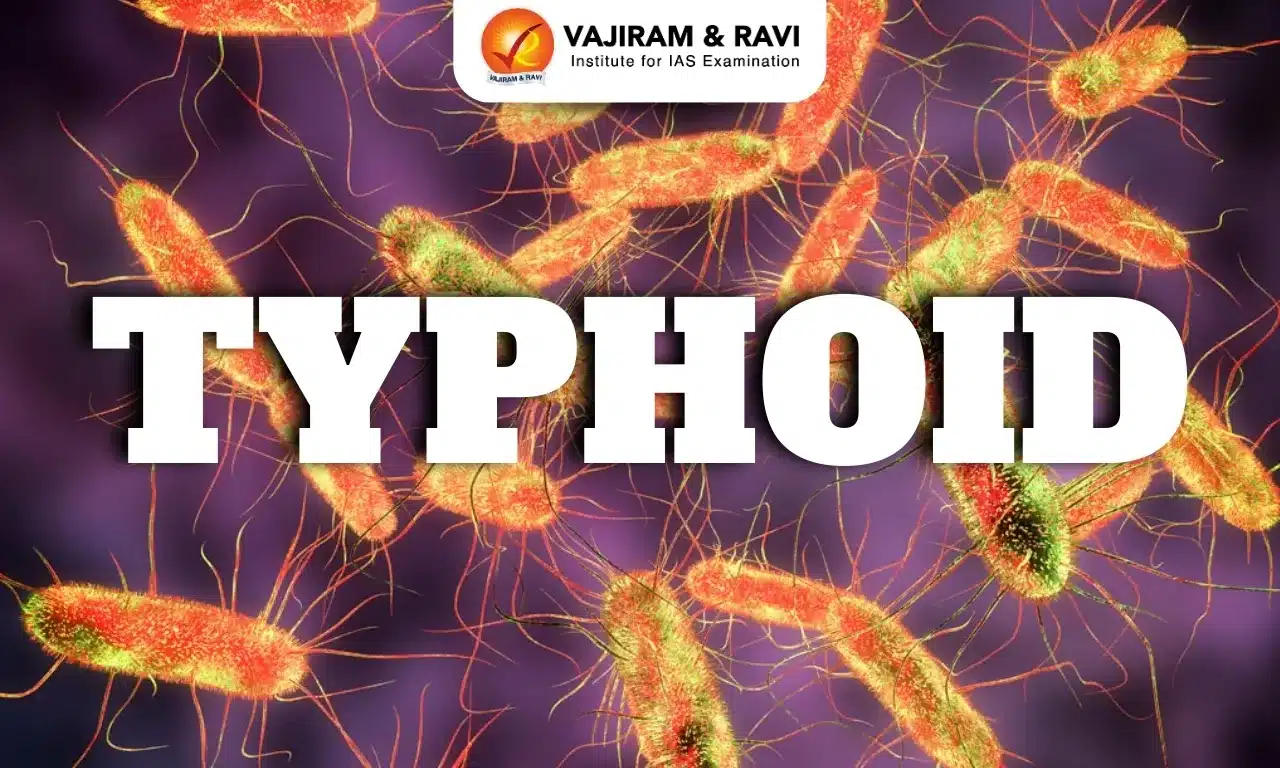
Typhoid

Typhoid

Typhoid Latest News

Gandhinagar is facing a surge in typhoid cases linked to contaminated drinking water, exposing serious flaws in the city's newly laid water supply system.

About Typhoid

  • It is a life-threatening infection caused by the bacterium Salmonella Typhi. 
  • Transmission:
    • No animals carry this disease, so transmission is always from human to human. 
    • A person typically contracts typhoid through contaminated food and drinking water. 
    • Once Salmonella Typhi bacteria are ingested, they multiply and spread into the bloodstream.
    • These bacteria are shed in the stools and urine of infected people.
  • Typhoid is more prevalent in places with less efficient sanitation and hygiene.
  • It is most prevalent in South Asia, Southeast Asia, Latin America, and sub-Saharan Africa.
  • Symptoms:
    • Symptoms include prolonged high fever, fatigue, headache, nausea, abdominal pain, and constipation or diarrhoea
    • Some patients may have a rash
    • Severe cases may lead to serious complications or even death.
    • Some people have typhoid without experiencing any symptoms. 
    • Others continue to harbor the bacteria after their symptoms have gone.
    • Sometimes, the disease can appear again.
  • Treatment:
    • Typhoid fever can be treated with antibiotics.  
    • Antimicrobial resistance is common, with the likelihood of more complicated and expensive treatment options required in the most affected regions.

Source: TOI

Typhoid FAQs

Q1: What bacterium causes typhoid?

Ans: Salmonella Typhi

Q2: How is typhoid transmitted?

Ans: Through contaminated food and drinking water.

Q3: In what type of areas is typhoid more prevalent?

Ans: Areas with poor sanitation and hygiene.

Q4: What is the most common symptom of typhoid?

Ans: Prolonged high fever.

Q5: How is typhoid treated?

Ans: With antibiotics.

Hydrokinetic Turbine Technology

Hydrokinetic Turbine Technology

Hydrokinetic Turbine Technology Latest News

In a major push to expand renewable energy and ensure 24x7 electricity supply, the Tripura government recently identified 10 river sites to generate 185 MW of power using Hydrokinetic Turbine Technology.

About Hydrokinetic Turbine Technology

  • Hydrokinetic turbines are an emerging hydropower technology that takes advantage of moving water currents to generate power. 
  • Unlike traditional hydroelectric dams that require larger in-channel infrastructure that can disrupt flow and the river ecosystem, hydrokinetic turbines are placed directly in the river channel and have a much smaller environmental footprint.
  • These turbines offer a renewable energy source by tapping into the natural flow of water in aquatic environments.
  • It uses kinetic energy of flowing water with practically zero potential head for generation of electrical energy, unlike conventional units, which utilize potential energy of water through construction of suitable civil structures such as dams, diversion weirs, and barrages for creation of necessary 'Head'.

Benefits of Hydrokinetic Turbines

  • Renewable Energy Source: Hydrokinetic turbines harness the steady flow of water to generate power. This clean energy source reduces reliance on fossil fuels.
  • Minimal Environmental Impact: These turbines operate with the natural flow of water, unlike traditional dams. It preserves ecosystems and minimizes disruption to aquatic life and landscapes.
  • Scalable and Flexible: Hydrokinetic turbines can be adjusted to meet different energy needs. They work well for small local setups or larger multi-turbine arrays, making them suitable for various projects.
  • Cost-Effective Maintenance: With fewer moving parts and strong debris protection, these turbines require less upkeep. This reduces maintenance costs and ensures reliable long-term operation.

Source: IT

Hydrokinetic Turbine Technology FAQs

Q1: What do hydrokinetic turbines primarily exploit to generate electricity?

Ans: The kinetic energy of flowing water.

Q2: How do hydrokinetic turbines differ from traditional hydropower dams in terms of infrastructure?

Ans: Hydrokinetic Turbines do not require large in-channel structures like dams, weirs, or barrages.

Q3: Do hydrokinetic turbines require a significant potential head for power generation?

Ans: No, they operate with practically zero potential head.

Q4: How do hydrokinetic turbines affect aquatic ecosystems compared to large dams?

Ans: They cause minimal disruption and preserve natural flow and habitats.

Q5: Why do hydrokinetic turbines have lower maintenance costs?

Ans: They have fewer moving parts and include strong debris-protection systems.

Taimoor Missile

Taimoor Missile

Taimoor Missile Latest News

The Pakistan Air Force has successfully conducted a flight test of the indigenously developed Taimoor Weapon System recently.

About Taimoor Missile

  • It is an air-launched cruise missile developed by Pakistan.
  • It is capable of striking enemy land and sea targets with high precision. 
  • Features:
    • It uses subsonic turbojet propulsion for long-range efficiency.
    • It has a range of upto 600 kilometers, carrying a conventional warhead.
    • Stealth design: Box-shaped fuselage, X-type tail, foldable wings.
    • The missile is designed to fly at very low altitudes, allowing it to effectively evade hostile air and missile defence systems.
    • It relies on a mix of inertial, satellite, and terrain-based guidance for accurate navigation.

What is a Cruise Missile?

  • Cruise missiles are unmanned vehicles that are propelled by jet engines, much like an airplane. 
  • They can be launched from ground, air, or sea platforms. 
  • Cruise missiles remain within the atmosphere for the duration of their flight and can fly as low as a few meters off the ground. 
  • Flying low to the surface of the earth expends more fuel but makes a cruise missile very difficult to detect.
  • Cruise missiles are capable of being launched from multiple ground, air, sea, and submarine platforms. 
  • Most cruise missiles are subsonic and use turbofan and turbojet engines. While less common, supersonic and hypersonic cruise missiles utilize ramjet and scramjet engines.
  • Cruise missiles are self-guided and use multiple methods to accurately deliver their payload, including terrain mapping, global positioning systems (GPS), and inertial guidance, which uses motion sensors and gyroscopes to keep the missile on a pre-programmed flight path.

Source: TH

Taimoor Missile FAQs

Q1: What type of weapon is the Taimoor Missile?

Ans: It is an air-launched cruise missile developed by Pakistan.

Q2: What is the maximum range of the Taimoor Missile?

Ans: It has a range of up to 600 kilometers.

Q3: What type of propulsion system does the Taimoor Missile use?

Ans: It uses subsonic turbojet propulsion.

Q4: What kind of warhead does the Taimoor Missile carry?

Ans: It carries a conventional warhead.

Spina Bifida

Spina Bifida

Spina Bifida Latest News

Many countries across the world have initiated programmes to create awareness to prevent Spina Bifida through folic acid supplementation but India is yet to do so.

About Spina Bifida

  • It is a birth defect of the spinal cord that causes serious childhood paralysis.
  • It occurs when the spine and spinal cord of a fetus do not fully develop during the embryonic period.
  • The condition occurs during early pregnancy, and can range from mild to severe.
  • Causes: The cause is not known. It's thought that a combination of genetic, nutritional and environmental risk factors causes the condition.
  • Types of Spina Bifida
    • Myelomeningocele: It is the most serious form of the condition.
    • In this type, part of the spinal cord and nerves are exposed through a sac at the opening of the gap in the spine.
    • Meningocele: It is a less common type of spina bifida that occurs when the meninges, or the protective membranes around the spinal cord, push out through the opening in a fluid-filled sac.
    • Spina bifida occulta: It is the mildest form of the condition in which one or more of the vertebrae not forming properly, resulting in a small gap.
  • Symptoms: Bowel and bladder issues, back pain, weakness or lack of movement in the legs and loss of sensation in the legs. 
  • Prevention: It can be prevented largely by having folic acid in the early weeks of pregnancy.
  • Treatment: There is no cure for the condition; however, treatment options are available to manage symptoms.

Source: TH

Spina Bifida FAQs

Q1: What is Spina Bifida?

Ans: A birth defect of the spinal cord

Q2: When does Spina Bifida occur?

Ans: During early pregnancy

Double-Humped Bactrian Camel

Double-Humped Bactrian Camel

Double-Humped Bactrian Camel Latest News

Ladakh's double-humped Bactrian camels are set to debut at the 77th Republic Day parade. 

About Double-Humped Bactrian Camel

  • It is scientifically known as Camelus bactrianus.
  • Its large even-toed ungulates are renowned as Ladakh’s “silent warriors”. 
  • Distribution
    • They are native to the harsh and arid regions of Central Asia.
    • They occupy habitats in Central Asia from Afghanistan to China, primarily up into the Mongolian steppes and the Gobi desert.
    • Small populations of these camels are found in high altitude cold deserts of Ladakh’s Nubra Valley.

Characteristics of Double-Humped Bactrian Camel

  • The two humps serve as a reservoir of fat that can be converted into water and energy during long treks where food is scarce.
  • They possess thick, shaggy coats that fluctuate with the seasons, growing dense to withstand temperatures as low as minus 40 degrees Celsius.
  • Their nostrils are sealable to block out frozen dust, while their broad feet act like natural snowshoes.
  • They are among the few land animals that can survive by eating snow to meet their hydration needs.
  • Diet: Bactrian camels are omnivores but primarily herbivores and eat various types of plants.
  • Conservation Status: IUCN Red List: Critically Endangered.

Source: India Today

Double-Humped Bactrian camel FAQs

Q1: What is the scientific name of the Double-Humped Bactrian camel?

Ans: Camelus bactrianus

Q2: Where are Double-Humped Bactrian camels primarily found?

Ans: Central Asia

Salal Hydroelectric Project

Salal Hydroelectric Project

Salal Hydroelectric Project Latest News

The Union Minister of Power and Housing and Urban Affairs recently directed sediment removal at the Salal Power Project in Jammu and Kashmir to ensure maximum utilisation of water resources, in the wake of the Indus Waters Treaty being kept in abeyance between India and Pakistan.

About Salal Hydroelectric Project

  • It is a 690 MW run-of-the-river power project on the Chenab River in the Reasi District of Jammu and Kashmir. 
  • Although the plan for a water reservoir was originally conceived in pre-independent India, the planning of the project started in the 1960s. 
  • The project construction commenced in 1970 and subsequently entered into commercial operation in 1987.
  • The project is developed and owned by National Hydroelectric Power Corporation (NHPC). 
  • This was the first hydropower project, which was built by India under the Indus Water Treaty regime in Kashmir.
  • Salal Dam is 130 meters high with an elevation of 1627 feet above mean sea level.
  • Jammu and Kashmir receives 12.5 percent of the energy generated from the project. 
  • The rest is transmitted to the Northern Grid, where it is distributed to the states of Punjab, Haryana, Delhi, Himachal Pradesh, Rajasthan, and Uttar Pradesh.
  • Jammu and Kashmir also purchases additional power at regular prices.

Source: TH

Salal Hydroelectric Project FAQs

Q1: Where is Salal Hydroelectric Project located?

Ans: It is located on the Chenab River in the Reasi District of Jammu and Kashmir.

Q2: What is the installed capacity of the Salal Hydroelectric Project?

Ans: 690 MW

Q3: When did the Salal Hydroelectric Project become commercially operational?

Ans: In 1987.

Q4: Which organization developed and owns the Salal Hydroelectric Project?

Ans: National Hydroelectric Power Corporation (NHPC).

Design Linked Incentive Scheme

Design Linked Incentive Scheme

Design Linked Incentive Scheme Latest News

The Design Linked Incentive (DLI) Scheme is critical to anchoring India in the most strategic and value-intensive segment of the global semiconductor value chain—chip design. 

About Design Linked Incentive Scheme

  • It is a key instrument in advancing India’s ambition to develop a strong fabless capability.
  • It is implemented by the Ministry of Electronics and Information Technology (MeitY) under the Semicon India Programme.
  • Aim: The scheme aims to reduce import dependence, strengthen supply chain resilience, and enhance domestic value addition.
  • Eligibility:  Start-ups and MSMEs are eligible for financial incentives and design infrastructure support for semiconductor product design & deployment.
  • Other domestic companies are eligible for financial incentives for deploying semiconductor designs.
  • The DLI Scheme supports: Semiconductor design across the full lifecycle—from design and development to deployment—covering Integrated Circuits (ICs), chipsets, Systems-on-Chip (SoCs), systems and IP cores.
  • Nodal Agency: C-DAC (Centre for Development of Advanced Computing).

Financial Incentives and Design Infrastructure Support under DLI

  • Product Design Linked Incentive
    • Reimbursement of up to 50% of eligible expenditure.
    • The reimbursement is capped at ₹15 crore per application.
    • The support is available to entities involved in semiconductor design for: Integrated Circuits (ICs) Chipsets Systems on Chips (SoCs) Systems & IP Cores Semiconductor-linked designs.
  • Deployment Linked Incentive
    • Incentives of 6% to 4% of net sales turnover are provided for five years.
    • The incentive is capped at ₹30 crore per application.
    • The minimum cumulative net sales required over Years 1–5 is 1 crore for startups/ ₹ MSMEs and 5 crore for other domestic companies.

Source: PIB

Design Linked Incentive Scheme FAQs

Q1: What is the primary objective of the Design Linked Incentive (DLI) Scheme?

Ans: To support semiconductor design and development

Q2: Who is eligible to apply for the DLI Scheme?

Ans: Domestic companies, Startups and MSMEs

Chilika Lake

Chilika Lake

Chilika Lake Latest News

The Odisha government is preparing a new action plan for the protection of Chilika Lake’s biodiversity and the development of its surrounding areas.

About Chilika Lake

  • It is a brackish water lake and a shallow lagoon with estuarine character spread across the districts of Puri, Khurda, and Ganjam in the state of Odisha.
  • It is Asia’s largest brackish water lake.
  • Located at the mouth of the Daya River, Chilika Lake is the second-largest brackish water lagoon in the world, after the New Caledonian barrier reef in New Caledonia.
  • The waterspread area of Chilika varies between 900 to 1165 sq. km. during summers and monsoons, respectively.
  • It is connected to the Bay of Bengal by a 32 km long and 1.5 km wide channel that mostly runs parallel to the Bay, separated by a narrow spit.
  • Chilika Lake has several islands, such as:
    • Nalabana IslandDeclared a Bird Sanctuary (1987)
    • Kalijai Island – Known for the Kalijai Temple
    • Other islands include Honeymoon Island, Breakfast Island, Beacon Island, Satpada Island, etc.
  • In 1981, Chilika Lake was designated the first Indian wetland of international importance under the Ramsar Convention.
  • Biodiversity:
    • It is the largest wintering ground for migratory birds on the Indian subcontinent. 
    • Birds from the Caspian Sea, Lake Baikal, Aral Sea, and other remote parts of Russia, Kirghiz steppes of Mongolia, Central and Southeast Asia, Ladakh and Himalayas come here. 
    • White-bellied sea eagles, Graylag Geese, Purple Moorhen, Jacana, Herons, and Flamingos are among the many species which make the lake a bird watcher's delight. 
    • It is also home to one of the world's largest breeding colonies of Flamingos.
    • Apart from the avifaunal species, the region also highlights varied wild animals such as Blackbuck, Golden Jackals, Spotted Deer, and Hyenas.
    • It is also famous for its population of Irrawaddy dolphins.

Source: NIE

Chilika Lake FAQs

Q1: What type of water body is Chilika Lake?

Ans: It is a brackish water lake and a shallow lagoon with estuarine characteristics.

Q2: Where is Chilika Lake located?

Ans: It is spread across the districts of Puri, Khurda, and Ganjam in Odisha.

Q3: Which is Asia’s largest brackish water lake?

Ans: Chilika Lake.

Q4: Chilika Lake is located at the mouth of which river?

Ans: The Daya River.

Q5: Which island in Chilika Lake is designated as a Bird Sanctuary?

Ans: Nalabana Island.

Archaea

Archaea

Archaea Latest News

According to a study published, a DNA sequence that signals cells in almost all other organisms to stop synthesising proteins instead encodes a rare amino acid in some archaea.

About Archaea

  • Archaea, which means "ancient things" in Greek, are one of the oldest forms of life on Earth and belong to a group called the third domain of life.
  • Habitat: They thrive in extreme habitats such as hot springs, cold deserts and hypersaline lakes.

Characteristics of Archaea

  • Archaea (singular archaeon) are a primitive group of microorganisms.
  • They are single-celled organisms without nucleus or organelles, and have a similar size and shape as bacteria, but differ from them biochemically.
  • Their membrane is made of a unique type of lipids and most archaea have a cell wall
  • These slow-growing organisms are also present in the human gut, and have a potential relationship with human health.
  • They are known for producing antimicrobial molecules, and for anti-oxidant activity with applications in eco-friendly waste-water treatment.
  • Archaea are extremely difficult to culture due to challenges in providing natural conditions in a laboratory setting.
  • Many archaea live in some of the harshest environments on Earth, which makes them ideal for studying how life can survive in tough conditions.

Source: TH

Archaea FAQs

Q1: Where are Archaea commonly found?

Ans: In human gut and extreme environments

Q2: What is a significant application of Archaea?

Ans: Eco-friendly wastewater treatment

Notifiable Diseases

Notifiable Diseases

Notifiable Disease Latest News

The Delhi government is set to declare rabies a notifiable disease to strengthen disease surveillance.

About Notifiable Disease

  • A notifiable disease is any disease that is required by law to be reported to government authorities. 
  • Effective notification allows the authorities to monitor the disease and provides early warning of possible outbreaks.
  • The Epidemic Diseases Act, 1897 provides the legal framework for notifying diseases in India.
  • Criteria for Declaring a Disease as Notifiable may be:
    • It is of interest to national or international regulations or control programs.
    • Its national/ State/District incidence.
    • Its severity (potential for rapid mortality).
    • Its communicability/Its potential to cause outbreaks.
    • Significant risk of international spread.
  • Medical practitioners and diagnostic labs are required to notify the local health department of cases of notified diseases. 
  • In India, the state government is responsible for determining which diseases must be reported to the medical officer in their area and to notify the diseases. 
  • The government and regional authorities maintain a list of notifiable diseases in India, which is subject to change as new diseases are added or existing ones are removed.
    • Examples: Cholera, tuberculosis, AIDS, dengue, hepatitis, leprosy, meningitis, plague, and measles.
  • WHO’s International Health Regulations (1969): Mandates countries to report diseases for global surveillance and advisory purposes.

Source: TH

Notifiable Disease FAQs

Q1: What is a notifiable disease?

Ans: A disease that must be reported to authorities

Q2: What is the purpose of notifying a disease?

Ans: To prevent outbreak and control spread

Enquire Now