Aralam Butterfly Sanctuary

Aralam Butterfly Sanctuary

Aralam Butterfly Sanctuary Latest News

The Kerala government has officially renamed the Aralam Wildlife Sanctuary the Aralam Butterfly Sanctuary, making it the first butterfly sanctuary in the State.

About Aralam Butterfly Sanctuary

  • Location: It is located in the state of Kerala.
  • It shares boundaries with the Brahmagiri Wildlife Sanctuary in Karnataka, the Kottiyoor Wildlife Sanctuary, and the North Wayanad forest division.
  • Vegetation: It consists of evergreen and semi-evergreen forests.
  • Rivers: The Cheenkanni River, originating from the Brahmagiri ranges, flows through the dense forests of Aralam.
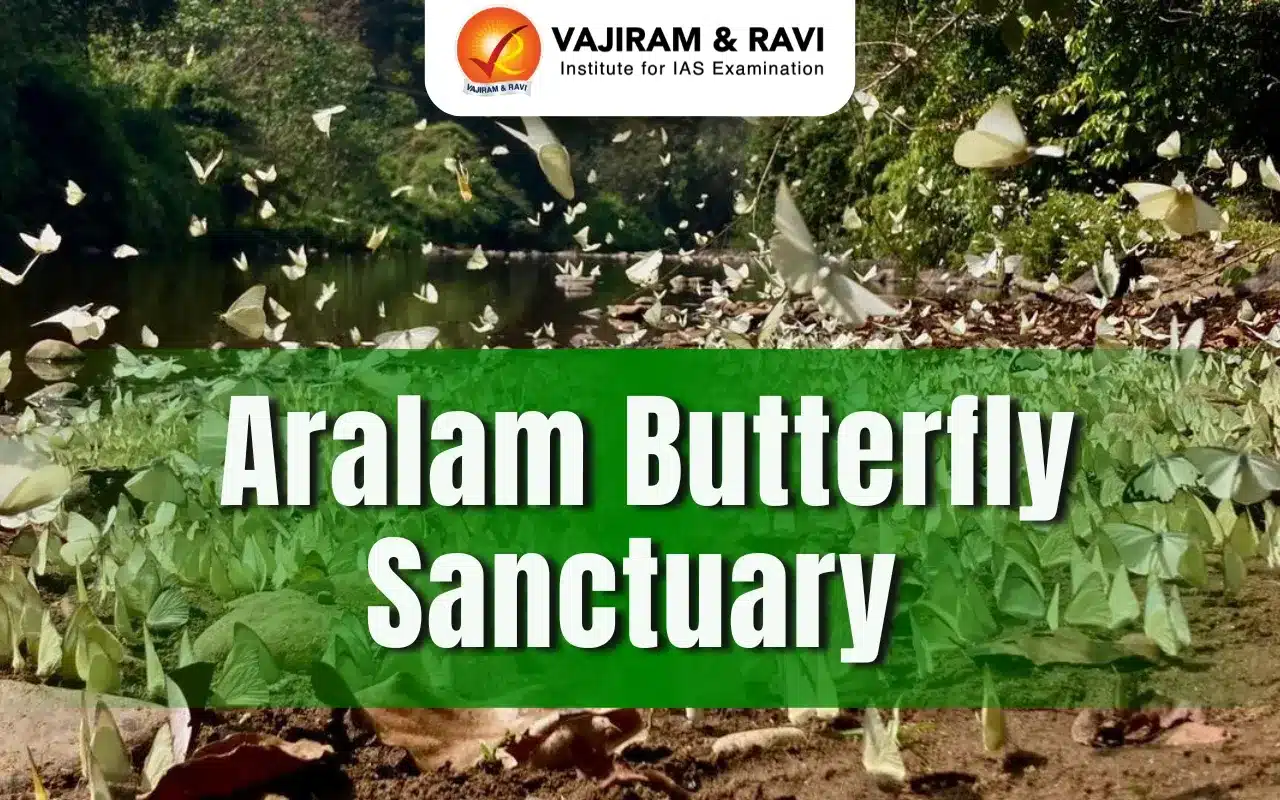
  • The region is known for large-scale butterfly migration and mud-puddling and is also a special habitat of the Schedule 1 Slender loris.
  • Fauna: It is home to over 266 species of butterflies, accounting for more than 80 percent of all butterflies in Kerala. Some of these are unique to this region, while others are endangered.
    • Every January or February, the sanctuary holds a Butterfly Migration Study, which celebrates this seasonal movement and deepens our understanding of these pollinators. 
    • In addition to butterflies, Aralam is home to several animals, including elephants, giant squirrels, leopards, and a variety of birds.

Source: TH

Aralam Butterfly Sanctuary FAQs

Q1: Where is the Aralam Butterfly Sanctuary located?

Ans: Western Ghats, Kerala

Q2: How many butterfly species are found in the Aralam Butterfly Sanctuary?

Ans: 206

Aerosols

What are Aerosols

Aerosols Latest News

A recent study found that water vapor heats the atmosphere much more than aerosols do.

About Aerosols

  • Aerosols refer to fine solid or liquid particles suspended in the atmosphere, where they reside typically for days to weeks before falling to the ground or being washed out by rain or snow. 
  • They arise both from human activities involving the burning of fossil fuels and biofuels, and from natural sources (such as desert dust, sea spray, and volcanic eruptions)
  • Aerosol particles are tiny but numerous and often comprise a number of inorganic and organic substances. 
  • Visible forms of atmospheric aerosol plumes include smoke, smog, haze, and dust.
  • How Do Aerosols Affect the Climate?
    • Some of these particles can reflect incoming sunlight back to outer space, helping to cool the atmosphere. 
    • Other aerosol particles absorb heat from sunlight. This causes the atmosphere to warm. 
      • This is especially true for black carbon. Because it is black, it is very good at absorbing sunlight.
    • Aerosols also have an impact on climate by acting as cloud condensation nuclei, which alters cloud properties and their radiative effects. 
  • Aerosol particles at surface level impact human health and are associated with disruption to transport (desert dust storms and volcanic eruptions) and can reduce the solar irradiance available for solar power plants.
  • Aerosols contribute to poor air quality and harm human health. 
    • Aerosols that are smaller than 2.5 µm in median diameter penetrate deep into human lungs, leading to respiratory and other diseases and premature death from air pollution.

Source: DST


Aerosols FAQs

Q1: What are aerosols?

Ans: Aerosols are fine solid or liquid particles suspended in the atmosphere.

Q2: How long do aerosols typically remain in the atmosphere?

Ans: They usually remain for days to weeks before settling or being washed out by rain or snow.

Q3: What are the main sources of aerosols?

Ans: They arise both from human activities involving the burning of fossil fuels and biofuels, and from natural sources (such as desert dust, sea spray, and volcanic eruptions).

Q4: How do aerosols influence cloud formation?

Ans: They act as cloud condensation nuclei.

Q5: How do aerosols impact human health at the surface level?

Ans: They degrade air quality and are linked to respiratory and other diseases.

Kathputli

Katputli

Kathputli Latest News

In Jaipur nearly 250 families carry forward one of Rajasthan’s oldest folk art forms, Kathputli.

About Kathputli

  • Kathputlis is a traditional string puppet play from Rajasthan. 
  • It is one of Rajasthan’s oldest folk art forms.
  • The name comes from kath (wood) and putli (doll), reflecting their simple yet expressive construction.
  • A kathaputli is made up of wood, cloth, thread, and metal wire. Its upper body is made up of wood, and the rest is made of cotton and fabric. 
  • They do not have legs and are covered with long trailing skirts.
  • The puppeteer manipulates them with his fingers tied with two to five strings.

Features of Kathputli

  • They possess distinctive facial features like large eyes, oval faces, large lips, and arched eyebrows.
  • Their colourful attire draw inspiration from royal courts and desert traditions, while their sharp features and exaggerated expressions add drama to every movement.
  • Theme: Historically, Kathputli performances were used by travelling performers to narrate tales of Rajput kings, brave warriors, folk heroes, and moral stories to village audiences.
  • Each puppet represents a character from everyday life or folklore.
  • It is accompanied by folk music on the dholak and harmonium.
  • The performances brim with humour, music, and satire, often reflecting social realities alongside legendary tales.

Source: TH

Kathputli FAQs

Q1: Kathputli performances typically narrate?

Ans: Folk tales, legends, and moral stories

Q2: Kathputli is a traditional puppetry form from which state?

Ans: Rajasthan

Vehicle-To-Vehicle Communication Technology

Vehicle-To-Vehicle Communication Technology

Vehicle-To-Vehicle Communication Technology Latest News

The Government of India is preparing to roll out Vehicle-to-Vehicle (V2V) communication technology by the end of 2026. 

About Vehicle-To-Vehicle Communication Technology

  • It is defined as a direct communication method that allows vehicles to exchange information with one another,
  • It enhances driver awareness of their surroundings through wireless technologies.
  • It allows vehicles to communicate directly with each other without the need for a network.
  • The initiative aims to strengthen road safety and reduce accidents across the country.
  • Functioning: The system will function through a device similar to a SIM card, which will be installed in vehicles.

Features of Vehicle-To-Vehicle Communication Technology

  • Vehicles will receive real-time alerts when another vehicle comes too close from any direction.
  • Each vehicle equipped with V2V technology continuously broadcasts and receives data such as speed, location, direction, acceleration and braking status.
  • When a potential risk is detected, the system alerts the driver, giving them extra time to react.
  • The technology will provide alerts related to safe vehicle distance and will also warn drivers about nearby roadside or stationary vehicles.
  • The system will provide signals from all sides of the vehicle, ensuring 360-degree communication.
  • It will work in coordination with Advanced Driver Assistance Systems (ADAS).
  • Advantage: This feature will be extremely useful during foggy conditions when visibility between vehicles drops to almost zero.

Source: NDTV


Vehicle-To-Vehicle Communication Technology FAQs

Q1: What does Vehicle-To-Vehicle (V2V) Communication Technology enable?

Ans: Vehicles to communicate with each other

Q2: How does V2V Communication Technology work?

Ans: Through a device similar to a SIM card

Narco-Coordination Centre

Narco-Coordination Centre

Narco-Coordination Centre Latest News

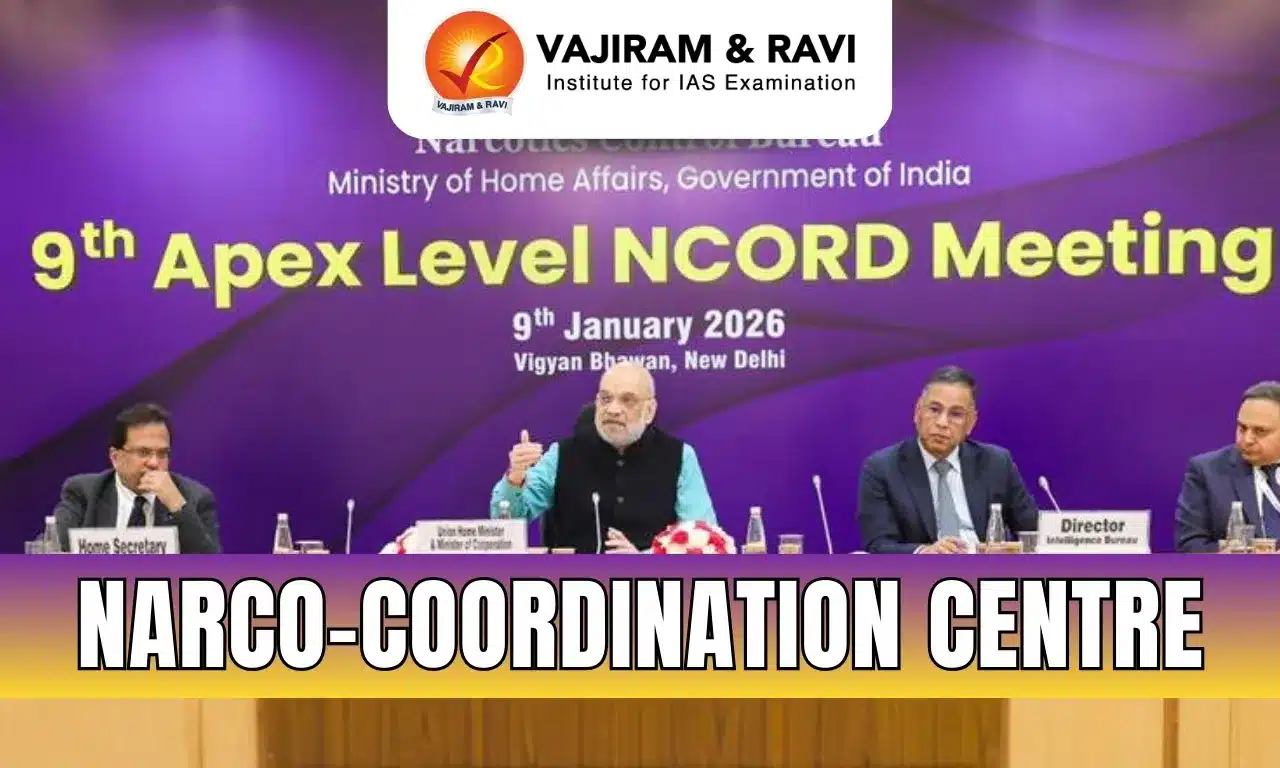
Recently, the union Home Minister chaired the 9th Apex-Level Meeting of the Narco-Coordination Centre (NCORD) at Vigyan Bhawan in New Delhi.

About Narco-Coordination Centre

  • The Narco-Coordination Centre (NCORD) mechanism was established in 2016 for better coordination between states and the Ministry of Home Affairs. 
  • It has been further strengthened through a four-tier system in 2019.
  • Purpose: To enhance coordination between the States, the Ministry of Home Affairs and concerned stakeholders in addressing the challenge of the drug menace in a holistic manner.
  • It is designed to facilitate better communication, cooperation, and intelligence sharing among law enforcement and drug control agencies. 

Structure of Narco-Coordination Centre (NCORD)

  • Apex Level NCORD Committee, headed by Union Home Secretary;
  • Executive Level NCORD Committee, headed by Special Secretary, Ministry of Home Affairs;
  • State Level NCORD Committees, headed by Chief Secretaries; and 
  • District Level NCORD Committees – headed by District Magistrates

Initiatives linked to NCORD

  • The NCORD portal has been launched as an effective mechanism for information exchange between various institutions/agencies.
  • A toll-free helpline called MANAS (Madak Padarth Nishedh Asuchna Kendra) with the number 1933 has been launched.

Source: PIB

Narco-Coordination Centre FAQs

Q1: Under which ministry does NCORD operate?

Ans: Ministry of Home Affairs

Q2: What is the primary objective of NCORD?

Ans: To coordinate efforts to curb illicit narcotics trade

Phayre’s Leaf Monkey

Phayre's Leaf Monkey

Phayre's Leaf Monkey Latest News

Recently, it was found that rapid habitat destruction forces arboreal Phayre’s leaf monkey to alter its habits.

About Phayre's Leaf Monkey

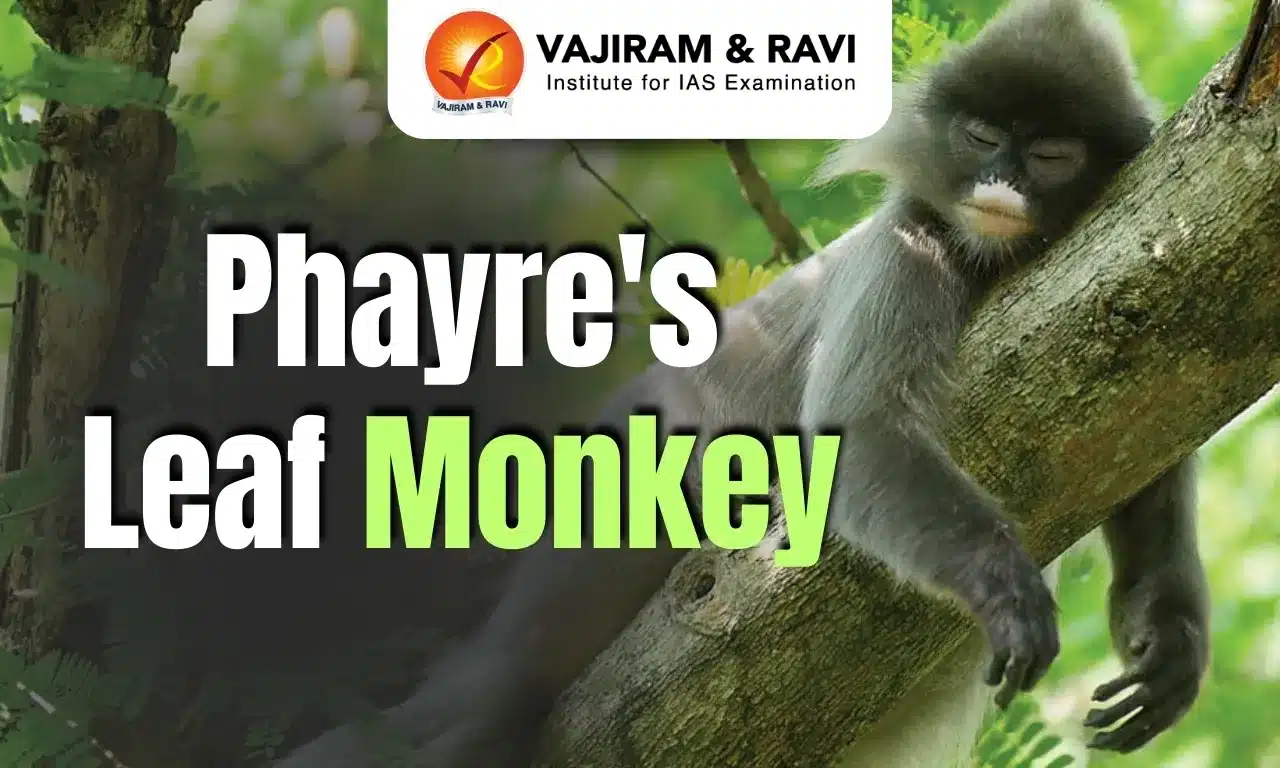
  • Phayre's leaf monkey (Trachypithecus phayrei) is a species of Old World monkey which is diurnal and arboreal.
  • Other names: The primate is known as chasma bandor (in Bengali) and chasma-chakuwa bandar (in Assamese).
  • Appearance: It has a white coloration around the ventral, mouth, and eye area. The broad ring-shaped patches around the eyes resemble spectacles.
  • Habitat: It inhabits tropical, deciduous, and evergreen forests and can also be seen in bamboo clusters and rubber plantations.
  • Distribution: It is found in North-East India (mainly found in Tripura, Assam and Mizoram), Eastern Bangladesh, and Western Myanmar.
  • Diet: It feeds primarily on young leaves, shoots, and flowers, occasionally consuming fruits and seeds.
  • Behavior: Phayre's leaf monkeys are very shy and typically flee when threatened. They spend over 75% of their time feeding within tree tops.
  • Its specialised multi-chambered stomach enables it to digest fibrous leaves efficiently, contributing to nutrient cycling and seed dispersal in the ecosystem.
  • Threats:  habitat loss, forest fragmentation and hunting

Conservation Status of Phayre's Leaf Monkey

  • IUCN Red List: Endangered
  • CITES: Appendix II

Source: DTE

Phayre's Leaf Monkey FAQs

Q1: What is the conservation status of Phayre's Leaf Monkey?

Ans: Endangered

Q2: Where is Phayre's Leaf Monkey primarily found?

Ans: Northeastern India, Bangladesh, and Myanmar

Exercise Sanjha Shakti

Exercise Sanjha Shakti

Exercise Sanjha Shakti Latest News

The Indian Army recently  conducted exercise 'Sanjha Shakti', a joint Military–Civil Fusion exercise, at the Dighi Hills Range under the aegis of the Maharashtra, Gujarat and Goa Area of the Southern Command.

About Exercise Sanjha Shakti

  • It is a joint Military Civil Fusion (MCF) exercise.
  • It was conducted at the Diggi Range, Khadki Military Station, under the aegis of the Maharashtra, Gujarat, and Goa Area of the Southern Command of the Indian Army.
  • The exercise focused on strengthening coordination between the armed forces and civilian agencies to deal with complex security challenges and emergency situations.
  • The drill brought together personnel from the Indian Army and 16 key civilian agencies, including the Maharashtra Police, Force One, and fire and emergency services. 
  • More than 350 personnel from civil agencies, in addition to Army troops, actively participated in the exercise. 
  • The joint exercise tested interoperability, communication protocols, decision-making processes, and rapid response mechanisms through realistic, mission-oriented scenarios.
  • The exercise validated seamless coordination between civil and military stakeholders, particularly in situations involving disaster response and public safety.

Source: TOI


Exercise Sanjha Shakti FAQs

Q1: What is Exercise Sanjha Shakti?

Ans: It is a joint Military Civil Fusion (MCF) exercise.

Q2: Where was Exercise Sanjha Shakti conducted?

Ans: It was conducted at the Diggi Range, Khadki Military Station.

Q3: Under which command was Exercise Sanjha Shakti conducted?

Ans: It was held under the aegis of the Maharashtra, Gujarat, and Goa Area of the Southern Command of the Indian Army.

Q4: What was the main objective of Exercise Sanjha Shakti?

Ans: To strengthen coordination between the armed forces and civilian agencies in dealing with complex security challenges and emergencies.

Boeing E-4B Nightwatch

What is the Boeing E-4B Nightwatch

Boeing E-4B Nightwatch Latest News

Amid the high geopolitical tensions, Boeing E-4B Nightwatch, better known as the US military’s “Doomsday Plane,” made a rare appearance in Los Angeles, sparking panic.

About Boeing E-4B Nightwatch

  • The Boeing E-4B Nightwatch, widely known as the “Doomsday Plane”, is the most secretive aircraft in the US military’s arsenal.
  • It serves as the National Airborne Operations Center and functions as a flying command post. 
  • It is designed to keep the US government operational during extreme scenarios such as nuclear war, catastrophic attacks on US soil, or the destruction of ground-based command centres.
  • Its mission is to ensure the US government can continue to function even if “doomsday" arrives.
  • It is a core component of the military’s Nuclear Command, Control, and Communications system, often referred to as NC3, which enables senior leaders to authorize and manage nuclear forces under all conditions.
  • There are currently four E-4Bs in service. At least one aircraft is kept on continuous alert at all times.
  • The E-4B has been activated in a real emergency only once, in the aftermath of the September 11, 2001 attacks, when it was used to ensure continuity of government. 

Boeing E-4B Nightwatch Features

  • It is built on a heavily modified Boeing 747-200 airframe.
  • Each E-4B has a maximum takeoff weight of around 360,000 kilograms, an unrefuelled endurance of roughly 12 hours, and an operating ceiling above 30,000 feet (about 9,091 metres). 
  • The aircraft is hardened against electromagnetic pulse effects, shielded against nuclear and thermal radiation, and equipped with multiple layers of secure communications.
  • It can carry up to 111 personnel, including senior command staff, intelligence teams, and communications specialists. 
  • The main deck is divided into six functional areas, including command workspaces, conference and briefing rooms, an operations floor, communications hubs, and rest areas. 
  • The aircraft can remain airborne for extended periods using in-flight refuelling, allowing national leadership to operate independently of ground infrastructure.

Source: ET


Boeing E-4B Nightwatch FAQs

Q1: What is the Boeing E-4B Nightwatch?

Ans: It is a highly secretive US military aircraft known as the “Doomsday Plane.”

Q2: Why is the Boeing E-4B called the “Doomsday Plane”?

Ans: Because it is designed to keep the US government functioning during extreme doomsday-like scenarios.

Q3: What role does the Boeing E-4B serve for the US government?

Ans: It serves as the National Airborne Operations Center.

Q4: In which extreme scenarios is the E-4B designed to operate?

Ans: Nuclear war, catastrophic attacks on US soil, or destruction of ground-based command centres.

Q5: When was the E-4B used in a real emergency?

Ans: After the September 11, 2001 terrorist attacks.

Ethylene Glycol (EG)

What is Ethylene Glycol (EG)

Ethylene Glycol Latest News

Telangana Drug Control Administration (DCA) recently issued a stop use notice for a batch of Almont-Kid Syrup contaminated with toxic Ethylene Glycol (EG).

About Ethylene Glycol

  • It is a colorless, odorless, sweet-tasting, and water-soluble organic compound.
  • It is usually produced by the reaction of ethylene oxide with water. 
  • It is the simplest member of the glycol family of organic compounds.
  • Its chemical formula is C2H6O2, and it is a diol (a compound containing two hydroxyl groups). 
  • It is a slightly viscous liquid that boils at 198°C (388.4°F). 
  • Applications
    • It has a wide range of other applications in industries such as automotive, manufacturing, chemical synthesis, and plastics production.
    • It is primarily used as an antifreeze and coolant in automotive and industrial applications due to its ability to significantly lower the freezing point of liquids.  
    • It is used as an ingredient in hydraulic fluids, printing inks, and paint solvents. 
    • It is also used as a reagent in making polyesters, explosives, alkyd resins, and synthetic waxes.
  • EG Poisoning? 
    • EG is highly poisonous; animals or humans that drink the solution become very ill and may die.
    • Automotive antifreeze, containing 95% EG, is the most common source of EG poisoning.

Source: TH


Ethylene Glycol (EG) FAQs

Q1: What is Ethylene Glycol (EG)?

Ans: It is a colorless, odorless, sweet-tasting, water-soluble organic compound.

Q2: How is Ethylene Glycol usually produced?

Ans: By the reaction of ethylene oxide with water.

Q3: What is the chemical formula of Ethylene Glycol?

Ans: C₂H₆O₂.

Q4: Why is Ethylene Glycol widely used as an antifreeze?

Ans: Because it significantly lowers the freezing point of liquids.

Q5: What is the most common source of Ethylene Glycol poisoning?

Ans: Automotive antifreeze containing about 95% Ethylene Glycol.

Indian Giant Squirrel

What is the Indian Giant Squirrel

Indian Giant Squirrel Latest News

During the ongoing All India Tiger Estimation 2026 survey, the Indian giant squirrel, Maharashtra’s state animal and locally known as Shekru, was recently sighted in the Atwan region of the Pune forest division.

About Indian Giant Squirrel

  • Also known as the Malabar Giant Squirrel, the Indian Giant Squirrel is a large rodent species native to India.
  • More specifically, it is a type of tree squirrel. 
  • It is one of the largest squirrels in the world.
  • Scientific Name: Ratufa indica 

Indian Giant Squirrel Distribution

  • It is found primarily in the Western Ghats, Eastern Ghats, and Satpura Range. 
  • Their ranges include many states, including Karnataka, Andhra Pradesh, Madhya Pradesh, Gujarat, Chhattisgarh, Jharkhand, Maharashtra, Kerala, and Tamil Nadu. 
  • It is Maharashtra’s state animal and locally known as Shekru.

Indian Giant Squirrel Habitat

  • It is arboreal, spending most of its time in trees.
  • It makes its shelter within holes in trees.

Indian Giant Squirrel Features

  • Total body length varies from 254 to 457 mm. The tail is typically longer than the length of its body.
  • These squirrels weigh approximately 1.5 to 2 kg.
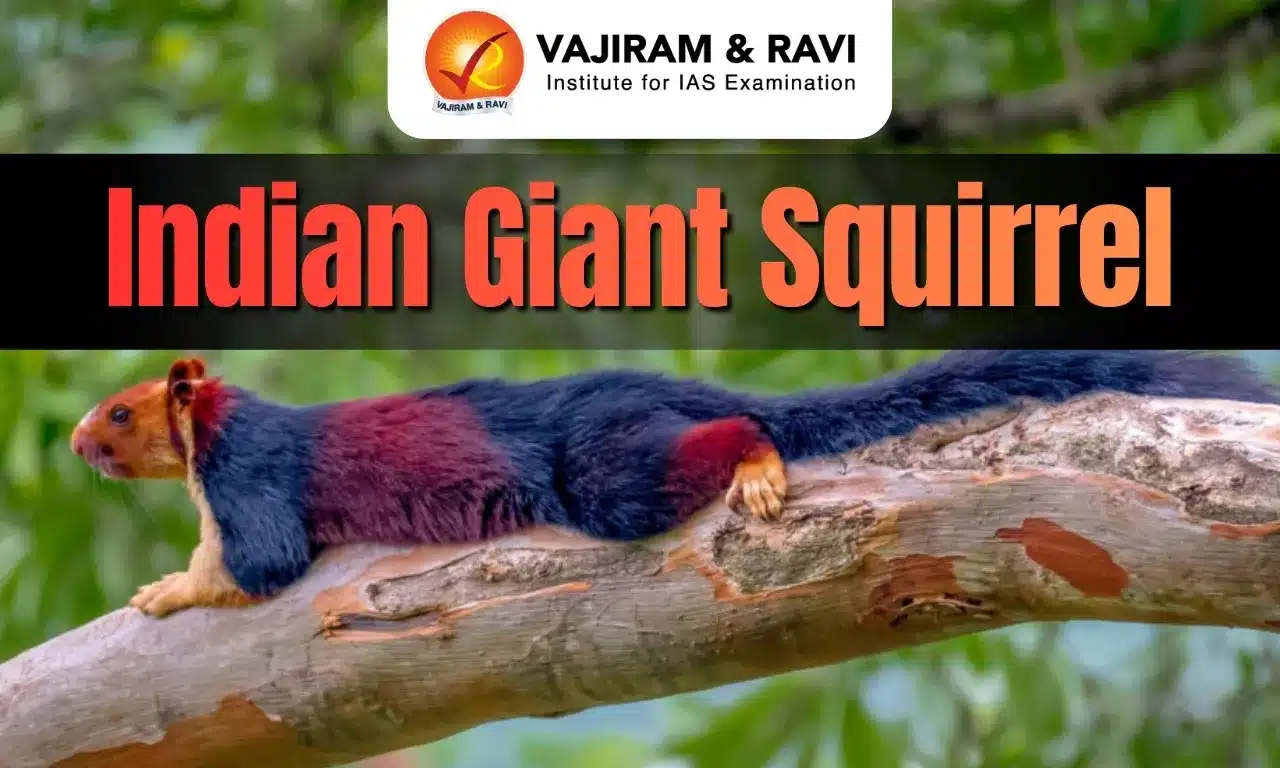
  • They are distinguishable by their striking, multi-colored hues
  • The colors vary between individual squirrels. There is a common pattern of two to three shades, including white or cream, brown, black, red, maroon, and sometimes dark Fuschia. 
  • The deep shades are primarily seen along the body, while the lighter colors occur on the underside and the long, bushy tail.
  • They have short, round ears, a broadened hand with an expanded inner paw for gripping, and large, powerful claws used for gripping tree bark and branches.
  • Females are usually larger in size than their male counterparts by about three centimeters and have mammae for nursing their young.
  • They are typically solitary animals, being seen only rarely in pairs during the breeding season.
  • They can propel impressive distances of 20 feet.

Indian Giant Squirrel Conservation Status

It is classified as 'Least Concern' under the IUCN Red List.

Source: IE


Indian Giant Squirrel FAQs

Q1: What is the Indian Giant Squirrel?

Ans: It is a large rodent species native to India, also known as the Malabar Giant Squirrel.

Q2: In which major geographical regions of India is the Indian Giant Squirrel found?

Ans: The Western Ghats, Eastern Ghats, and the Satpura Range.

Q3: Which state has declared the Indian Giant Squirrel as its state animal?

Ans: Maharashtra

Q4: Which colours are commonly seen in the Indian Giant Squirrel?

Ans: White or cream, brown, black, red, maroon, and sometimes dark fuchsia.

Q5: What is the IUCN Red List status of the Indian Giant Squirrel?

Ans: Least Concern.

Enquire Now