Bhadrakali Inscription

Bhadrakali Inscription

Bhadrakali Inscription Latest News

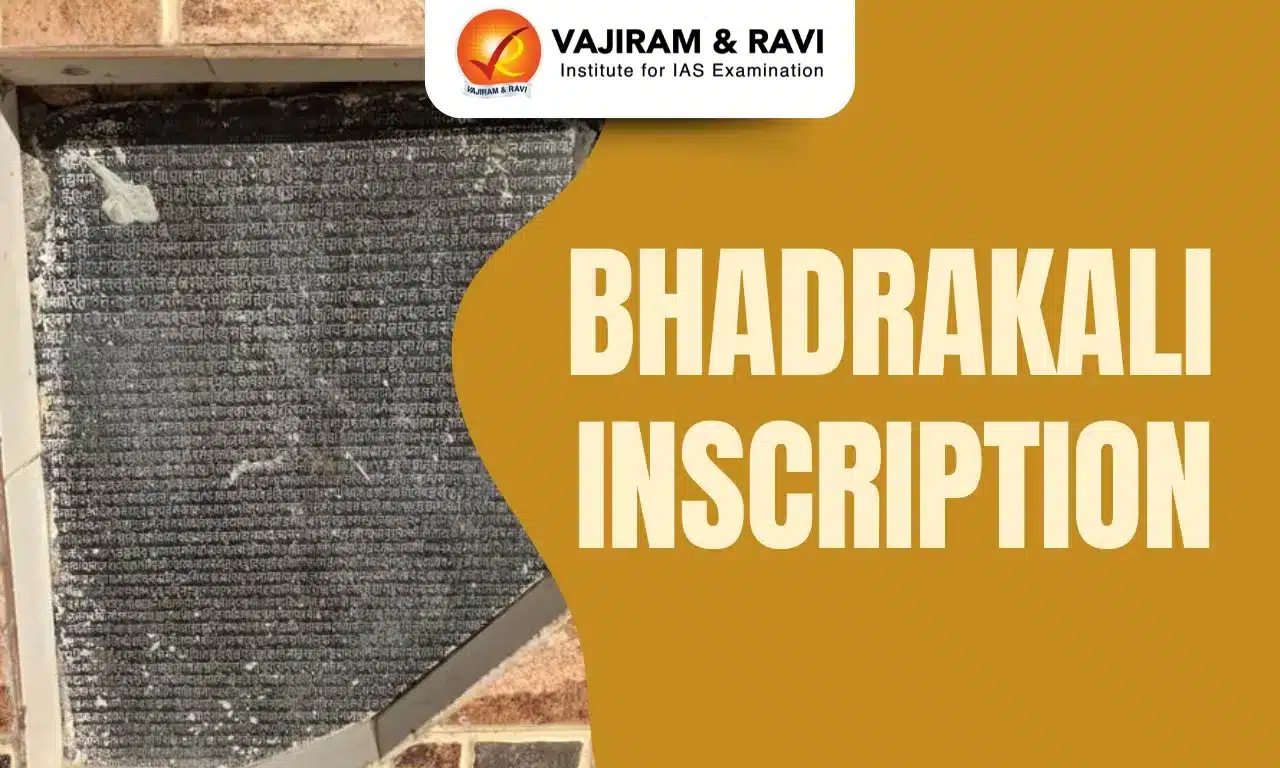
The Bhadrakali inscription is a key 12th-century record that confirms the history and development of Somnath Temple and patronage given by the Solanki dynasty.

About Bhadrakali Inscription

  • Location: It is situated in Prabhas Patan, Gujarat specifically on the wall of the Bhadrakali Temple.
  • It was carved in 1169 CE (Valabhi Samvat 850 and Vikram Samvat 1255) and currently protected by the State Department of Archaeology,
  • It is a eulogistic inscription of Param Pashupata Acharya Shriman Bhavabrihaspati, the (spiritual preceptor of Maharajadhiraj Kumarapala of Anhilwad Patan).

Historical Details in Bhadrakali Inscription

  • This inscription records the ancient and medieval history of the Somnath Temple.
  • It mentions the construction of Somnath Temple in all four yugas.
  • Accordingly, in the Satya Yuga, Chandra (Soma) built it of gold; in the Treta Yuga, Ravana built it of silver; in the Dvapara Yuga, Shri Krishna built it of wood; and in the Kali Yuga, King Bhimdev Solanki constructed a beautifully artistic stone temple.
  • The historic Bhadrakali inscription reflects the devotion of the Solanki rulers and scholars like Bhavabrihaspati. 
  • Protection: State Department of Archaeology, Gujarat

Source: PIB

Bhadrakali Inscription FAQs

Q1: When was the Bhadrakali Inscription carved?

Ans: 1169 CE

Q2: Where is the Bhadrakali Inscription located?

Ans: Bhadrakali Temple, Prabhas Patan, Gujarat

National Federation of Cooperative Sugar Factories Limited

BhadraNational Federation of Cooperative Sugar Factories Limitedkali Inscription

National Federation of Cooperative Sugar Factories Limited Latest News

Recently, the National Cooperative Sugar Federation sought government intervention amid falling sugar prices.

About National Federation of Cooperative Sugar Factories Limited

  • It was established in 1960 to build a strong and vibrant co-operative sugar sector in India. 

Genesis of National Federation of Cooperative Sugar Factories Limited

  • It was registered as a Multi-Unit Cooperative Society on December 2, 1960 under the provisions of Bombay Cooperative Societies Act 1925.
  • In 1972, it was deemed to be under The Delhi Cooperative Societies Act 1972 and later under the Multi State Cooperative Societies Act 1984.
  • Since 2002, NFCSF has been deemed to be under the Multi State Cooperative Societies Act, 2002.

Functions of National Federation of Cooperative Sugar Factories Limited

  • It participates in sugar policy formulation at national and state level and helps set an agenda for the development and growth of the sector in India.
  • It advocates, promotes and safeguards the collective interests of its members in accordance with the cooperative principles.
  • The NFCSF also offers Techno-commercial services to establish, expand and modernize sugar factories, within India and Overseas.
  • Governance: It functions under the overall guidance of an elected Board of Directors, composed of representatives of Cooperative Sugar Factories and State Sugar Federations across India. 

Source: News On Air

National Federation of Cooperative Sugar Factories Limited FAQs

Q1: What is the primary objective of NFCSF?

Ans: To support cooperative sugar factories

Q2: What is the role of NFCSF in the sugar industry?

Ans: To promote cooperative sugar factories

Q3: When was NFCSF established?

Ans: 1965

Man Portable Anti-tank Guided Missile Weapon System

Man Portable Anti-tank Guided Missile Weapon System

Man Portable Anti-tank Guided Missile Weapon System Latest News

Recently, the Defence Research and Development Organisation & Indian Army conducted successful trials of indigenous Man Portable Anti-tank Guided Missile Weapon System.

About Man Portable Anti-tank Guided Missile Weapon System

  • It is indigenously designed and developed by Defence Research & Development Organisation (DRDO).
  • The system consisted of the MPATGM, Launcher, Target Acquisition System, and the Fire Control Unit.
  • It is the third-generation “fire and forget” missile.

Features of Man Portable Anti-tank Guided Missile Weapon System

  • It incorporates cutting-edge indigenous technologies, including ;
  • an Imaging Infrared (IIR) homing seeker, all-electric control actuation system, advanced fire control system, tandem warhead, propulsion system and a high-performance sighting system.
  • The IIR seeker provides robust day-and-night operational capability.
  • The tandem warhead is designed to defeat modern main battle tanks equipped with advanced armour protection.
  • The missile can be launched from a tripod-mounted system as well as from a military vehicle-based launcher, enhancing its operational flexibility.
  • Bharat Dynamics Limited (BDL) and Bharat Electronics Limited (BEL) are the development-cum-production partners (DcPP) for the MPATGM.

Source: PIB

Man Portable Anti-tank Guided Missile Weapon System FAQs

Q1: What is the primary purpose of the MPATGM?

Ans: To engage and destroy enemy tanks and armored vehicles

Q2: What type of guidance system does the MPATGM use?

Ans: Imaging Infrared (IIR) homing seeker

Q3: What is the range of the MPATGM?

Ans: Up to 4 km

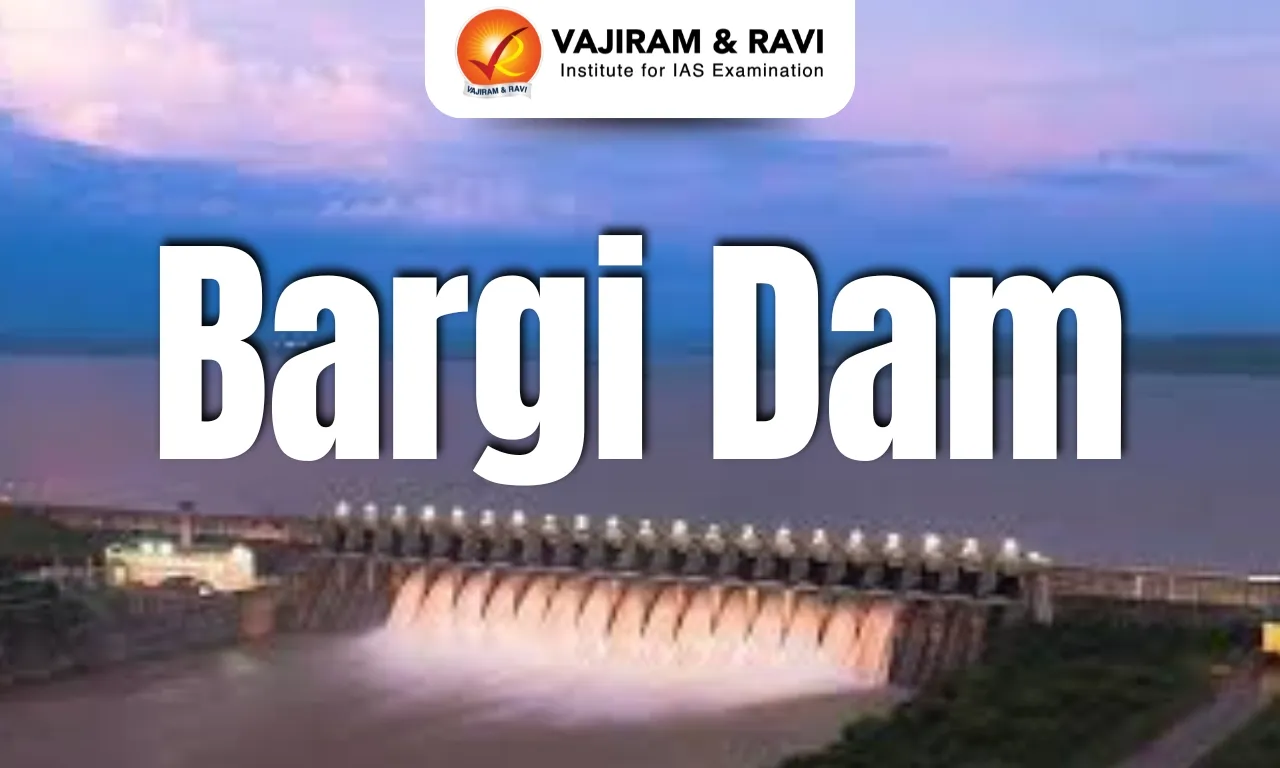
Bargi Dam

Bargi Dam

Bargi Dam Latest News

Recently, the National Dam Safety Authority has issued a show-cause notice to the Narmada Valley Development Authority over safety concerns at Bargi Dam. 

About Bargi Dam

  • It is a major multi-purpose dam, serving irrigation, water supply, and power generation. 
  • It is on the Narmada river.
  • Location: It is located in the state of Madhya Pradesh.
  • Out of 30 major dam projects on Narmada river, it is one of the first completed dams on the river.
  • Bargi dam construction started in 1974 and completed in 1990.
  • It was constructed as part of the Narmada Valley Development Project.
  • It was classified as Safety Category III, meaning “minor deficiencies,” during pre-monsoon and post-monsoon inspections.

What is the National Dam Safety Authority?

  • It is a statutory body set up by the Central Government under the Dam Safety Act, 2021.
  • It operates with a clear mandate to regulate, oversee, and inspect dams.
  • It is headed by a chairman and assisted by five members to lead its five wings – policy and research, technical, regulation, disaster and resilience, and administration and finance.
  • Headquarter: New Delhi.
  • Functions of the Authority include 
    • implementing the policies formulated by the National Committee on Dam Safety;
    • resolving issues between State Dam Safety Organisations (SDSOs), or between a SDSO and any dam owner in that state;
    • specifying regulations for inspection and investigation of dams;
    • providing accreditation to agencies working on construction, design, and alteration of dams.

Source: DTE

Bargi Dam FAQs

Q1: Where is Bargi Dam located?

Ans: Madhya Pradesh

Q2: On which river is Bargi Dam built?

Ans: Narmada

Catastrophe Bonds

Catastrophe Bonds

Catastrophe Bonds Latest News

Recently, the Kerala government has asked the Union government to consider instituting ‘catastrophe bonds’ as protection against disaster-linked losses.

About Catastrophe Bonds

  • These are insurance-linked securities that transfer the financial risks from natural disasters from the bond issuer to the capital market.
  • These are a unique hybrid insurance-cum-debt financial product that transforms insurance cover into a tradable security.
  • At present, the financial risk is fully borne by the State or Central governments.

Key Stakeholders and Mechanism of Catastrophe Bonds

  • These bonds are sponsored by sovereign governments, who pay premiums.
  • These are issued through intermediaries, such as the World Bank or Asian Development Bank, to reduce issuance risks.
  • These are purchased by global investors, including pension funds, hedge funds, and family offices, who are attracted by high returns and the diversification benefits of non-market correlated risks.
  • The risk level and frequency of disaster occurrence directly influence coupon rates.
    • For instance, earthquake-related bonds often offer lower premiums (1-2%) compared to those covering cyclones or hurricanes.
  • Global scene: Mexico and the Philippines have been using CAT bonds to protect themselves against disaster-linked losses.

Source: TH

Catastrophe Bonds FAQs

Q1: What are Catastrophe Bonds?

Ans: Insurance-linked securities that transfer risk to investors

Q2: What is the primary purpose of Cat Bonds?

Ans: To transfer risk from insurers to investors

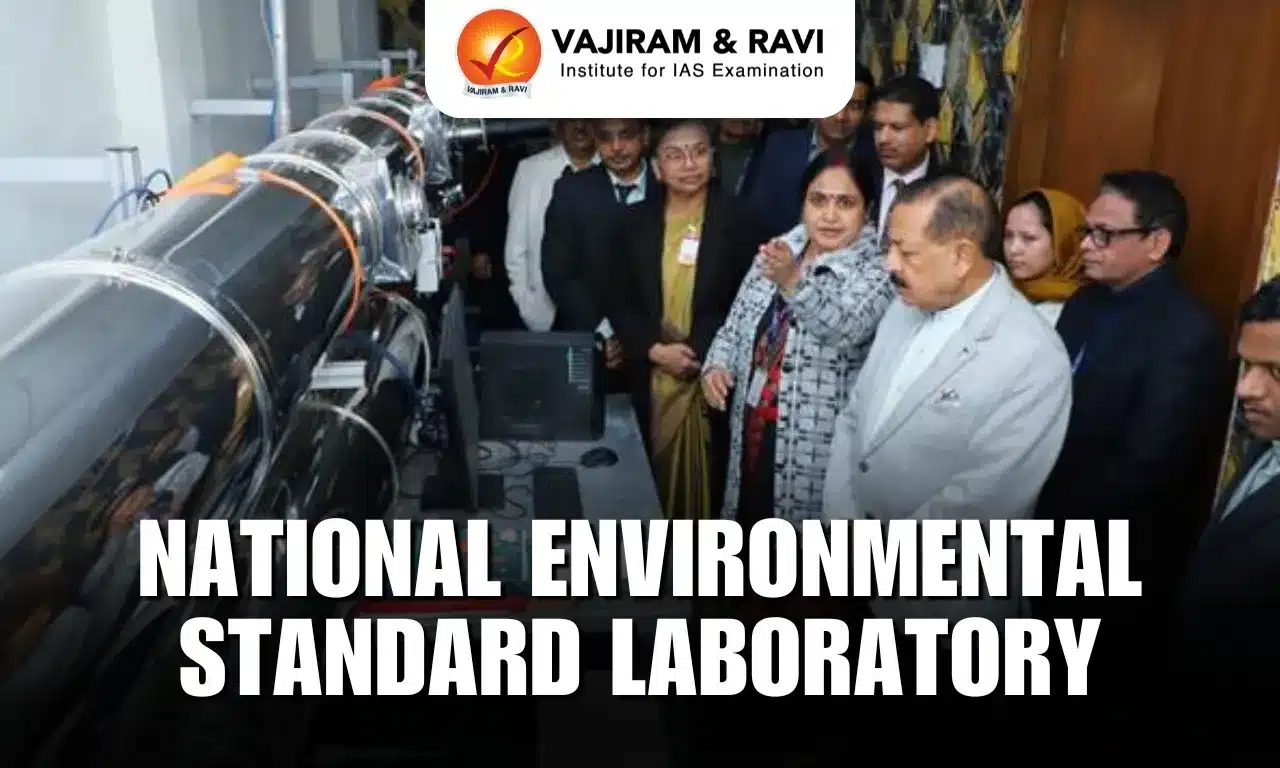
National Environmental Standard Laboratory

National Environmental Standard Laboratory

National Environmental Standard Laboratory Latest News

Recently, the CSIR-National Physical Laboratory established the National Environmental Standard Laboratory (NESL).

About National Environmental Standard Laboratory

  • It was established to test and recalibrate instruments used for air pollution monitoring systems and environmental sensors under Indian environmental conditions.
  • It provides credible data for the National Clean Air Programme.
  • Location: CSIR–National Physical Laboratory, New Delhi

Features of National Environmental Standard Laboratory

  • NESL allowed manufacturers, industries, and municipal agencies to validate performance within the country,
  • It provides Industrial emission audits, and smart-city monitoring networks, and provided reference gases, protocols.
  • Significance: It is expected to help MSMEs, start-ups, and indigenous manufacturers to demonstrate product quality at lower cost, meet tightening regulatory guidelines on quality and transparency.

Key Facts about Council of Scientific and Industrial Research (CSIR)

  • CSIR is a cutting edge R&D organisation dealing in diverse fields of science and technology.
  • It undertakes research, design & development of scientific & industrial instruments, components and systems.
  • It facilitates service, maintenance, testing & calibration of instruments.
  • It promotes Human Resource Development in the area of instrumentation.
  • It offers technical assistance to industry and provides ecosystem support.
  • Headquarter: New Delhi

Source: PIB

National Environmental Standard Laboratory FAQs

Q1: Where was the world's second national environmental standards laboratory inaugurated?

Ans: CSIR-National Physical Laboratory (CSIR-NPL)

Q2: What is the primary function of NPL?

Ans: To maintain and update national standards of measurements

Shaksgam Valley

Shaksgam Valley

Why Shaksgam Valley in News?

China has rejected India’s territorial claim over the Shaksgam Valley in the Jammu & Kashmir region, insisting the area is part of Chinese territory. 

About Shaksgam Valley

  • The Shaksgam Valley, or Trans Karakoram Tract, is part of the Hunza-Gilgit region of Pakistan-Occupied Kashmir (POK) and is a disputed territory claimed by India but controlled by Pakistan.
  • It borders Xinjiang Province of the People’s Republic of China (PRC) to the north, the Northern Areas of POK to the south and west, and the Siachen Glacier region to the east.
  • It was ceded to China by Pakistan in 1963, when both countries signed a boundary agreement to settle their border differences.
  • However, Article 6 of the agreement clearly stated that “the two parties have agreed that after the settlement of the Kashmir dispute between Pakistan and India, the sovereign authority concerned will reopen negotiations with the Government of the People's Republic of China, on the boundary as described in Article Two of the present agreement, so as to sign a formal Boundary Treaty to replace the present agreement.”
  • The agreement laid the foundation of Karakoram highway, which was built jointly by Chinese and Pakistani engineers in the 1970s.

Source: IE

Shaksgam Valley FAQs

Q1: Why is the issue in the news now?

Ans: China recently rejected India’s claim and defended its infrastructure work in the valley, including projects linked to the China-Pakistan Economic Corridor (CPEC).

Q2: Where is the Shaksgam Valley located which recently became the site of dispute between India and China?

Ans: The Shaksgam Valley also known as Trans Karakoram Tract is located in the northernmost part of the Jammu & Kashmir region, north of the Siachen Glacier

Q3: Why is Shaksgam Valley strategically important?

Ans: The valley lies north of the Siachen Glacier and near China’s Xinjiang region, making it critical for military logistics, regional security, and connectivity, despite being sparsely populated.

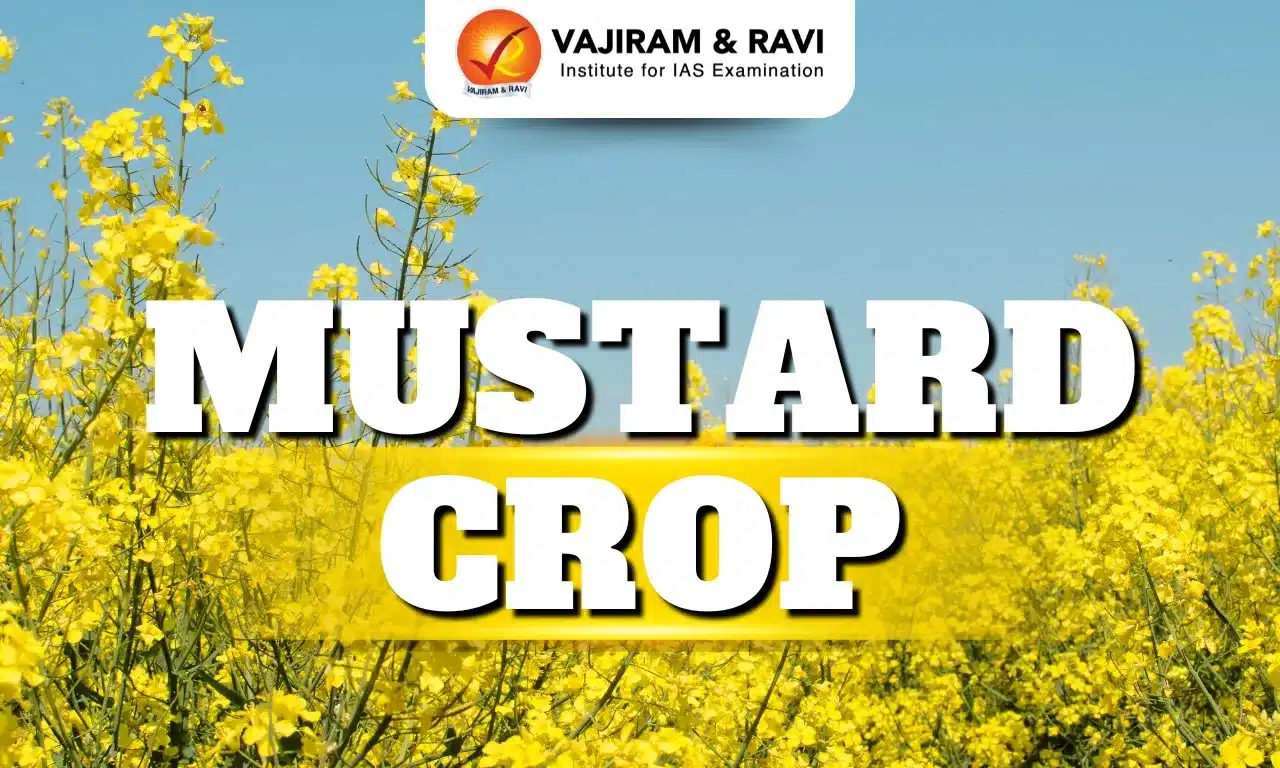
Mustard Crop

Mustard Crop

Mustard Crop Latest News

Recently, Mustard Crop has been increasingly susceptible to infestation by Orobanche aegyptiaca.

About Mustard Crop

  • It is a predominantly self-pollinating crop.
  • Common Name: Sarason (Hindi), Rai (Punjabi), Katuku (Tamil), Kaduk (Malayalam), Avalu (Telugu). 
  • Crop Season:  Rabi season 

Climatic Requirements for Mustard crop

  • Soil Requirements: Sandy loam soil is the most ideal textural classification for the cultivation of mustard crop. 
  • Mustard thrives well in dry and chilled environmental conditions.
  • Temperature: It requires temperatures ranging between 10°C to 25°C
  • Rainfall: An annual rainfall between 625 to 1000 mm is suitable for cultivation of mustard crop.
  • It is highly sensitive to frost damage. 
  • Mustard seeds and its oil is used for culinary purpose. Young leaves are used for vegetable purpose. Its oil cake is used for feeding cattle.
  • Major Mustard Production States: Rajasthan (largest producing state), Gujarat, Uttar Pradesh, West Bengal, Haryana, Punjab, Madhya Pradesh.

Key Facts about Orobanche aegyptiaca

  • It is a parasitic weed that attaches to mustard roots and siphons off water and nutrients, leading to poor plant growth and reduced seed yields.
  • This leads to wilting, yellowing, stunted plant growth and ultimately sharp declines in seed yields. 
  • This parasite remains hidden below the soil initially, damage is already extensive by the time it becomes visible.

 Source: IE

Mustard Crop FAQs

Q1: Which variety of mustard is known for its high oil content?

Ans: Pusa Bold

Q2: What is the approximate oil content of mustard seeds?

Ans: 40-45%

Yemen

Yemen

Yemen Latest News

Recently, the Southern Transitional Council (STC) in Yemen announced a new Constitution for the “State of South Arabia”.

About Yemen

  • Location: It is situated at the south-western corner of the Arabian Peninsula in Western Asia. 
  • Borders: It shares Saudi Arabia (North) and Oman (East).
  • Coastline & Strategic Importance:
    • Red Sea (West), Gulf of Aden, Arabian Sea, and Guardafui Channel (South).
    • Yemen is strategically located at the entrance of the Bab-el-Mandeb Strait. The strait links the Indian Ocean to the Red Sea via the Gulf of Aden. 
  • Capital City: Sanaa

Geographical Features of Yemen

  • Climate: It lies in the border zone between two main weather patterns: the regular northerly winds (from the Mediterranean basin) and the southwest monsoon winds.
  • Highest Point: Yemen's highest point is Jabal an Nabi Shu'ayb at 3,760 m. 
  • Desert: Rub' Al Khali Desert.
  • There are no perennial lakes and rivers. 

Source: TH

Yemen FAQs

Q1: Where is Yemen located?

Ans: West Asia

Q2: What is the capital of Yemen?

Ans: Sana'a

Q3: Yemen is bordered by which two countries?

Ans: Saudi Arabia and Oman

Indian Customs Electronic Gateway

Indian Customs Electronic Gateway

Indian Customs Electronic Gateway Latest News

Recently, the Special Secretary Central Board of Indirect Taxes & Customs (CBIC) inaugurated Indian Customs Electronic Gateway–Land Port Management System (ICEGATE–LPMS) at the Integrated Check Post (ICP), at Agartala, Tripura.

About Indian Customs Electronic Gateway

  • It is known as ICEGATE which was established in 2007.
  • It is the national portal of Indian Customs of Central Board of Indirect Taxes and Customs (CBIC).
  • It provides e-filing services to the Trade, Cargo Carriers and other Trading Partners electronically.
  • It serves as a centralized hub for all electronic interactions between Indian customs and the trading community.
  • It is the main infrastructure for connecting trade users with the Indian government’s customs department, and acts as a hub for exchanging information between external trading partners involved in international trading.
  • It is internally linked with multiple partner agencies including RBI, Banks, DGFT, DGCIS, Ministry of Steel, Directorate of Valuation and other various Partner Government Agencies involved in EXIM.
  • Functions: It collectively contributes to streamlining customs procedures, enhancing trade facilitation, and promoting transparency and efficiency in cross – border trade activities in India by providing multiple features for its users

 Integration of ICEGATE -Land Port Management System

  • The integration focuses on critical customs data elements, including Bill of Entry, Shipping Bill, Out of Charge (OOC), and Let Export Order (LEO).
  • It enables real-time, bidirectional exchange of data between ICEGATE and the Land Port Management System, creating a seamless digital ecosystem at land ports. 
  • It also helps in early risk assessment, identification of anomalies, and selective application of controls.

Source: PIB

Indian Customs Electronic Gateway FAQs

Q1: What is ICEGATE?

Ans: A national portal for electronic filing of customs documents

Q2: What is the primary objective of ICEGATE?

Ans: To facilitate international trade

Bannerghatta National Park

Bannerghatta National Park

Bannerghatta National Park Latest News

Recently, the Central Empowered Committee recommended that the Ecologically Sensitive Zone (ESZ) around Bengaluru’s Bannerghatta National Park (BNP) should be restored to its original 2016 extent.

About Bannerghatta National Park

  • Location: It is in the hills of the Anekal range, near Bangalore, Karnataka,
  • It was declared a National Park in 1974. 
  • In 2006, India’s first butterfly enclosure was inaugurated at the park.
  • River: The Suvarnamukhi stream, the main source of water for the animals in the park, runs through the centre of the park.
  • Vegetation: There are three types of vegetation that can be found: Dry Deciduous Scrub Forests, Southern Tropical Dry Deciduous Forests and Southern Tropical Moist Mixed Forests.
  • Flora: Include Narcissus latifolia, Schleichera oleosa, Sandalwood, Neem, Tamarind, Bamboo, Eucalyptus, etc.
  • Fauna: Prime habitat for several species, including the endangered Asian Elephant, Indian gaur, Tiger, Sambar deer, Spotted deer,Leopard, Wild dog, Wild pig, Sloth bear etc.

What is an Ecologically Sensitive Zone?

  • Eco-Sensitive Zones are created as “shock absorbers” for the protected areas, to minimize the negative impact on the “fragile ecosystems”.
  • These zones are notified by the Ministry of Environment, Forests and Climate Change under the Environment (Protection) Act, 1986.

Source: IE

Bannerghatta National Park FAQs

Q1: Where is Bannerghatta National Park located?

Ans: Karnataka

Q2: Bannerghatta National Park is part of which hill range?

Ans: Anekal range

Enquire Now