Key Facts about Argentina

Key Facts about Argentina

Argentina Latest News

Recently, raging wildfires in the Argentine Patagonia have blazed through nearly 12,000 hectares of scrubland and planted and native forests.

About Argentina

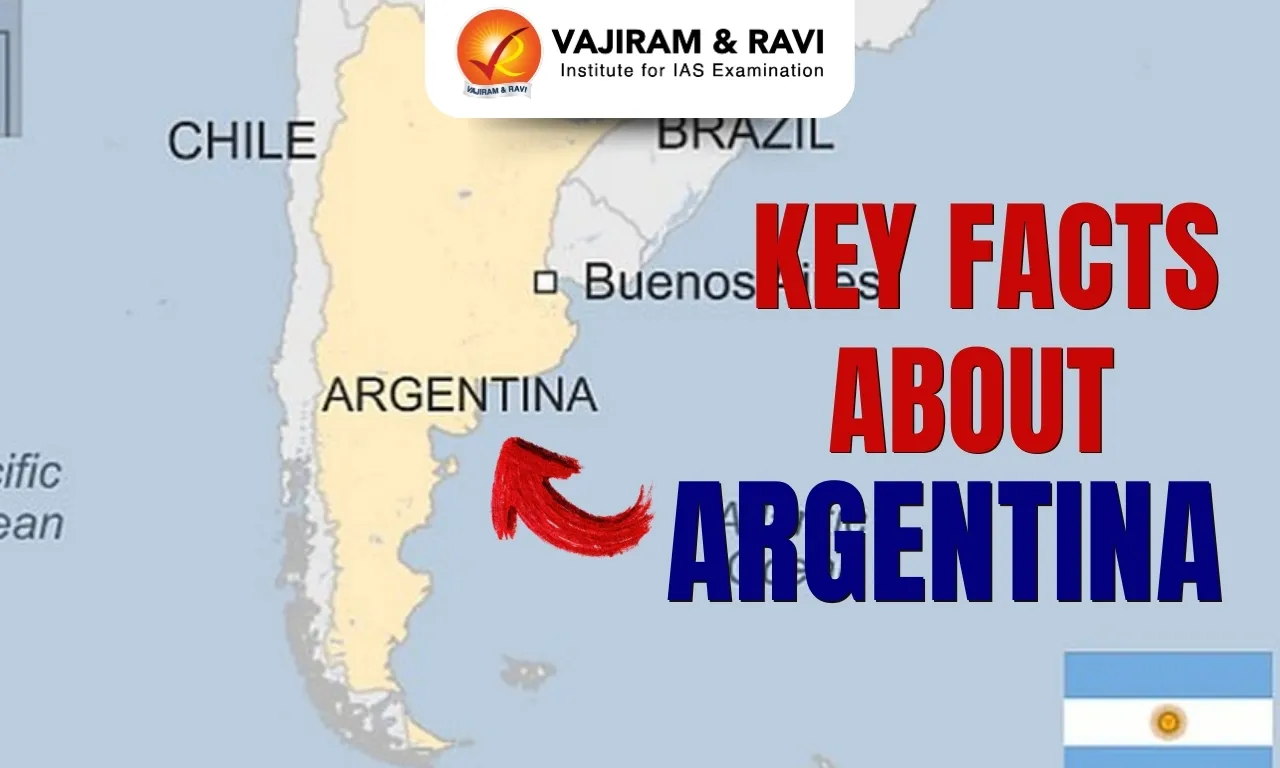
  • It is a large country occupying the southern part of South America.
  • Bordering Countries: It shares its borders with 5 countries: Chile (south and west), Bolivia and Paraguay (north), and Brazil, Uruguay (east)
  • Maritime boundaries: It is also bounded by the South Atlantic Ocean to the east and the Drake Passage to the south.
  • Capital City: Buenos Aires

Geographical Features of Argentina

  • Terrain: Argentina's landmass can be divided into four general topographical regions: the Andean region, the Pampas, the Patagonian plateau, and the Gran Chaco.
  • Climate: Mostly temperate; arid in southeast; subantarctic in southwest
  • Major rivers: Parana, Paraguay, Uruguay, etc.
  • Highest Point: Cerro Aconcagua
  • Natural Resources: Fertile plains of the pampas, lead, zinc, tin, copper, iron ore, manganese, petroleum, uranium and Lithium.
  • Northeast Argentina features rain forests and Iguazù Falls. 

Source: TH

Key Facts about Argentina FAQs

Q1: What is Argentina's primary agricultural product?

Ans: Soybeans

Q2: Which mountain range runs along Argentina's western edge?

Ans: Andes

Advisory Board on Disarmament Matters

Advisory Board on Disarmament Matters

Advisory Board on Disarmament Matters Latest News

Recently, an Indian diplomat has been nominated by the UN Secretary General as chair of Advisory Board on Disarmament Matters for 2026-27.

About Advisory Board on Disarmament Matters

  • It was established in 1978.
  • Membership: The Secretary-General chooses the members of the Board from all regions of the world for their knowledge and experience in the field of disarmament and international security.
    • There are fifteen members of the Board. The Director of UNIDIR is an ex officio member.
    • The Advisory Board holds two sessions a year, alternating between New York and Geneva. The
    • Board adopts its agenda based on requests from the Secretary-General for advice on specific disarmament issues and upon its own recommendations of items to be considered. 
    • The chairman of the Board rotates by region on a yearly basis.
    • Headquarter: New York

Functions of Advisory Board on Disarmament Matters

  • To advise the Secretary-General on matters within the area of arms limitation and disarmament
  • To serve as the Board of Trustees of the United Nations Institute for Disarmament Research (UNIDIR)
  • To advise the Secretary-General on the implementation of the United Nations Disarmament Information Programme

Source: ET

Advisory Board on Disarmament Matters FAQs

Q1: Who chairs the Advisory Board on Disarmament Matters for 2026-27?

Ans: DB Venkatesh Varma

Q2: What is the primary role of the Advisory Board on Disarmament Matters?

Ans: To advise the UN Secretary-General on disarmament issues

Valley of Flowers National Park

Valley of Flowers National park

Valley of Flowers National Park Latest News

With forest fire raging in the Valley of Flowers, a UNESCO heritage site, for the last five days, the Uttarakhand Disaster Management Department has sought the Indian Air Force’s (IAF) help to douse the inferno.

About Valley of Flowers National Park

  • It is located in the Chamoli district of Uttarakhand.
  • It is spread over an area of 87 sq.km.
  • The valley is believed to have been discovered in 1931, when three British mountaineers – led by Frank S. Smythe – lost their way and chanced upon this spectacular valley. 
  • It is a UNESCO World Heritage Site and forms one of the two core zones (the other being the Nanda Devi National Park) of the Nanda Devi Biosphere Reserve.
  • The gentle landscape of the Valley of Flowers National Park complements the rugged mountain wilderness of Nanda Devi National Park. 
  • Together they encompass a unique transition zone between the Zanskar and Great Himalayan ranges.
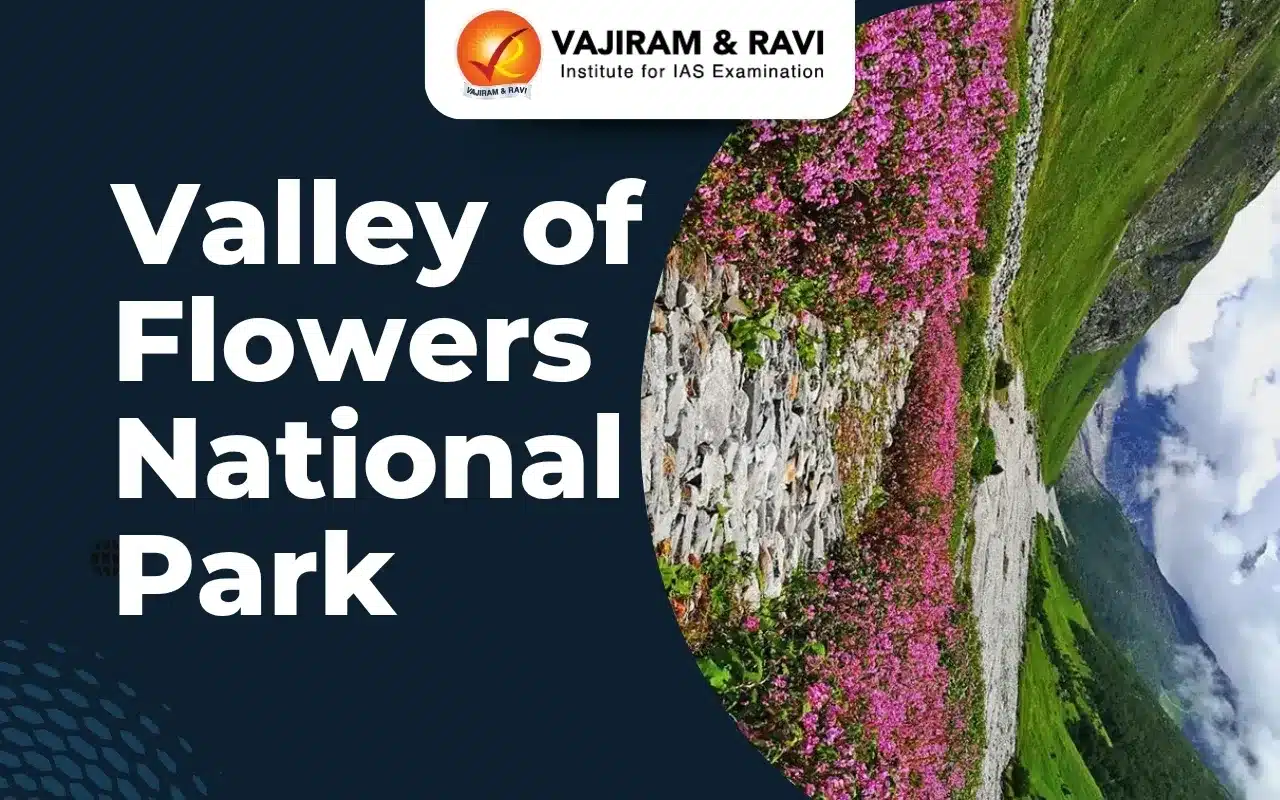
  • It is famed for its vibrant alpine meadows, rich biodiversity, and breathtaking scenic beauty. 
  • It has snow-capped peaks of the Himalayas as a backdrop. 
  • It remains covered with a thick blanket of snow during the winter season.
  • Flora: 
    • Exotic flowers (over 600 species) like orchids, poppies, primulas, marigolds, daisies, and anemones are an eye-catching spectacle. 
    • The valley also abounds in medicinal plants and herbs. 
    • Sub-alpine forests birch and rhododendron cover parts of the park’s area.
    • Fauna: It is home to such rare and amazing wildlife species like the gray langur, the flying squirrel, the Himalayan weasel, black bear, the red fox, the lime butterfly, and the snow leopard.

Source:TH


Valley of Flowers National Park FAQs

Q1: Where is the Valley of Flowers National Park located?

Ans: It is located in the Chamoli district of Uttarakhand.

Q2: Is Valley of Flowers National Park, a UNESCO World Heritage Site?

Ans: Yes, Valley of Flowers National, is a UNESCO World Heritage Site.

Q3: Which biosphere reserve does the Valley of Flowers National Park form a part of?

Ans: The Nanda Devi Biosphere Reserve.

Q4: For what natural features is the Valley of Flowers National Park famous?

Ans: Vibrant alpine meadows, rich biodiversity, and scenic beauty.

Q5: Which types of exotic flowers are commonly found in the Valley of Flowers?

Ans: Orchids, poppies, primulas, marigolds, daisies, and anemones.

Drosophila Melanogaster

Drosophila Melanogaster

Drosophila Melanogaster Latest News

Researchers studied the ovaries of the fruit fly Drosophila melanogaster to investigate the mechanisms that maintain the function of reproductive stem cells over time.

About Drosophila Melanogaster

  • It is colloquially known as the fruit fly.
  • Habitat: It lives in a wide range of habitats.
  • Native habitats include those in the tropical regions of the Old World, but the common fruit fly has been introduced to almost all temperate regions of the world.
  • Food Habit: The fruit flies lives primarily on plant material. The adults thrive on rotting plants
  • Reproduction: Reproduction in Drosophila is rapid. A single pair of flies can produce hundreds of offspring within a couple of weeks, and the offspring become sexually mature within one week.

Physical Description of Drosophila Melanogaster

  • Drosophila matures through complete metamorphosis.
  • It is covered in a chitinous exoskeleton; has three main body segments; and has three pairs of segmented legs.
  • They are easily drawn towards the smell of any food source
  • Their eyes are sensitive to slight differences in light intensity.
  • They are sexually dimorphic (males and females are different), making it is quite easy to differentiate the sexes.
  • It remains one of the most commonly used model organisms for biomedical science. 

Source: PIB

Drosophila melanogaster FAQs

Q1: What is Drosophila melanogaster commonly known as?

Ans: Fruit fly

Q2: Why is Drosophila melanogaster used in genetic research?

Ans: Rapid reproduction and simple genetics

Zanskar River

Zanskar River

Zanskar River Latest News

The much-awaited Chadar trek on the frozen Zanskar River in Ladakh has been deferred due to inadequate ice formation, disappointing trekkers eager to participate in the adventure sport.

About Zanskar River

  • It is a major left-bank tributary of the Indus River, flowing entirely within the union territory of Ladakh in northern India.
  • It drains the remote Zanskar Valley in the northwestern Himalayas.
  • Course: 
    • The Zanskar River starts high in the Himalayas. 
    • The Zanskar River has two main branches; one is Doda, with main source near Pansi-La Pass, and the other branch is formed by the Kargyag River (source near Shingo La) and the Tsarap River (source near Baralacha La). 
    • The river meanders northwestwards and finally meets the Indus River near Nimmu of the Ladakh region at an elevation of about 3,100 meters.
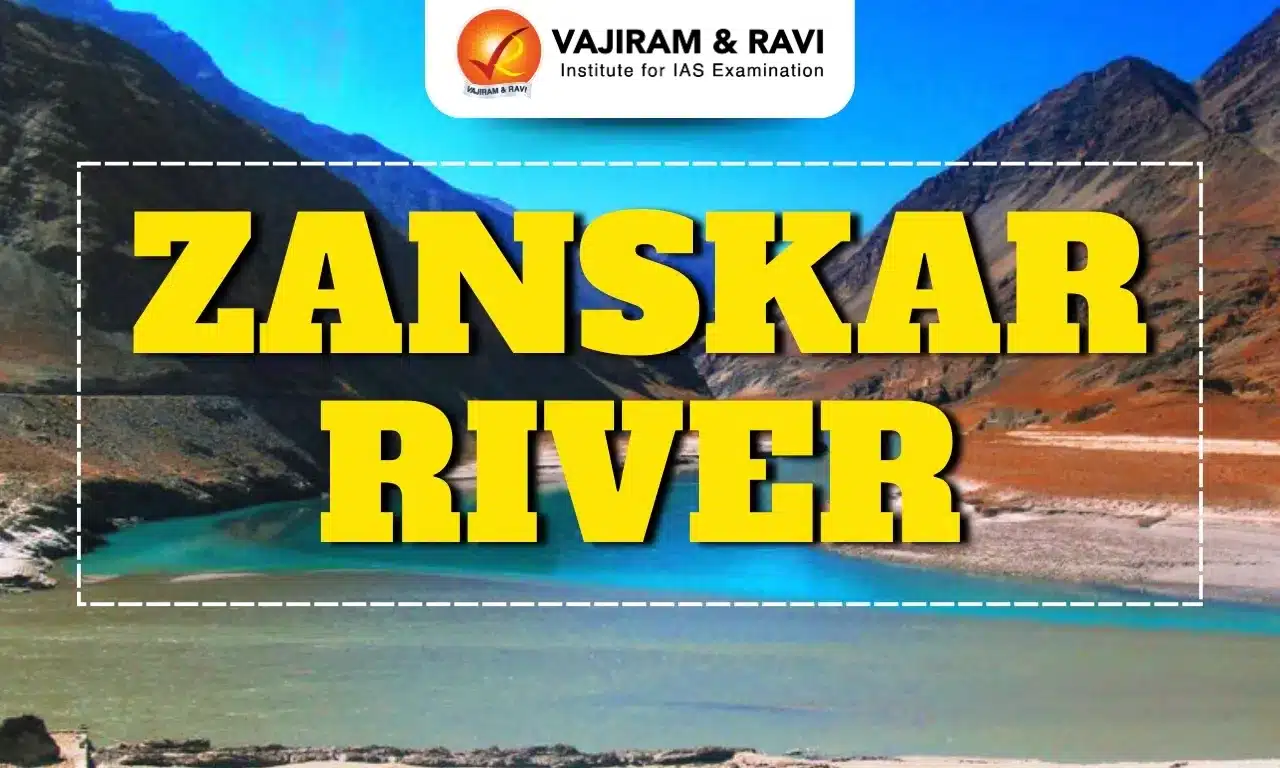
  • It is famous for its incredible Zanskar Gorge, which is a super deep canyon it has carved over many years. 
  • The entire catchment area of the Zanskar River has been formed by the action of glaciers. 
  • Its valley is U-shaped, and a number of hanging valleys open into it.
  • The Zanskar River offers immense opportunities for expeditions to adventure lovers.
    • In the summer season, tourists can embark on river rafting trips, especially in the stretches between Chilling and Nimmu. 
    • Winter brings a unique and thrilling experience of walking along the frozen river of Zanskar, which is often called ‘Chadar Trek’.

Source: TRI

Zanskar River FAQs

Q1: The Zanskar River is a tributary of which major river?

Ans: It is a major left-bank tributary of the Indus River.

Q2: Does the Zanskar River flow entirely within the Union Territory of Ladakh?

Ans: Yes, it flows entirely within Ladakh.

Q3: Near which place does the Zanskar River meet the Indus River?

Ans: Near Nimmu in Ladakh.

Q4: Which deep canyon has been carved by the Zanskar River?

Ans: The Zanskar Gorge.

Q5: What is the winter trek along the frozen Zanskar River popularly called?

Ans: The Chadar Trek.

Artemis II Mission

Artemis II Mission

Artemis II Mission Latest News

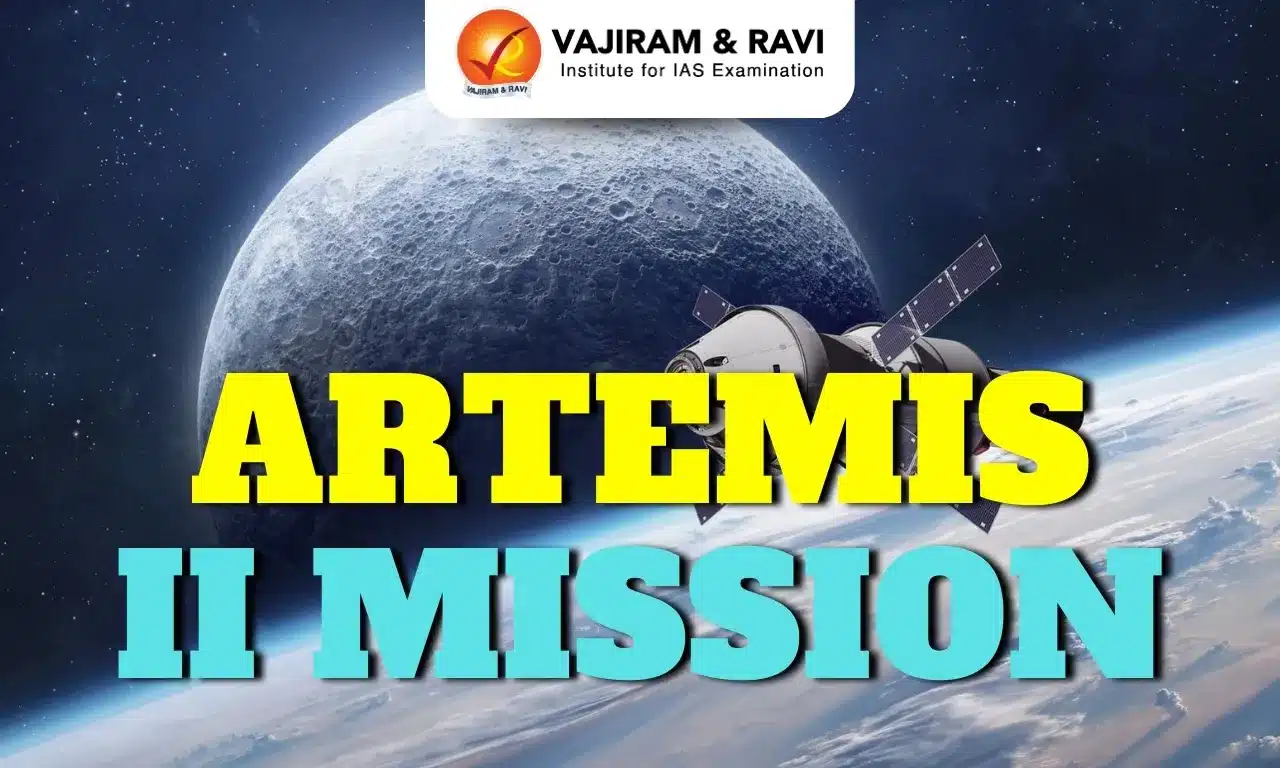
NASA is on track to send humans around the moon as early as the first week of February as it makes final preparations for the imminent rollout of its Artemis 2 mega moon rocket.

About Artemis II Mission

  • It will be the first mission to carry humans to the moon’s vicinity since 1972.
  • It is the second scheduled flight of the Artemis program and the first crewed Artemis mission. 
  • It is the first to fly astronauts aboard the Space Launch System (SLS) rocket and Orion spacecraft. 
  • While Artemis 1 successfully flew Orion around the moon without astronauts in 2022, Artemis 2 will be the first time humans travel aboard the spacecraft and venture beyond low Earth orbit in more than 50 years.
  • Four astronauts will take a 10-day flight around the moon and back to Earth, testing systems ahead of the Artemis 3 mission, which aims to deliver astronauts to the lunar surface by 2028.
  • The mission will include three NASA astronauts and one astronaut from the Canadian Space Agency (CSA).
  • Several payloads will fly aboard Artemis II to expand our knowledge of space radiation, human health and behavior, and space communications.
  • The astronauts and mission controllers will collect data on Orion and the crew’s performance to assess how ready the Artemis program is to send people to the moon’s surface.
  • Orion will undergo high-speed reentry through Earth's atmosphere before safely splashing down in the Pacific Ocean off the coast of San Diego.

Key Facts of Artemis Program

  • It is NASA’s program to return astronauts to the Moon, preparing the way for human missions to Mars.
  • It aims to “land the first woman and first person of colour on the Moon“, explore the lunar surface.
  • The Artemis program includes the construction of the Lunar Gateway space station in orbit around the Moon.
  • The next missions are currently in preparation:
    • Artemis 3 will be the first crewed Moon landing mission since Apollo 17 in 1972. 
      • NASA aims to land the first female astronaut and first astronaut of colour on the lunar surface. 
      • They will spend a week on the Moon performing scientific studies, before returning to Earth.
    • Artemis 4 will deliver a core part of a new lunar space station (named 'Gateway') into orbit around the Moon, and land another two astronauts on the Moon's surface.
    • Artemis 5 will add another important module to Gateway and involve a third crewed lunar landing to undertake further surface science.

Source: LS

Artemis II Mission FAQs

Q1: Which mission will be the first to carry humans to the Moon’s vicinity since 1972

Ans: Artemis II Mission.

Q2: How many astronauts will fly on the Artemis II mission?

Ans: Four astronauts.

Q3: Which spacecraft will carry the crew on the Artemis II mission?

Ans: Orion spacecraft.

Q4: What is the primary purpose of the Artemis II mission?

Ans: To test systems and crew performance before Artemis III.

Q5: What types of scientific data will Artemis II payloads collect?

Ans: Data on space radiation, human health and behavior, and space communications.

White Dwarf

White Dwarf

White Dwarf Latest News

Recently, astronomers have observed a white dwarf that is creating a colorful shockwave as it moves through space.

About White Dwarf

  • It is the stellar core left behind after a dying star has exhausted its nuclear fuel and expelled its outer layers to form a planetary nebula.
  • It is what stars like the Sun become after they have exhausted their nuclear fuel.

Characteristics of White dwarfs 

  • It no longer supports nuclear fusion reactions that generate energy, but they are still extremely hot.
  • Size: A typical white dwarf is half as massive as the Sun, yet only slightly bigger than Earth. 
  • This makes white dwarfs one of the densest collections of matter, surpassed only by neutron stars.
  • Composition: A newly born white dwarf consists of helium, carbon, and oxygen nuclei, swimming in a sea of highly energetic electrons.
  • Unlike most other stars that are supported against their own gravitation by normal gas pressure, white dwarf stars are supported by the degeneracy pressure of the electron gas in their interior.
  • Degeneracy pressure is the increased resistance exerted by electrons composing the gas, as a result of stellar contraction.
  • Unless it is accreting matter from a nearby star, the white dwarf cools down over the next billion years or so.
  • It is predicted that they would ultimately form ‘black dwarfs’, although the Universe is likely not old enough for any black dwarfs to exist yet.
  • The luminosity of white dwarfs can therefore be used by astronomers to measure how long-ago star formation began in a particular region.

Source: DD News

White Dwarf FAQs

Q1: What is a white dwarf?

Ans: A stellar core left after a star exhausts nuclear fuel

Q2: What supports a white dwarf against gravity?

Ans: Electron degeneracy pressure

Urban Cooperative Banks

Urban Cooperative Banks

Urban Cooperative Banks Latest News

The Reserve Bank of India (RBI) proposed resuming the issuance of licenses for Urban Cooperative Banks (UCBs) after nearly two decades. 

About Urban Cooperative Banks

  • Urban Cooperative Banks are not formally defined but refers to primary cooperative banks located in urban and semi-urban areas
  • History: The first formal co-operative legislation in India came with the Co-operative Credit Societies Act of 1904 (During Lord Curzon’s tenure) and also enacted the more comprehensive Co-operative Societies Act of 1912.
    • The first urban cooperative credit society,(Anyonya Sahakari Mandali) was established in 1889 in Baroda.
  • Functions: Provide services like housing finance, personal loans, MSME credit, and deposits to small borrowers, traders, and small-scale industries.
  • They are registered as cooperative societies under the provisions of, either the State Cooperative Societies Act of the State concerned or the Multi State Cooperative Societies Act, 2002.
  • Regulation: The Reserve Bank regulates and supervises the banking functions of UCBs under the provisions of Banking regulation Act, 1949.
    • Banking related functions (viz. licensing, area of operations, interest rates etc.) are to be governed by RBI.
    • Registration, management, audit and liquidation, etc. are governed by State Governments as per the provisions of respective State Acts.
    • The Reserve Bank has vested powers to issue licenses to UCBs under Section 22 and 23 Banking Regulation Act, 1949 to carry on banking business and to open new places of business(branches, extension counters, etc.) respectively.

Source: ET

Urban Cooperative Banks FAQs

Q1: Who regulates Urban Cooperative Banks in India?

Ans: RBI

Q2: What is the primary purpose of Urban Cooperative Banks?

Ans: Providing credit to small borrowers and urban communities

Enquire Now