National Voters’ Day

National Voters’ Day

National Voters' Day Latest News

Recently, the Prime Minister of India extended greetings to citizens on the occasion of National Voters’ Day.

About National Voters' Day

  • It is observed on January 25th across India every year since 2011 to commemorate the foundation day of the Election Commission of India.
  • It is celebrated to honour voters, encourage youth participation, and strengthen democratic values, and promote universal adult suffrage.
  • It celebrates democracy and empowers every citizen to take part in the electoral process. 
  • Theme: The theme for National Voters' Day 2026 is "My India, My Vote" with a tagline of "Citizen at the Heart of Indian Democracy.
  • It is celebrated at the level of national, state, district, constituency, and polling booth NVD stands as one of the country’s most widespread and significant celebrations.
  • It is dedicated to the voters of the nation, National Voters’ Day also promotes the enrolment of new voters, particularly young individuals who have recently become eligible.

Source: PIB

National Voters' Day FAQs

Q1: When is National Voters' Day celebrated every year?

Ans: January 25

Q2: What is the main objective of National Voters' Day?

Ans: To encourage voter registration and participation

Madras Hedgehog

Madras Hedgehog

Madras Hedgehog Latest News

For the first time, the Tamil Nadu forest department has begun a study on the rare mammal species Madras Hedgehog at the Theri forests in the district. 

About Madras Hedgehog

  • Madras Hedgehog, locally known as Mulleli is a tiny mammal.
  • It is also known as the bare-bellied hedgehog, discovered in 1851.
  • It has sharp spines on its back and soft white fur on its belly.
  • Its spines offer protection from predators such as foxes, jackals and mongooses.
  • It is a nocturnal species curls into a ball to protect itself from danger.
  • It has mastered survival in some of the harshest and driest landscapes.
  • Habitat: The species prefers dry scrublands, thorn forests, grasslands and the edges of farmlands. 
  • Distribution: It is found only in peninsular India, primarily across Tamil Nadu, Kerala, Andhra Pradesh and parts of Karnataka.
  • Diet: It feeds on insects such as beetles, ants, earthworms and termites, apart from plants.
  • Conservation Status: IUCN: Least Concern
  • Threats: Its population declined largely due to hunting driven by mythical beliefs that its quills and meat have medicinal value.

Hedgehog Species in India

  • Of the 17 species of hedgehog around the world, India is home to three:
    • Indian Long-eared or collared hedgehog
    • Indian hedgehog
    • Bare-bellied or Madras hegehog

Source: NIE

Madras Hedgehog FAQs

Q1: What is the scientific name of the Madras Hedgehog?

Ans: Paraechinus nudiventris

Q2: Where is the Madras Hedgehog primarily found?

Ans: Southern India

Agarwood

Agarwood

Agarwood Latest News

Recently, the union Minister for Development of North Eastern Region laid the foundation stone for the ₹80 crore Agarwood Value Chain Development Scheme.

About Agarwood

  • Aquilaria malaccensis, commonly known as agarwood, is a species of tree belonging to the Thymelaeaceae family.
  • It is also known as Oud, Gaharu or Agar is prized as the world’s most valuable incense. 
  • The resin is produced as a defence mechanism due to the intense stress suffered by the trees when they are infected by a type of mold belonging to the Phaeoacremonium species (Phialophora parasitica).
  • The Aquilaria tree is a fast-growing, subtropical forest tree.
  • Distribution: It is mainly found in South Asia’s Himalayan foothills, throughout Southeast Asia, and into the rainforests of Papua New Guinea.
    • In India, it grows in the wild in the Northeast, especially in Assam, Tripura, Arunachal Pradesh, Nagaland, Mizoram and Manipur.
  • Soil: Aquilaria can grow on a wide range of soils, including poor sandy soil.
  • Applications of Agarwood: The resinous wood is used as incense, for medicinal purposes, and pure resin in distilled form is used as an essential oil as well as a perfume component. 

Characteristics of Agarwood

  • It grows at elevations from a few meters above sea level to about 1000 meters, with approx. 500 meters being most ideal.
  • Seedlings require a great deal of shade and water but will grow rapidly, producing flowers and seeds as early as four years old. 
  • In the wild, it takes nearly a decade for a tree to mature

Source: PIB

Agarwood FAQs

Q1: Agarwood is primarily found in which region?

Ans: Southeast Asia

Q2: What is the main use of Agarwood?

Ans: Perfume and incense

Advanced Chemistry Cell Production Linked Incentive (ACC-PLI) Scheme

Advanced Chemistry Cell Production Linked Incentive (ACC-PLI) scheme

Advanced Chemistry Cell Production Linked Incentive (ACC-PLI) Scheme Latest News

Recently, it was observed that there is a substantial gap between the intended and actual outcomes of the Advanced Chemistry Cell Production Linked Incentive (ACC-PLI) scheme.

About Advanced Chemistry Cell Production Linked Incentive (ACC-PLI) scheme

  • It was launched in October 2021 to catalyse domestic manufacturing of next-generation battery cells. 
  • It is aimed to set up 50 gigawatt hour (GWh) of battery cell manufacturing capacity by 2026.
  • It is also aimed to build a local battery supply chain (cathode, anode, electrolyte) to reduce import dependence, mobilising private investments and global tech partnerships, lowering battery costs, and accelerating electric vehicle (EV) and energy storage adoption.
  • Nodal Ministry: It was launched by the Ministry of Heavy Industries.
  • Total Outlay: With a total financial outlay of Rs. 18,100 crore.

Features of Advanced Chemistry Cell Production Linked Incentive (ACC-PLI) scheme

  • Incentives: Under the scheme, selected manufacturers were promised incentives linked to actual battery sales, with a maximum subsidy of about Rs. 2,000 per kilowatt-hour. 
  • Companies were required to make a minimum investment of Rs. 1,100 crore and meet phased domestic value-addition targets, 25% within two years and 60% within five years.
  • Beyond capacity creation, the policy intended to develop a complete battery supply chain covering cathodes, anodes, electrolytes, and cell assembly, while also generating over one million jobs.

Source: TH

Advanced Chemistry Cell Production Linked Incentive (ACC-PLI) Scheme FAQs

Q1: What is the objective of ACC-PLI scheme?

Ans: To boost domestic value addition in battery production

Q2: What is the total outlay for ACC-PLI scheme?

Ans: ₹18,100 Crore

Forever Chemicals

What are Forever Chemicals

Forever Chemicals

When scientists tested human blood samples collected from 2003 to 2021, they found that levels of older PFAS, a.k.a. “Forever chemicals” dropped by 86% because manufacturers stopped producing them.

About Forever Chemicals

  • Forever chemicals, or PFAS (per- and poly- fluoroalkyl substances), are a large chemical family of thousands of highly persistent, toxic, man-made, hazardous chemicals.
  • PFAS molecules have a chain of linked carbon and fluorine atoms. Because the carbon-fluorine bond is one of the strongest, these chemicals do not degrade easily in the environment.
  • The name ‘forever chemicals’ comes from the fact that they remain in the environment without breaking down for generations, if ever.
  • In manufacturing, PFAS are favoured for their durability and useful properties such as non-stick, water repellence, and anti-grease. 
  • PFAS are used in the manufacture of many domestic products, including:
    • skin creams and cosmetics,
    • car and floor polish,
    • rinse aid for dishwashers,
    • textile and fabric treatments,
    • food packaging and microwave popcorn bags,
    • baking equipment,
    • frying pans,
    • outdoor clothing and shoes.
  • They also have many and widespread uses in industry, including in firefighting foam.
  • Over time, PFAS may leak into the soil, water, and air.
  • People are most likely exposed to these chemicals by consuming PFAS-contaminated water or food, using products made with PFAS, or breathing air containing PFAS
  • Because PFAS breaks down slowly, if at all, people and animals are repeatedly exposed to them, and blood levels of some PFAS can build up over time.
  • Impacts of PFAS on Human Health: Forever chemicals have been linked to multiple health problems, including compromised immune systems, liver damage, thyroid diseases, increased cholesterol levels, hypertension, developmental delays in infants, and increased certain cancers such as kidney and testicular. 
  • Regulation: The Stockholm Convention has listed some PFAS, such as Perfluorooctane sulfonic acid (PFOS) and Perfluorooctanoic acid (PFOA), as persistent organic pollutants (POPs).

Source: TH


Forever Chemicals FAQs

Q1: What are forever chemicals?

Ans: Forever chemicals are PFAS (per- and poly-fluoroalkyl substances), a large family of highly persistent, toxic, man-made hazardous chemicals.

Q2: What is the basic molecular structure of forever chemicals?

Ans: Forever chemicals consist of a chain of linked carbon and fluorine atoms.

Q3: Why do forever chemicals not degrade easily in the environment?

Ans: Because the carbon-fluorine bond is one of the strongest chemical bonds.

Q4: Why are forever chemicals widely used in manufacturing?

Ans: They are valued for durability and properties such as non-stick, water repellence, and anti-grease.

Q5: Why do forever chemicals accumulate in the human body?

Ans: Because they break down very slowly, leading to repeated exposure and buildup of forever chemicals in blood over time.


Granth Kutir

Granth Kutir

Granth Kutir Latest News

Recently, the President of India inaugurated Granth Kutir at Rashtrapati Bhavan.

About Granth Kutir

  • It has a rich collection of manuscripts and books in 11 classical languages of India which are Tamil, Sanskrit, Kannada, Telugu, Malayalam, Odia, Marathi, Pali, Prakrit, Assamese, and Bengali.
  • Aim: The aim of developing the Granth Kutir is to enhance awareness among the citizens regarding the rich cultural and literary heritage of India.
  • It showcases India’s rich and diverse cultural, philosophical, literary and intellectual heritage.
  • It has a collection of about 2,300 books in 11 Indian classical languages of India.
  • Coverage: The collection covers a wide range of subjects such as epics, philosophy, linguistics, history, governance, science, and devotional literature as well as the Constitution of India in these languages.
  • It has been developed through collaboration with central government, state governments, universities, research institutions, cultural organisations, and individual donors from across the country. 
  • It supports the vision of Gyan Bharatam Mission.
    • The Gyan Bharatam Mission is a comprehensive national initiative under the Ministry of Culture, Government of India, dedicated to the systematic survey, documentation, conservation, and digitisation of India’s vast manuscript heritage.

Source: PIB

Granth Kutir FAQs

Q1: Who inaugurated Granth Kutir at Rashtrapati Bhavan?

Ans: President of India

Q2: How many classical languages are represented in Granth Kutir?

Ans: 11

Schizophrenia

What is Schizophrenia

Schizophrenia Latest News

Researchers analysing data from more than half a million people find that compared to the general population, people with schizophrenia are more likely to have weaker bones and to suffer fractures.

About Schizophrenia

  • Schizophrenia is a serious mental disorder characterized by disruptions in thought processes, perceptions, emotional responsiveness, and social interactions. 
  • Although the course of schizophrenia varies among individuals, schizophrenia is typically persistent and can be both severe and disabling.
  • Cause
    • Researchers believe that several genetic and environmental factors contribute to the risk of developing schizophrenia, and life stressors may play a role in the start of symptoms and their course. 
    • Since multiple factors may contribute, scientists cannot yet be specific about the exact cause in each individual case.
  • Symptoms
    • Symptoms of schizophrenia include psychotic symptoms such as hallucinations, delusions, and thought disorder, as well as reduced expression of emotions, reduced motivation to accomplish goals, difficulty in social relationships, motor impairment, and cognitive impairment. 
    • Suicidal thoughts and attempts are much higher than average in people with schizophrenia.
    • Although symptoms typically start in late adolescence or early adulthood, schizophrenia is often viewed from a developmental perspective. 
    • Cognitive impairment and unusual behaviors sometimes appear in childhood, and persistent presence of multiple symptoms represent a later stage of the disorder. 
    • This pattern may reflect disruptions in brain development as well as environmental factors such as prenatal or early life stress. 
  • Schizophrenia affects approximately 23 million people, or 1 in 345 people (0.29%), worldwide. 
  • Stigma against people with this condition is intense and widespread, causing social exclusion and impacting their relationships with others, including family and friends. 
  • Treatment
    • There is no cure for schizophrenia. People with schizophrenia need lifelong treatment. 
    • This includes medicine, talk therapy, and help in learning how to manage daily life activities.

Source: TH


Schizophrenia FAQs

Q1: What is schizophrenia?

Ans: Schizophrenia is a serious mental disorder.

Q2: What factors contribute to the development of schizophrenia?

Ans: A combination of genetic and environmental factors contributes to the risk, with life stressors playing a role in triggering symptoms.

Q3: What are the main psychotic symptoms of schizophrenia?

Ans: Psychotic symptoms include hallucinations, delusions, and thought disorder.

Q4: At what age do symptoms of schizophrenia usually begin?

Ans: Symptoms typically begin in late adolescence or early adulthood.

Q5: Is there a cure for schizophrenia?

Ans: No, there is no cure for schizophrenia.

What is Sonic Boom?

What is Sonic Boom

Sonic Boom Latest News

Researchers have used seismometers to detect the sonic booms created by debris from orbit falling back to the earth.

About Sonic Boom

  • A sonic boom is a thunderous noise caused by an object, like an aircraft, moving faster than the speed of sound.
  • How is it Formed?
    • As the object zooms through the sky, the air molecules around it are pushed aside with tremendous force, generating shock waves along its flight path. 
    • The release of pressure, following the shock waves’ buildup, is heard as the sonic boom.
    • Sonic booms create huge amounts of sound energy.
  • The intensity of the sonic boom is determined not only by the distance between the craft and the ground but also by the size and shape of the aircraft, the types of maneuvers that it makes, and the atmospheric pressure, temperature, and winds.
    • A larger and heavier aircraft must displace more air and create more lift to sustain flight, compared with small, light aircraft. 
    • Therefore, they will create sonic booms stronger and louder than those of smaller, lighter aircraft. 
    • The larger and heavier the aircraft, the stronger the shock waves will be.
    • Generally, the higher the aircraft, the greater the distance the shock wave must travel, reducing the intensity of the sonic boom.
    • If the aircraft is especially long, double sonic booms might be detected, one emanating from the leading edge of the plane and one from the trailing edge.
  • Visible Effects:
    • Sometimes, you can see a cloud or a cone shape around an aircraft making a sonic boom. This isn't the sound itself. 
    • It's water vapor in the air that suddenly cools down due to the pressure changes from the shock wave. This makes a temporary cloud.
  • Sonic booms can shatter glass, but there is generally little risk for people on the ground.

Source: TH


Sonic Boom FAQs

Q1: What is a sonic boom?

Ans: A sonic boom is a thunderous noise produced when an object, such as an aircraft, travels faster than the speed of sound.

Q2: What causes the sound heard as a sonic boom?

Ans: The sound is caused by the sudden release of pressure following the buildup of shock waves.

Q3: Do sonic booms involve large amounts of sound energy?

Ans: Yes, sonic booms create huge amounts of sound energy.

Q4: Why do larger and heavier aircraft create stronger sonic booms?

Ans: Because they displace more air and generate greater lift, producing stronger shock waves.

Q5: How does altitude affect the intensity of a sonic boom?

Ans: Greater altitude reduces the intensity because the shock waves travel a longer distance before reaching the ground.

Strobilanthes riteshii

What is Strobilanthes riteshii

Strobilanthes riteshii Latest News

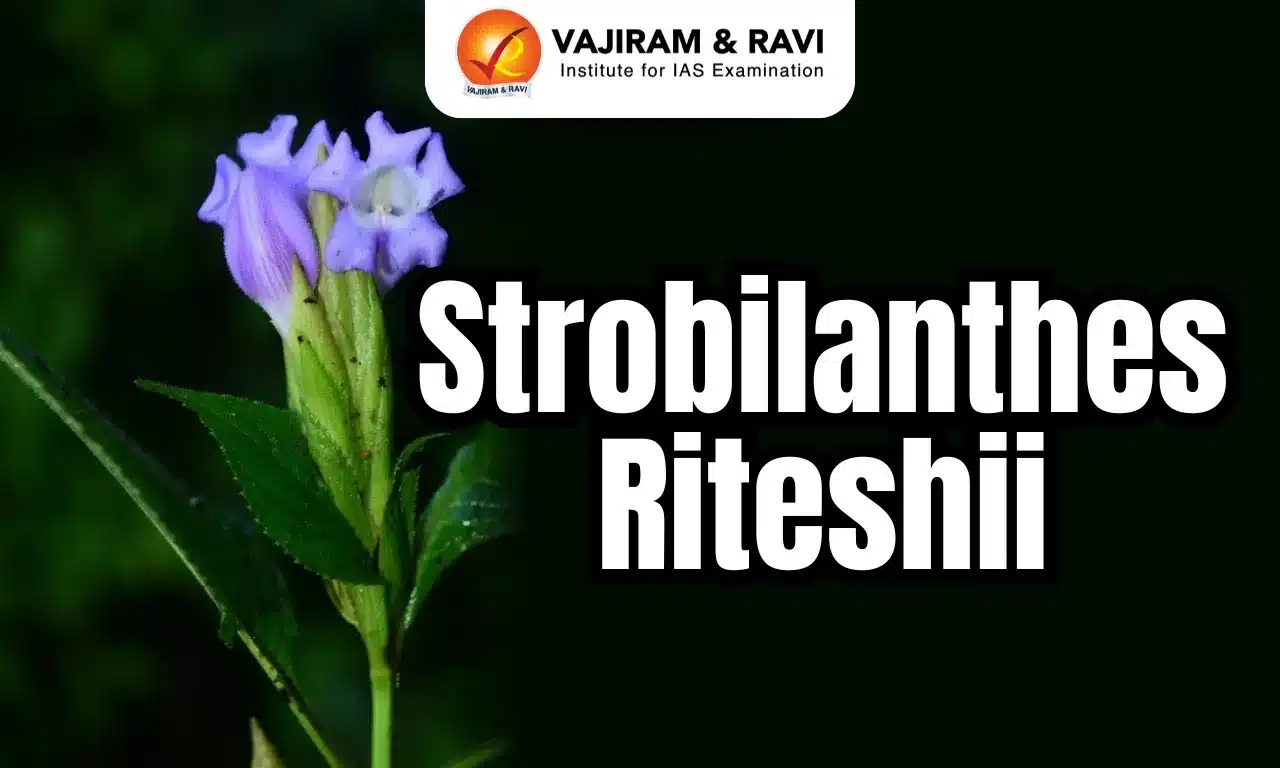
A new flowering plant species named Strobilanthes riteshii has been formally recorded from Arunachal Pradesh recently.

About Strobilanthes riteshii

  • It is a new species of flowering plant.
  • It belongs to the family Acanthaceae.
  • It was discovered during recent floristic surveys at Chayangtajo in the East Kameng district, Arunachal Pradesh.
  • The plant is currently known only from its type locality at an elevation of around 1,600 metres. 
  • It grows along roadsides on open hill slopes, often near small waterfalls and streams within evergreen forest patches. 
  • Flowering has been observed between August and October, while fruiting occurs from September to December.
  • The species has been named Strobilanthes riteshii in honour of Dr. Ritesh Kumar Choudhary, an Indian plant taxonomist at the Agharkar Research Institute, recognising his contributions to plant taxonomy and molecular systematics.
  • Based on current information, the species has been provisionally assessed as Data Deficient under the IUCN Red List criteria, indicating that more field data is required to understand its population status and threats.

Source: IT


Strobilanthes riteshii FAQs

Q1: What is Strobilanthes riteshii?

Ans: It is a newly discovered species of flowering plant.

Q2: Where was Strobilanthes riteshii discovered?

Ans: It was discovered at Chayangtajo in the East Kameng district of Arunachal Pradesh.

Q3: What type of habitat does Strobilanthes riteshii grow in?

Ans: It grows along roadsides on open hill slopes near small waterfalls and streams within evergreen forest patches.

Q4: Why is the species named Strobilanthes riteshii?

Ans: The species has been named Strobilanthes riteshii in honour of Dr. Ritesh Kumar Choudhary, an Indian plant taxonomist.

Q5: What is the IUCN Red List status of Strobilanthes riteshii?

Ans: It has been provisionally assessed as Data Deficient.

Java Island

Java Island

Java Island Latest News

Indonesia’s main island of Java has been recently hit by a massive landslide in which at least 8 people have been reported to be killed.

About Java Island

  • It is a very large island in the country of Indonesia
  • It is the 13th largest island globally. It is also the fifth largest in Indonesia. 
  • It's part of the Greater Sunda Islands, which also includes Sumatra, Borneo, and Sulawesi.  
  • To the north of the island is the Java Sea, across which the island of Borneo is found. 
  • To the south is part of the Indian Ocean.
  • To Java’s northwest, across the Sunda Strait, is the island of Sumatra.
  • Java was created by volcanoes. This happened because the Australian Plate slid under the Sunda Plate.  
  • History:
    • It was once the center of powerful Hindu-Buddhist kingdoms. 
    • Later, Islamic sultanates ruled the island. 
    • It also became the main part of the colonial Dutch East Indies. 
    • Java was key to Indonesia's fight for independence in the 1930s and 1940s.
  • Java is the most populated island in the world. 
    • About 156.4 million people live there. This means about 56% of all Indonesians call Java home. 
  • Jakarta, Indonesia's capital city, is on Java's northwest coast.

Source: WION


Java Island FAQs

Q1: Which country does Java Island belong to?

Ans: Java is a very large island in the country of Indonesia.

Q2: Which island group does Java belong to?

Ans: Java is part of the Greater Sunda Islands.

Q3: Which sea lies to the north of Java?

Ans: The Java Sea lies to the north of Java.

Q4: Which ocean lies to the south of Java?

Ans: Part of the Indian Ocean lies to the south of Java.

Q5: Which island lies northwest of Java across the Sunda Strait?

Ans: Sumatra lies northwest of Java across the Sunda Strait.

Enquire Now