Euratom

Euratom

Euratom Latest News

The European Union (EU) and India recently committed to promoting collaboration on the peaceful uses of nuclear energy under the India-Euratom agreement.

About Euratom

  • The European Atomic Energy Community (Euratom) is an international organization established under the Treaty of Rome in 1957.
  • Objective: To form a common market for the development of the peaceful uses of atomic energy. 
  • A major incentive for the creation of Euratom was the desire to facilitate the establishment of a nuclear-energy industry on a European rather than a national scale. 
  • Euratom’s control was not extended to nuclear materials intended for military use.
  • Membership
    • The original members were Belgium, France, West Germany, Italy, Luxembourg, and the Netherlands. 
    • It subsequently came to include all members of the European Union (EU).
  • Euratom regulates the European civil nuclear industry, which produces almost 30% of energy in the EU. 
  • Euratom’s work safeguards nuclear materials and technology, facilitates investment, research, and development, and ensures equal access to nuclear supplies, as well as the correct disposal of nuclear waste and the safety of operations. 
  • It is governed by the Commission and Council, operating under the jurisdiction of the European Court of Justice.
  • Its main instruments are the Euratom Supply Agency and its research and nuclear safeguard activities. 
  • The EU has its own Joint Research Centre (JRC) in the nuclear field. 
  • Euratom is involved in developing atomic fusion technology, which has the potential of delivering abundant sustainable energy in the future.

Source: TH

Euratom FAQs

Q1: What is Euratom?

Ans: Euratom is the European Atomic Energy Community, an international organisation for peaceful use of atomic energy.

Q2: Under which treaty was Euratom established?

Ans: Under the Treaty of Rome, 1957.

Q3: What was the main objective behind the creation of Euratom?

Ans: To create a common market for the development of peaceful uses of atomic energy.

Q4: Which countries are members of Euratom today?

Ans: All member states of the European Union.

Q5: What are the key functions of Euratom?

Ans: Safeguarding nuclear materials, facilitating investment and R&D, ensuring equal access to nuclear supplies, nuclear safety, and proper disposal of nuclear waste.
Lepidagathis Konkanensis

Lepidagathis konkanensis

Lepidagathis Konkanensis Latest News

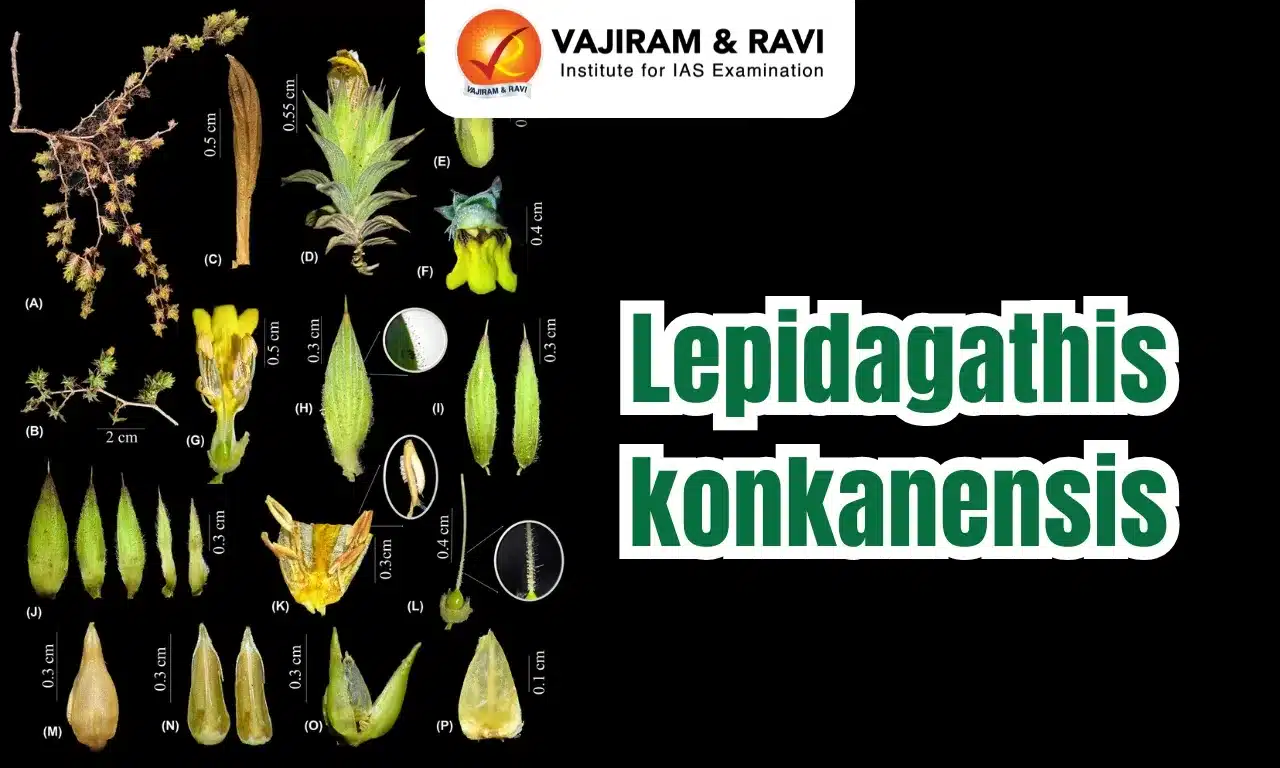
A team of researchers recently discovered a new species of wildflower named Lepidagathis konkanensis, tucked away on the sun-drenched, rocky plateaus of Maharashtra’s Konkan region.

About Lepidagathis Konkanensis

  • It is a new species of flowering plant.
  • It was discovered in the Ratnagiri district in Maharashtra’s Konkan region.
  • It was first encountered during a floristic survey of the region’s lateritic plateaus, harsh, iron-rich environments that often host specialised life forms. 
  • It is currently only known to exist in a small area of less than 65 sq.km.
  • It is unique with its striking appearance and compact size. 
    • While many of its cousins have pink or pale flowers and long flowering spikes, this new species features bright yellow, two-lipped blossoms and very short, dense flowering heads that measure only about two centimetres. 
    • It also has smaller seeds and a shorter style—the part of the flower that receives pollen—than its closest relatives. 
  • The plant’s name, konkanensis, serves as a tribute to the Konkan region of Maharashtra where it was found.
    • This area is geographically isolated by the Arabian Sea to the west and the Sahyadri Mountains to the east, creating a cradle for evolution where unique species can develop in isolation.
  • Scientists have recommended it be classified as Data Deficient by the IUCN.

Source: RM

Lepidagathis Konkanensis FAQs

Q1: What is Lepidagathis konkanensis?

Ans: It is a newly discovered species of flowering plant.

Q2: Where was Lepidagathis konkanensis discovered?

Ans: In the Ratnagiri district of Maharashtra’s Konkan region.

Q3: What type of habitat does Lepidagathis konkanensis grow in?

Ans: Harsh, iron-rich lateritic plateaus.

Q4: What makes Lepidagathis konkanensis visually unique compared to related species?

Ans: It has bright yellow, two-lipped flowers and very short, dense flowering heads.

Key Facts about Myanmar

Key Facts about Myanmar

Myanmar Latest News

Recently, the Union Solidarity and Development Part won the election in Myanmar.

About Myanmar

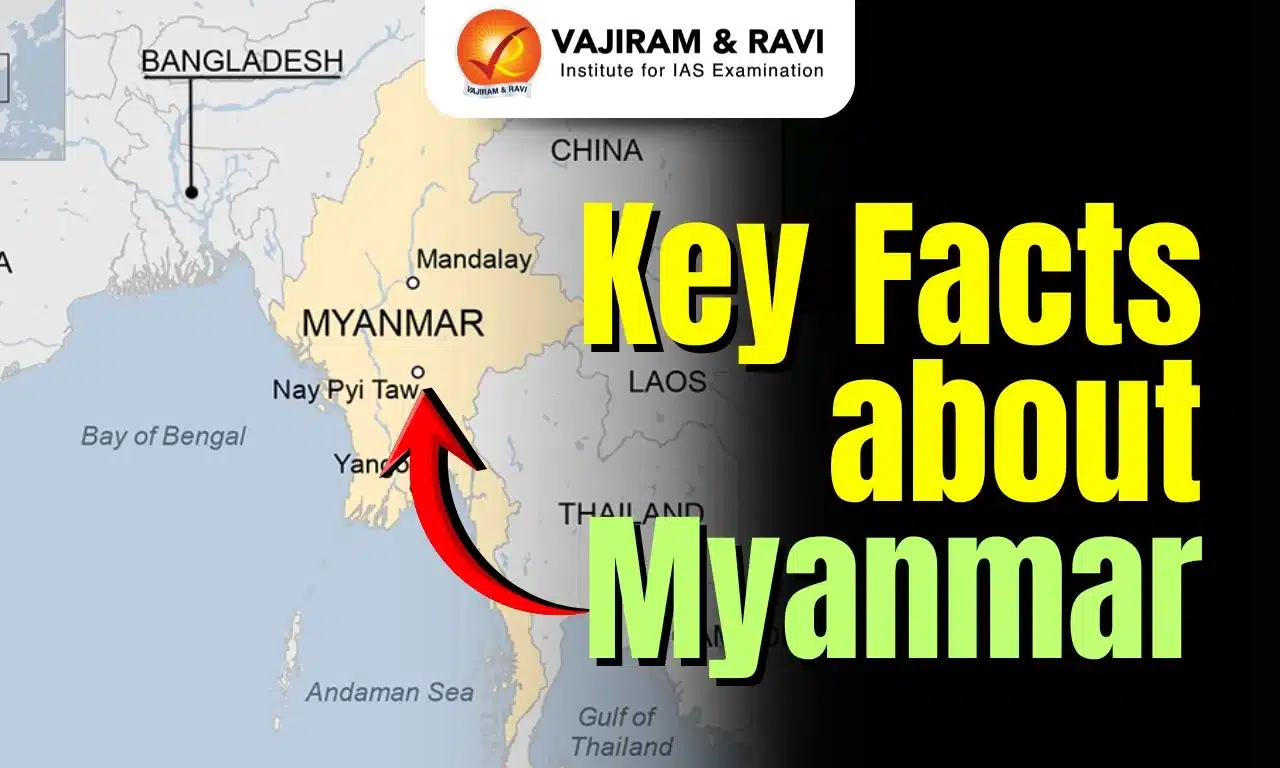
  • It is the northernmost country of Southeast Asia.
  • Bordering Countries: It is bordered by India in the west, Bangladesh in the northwest; China in the north and northeast; by Laos in the east and by Thailand in the southeast. 
  • Maritime Borders: It is bounded by the Andaman Sea in the south and by the Bay of Bengal in the southwest. 
  • Capital City: Naypyidaw

Geographical Features of Myanmar 

  • Climate: Tropical monsoon
  • Mountain ranges: It consists of Bago Yoma, Rakhine Yoma, and Shan Hills.
  • Highest Point: Hkakabo Razi.
  • Major Rivers: It is drained by Mekong, Irrawaddy, Salween and Chindwin.
  • Natural resources: Petroleum, timber, tin, copper, tungsten, lead, coal, marble, limestone, natural gas, hydropower etc.

Source: TH

Myanmar FAQs

Q1: Which river is the lifeline of Myanmar?

Ans: Irrawaddy River

Q2: What is the capital of Myanmar?

Ans: Naypyidaw

PANCHAM

PANCHAM

PANCHAM Latest News

Recently, the Union Minister of State for Panchayati Raj launched the PANCHAM – Panchayat Assistance and Messaging Chatbot.

About PANCHAM

  • It is a digital tool developed in collaboration with UNICEF.
  • Aim: It is a flagship digital initiative aimed at empowering Panchayat Elected Representatives and Functionaries.
  • It is designed as a digital companion for Panchayats, providing timely and contextual guidance, simplified workflows, and easy access to information to support day-to-day governance and service delivery functions.

Features of PANCHAM

  • Direct Connect: It enables, for the first time, a direct digital connect between the Government of India and Elected Representatives and Panchayat Functionaries across the country.
  • Language Support: It is integrated with BHASHINI and will support 22 Indian languages, enabling Panchayat representatives to interact with the platform in their preferred local language.
  • Citizen Access: Citizens would be able to access PANCHAM through a QR-code-based entry mechanism.
  • It will facilitate quicker decision-making, faster resolution of field-level issues, and stronger feedback loops between the grassroots and decision-making centers.
  • Two way communications:  PANCHAM facilitates two way communication and officials can send feedback, ask questions, and flag local problems directly to the ministry. 
  • Information Dissemination: The Ministry would be able to directly disseminate circulars, advisories, key messages, and updates to Panchayat Elected Representatives and Functionaries.

Source: PIB

PANCHAM FAQs

Q1: What is the primary function of PANCHAM?

Ans: To facilitate communication between government and panchayats

Q2: What is PANCHAM?

Ans: A digital platform for panchayats

Hoya Nagaensis

Hoya Nagaensis

Hoya Nagaensis Latest News

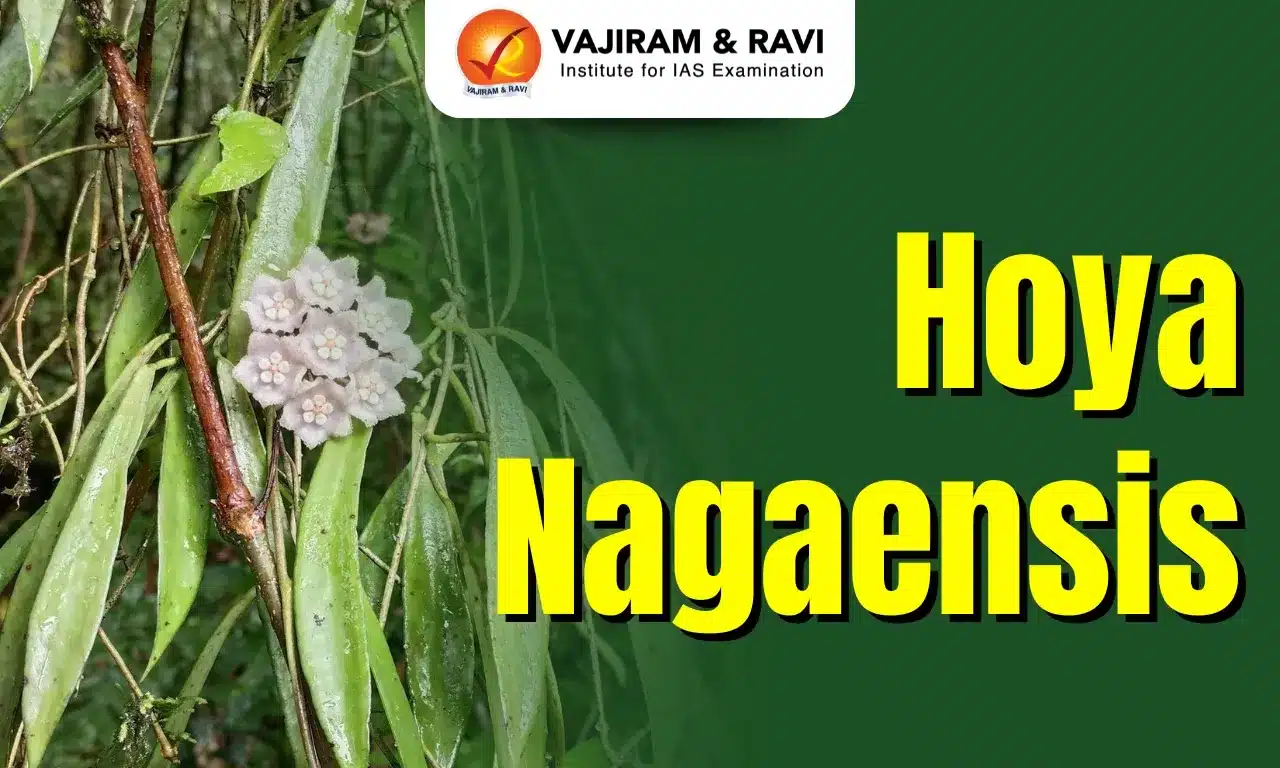
Recently, a new plant species has been discovered in Nagaland and it’s named as Hoya Nagaensis.

About Hoya Nagaensis

  • It is a new plant species found in the high-altitude forests of Nagaland.
  • It is a member of the 'wax plant family' discovered in the Kavunhou Community Reserved Forest in Phek district.
  • It is currently known from only a single location, making it highly vulnerable.

Features of Hoya Nagaensis

  • The plant displays unique leaf shapes and floral features.
  • It belongs to the Hoya genus, a group known for its ornamental value.
  • Habitat: It was found growing in a temperate forest ecosystem that remains largely unexplored by science.
  • It produces distinctive star-shaped flowers and exudes milk-like latex, a characteristic of many species in the Apocynaceae or milkweed family.

What is Hoya Genus?

  • Hoyas, commonly known as wax plants, are a captivating genus cherished by indoor gardeners for their unique flowers and diverse growth forms. 
  • Native Range: Southeast Asia, Australia, and Polynesia
  • Flower Characteristics: Hoya flowers are star-shaped and have a wax-like appearance.
  • Growth Habit: Hoyas are known for their climbing or trailing growth habit. 

Source: TH

Hoya Nagaensis FAQs

Q1: Where was Hoya Nagaensis recently discovered?

Ans: Nagaland, India

Q2: What is Hoya Nagaensis?

Ans: A species of Hoya plant

Mahakaleshwar Temple

Mahakaleshwar Temple

Mahakaleshwar Temple Latest News

The Supreme Court recently did not entertain a petition challenging the practice of ‘VIP darshan’ at the famed Shri Mahakaleshwar temple in Ujjain, observing that the court is not meant to play the role of a gatekeeper on who enters a temple and when.

About Mahakaleshwar Temple

  • It is a Hindu temple located on the banks of the River Shipra at Ujjain in Madhya Pradesh.
  • It is dedicated to Lord Shiva. It is one of the 12 Jyotirlingas in India.
  • The history of Mahakaleshwar Temple dates back to ancient times, with references to the temple found in various Hindu scriptures and texts.
    • The temple finds mention in the Puranas
    • The renowned poet Kalidas also mentioned this temple in his creations. 
  • The current structure of the temple was built in the 18th century by the Maratha ruler Ranoji Shinde.
  • However, the temple has been destroyed and rebuilt several times throughout history.

Mahakaleshwar Temple Architecture

  • The architecture of the temple shows the influence of Maratha, Bhumija, and Chalukya styles of structural design. 
  • The temple complex is spread over five levels, one of which is underground. 
  • The Sabha Mandap (assembly hall) and Garbha Griha (sanctum sanctorum) are adorned with elaborate sculptures depicting various Hindu deities and mythological scenes. 
  • The sanctum houses the Jyotirlinga, which is the focal point of devotion and rituals. 
  • The grand spire (shikhara), intricately carved pillars, and ornate ceilings are proof of the exquisite craftsmanship.

Source: TH

Mahakaleshwar Temple FAQs

Q1: Where is the Mahakaleshwar Temple located?

Ans: On the banks of the River Shipra at Ujjain in Madhya Pradesh.

Q2: Who built the present structure of the Mahakaleshwar Temple?

Ans: The current structure of the temple was built in the 18th century by the Maratha ruler Ranoji Shinde.

Q3: Which architectural styles influence the Mahakaleshwar Temple?

Ans: Maratha, Bhumija, and Chalukya styles.

Q4: What is the religious significance of Mahakaleshwar Temple among Shiva temples?

Ans: It is one of the 12 Jyotirlingas in India.

Achanakmar Tiger Reserve

Achanakmar Tiger Reserve

Achanakmar Tiger Reserve Latest News

Recently, a young male tiger was found dead inside due to territorial infighting inside the Achanakmar Tiger Reserve in Chhattisgarh.

About Achanakmar Tiger Reserve

  • Location: It is situated in the state of Chhattisgarh. 
  • It is part of the huge Achanakmar – Amarkantak Biosphere Reserve.
  • It is one of three tiger reserves in Chhattisgarh. It plays a crucial role in the tiger corridor network, vital for the movement of wildlife.
  • It has a corridor connecting Kanha and Bandhavgarh Tiger Reserve and plays a critical role in the dispersal of tigers among these reserves.
  • River: The Maniyari River flows right from the centre of this reserve, which is the forest’s lifeline.
  • Tribal Community: It is home to the Baigas, (Particularly Vulnerable Tribal Group), Gond and Yadav communities residing inside of this tiger reserve.
  • Vegetation: Tropical moist deciduous vegetation covers the majority of the area.
  • Flora: Sal, bija, saja, haldu, teak, tinsa, dhawara, lendia, khamar, and bamboo bloom here, along with over 600 species of medicinal plants.
  • Fauna: It includes the tiger, leopard, bison, flying squirrel, Indian giant squirrel, chinkara, wild dog, hyena, sambar, chital, and over 150 species of birds.

Source: TOI

Achanakmar Tiger Reserve FAQs

Q1: Where is Achanakmar Tiger Reserve located?

Ans: Chhattisgarh

Q2: Which river flows through Achanakmar Tiger Reserve?

Ans: Maniyari River

Polar Vortex

Polar Vortex

Polar Vortex Latest News

A severe winter storm impacting the U.S. from Texas to New England recently highlights the dynamic role of the stratospheric polar vortex.

About Polar Vortex

  • The polar vortex is a large area of low pressure and cold air surrounding both of the Earth’s poles. 
  • The polar vortex extends from the tropopause (the dividing line between the stratosphere and troposphere) through the stratosphere and into the mesosphere (above 50 km).
  • The term “vortex” refers to the counter-clockwise flow of air that helps keep the colder air near the Poles.
  • These winds circulate and form a vortex near the North and South Poles of the planet.
  • The polar vortex contains some of the coldest air on Earth. 
  • The strength of the polar vortex varies with the season, but it is strongest during the winter season in each hemisphere, when the temperature contrast between the pole and the Equator is greatest. 
  • It may weaken or disappear entirely during the warmer months of the year.
  • Many times, during winter in the northern hemisphere, the polar vortex will expand, sending cold air southward with the jet stream.
    • Jet streams are relatively narrow bands of strong wind in the upper levels of the atmosphere, typically occurring around 30,000 feet (9,100 meters) in elevation.
  • This occurs fairly regularly during wintertime and is often associated with large outbreaks of Arctic air in the United States.
  • This is not confined to the United States. Portions of Europe and Asia also experience cold surges connected to the polar vortex.
  • By itself, the only danger to humans is the magnitude of how cold temperatures will get when the polar vortex expands, sending Arctic air southward into areas that are not typically that cold.
  • The Antarctic polar-front jet stream is more uniform and constant than its Arctic counterpart, because Antarctica is surrounded by ocean rather than a mix of land and water.
  • Cold-air outbreaks, however, do occur in the Southern Hemisphere, but they are less frequent and strike heavily populated areas less frequently.

Source: DEVD

Polar Vortex FAQs

Q1: What is the polar vortex?

Ans: It is a large area of low pressure and cold air surrounding both of the Earth’s poles.

Q2: Where is the polar vortex located in the atmosphere?

Ans: It extends from the tropopause through the stratosphere and into the mesosphere.

Q3: What does the term “vortex” in polar vortex signify?

Ans: It refers to the counter-clockwise circulation of air that keeps cold air near the poles.

Q4: During which season is the polar vortex strongest?

Ans: During the winter season in each hemisphere.

Q5: What phenomenon occurs when the polar vortex expands in winter?

Ans: Cold Arctic air is pushed southward along with the jet stream.

Model Youth Gram Sabha

Model Youth Gram Sabha

Model Youth Gram Sabha Latest News

The Ministry of Panchayati Raj in collaboration with the Ministry of Education and the Ministry of Tribal Affairs, is jointly organizing a National Award Ceremony to felicitate the winners of the Model Youth Gram Sabha.

About Model Youth Gram Sabha

  • It is a simulated forum for School Children to participate in mock Gram Sabha sessions.
  • Purpose: It is a pioneering initiative to strengthen Janbhagidari and promote participatory local governance by engaging students in simulated Gram Sabha sessions.
  • It is an initiative based on the Model UN – an educational simulation of the United Nations – in schools across the country
  • It is an initiative of the Ministry of Panchayati Raj, in collaboration with the Ministry of Education and the Ministry of Tribal Affairs. 
  • Implementation: It will be rolled out across more than 1,000 schools nationwide, including Jawahar Navodaya Vidyalayas, Eklavya Model Residential Schools (EMRSs), and State Government Schools.

Key Features of Model Youth Gram Sabha

  • Focus: Students from classes 9-12 will play the roles of sarpanch, ward members, and village-level officials, including village secretary, Anganwadi worker etc.
  • They will hold mock meetings of the Gram Sabha, discuss various issues, and prepare the village budget and development plans.
  • Financial Support: The Panchayati Raj Ministry also provides a support of Rs 20,000 to each school for holding the mock Gram Sabha.

Source: PIB

Model Youth Gram Sabha FAQs

Q1: What is the objective of Model Youth Gram Sabha?

Ans: To empower rural youth through democratic processes

Q2: What is the format of Model Youth Gram Sabha?

Ans: Similar to actual Gram Sabha

Doomsday Clock

Doomsday Clock

Doomsday Clock Latest News

The Bulletin of the Atomic Scientists recently moved the hands of the Doomsday Clock to 85 seconds to midnight, the closest the world has ever been to global catastrophe in its estimation.

About Doomsday Clock

  • It is a symbolic clock adopted by atomic scientists to show how close human beings are considered to be to a global catastrophe, with midnight standing for annihilation, or “doomsday.” 
  • Metaphorically, the clock’s minute hand moves closer to or farther from midnight, depending on the level of threat thought to be posed by nuclear weapons, climate change, or disruptive technologies. 
  • The clock was created in 1947 by the Bulletin of the Atomic Scientists (BAS), which was founded two years earlier.
  • During that time, the clock was set at seven minutes to midnight.
  • Since its invention in 1947, the clock has been reset 27 times. 
  • In January 2026 the clock was set to 85 seconds before midnight, the closest it has ever been to doomsday.

Key Facts about Bulletin of the Atomic Scientists (BAS)

  • It is a nonprofit organization that sought to warn the public about the danger of nuclear weapons. 
  • The Bulletin was founded by a group called the Atomic Scientists of Chicago in September 1945 at the University of Chicago. 
  • Its founding members and sponsors were scientists who had contributed to the development of the first atomic bombs as part of the Manhattan Project, including physicists Albert Einstein, J. Robert Oppenheimer, and Eugene Rabinowitch. 
  • Concerned about the devastating consequences of this new technology, the group published their first newsletter, the Bulletin of the Atomic Scientists, in December 1945.

Source: MINT

Doomsday Clock FAQs

Q1: What is the Doomsday Clock?

Ans: It is a symbolic clock used to indicate how close humanity is to a global catastrophe.

Q2: What does midnight on the Doomsday Clock represent?

Ans: Global annihilation or “doomsday”.

Q3: Who created the Doomsday Clock?

Ans: The Bulletin of the Atomic Scientists (BAS).

Q4: What factors influence the movement of the Doomsday Clock’s hands?

Ans: Threats from nuclear weapons, climate change, and disruptive technologies.

Q5: What was the Doomsday Clock time set in January 2026?

Ans: 85 seconds before midnight.

Enquire Now