JALAJ Livelihood Centres

JALAJ Livelihood Centres

JALAJ Livelihood Centres Latest News

Recently, the union Minister of Jal Shakti inaugurated 25 JALAJ Livelihood Centres.

About JALAJ Livelihood Centres

  • It is a joint initiative of the Namami Gange Mission and the Wildlife Institute of India (WII).
  • Aim: It is aimed at integrating river conservation with sustainable livelihoods in the Ganga river basin.
  • Jalaj is based on the circular economy model where the local people will be trained in sustainable livelihood practices and mobilized to contribute to biodiversity conservation and clean river ecosystem.

Features of JALAJ Livelihood Centres

  • The initiative promotes community ownership of conservation efforts while creating dignified livelihood opportunities, with a special focus on women’s participation.
  • Jalaj is a concept to establish symbiotic linkages between river and people.
  • The Jalaj established at different locations in the Ganga basin represent the culture and communities indigenous to that area.
  • These are established as holistic Centres of overall community well-being, conservation education and livelihood training.
  • It will have facilities for dissemination of the information on aquatic biodiversity conservation, livelihood training and sale centres for the products developed by livelihood trainees.

Source: PIB

JALAJ Livelihood Centres FAQs

Q1: How many JALAJ centres are aimed to be established?

Ans: 75

Q2: Under which mission is the JALAJ initiative implemented?

Ans: Namami Gange Mission
Phosphorus

Phosphorus

Phosphorus Latest News

Phosphorus accumulation in US farmland is causing significant water pollution.

About Phosphorus

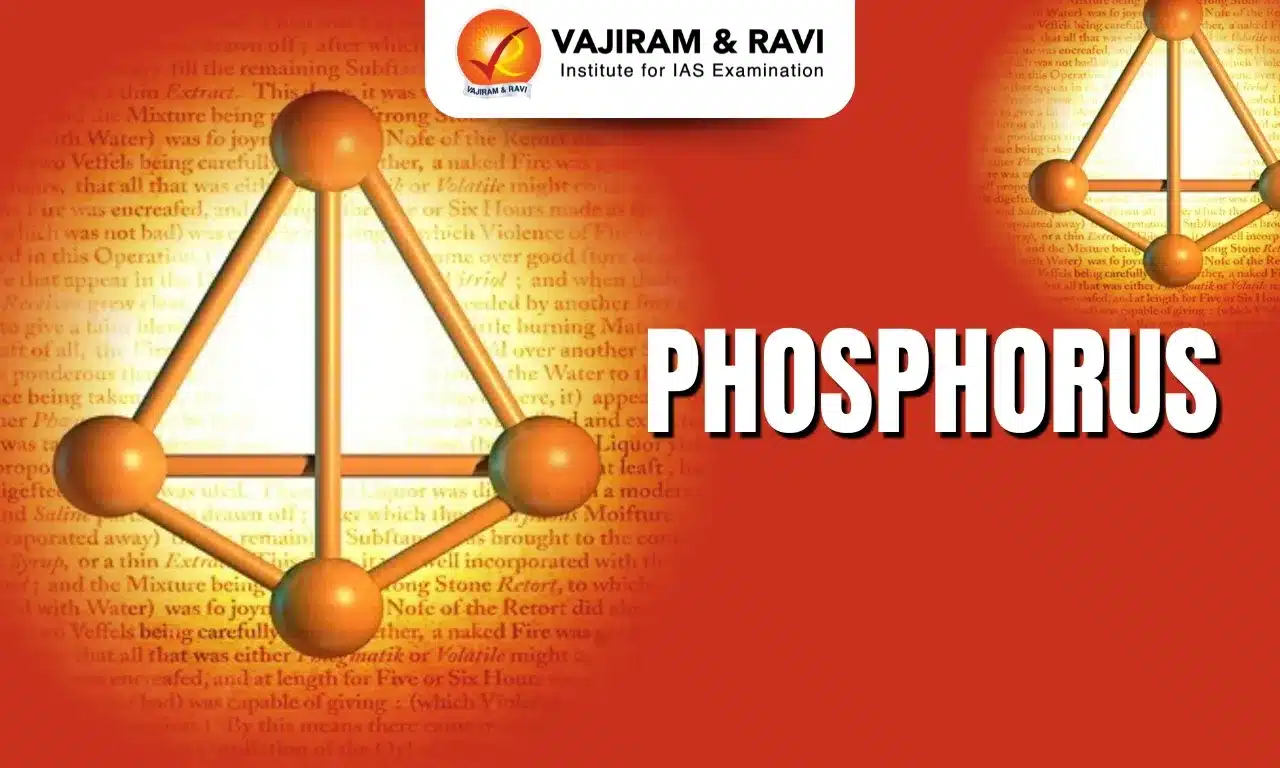
  • It is a highly reactive nonmetallic chemical element of the nitrogen family (Group 15 [Va] of the periodic table).
  • It has the symbol P and atomic number 15.
  • The two main forms of phosphorus are white phosphorus and red phosphorus.
    • White phosphorus is a poisonous waxy solid, and contact with skin can cause severe burns. It glows in the dark and is spontaneously flammable when exposed to air.
    • Red phosphorus is an amorphous, non-toxic solid.

Uses of Phosphorus

  • White phosphorus is used in flares and incendiary devices.
  • Red phosphorus is in the material stuck on the side of matchboxes, used to strike safety matches against to light them.
  • By far the largest use of phosphorus compounds is for fertilisers.
    • Ammonium phosphate is made from phosphate ores.
    • The ores are first converted into phosphoric acids before being made into ammonium phosphate.
  • Phosphorus is also important in the production of steel.
  • Phosphates are ingredients in some detergents but are beginning to be phased out in some countries.
    • This is because they can lead to high phosphate levels in natural water supplies, causing unwanted algae to grow.
  • Phosphates are also used in the production of special glasses and fine chinaware.

Biological Role of Phosphorus

  • The main function of phosphorus is in the formation of bones and teeth.
  • It plays an important role in how the body uses carbohydrates and fats.
  • It is also needed for the body to make protein for the growth, maintenance, and repair of cells and tissues.
  • Phosphorus also helps the body make ATP, a molecule the body uses to store energy.

Occurrence of Phosphorus

  • Because phosphorus cannot naturally occur in the environment, it is typically mined from phosphates.
  • Phosphates typically accumulate at the bottom of rivers and lakes, within different rocks, and in large mineral deposits around the world.
  • Natural phosphates exist inside every living thing. They comprise DNA, RNA, ATP, phospholipids, and other compounds crucial for cellular function and, by extension, life.
  • The main food sources are the protein food groups of meat and milk, as well as processed foods that contain sodium phosphate.

Source: DTE

Phosphorus FAQs

Q1: What is the primary use of Phosphorus?

Ans: Fertilizers

Q2: What is the atomic number of Phosphorus?

Ans: 15

Deuteron

Deuteron

Deuteron Latest News

Recently, a new study out of the ALICE collaboration at CERN’s Large Hadron Collider (LHC) has explained how deuterons survive high-energy particle collisions.

About Deuteron

  • A deuteron is a stable isotope of hydrogen with a nucleus containing one proton and one neutron.
  • It is denoted by the symbol “²H” or “D”.
  • It is found in small amounts in natural water and in the atmosphere of Jupiter and Saturn. 

Properties of Deuteron

  • Mass: The mass of a deuteron is approximately about twice the mass of a proton.
  • Charge: A deuteron has a net positive charge of +1, since it contains one proton.
  • Spin: The deuteron has a nuclear spin of 1, which means that it behaves like a tiny magnet with a north pole and a south pole.
  • Magnetic Moment: The deuteron has a magnetic moment that is approximately 0.8574 nuclear magnetons, which is about 0.31 times the magnetic moment of a proton.

Applications of Deuteron

  • It is used in the production of heavy water, which is used as a moderator in nuclear reactors.
  • It is used in the production of deuterium, which is used as a fuel in fusion reactors.
  • It is used in the production of tritium, which is used in nuclear weapons.

Source: TH

Deuteron FAQs

Q1: What is a deuteron?

Ans: A nucleus of hydrogen with one proton and one neutron.

Q2: What is the spin of a deuteron?

Ans: 1

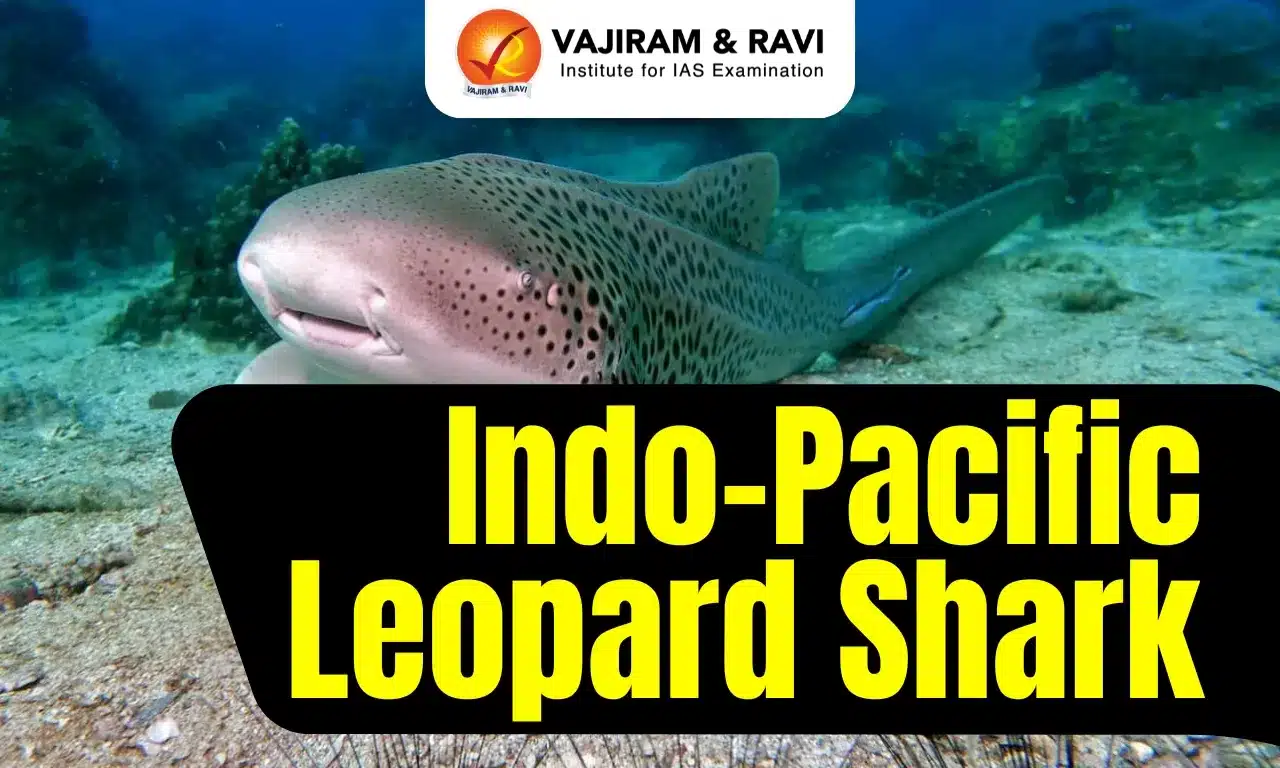
Indo-Pacific Leopard Shark

Indo-Pacific Leopard Shark

Indo-Pacific Leopard Shark Latest News

Recently, conservationists have initiated Thailand's first rewilding effort with the release of a young Indo-Pacific leopard shark into the waters off Maiton Island. 

About Indo-Pacific Leopard Shark

  • Indo-Pacific leopard sharks are also called zebra sharks.
  • Their names come from their distinctive patterning, which changes over time. 
  • These are slow-swimming reef sharks whose bodies have either a spotted or striped pattern depending on their age.
  • Habitat: Found in tropical waters of the Indo-Pacific usually in the coastal waters.
  • Reproduction: These sharks are oviparous, meaning the females lay eggs 
  • Diet: Leopard sharks primarily eat molluscs & crustaceans, as well as small bony fishes.
  • Life Span: The average lifespan for a leopard shark in the wild is 18 to 24 years.
  • Threats: Overfishing and habitat loss.
  • Conservation Status: IUCN: Endangered

Source: Reuters

Indo-Pacific Leopard Shark FAQs

Q1: What is another name for the Indo-Pacific Leopard Shark?

Ans: Zebra Shark

Q2: Where is the Indo-Pacific Leopard Shark commonly found?

Ans: Indian Ocean and Pacific Ocean

Scabies

Scabies

Scabies Latest News

According to the World Health Organization, scabies is one of the commonest dermatological conditions, accounting for a substantial proportion of skin disease in developing countries. 

About Scabies

  • It is a contagious parasitic skin infestation that occurs in all parts of the world.
  • Scabies is caused by a tiny bug, the Sarcoptes scabiei mite that burrows under the skin, causing an itchy rash.
  • It is more common in hot, tropical countries like India.
  • Occurrence of Scabies: It develops when the female mites (invisible to the naked eye) tunnel their way under the skin, where they live, lay eggs and excrete waste, spreading to other parts of the skin as well.
    • The mites generally live in the folds of the skin, and can be commonly found: between the fingers and toes, in the armpits, in the folds of the thighs and in the genital area, in the soles of the feet
  • Transmission: Scabies spreads easily in crowded conditions and generally through close, direct contact with an infected person, and sometimes through shared clothing and bedding.
  • Symptom: The most common symptom is an intense itchy rash that may become worse at night.
  • Treatment: Treatment of scabies is usually with topical creams and oral medication. 
  • The World Health Organization classified scabies as a neglected tropical disease due to its significant burden on impoverished and vulnerable populations

Source: TH

Scabies FAQs

Q1: What is the causative agent of scabies?

Ans: Mite

Q2: How does scabies typically spread?

Ans: Skin-to-skin contact

Sea of Japan

Sea of Japan

Sea of Japan Latest News

Recently, North Korea fired a ballistic missile towards the Sea of Japan.

About Sea of Japan

  • Location: The Sea of Japan, or East Sea, is a marginal sea of the western Pacific Ocean.
  • It is bound by Japan and Sakhalin to the east and by mainland Russia, North Korea, and South Korea to the west.
  • Connections
    • It is connected with the East China Sea via the Tsushima and Korea straits and with the Okhotsk Sea in the north by the La Perouse and Tatar straits.
    • In the east, it is connected with the Inland Sea of Japan via the Kanmon Strait and the Pacific Ocean by the Tsugaru Strait.
  • Dohoku Seamount, an underwater volcano, is its deepest point.
  • Climate: Its relatively warm waters contribute greatly to the mild climate of Japan.
  • Tides: Like the Mediterranean Sea, it has almost no tides due to its nearly complete enclosure from the Pacific Ocean. 
  • The sea is known for its high concentration of oxygen (dissolved in the seawater), which results in high biological productivity. 
  • Major Ports
    • Russia: Vladivostok, Sovetskaya Gavan, Nakhodka, Alexandrovsk-Sakhalinsky, and Kholmsk. 
    • North Korea: Hamhung, Chongjin, and Wonsan.
    • Japan: Niigata, Tsuruta, and Maizuru.

Source: TH

Sea of Japan FAQs

Q1: What is the Sea of Japan also known as?

Ans: East Sea

Q2: Which countries border the Sea of Japan?

Ans: apan, Russia, North Korea, South Korea

Rusty-Spotted Cat

Rusty-Spotted Cat

Rusty-Spotted Cat Latest News

The Rusty-spotted Cat, a rare and one of the world's smallest cats, was recently spotted in the Shergarh forest of Baran district in Rajasthan.

About Rusty-Spotted Cat

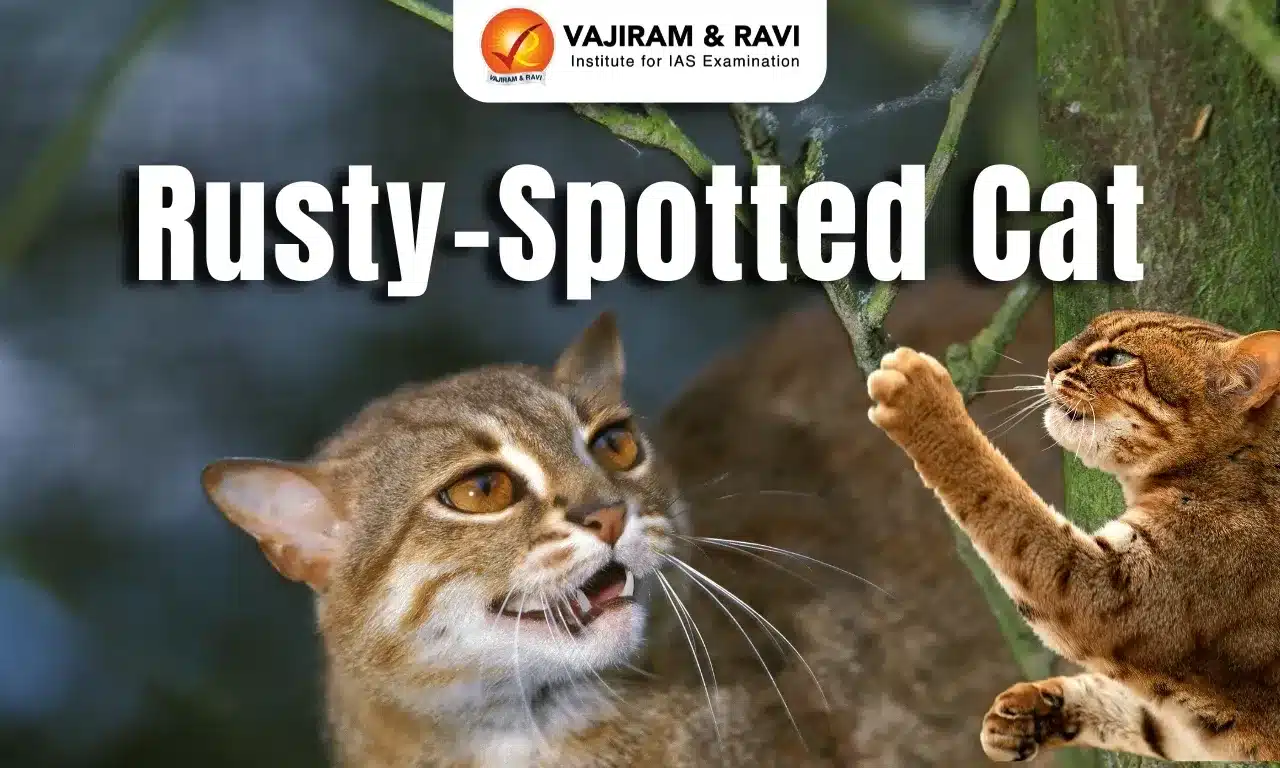
  • It is the world’s smallest and lightest known cat.
  • Scientific Name: Prionailurus rubiginosus.

Distribution of  Rusty-Spotted Cat

  • The species has been recorded in dry deciduous and semi-deciduous forests in northern and central India, Western Ghats, Kachchh and Rajasthan, and peninsular India, besides Nepal and Sri Lanka.
  • India holds 80 percent of the cat’s total population.

Features of  Rusty-Spotted Cat

  • It weighs less than 1.5 kilograms and is 20 to 29 inches in length, about half the size of a domestic cat.
  • The fur is short and soft, with the upper parts a grizzled brownish grey, tinged with rufous to varying degrees and marked with rust-brown spots.
  • There are horizontal bars on the legs and chest; the belly and inner sides of the legs are white.
  • Their head is short and rounded, and marked with two white streaks on the inner edges of the eyes.
  • The eyes are fairly large with irises of greyish brown to amber. Its large eyes may be an adaptation to its nocturnal behaviour.
  • Their legs are relatively short, and their feet have black soles.
  • The tail is moderately long, more rusty coloured than the body, and unmarked.
  • Very active and agile, this cat is small, but extremely fierce. It is primarily nocturnal, resting in dense cover during the daytime.
  • Conservation Status: IUCN Red List: Near Threatened.

Source: Research matters

Rusty-Spotted Cat FAQs

Q1: What is the scientific name of the Rusty-Spotted Cat?

Ans: Prionailurus rubiginosu

Q2: Where is the Rusty-Spotted Cat primarily found?

Ans: India and Sri Lanka

Nipah Virus

Nipah Virus

Nipah Virus Latest News

India recently confirmed two Nipah virus cases in West Bengal since December, with health authorities containing the situation amid misinformation and heightened airport screenings in parts of Asia.

About Nipah Virus

  • Nipah virus (NiV) is a zoonotic virus (it is transmitted from animals to humans) and can also be transmitted through contaminated food or directly between people.
    • Fruit bats of the Pteropodidae family are the natural hosts of Nipah virus.
  • In infected people, it causes a range of illnesses from asymptomatic (subclinical) infection to acute respiratory illness and fatal encephalitis.
  • The virus can also cause severe disease in animals such as pigs, resulting in significant economic losses for farmers. 
  • So far, NiV outbreaks have only been described in Asia.
    • The first reported outbreak occurred in 1998–1999 and involved pig farmers in the village of Sungai Nipah (Malaysia).
    • Since then, sporadic outbreaks have been documented in Bangladesh, India, the Philippines, and Singapore.
    • NiV infection is one of the priority diseases on the World Health Organization (WHO) R&D Blueprint because of its epidemic or pandemic potential.

Symptoms of Nipah Virus

  • Infected people initially develop symptoms including fever, headaches, myalgia (muscle pain), vomiting and sore throat.
  • This can be followed by dizziness, drowsiness, altered consciousness, and neurological signs that indicate acute encephalitis.
  • Some people can also experience atypical pneumonia and severe respiratory problems, including acute respiratory distress.
  • Encephalitis and seizures occur in severe cases, progressing to coma within 24 to 48 hours.
  • The incubation period is believed to range from 4 to 14 days.
  • The virus is considered highly fatal, with fatality rates in past outbreaks ranging from approximately 40% to 75%, depending on surveillance and care.

Treatment of Nipah Virus

  • There are no specifically approved treatments or vaccines available for NiV infection, either for people or animals.  
  • Intensive supportive care is recommended to treat severe respiratory and neurologic complications.

 Source: NDTV

Nipah Virus FAQs

Q1: What is the primary mode of transmission of Nipah Virus?

Ans: Direct contact with infected animals or humans

Q2: What is the primary reservoir of Nipah Virus?

Ans: Fruit bats

Shettihalli Wildlife Sanctuary

Shettihalli Wildlife Sanctuary

Shettihalli Wildlife Sanctuary  Latest News

In the wake of the controversy surrounding the move to ‘reduce’ the boundary of Shettihalli Sanctuary in Shivamogga, the forest minister recently visited the sanctuary to understand the situation.

About Shettihalli Wildlife Sanctuary

  • It is located in the Shimoga District of Karnataka.
  • The Tunga Anicut Dam is situated within the sanctuary and provides shelter for otters and water birds.
  • The Mandagadde Bird Sanctuary is also a part of the Shettihalli Wildlife Sanctuary. 
  • It is a popular bird nesting site situated on an island in the midst of the Tunga River.
  • There are a large number of human settlements inside Shettihalli Sanctuary, mainly consisting of families that were displaced by the construction of the Sharavathi Dam in the 1960s.
  • Vegetation 
    • It is mainly covered by tropical evergreen and semi-evergreen forests.
    • The eastern and central parts are mostly covered by dry and moist deciduous forests, while the western parts have semi-evergreen forests.

Flora and Fauna of Shettihalli Wildlife Sanctuary

  • Major tree species include silver oak, teak, Indian Thorny Bamboo, Calcutta Bamboo, Asan, Tectona Grandis, Sweet Indrajao, Amla, etc.
  • It houses mammals like Tiger, Leopard, Wild Dog, Jackal, Gaur, Elephant, Sloth Bear Sambar, Spotted Deer, Wild Pig, Common Langur, Bonnet Macaque, etc.
  • Birds include Hornbills, Kingfishers, Bulbuls, Parakeets, Doves, Pigeons, Babblers, Flycatchers, Munias, Swallows, Woodpeckers, Peafowl, Jungle fowl and Partridges.

 Source: DH

Shettihalli Wildlife Sanctuary FAQs

Q1: Where is Shettihalli Wildlife Sanctuary located?

Ans: Karnataka

Q2: Which dam is located inside Shettihalli Wildlife Sanctuary?

Ans: Tunga Anicut Dam

Shiveluch Volcano

Shiveluch Volcano

Shiveluch Volcano Latest News

The Shiveluch volcano on Russia’s Kamchatka Peninsula erupted twice recently, sending ash plumes up to 8 kilometres above sea level.

About Shiveluch Volcano

  • It is one of the largest and most active volcanoes located on Russia's Kamchatka Peninsula, one of the most intense volcanic regions in the world.
  • It’s estimated to be between 60,000-70,000 years old.
  • It is a stratovolcano—a steep-sloped volcano composed of alternating layers of solidified ash, hardened lava, and volcanic rocks.
  • It sports a summit reaching 3,283 meters (10,771 feet).
  • Many lava domes dot its outer flanks.
    • It has had more major eruptions than any other volcano in our current period of geologic time,  with an estimated 60 substantial eruptions in the past 10,000 years.
    • The volcano has been continuously erupting since August 1999, but occasionally undergoes powerful explosive events, including in 2007.
  • It has been spewing ash and steam intermittently—with occasional dome collapses, pyroclastic flows, and lava flows, as well—for the past decade.

Key Facts about Kamchatka Peninsula

  • It lies in far eastern Russia, between the Sea of Okhotsk on the west and the Pacific Ocean and Bering Sea on the east.
  • About the size of New Zealand, it is one of the largest peninsulas in the world.
  • It is one of the world’s most concentrated areas of geothermal activity.
  • Of the 127 volcanoes on the peninsula, 22 are still active, as are a number of geysers and hot springs.
  • Climate: Severe, with prolonged, cold, and snowy winters and wet, cool summers.
  • Most of Kamchatka is tundra.
  • The main center is the city and port of Petropavlovsk-Kamchatsky.
  • The Kuril Island chain runs from the southern tip of the peninsula to a short distance from Japan’s northern Hokkaido Island.
  • The volcanoes of Kamchatka have been a UNESCO World Heritage Site since 1996.

Source: MSN

Shiveluch Volcano FAQs

Q1: What is the location of Shiveluch Volcano?

Ans: Russia's Kamchatka Peninsula

Q2: What type of volcano is Shiveluch?

Ans: Stratovolcano

Enquire Now