New Marine Worm Species

New Marine Worm Species

New Marine Worm Species Latest News

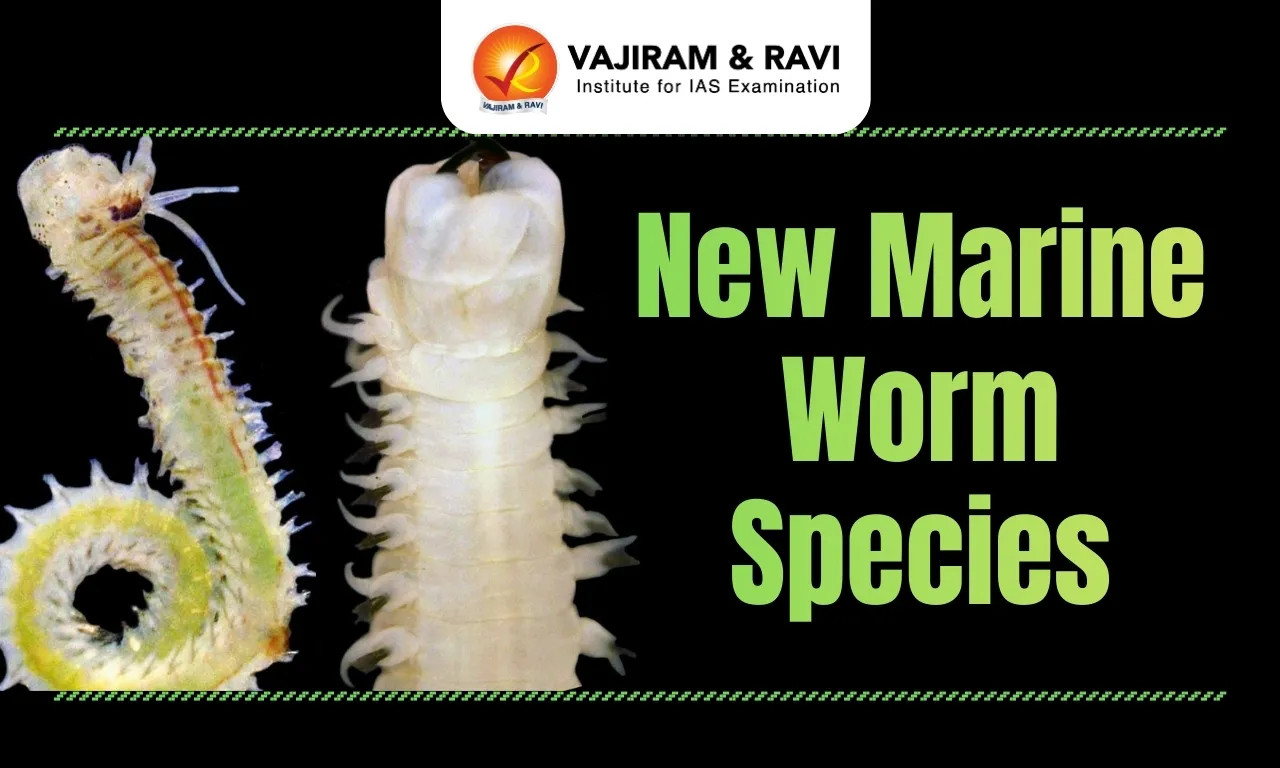
Recently, researchers from the Zoological Survey of India (ZSI) have uncovered two new marine worm species (polychaetes) namely Namalycastis solenotognatha and Nereis dhritiae from the Nereidid family coasts of West Bengal.

About New Marine Worm Species

  • Namalycastis solenotognatha
    • It derives its name from the Greek words “solenotos” (channeled) and “gnatha” (jaw).
    • The “channeled jaw” refers to its unusual jaw structure with a large number of canals that emerge from the pulp cavity.
    • Habitat: Ideal conditions for its survival are extreme environments, sulfide-rich, foul-smelling mudflats, and they are mostly found on decomposing mangrove wood and hardened clay.

About Nereis Dhritiae

  • It is named after the first woman director of ZSI, Dhriti Banerjee.
  • Habitat: This species was found living inside wooden dock piles on sandy beaches, which are submerged during times of high tide.

Significance of Nereidid worms

  • They help maintain coastal health, and they play a major role in nutrient cycling and sediment aeration.
  • These species of marine worms were found in areas that were heavily impacted by human activities and subject to pollution.
  • These worms can serve as vital bioindicators and help in monitoring coastal health.

Source: IE

New Marine Worm Species FAQs

Q1: Where were the new marine worm species discovered?

Ans: Bay of Bengal

Q2: What are the names of the new marine worm species?

Ans: Namalycastis solenotognatha and Nereis dhritiae

Model Context Protocol

Model Context Protocol

Model Context Protocol Latest News

Recently, the National Statistics Office under the Ministry of Statistics and Programme Implementation (MoSPI) launched the beta version of its Model Context Protocol (MCP) server for eSankhyiki portal.

About Model Context Protocol

  • It is a technology that allows users to connect directly with datasets through their own AI tools and applications.
  • It is a standard way to make information available to large language models (LLMs).
  • Using MCP, AI applications can connect to data sources (e.g. local files, databases), tools (e.g. search engines, calculators) and workflows (e.g. specialized prompts)—enabling them to access key information and perform tasks.

Key Facts about eSankhyiki portal

  • It provides real-time inputs for planners, policy-makers, researchers and the public at large.
  • The objective of this portal is to establish a comprehensive data management and sharing system for ease of dissemination of official statistics in the country.
  • It has two modules namely:
    • Data Catalogue Module: This module catalogues the major data assets of the Ministry at one place for ease of access.
      • It allows users to search within datasets, including within tables, and download data of interest to increase its value and re-usability.
      • The module has seven data products, namely National Accounts Statistics, Consumer Price Index, Index of Industrial Production, Annual Survey of Industries, Periodic Labour Force Survey, Household Consumption Expenditure Survey and Multiple Indicator Survey.
    • Macro Indicators Module: This module offers time series data of key macro indicators with features for filtering and visualizing data enabling ease of access for the users.
      • It allows users to download custom datasets, visualizations and share them through APIs, thereby increasing the re-usability of data.

Source: PIB

Model Context Protocol FAQs

Q1: What is Model Context Protocol (MCP)?

Ans: An open standard for AI model interoperability

Q2: What is the goal of MCP?

Ans: To enable seamless switching between AI models

Key Facts about Malaysia

Key Facts about Malaysia

Malaysia Latest News

Recently, the Prime Minister of India began a two-day official visit to Malaysia.

About Malaysia

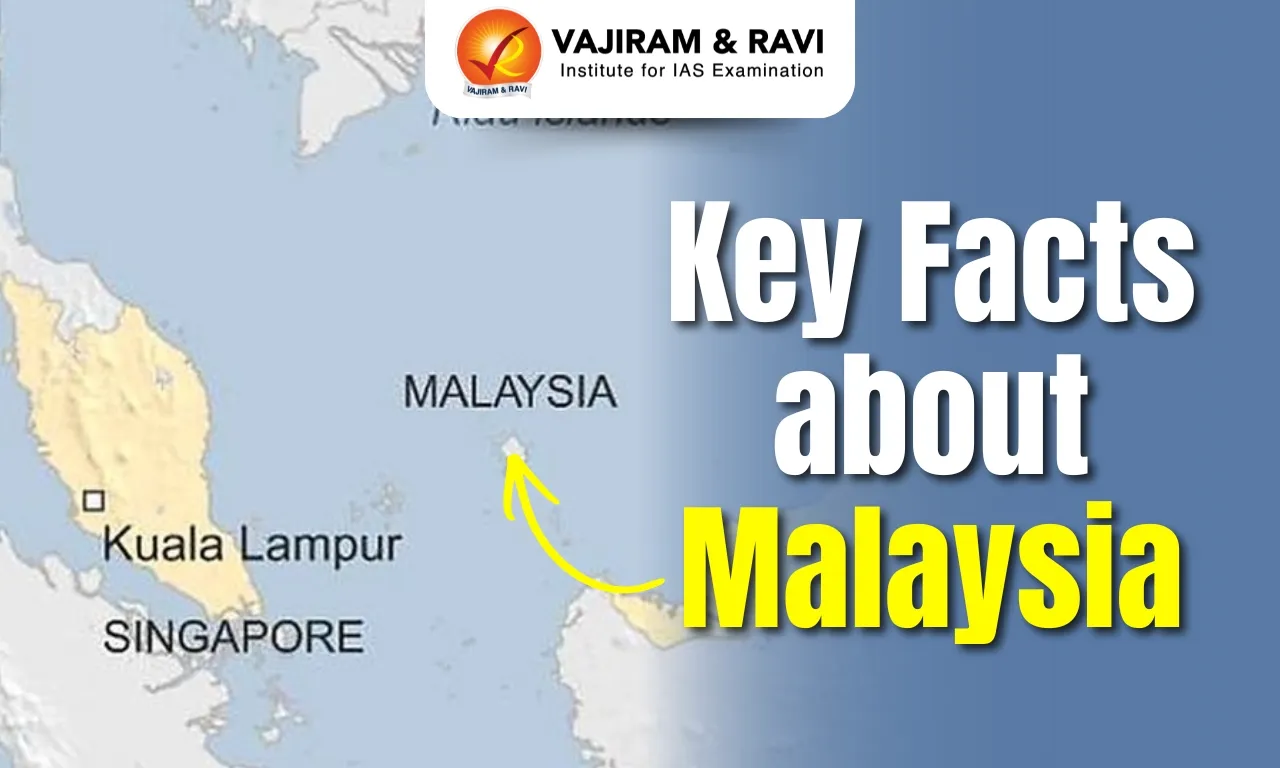
  • Location: It is a country in Southeast Asia, lying just north of the Equator.
    • The South China Sea separates Malaysia into two regions: Peninsular Malaysia (West Malaysia) and East Malaysia.
  • Bordering Countries: Land (Thailand, Brunei and Indonesia) Maritime (Philippines, Singapore, Vietnam)
  • Bordering Seas and straits: Strait of Malacca, South China Sea, Celebes Sea and the Sulu Sea border Sabah in East Malaysia.
  • Capital:  Kuala Lumpur

Geographical Features of Malaysia

  • Terrain and Climate: The country’s terrain is characterized by coastal plains and jungle-covered mountains in the interior, and its climate is tropical. 
  • Major Mountain: Main Range 
  • Highest Peak: Mount Kinabalu (4,095 metres)
  • Major Rivers: It is drained by Pahang, Rajang, and Kinabatangan rivers.
  • Natural Lakes: Bera Lake and Tasik Chini
  • Natural Resources: It has abundant natural resources including forests, minerals, oil, natural gas and agricultural commodities.

Source: PIB

Malaysia FAQs

Q1: What is the capital of Malaysia?

Ans: Kuala Lumpur

Q2: What is the official language of Malaysia?

Ans: Malay

Bharat GenAI

Bharat GenAI

Bharat GenAI Latest News

Recently, the Ministry of Science & Technology informed that Bharat GenAI Large Language Model will complete text models in all 22 scheduled languages this month.

About Bharat GenAI

  • BharatGen is the first government supported national initiative to develop a range of sovereign foundational AI models tailored to Indian languages and societal contexts.
  • Aim: BharatGen aims to revolutionize AI development across India’s linguistic and cultural spectrum.
  • It spans multiple modalities, including text (via Large Language Models), speech (Text-to-Speech and Automatic Speech Recognition), and vision-language systems.
    • Currently, it supports 15 Indian languages which include Hindi, Assamese, Bengali, Gujarati, Kannada, Maithili, Malayalam, Marathi, Nepali, Oriya, Punjabi, Sanskrit, Sindhi, Tamil and Telugu.
  • It is developed under the National Mission on Interdisciplinary Cyber-Physical Systems (NM-ICPS) and implemented through TIH Foundation for IoT and IoE at IIT Bombay.
  • It is being executed through a network of 25 Technology Innovation Hubs (TIHs), four of which have been upgraded to Technology Translational Research Parks (TTRPs).
  • Pillars of Bharat GenAI: The Mission’s four pillars include technology development, entrepreneurship, human resource development, and international collaboration.
  • It has four key Features
    • Multilingual and multimodal models
    • Bhartiya dataset-based training
    • Open-source platform
    • Generative AI research ecosystem in India

Source: PIB

Bharat GenAI FAQs

Q1: What is BharatGen?

Ans: India's first sovereign AI initiative

Q2: What is the goal of BharatGen?

Ans: To create AI models tailored to India's languages and culture

Titanidiops Kolhapurensis

Titanidiops Kolhapurensis

Titanidiops Kolhapurensis Latest News

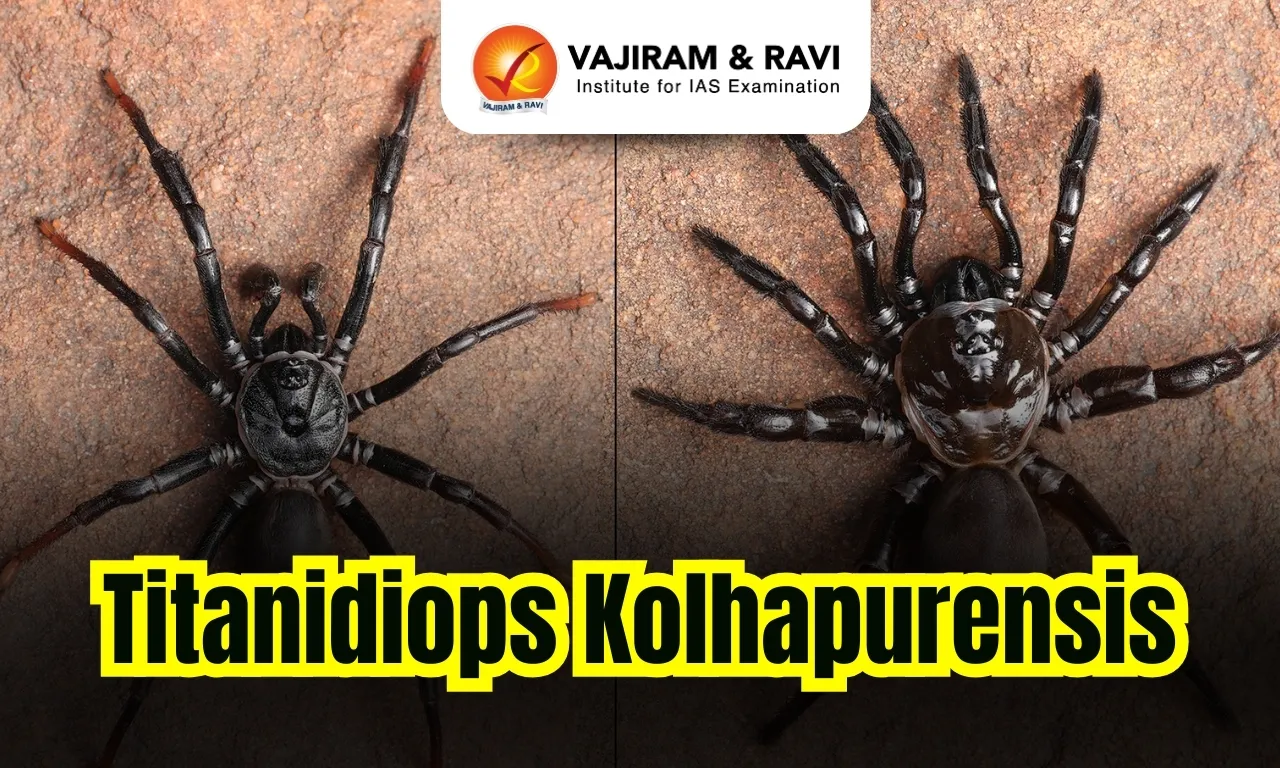
A new species of trapdoor spider named Titanidiops kolhapurensis has been recently discovered in the grasslands of Kolhapur district by a joint team of researchers from the Thackeray Wildlife Foundation and Shivaji University, Kolhapur (SUK).

About Titanidiops Kolhapurensis

  • It is a new species of trapdoor spider.
  • It has been discovered in the grasslands of the Kolhapur district, Maharashtra.
  • This spider builds vertical or slanted burrows in flat or sloping grassy meadows.
  • These entrances are masterfully camouflaged to blend with the soil, making them nearly invisible to the naked eye.
  • While researchers found a healthy presence of the species in natural forests and native grasslands, they were notably absent in areas overtaken by exotic tree plantations, such as Gliricidia sepium (commonly known as Undirmari).
  • It is on the verge of local extinction due to rapid habitat degradation.

What are Trapdoor Spiders?

  • They are a unique group of large-bodied, burrowing spiders found across several taxonomic families. 
  • They construct burrows in the ground, the entrance of which features a silken-hinged door
  • They burrow up to 6 inches (15 centimeters) deep in the soil.
  • The reclusive spider feeds by quickly opening the trapdoor and grabbing an insect or other arthropod that is passing close by. 
  • They are generally timid and quickly retreat into the burrow if frightened.
  • Their bite is not considered medically significant to humans.
  • They are found in climates with tropical, subtropical, and warm temperatures.
  • These spiders typically grow to about one inch (2.5 centimeters) long, with some larger species reaching up to 1.5 inches (4 centimeters). 
  • Despite their protective burrows, trapdoor spiders are often threatened by spider-hunting wasps. 
  • They typically do not disperse far from their mother’s burrow, making populations vulnerable to human development or other land-use changes.

Source: TOI

Titanidiops Kolhapurensis FAQs

Q1: What is Titanidiops kolhapurensis?

Ans: It is a newly discovered species of trapdoor spider.

Q2: Where was Titanidiops kolhapurensis discovered?

Ans: In the grasslands of Kolhapur district, Maharashtra.

Q3: What are trapdoor spiders?

Ans: They are large-bodied, burrowing spiders belonging to several taxonomic families.

Q4: How do trapdoor spiders capture their prey?

Ans: By quickly opening the trapdoor and grabbing passing insects or arthropods.

INS Arnala

INS Arnala

INS Arnala Latest News

INS Arnala, the Indian Navy’s first indigenously designed and built Anti-Submarine Warfare Shallow Water Craft (ASW-SWC), marks a significant milestone in India’s transition from a “Buyer’s Navy” to a “Builder’s Navy”.

About INS Arnala

  • It is the first of the eight ASW SWCs (Anti-Submarine Warfare Shallow Water Craft) built for the Indian Navy.
  • It is the Indian Navy’s first indigenously designed and built ASW SWC.
  • It was designed and built by Garden Reach Shipbuilders and Engineers (GRSE), Kolkata.
  • It was commissioned into the Eastern Naval Command of the Indian Navy on 18 Jun 2025.
  • It is named after the historic fort ‘Arnala’ located off Vasai, Maharashtra.
  • This 77-meter-long warship, with a gross tonnage of over 1490 tonnes, is the largest Indian Naval warship to be propelled by a Diesel Engine-Waterjet combination.
  • The ship has been designed for underwater surveillance, search & rescue operations, and Low Intensity Maritime Operations (LIMO). 
  • The ship is capable of undertaking Anti-Submarine Warfare (ASW) in coastal waters, along with advanced mine-laying capabilities. 
  • The vessel features homegrown systems, including stealth technology, electronic warfare capabilities, and advanced sensors, which improve combat readiness.

Source: TOI

INS Arnala FAQs

Q1: What is INS Arnala?

Ans: INS Arnala is an Anti-Submarine Warfare Shallow Water Craft (ASW-SWC) of the Indian Navy.

Q2: Why is INS Arnala significant for the Indian Navy?

Ans: It is the first indigenously designed and built ASW-SWC of the Indian Navy.

Q3: When was INS Arnala commissioned into the Indian Navy?

Ans: INS Arnala was commissioned on 18 June 2025.

Q4: What are the primary operational roles of INS Arnala?

Ans: Underwater surveillance, search and rescue, and Low Intensity Maritime Operations (LIMO).

Bailey Bridge

Bailey Bridge

Bailey Bridge Latest News

Recently, India has sent Bailey bridge materials to Sri Lanka for post-Cyclone reconstruction.

About Bailey Bridge

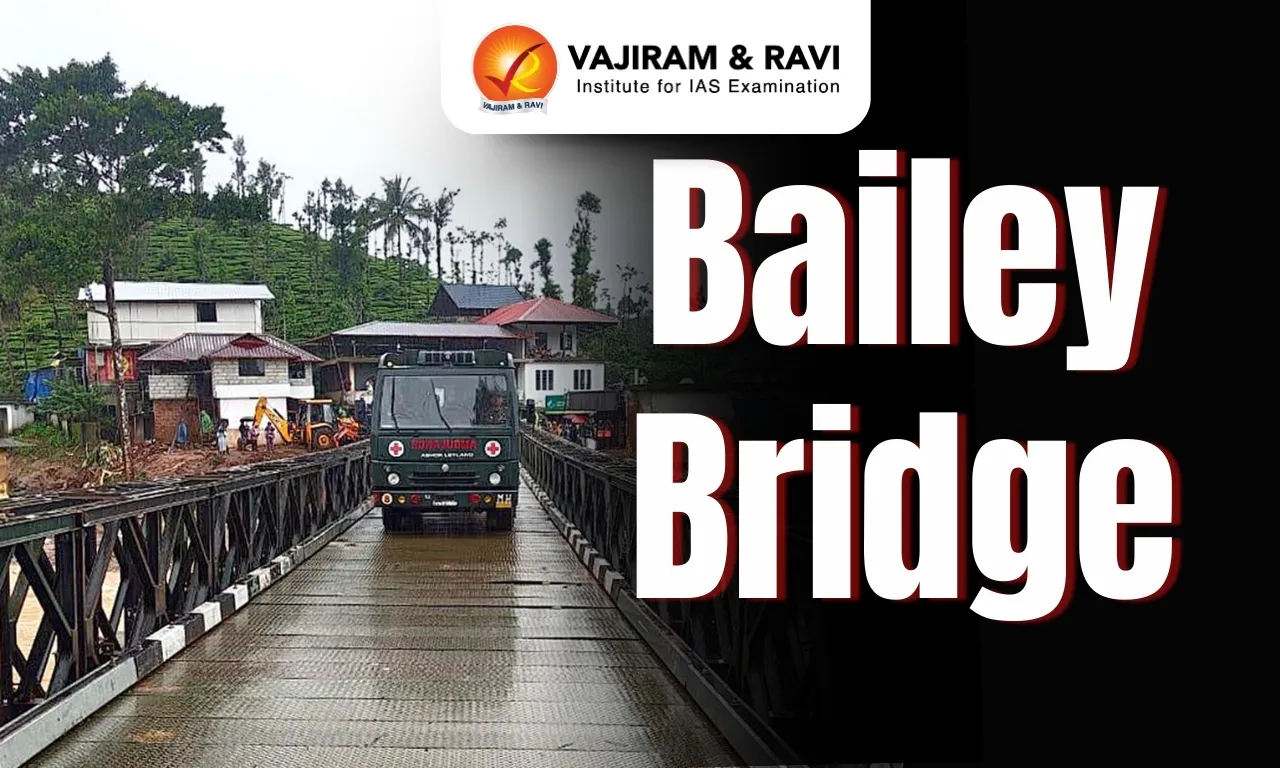
  • It is a type of modular bridge whose parts are pre-built, so they can be put together quickly as needed. 
  • An English civil engineer named Donald Coleman Bailey is credited with inventing it in 1941.
  • The key characteristics include their modularity, portability, strength, and versatility. 
  • It is preferred because these bridges are designed for rapid construction in difficult conditions without the need for heavy equipment or sophisticated construction methods. 
  • Design and Constructions of Bailey bridge
    • The bridges are made of modular steel panels, which can be easily transported and assembled using manpower alone.
    • The construction of a Bailey bridge involves assembling prefabricated panels into sections, which are then connected to form the bridge’s span.
    • The panels are connected using pins and bolts, creating a truss structure that distributes the load evenly. 
  • Uses: The design supports heavy loads, including tanks and other military vehicles.
  • Advantages: Bailey bridge assembly covers a small area, which can avoid the situation that large hoisting equipment cannot enter the construction site. 
  • Ideal for: It is generally used in terrains that span rivers, valleys, and spans that are not very large.

Source: News On AIR

Bailey Bridge FAQs

Q1: Who invented the Bailey Bridge?

Ans: Donald Coleman Bailey

Q2: What is a key feature of Bailey Bridges?

Ans: Modular and portable design

Agni-3 Missile

Agni-3 Missile

Agni-3 Missile Latest News

Recently the Intermediate Range Ballistic Missile ‘Agni-3’ was successfully test-fired from the Integrated Test Range, Chandipur, Odisha.

About Agni-3 Missile

  • It is an indigenously developed intermediate-range ballistic missile (IRBM).
  • It is a surface-to-surface ballistic missile.
  • It is one of the sophisticated and accurate missiles of its class and has already been inducted into the armed forces.

Features of Agni-3 Missile

  • The missile is two-stage and solid-fuelled, capable of carrying a 1,500 kg payload.
  • Range: 3,000–3,500 km
  • It is designed primarily as a nuclear delivery system, with an estimated warhead yield of 200–300 kilotons.
  • The missile measures 16.7 metres in length, 2 metres in diameter and has a launch weight of 48,300 kg.
  • It uses a strapdown inertial navigation system (INS) supported by GPS, giving it an accuracy of around 40 metres circular error probable (CEP). 
  • Its first stage uses a maraging steel motor case, while the second stage employs a carbon-fibre motor case, both featuring thrust vector control systems for improved accuracy and stability.
  • Due to its high range of circular error probable (CEP), the Agni-3 missile is known as one of the world's most accurate strategic ballistic missiles of its range class.

Source: PIB

Agni-3 Missile FAQs

Q1: What is the range of Agni-3 Missile?

Ans: 3,000-3,500 km

Q2: What type of propulsion does Agni-3 Missile use?

Ans: Solid-fuel propulsion

Reticulated Python

Reticulated Python

Reticulated Python Latest News

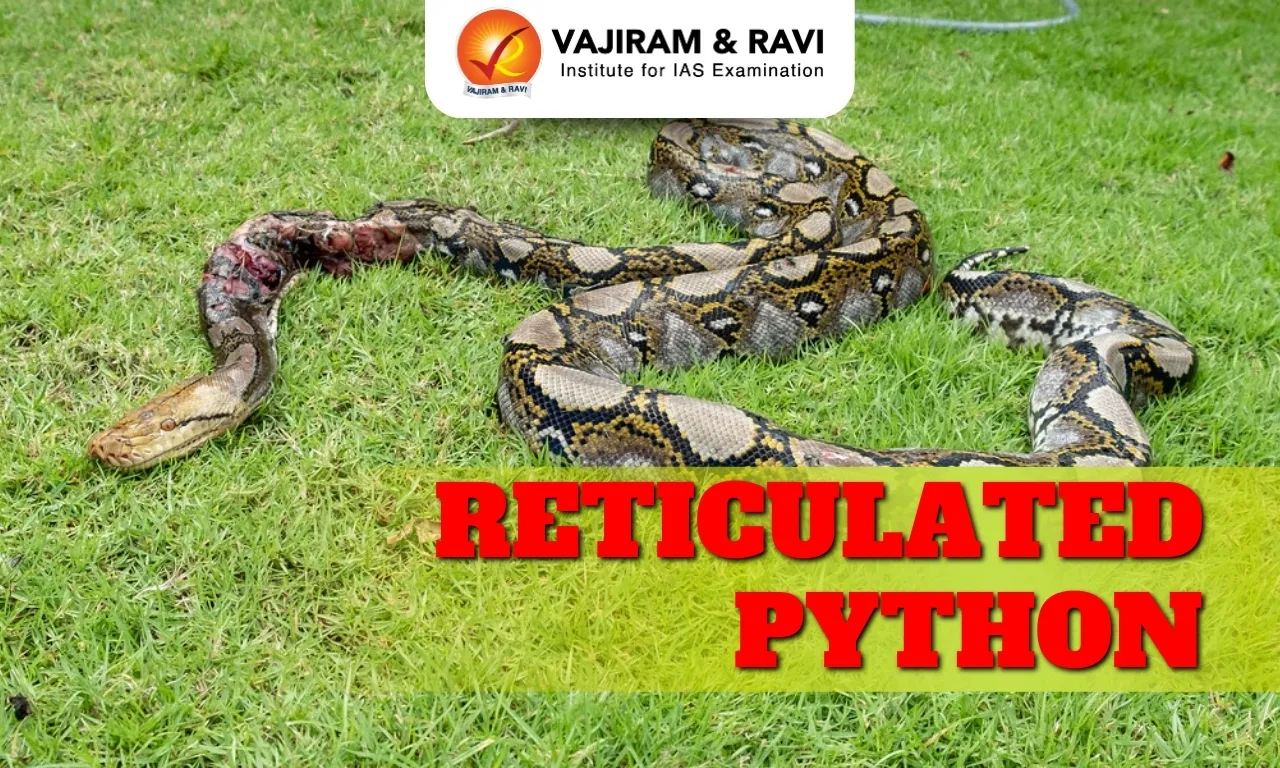
A giant female reticulated python discovered deep in the forests of the Indonesian island of Sulawesi late last year is now believed to be the longest measured snake in the world at 7.22 metres (23 feet 8 inches), the Guinness Book of World Records has confirmed.

About Reticulated Python

  • It is a giant constricting snake belonging to the python family, Pythonidae. 
  • Scientific Name: Malayopython reticulatus
  • It is the longest snake in the world and the third heaviest after the green anaconda and the Burmese python
  • Like all pythons, it is a non-venomous constrictor. 
  • It is an ambush predator, usually waiting until prey comes within striking range before trapping it in its rings and killing it by constriction. 

Reticulated Python Distribution

    • It is native to South and Southeast Asia. 
    • It inhabits tropical forest regions in India, Indonesia, the Philippines, and other parts of Southeast Asia.

Reticulated Python Features

  • Specimens have been recorded reaching a length of more than 7 metres and weighing more than 160 kg.
  • They have grayish-tan bodies with X- or diamond-shaped blotches containing black, white, yellow, and red scales.
  • The name ‘reticulated’ comes from the intricate and beautiful pattern of its skin, which resembles a net (or ‘lattice’). 
  • The snake’s head has smooth brown scales. 
  • The head is elongated with a dark line down the middle, and the eyes are orange with vertical pupils.
  • Embedded in the lip scales are heat-sensing pits that can detect any object or prey whose temperature exceeds that of the surrounding environment.

Reticulated Python Conservation Status

It is classified as 'Least Concern' under the IUCN Red List.

Source: DTE

Reticulated Python FAQs

Q1: What is a Reticulated Python?

Ans: It is a giant constricting snake belonging to the python family, Pythonidae.

Q2: What is the scientific name of the Reticulated Python?

Ans: Malayopython reticulatus.

Q3: What is the distinguishing global record of the Reticulated Python?

Ans: It is the longest snake in the world.

Q4: Is the Reticulated Python venomous?

Ans: No, it is a non-venomous constrictor.

Peregrine Falcon

Peregrine Falcon

Peregrine Falcon Latest News

Recently, a wildlife researcher has made a historic sighting of a Siberian peregrine falcon in central Australia, where this subspecies has never been recorded before.

About Peregrine Falcon

  • It is a large cosmopolitan raptor in the family Falconidae.
  • Distribution: It is found on all continents except Antarctica, and on many oceanic islands.
  • Habitat:
    • They prefer open habitats, such as grasslands, tundra, and meadows.
    • They are most common in tundra and coastal areas and rare in sub-tropical and tropical habitats. They nest on cliff faces and crevices.

Characteristics of Peregrine Falcon

  • It is renowned for its speed during its characteristic hunting stoop (high-speed dive), making it the fastest bird in the world, as well as the fastest member of the animal kingdom.
  • They are active during the day. When not breeding they are primarily solitary and establish and defend territories.
  • Ecological role: They are high level predators, peregrine falcons play an important role in regulating populations of their prey, particularly pigeons and doves.
  • Conservation status: IUCN Red List: Least Concern.

Source: Live Science

Peregrine Falcon FAQs

Q1: What is the IUCN conservation status of Peregrine Falcon?

Ans: Least Concern

Q2: Where do we find Peregrine Falcon?

Ans: In all continent except Antarctica.

Enquire Now