Piton de la Fournaise Volcano Latest News
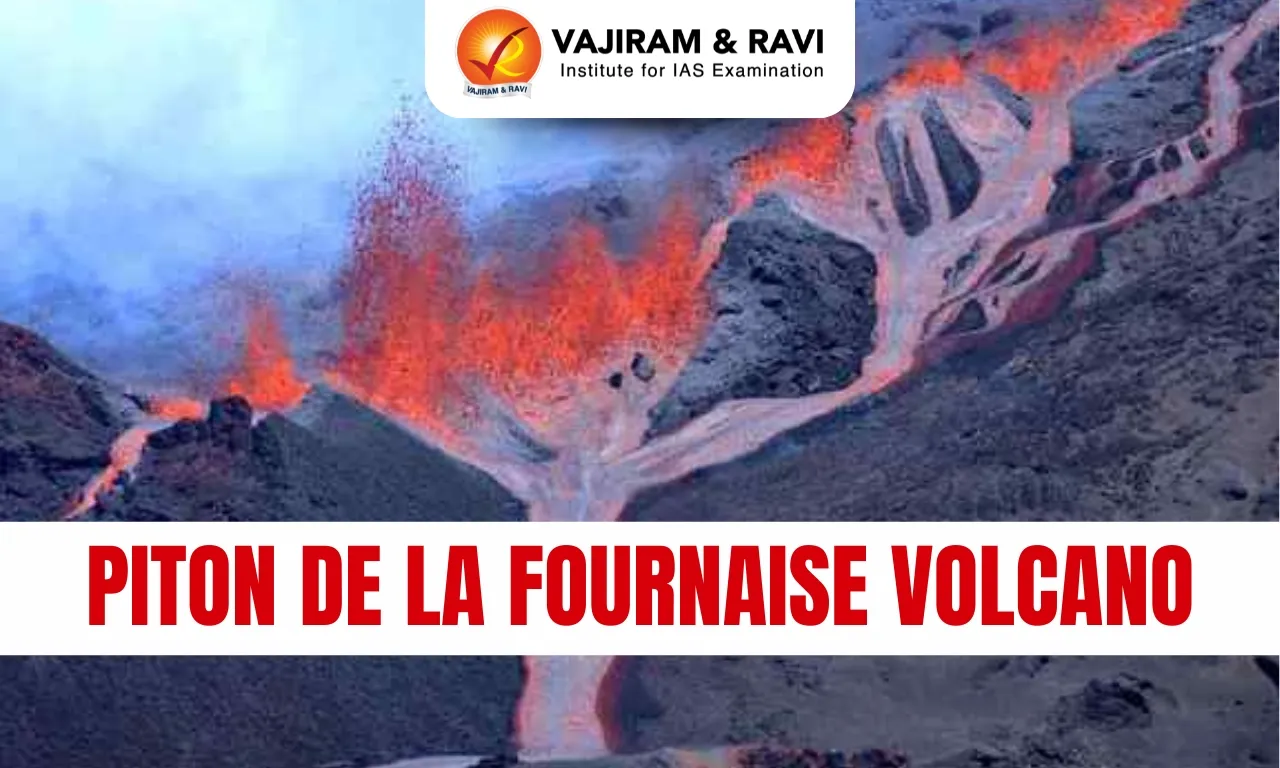
The Piton de la Fournaise volcano on Reunion Island erupted for the second time this year.
About Piton de la Fournaise Volcano
- Location: It occupies the east-southeastern end of French Island La Réunion in the western Indian Ocean.
- Type: It is a massive basaltic shield volcano.
- It is built on the flank of the larger and older Piton des Neiges volcano whose early activity was basaltic but ended with eruption of differentiated alkaline lavas.
- It is one of the most active volcanoes in the world.
- It is in a phase of frequent but short-lived eruptions that start with lava fountains and produce large lava flows.
- Status: It is around 500,000 years old and since 2010, it has been a member of the prestigious club of natural treasures listed as World Heritage sites by UNESCO.
Key Facts about Shield Volcano
- They are the largest volcanoes on Earth.
- They do not form soaring mountains with conical peaks like composite volcanoes. Instead, they are broad volcanoes with gentle slopes.
- They are almost exclusively basalt, a type of lava that is very fluid when erupted.
- Because basalt has a low viscosity, it can flow on the surface better. So, when these types of volcanoes erupt, lava flows outwards at large distances.
- They are built by repeated eruptions that occurred intermittently over vast periods of time.
- The Hawaiian shield volcanoes are the most famous examples.
Source: Watchers
Piton de la Fournaise Volcano FAQs
Q1: Where is Piton de la Fournaise located?
Ans: La Réunion Island, western Indian Ocean
Q2: What type of volcano is Piton de la Fournaise?
Ans: Shield volcano