Galathea Balasubramaniani

Galathea Balasubramaniani

Galathea Balasubramaniani Latest News

Researchers recently discovered a tiny crab species named Galathea balasubramaniani from the coral reefs of Agatti in the Lakshadweep Islands.

About Galathea Balasubramaniani

  • It is a new species of crab.
  • It was discovered from the coral reefs of Agatti in the Lakshadweep Islands. 
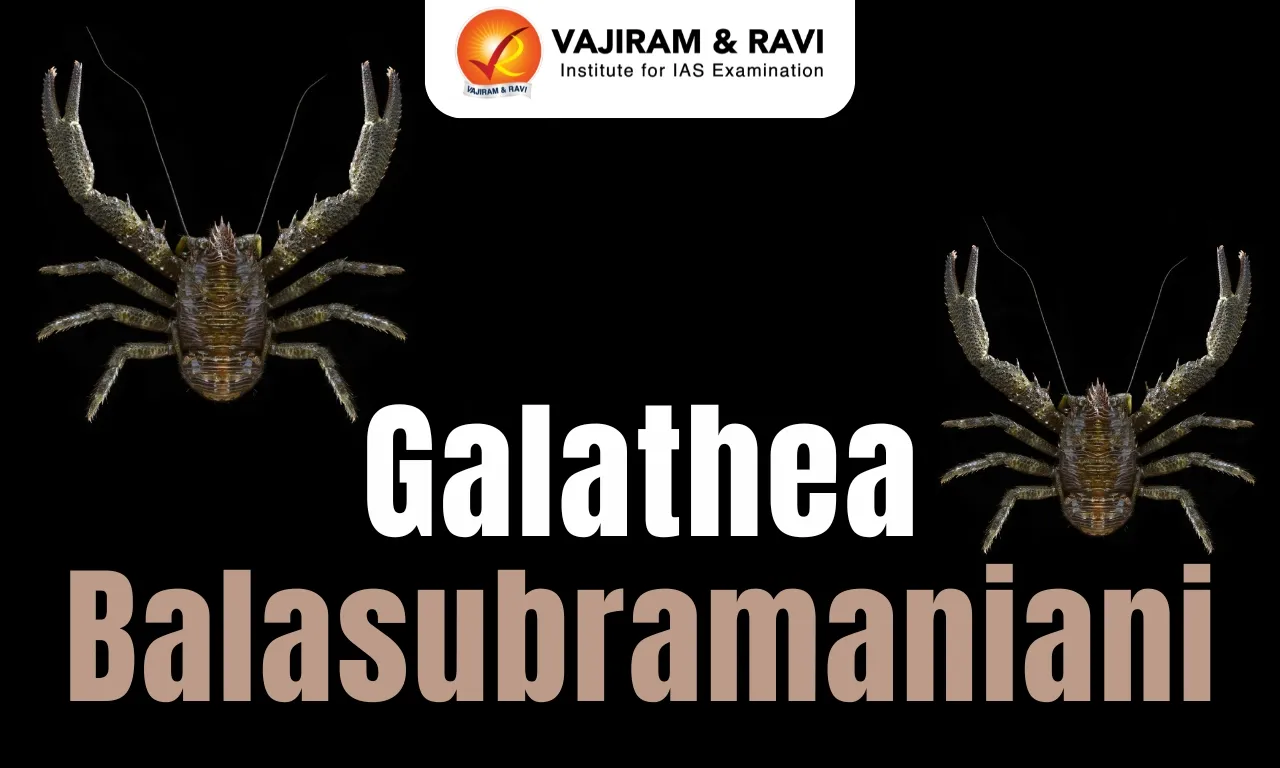
  • It belongs to the genus Galathea, a group of small, reef-dwelling anomuran crabs commonly called squat lobsters. 
    • Resembling tiny lobsters, these crabs have the ability to hide among coral and rocky crevices. 
    • They play an important role in coral reef ecosystems by recycling organic matter and serving as food for fish and other marine organisms.
  • It differs from its closest relative, G. mauritiana, in several body characteristics, including the structure of its legs and other morphological features, alongside clear genetic distinctions.
  • It measures up to 3 millimetres in length. It is one of the tiniest reef crabs recorded in the region.

Source: NIE

Galathea Balasubramaniani FAQ's

Q1: What is Galathea balasubramaniani?

Ans: It is a newly discovered species of crab (squat lobster).

Q2: Where was Galathea balasubramaniani discovered?

Ans: It was discovered from the coral reefs of Agatti in the Lakshadweep Islands.

Q3: To which genus does Galathea balasubramaniani belong?

Ans: It belongs to the genus Galathea, a group of small, reef-dwelling anomuran crabs commonly called squat lobsters.

Q4: What ecological role does Galathea balasubramaniani play in coral reef ecosystems?

Ans: Recycling organic matter and serving as food for fish and other marine organisms.
Key Facts about Finland

Key Facts about Finland

Finland Latest News

Recently, the Prime Minister of Finland said that Finland and India, together with global partners, can lead resilient, sustainable and human-centric technological progress.

About Finland

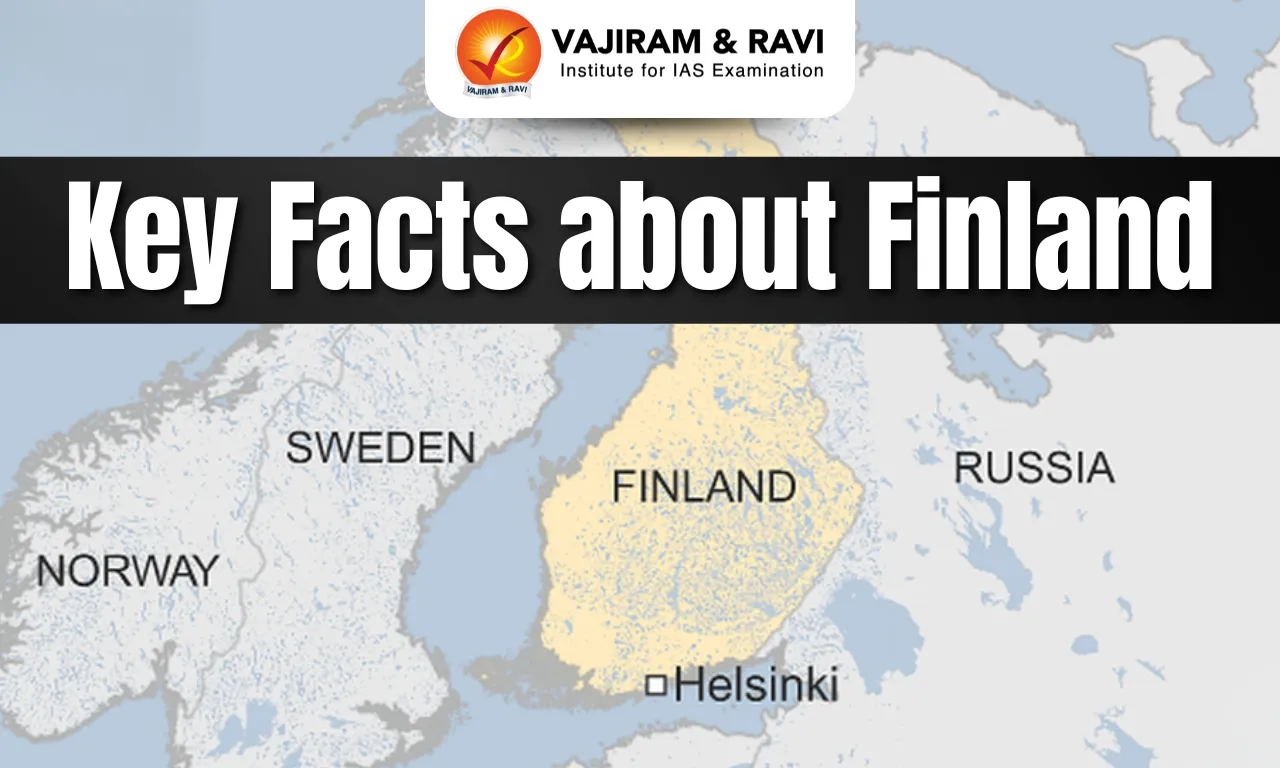
  • Location: It is located in Northern Europe.
  • Bordering Countries: Norway (north), Sweden (northwest) and Russia (east).
  • Bordering water bodies: It is bounded by the Gulf of Finland (south), Gulf of Bothnia (southwest) and Baltic Sea.
  • Capital City: Helsinki
  • It is a member of the European Union (EU) and NATO.

Geographical Features of Finland

  • Climate: Finland has a severe climate due to its northern location. Winter is the longest season, with temperatures in the north falling as low as -22 °F (-30 °C). 
  • Terrain: It is heavily forested and contains some 56,000 lakes, numerous rivers, and extensive areas of marshland.
  • It has one of the highest concentrations of lakes of any country in the world. The largest lake of Finland is Lake Saimaa.
  • Highest Point: Mount Halti (1,328 m).
  • Natural Resources: The country consists of copper, iron ore, nickel, cobalt, and chromium.

Source: News On Air

Finland FAQs

Q1: What is the capital of Finland?

Ans: Helsinki

Q2: What is the largest lake in Finland?

Ans: Lake Saimaa

VoicERA

VoicERA

VoicERA Latest News

Recently, the Ministry of Electronics and Information Technology unveiled VoicERA at the India AI Impact Summit 2026.

About VoicERA

  • It is an open-source, end-to-end Voice AI stack.
  • It is deployed on the BHASHINI National Language Infrastructure. 
  • It establishes a national execution layer for multilingual Voice and Language AI.
  • It is designed to be open, pluggable, interoperable, cloud deployable, and on premise ready.
  • The platform enables secure and scalable deployment of voice systems across government, research institutions, and innovation ecosystems.
  • Significance
    • Modularising the voice stack reduces duplication of effort and eliminates vendor lock-in.
    • The integration of VoicERA strengthens BHASHINI’s role as India’s national language infrastructure,
    • It expands its capabilities from translation and language technologies to real-time speech systems, conversational AI, and multilingual telephony at a population scale.

What is BHASHINI?

  • BHASHINI, or the BHASHa INterface for India, is an artificial intelligence (AI)-powered language translation platform.
  • It is developed by the Ministry of Electronics and Information Technology (MeitY) under its National Language Translation Mission. 
  • It aims to build a National Public Digital Platform for languages to develop services and products for citizens by leveraging the power of AI and other emerging technologies.
  • It helps people translate content into various Indian languages.
  • It uses cutting-edge AI and natural language processing (NLP) technologies to bridge the language divide, enabling users to access content and services in their preferred language. 
  • It is implemented by Digital India BHASHINI Division, a division under Digital India Corporation, a Section 8 Company of the MeitY.
  • Bhashini currently supports more than 22 languages, enabling inclusivity for a broad range of linguistic communities.

Source: PIB

VoicERA FAQs

Q1: What is VoicERA?

Ans: Open-source Voice AI stack

Q2: On which platform is VoicERA deployed?

Ans: BHASHINI National Language Infrastructure

Lymphedema

Lymphedema

Lymphedema Latest News

A newly discovered cellular mechanism shows promise for treating painful lymphedema.

About Lymphedema

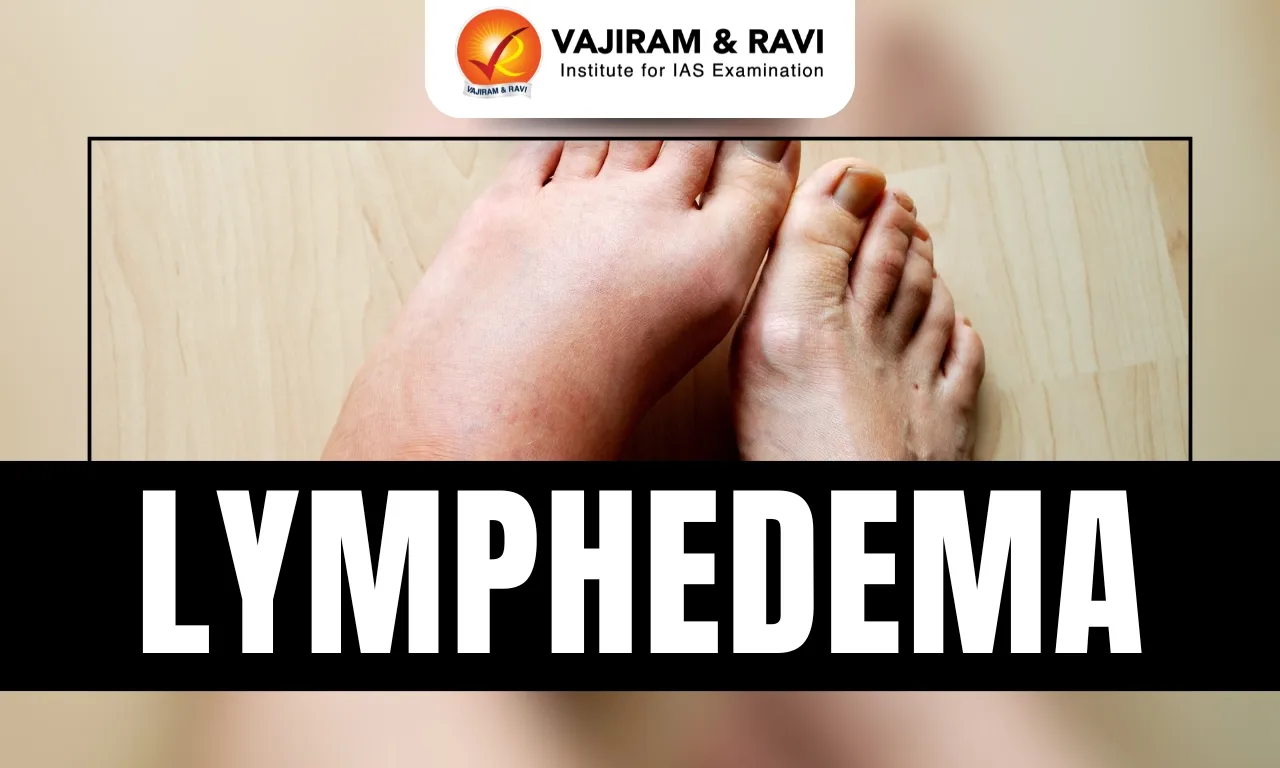
  • It is swelling in various areas of your body that happens when something affects your lymphatic system. 
  • Your lymphatic system collects excess fluid, proteins, and toxins from your cells and tissues and returns them to your bloodstream.
  • When your lymphatic system doesn’t work well, your body accumulates fluid and may begin to swell. 
  • The swelling typically affects your arms and legs, but it can affect other areas of your body, too. 

Lymphedema Causes

  • Lymphedema can happen after certain surgeries or because you have certain medical conditions or genetic conditions. 
  • It can be caused by cancer treatments that remove or damage your lymph nodes.
  • You may develop lymphedema spontaneously, meaning it happens for no known reason.

Lymphedema Symptoms

  • Lymphedema symptoms may be mild, causing minor swelling and discomfort. 
  • Severe cases of lymphedema can affect the ability to move the affected limb, increase the risks of skin infections and sepsis, and can lead to skin changes and breakdown.

Lymphedema Treatment

  • Once lymphedema develops, it is a chronic condition that cannot be cured but can be treated to relieve swelling and improve your ability to function day to day.
  • Treatment includes wearing compression garments, taking good care of your skin, moving and exercising regularly, having a healthy diet and lifestyle, and using specialised massage techniques.

Source: NEWSM

Lymphedema FAQs

Q1: What is lymphedema?

Ans: It is swelling in parts of the body caused by problems in the lymphatic system.

Q2: What is the main function of the lymphatic system?

Ans: It collects excess fluid, proteins, and toxins from tissues and returns them to the bloodstream.

Q3: Why does swelling occur in lymphedema?

Ans: Because the lymphatic system does not function properly, leading to fluid accumulation.

Q4: Is lymphedema a curable condition?

Ans: Once lymphedema develops, it is a chronic condition that cannot be cured but can be treated to relieve swelling.

Bandhavgarh Tiger Reserve

Bandhavgarh Tiger Reserve

Bandhavgarh Tiger Reserve Latest News

The Madhya Pradesh High Court recently directed the Field Director of Bandhavgarh Tiger Reserve to submit a detailed report on recent tiger fatalities in the reserve and surrounding areas.

About Bandhavgarh Tiger Reserve

  • It is located in the Umaria district of Madhya Pradesh.
  • It is spread over the Vindhya hills.
  • It derives its name from the most prominent hillock in the area, which was said to be given by Hindu Lord Rama to his brother Lakshmana to keep a watch on Lanka. Hence the name Bandhavgarh (Sanskrit: Brother’s Fort).
  • Topography: Varies between steep ridges, undulating forests, and open meadows. 
  • The reserve features around 39 caves with Pali inscriptions and animal depictions.
  • It also contains ancient structures, including stupas and statues from the 1st century BCE.
  • Flora:
    • The vegetation of Bandhavgarh is specially filled with Sal forest in the valleys, and bamboo stretches on the lower slopes of the region.
    • Some of the most famous floral species include Saj, Dhaora, Tendu, Arjun , Amla, Palas, etc.
  • Fauna:
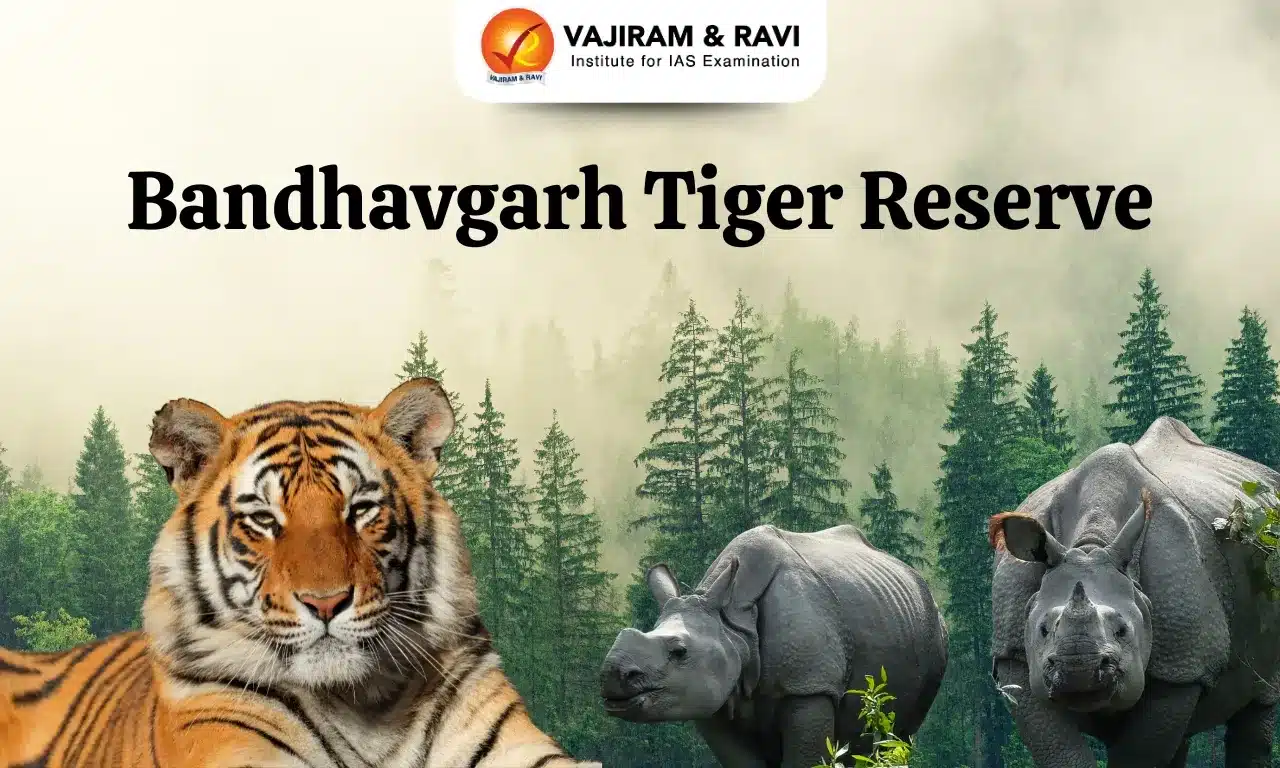
    • It is known to have one of the highest density of tigers in the world. 
    • It also hosts other notable mammals such as leopards, Indian bison (gaur), sambar deer, spotted deer, nilgai, wild boar, sloth bears, Indian wolves, jackals, and both langur and rhesus macaque monkeys.
    • It also has over 250 bird species, including the crested serpent eagle, Malabar pied hornbill, white-rumped vulture, and Indian roller.

Source: IM

Bandhavgarh Tiger Reserve FAQs

Q1: Where is Bandhavgarh Tiger Reserve located?

Ans: It is located in the Umaria district of Madhya Pradesh.

Q2: In which mountain range is Bandhavgarh Tiger Reserve situated?

Ans: It is spread over the Vindhya hills.

Q3: What type of topography is found in Bandhavgarh Tiger Reserve?

Ans: It varies between steep ridges, undulating forests, and open meadows.

Q4: Which type of forest dominates the valleys of Bandhavgarh?

Ans: Sal forests.

Dibang Multipurpose Project

Dibang Multipurpose Project

Dibang Multipurpose Project Latest News

The under-construction 2,880 MW Dibang multipurpose hydel project in Arunachal Pradesh recently achieved a significant milestone on Tuesday with the successful daylighting of Diversion Tunnel-3 (DT-3).

About Dibang Multipurpose Project

  • It is a flood control cum hydroelectric power project to be developed on the Dibang River, a tributary of the Brahmaputra River, in Arunachal Pradesh.
  • At 2,880 MW installed capacity, it will be the country’s biggest hydropower facility.
  • It is being developed by India’s state-run National Hydroelectric Power Corporation (NHPC).
  • The project is designed as an energy storage project, with flood moderation as one of the key objectives, besides power generation. 
  • Project Features:
    • The project envisages the construction of a 278 m-high and 375 m-long concrete gravity dam, which will be the highest concrete gravity dam of India. 
    • The dam is planned to be constructed with the Roller Compacted Concrete (RCC) technique, and it will be the highest RCC dam in the World. 
    • The dam will create a 43 km-long reservoir with a gross storage capacity of 3.85 billion cubic metres.
    • It includes six horseshoe-shaped headrace tunnels of length varying from 300 m to 600 m with 9 m diameter, an underground powerhouse, and six horseshoe-shaped tailrace tunnels of length varying from 320 m to 470 m with 9 m diameter.

Source: NET

Dibang Multipurpose Project FAQs

Q1: Where is the Dibang Multipurpose Project being developed?

Ans: It is being developed on the Dibang River, a tributary of the Brahmaputra River, in Arunachal Pradesh.

Q2: What is the power generation capacity of the Dibang Multipurpose Project?

Ans: 2,880 MW.

Q3: What are the primary objectives of the Dibang Multipurpose Project?

Ans: Power generation, flood moderation, and energy storage.

Q4: What type of dam is proposed under the Dibang Multipurpose Project?

Ans: The project envisages the construction of a concrete gravity dam, which will be the highest concrete gravity dam of India.

World Food Programme

World Food Programme

World Food Programme Latest News

Recently, the Food Corporation of India (FCI) and the World Food Programme (WFP) have signed a Memorandum of Understanding (MoU) for the supply of rice in support of global humanitarian operations aimed at combating hunger.

About World Food Programme

  • It is a branch of the United Nations that deals with hunger eradication and promotes food security in the world.
  • It is the world’s largest humanitarian agency and was established in 1961.
  • It operates in more than 120 countries, provides food assistance during emergencies and works with communities to enhance nutrition and generate resilience.
  • Funding: WFP is funded by voluntary donations from governments, corporates and private donors.
    • The organization’s work is guided by Sustainable Development Goal 2, which aims to end hunger, achieve food security and improved nutrition, and promote sustainable agriculture by 2030.
  • Governance
    • It is governed by the WFP Executive Board, which consists of 36 Member States and provides intergovernmental support, direction and supervision of activities.
    • WFP is headed by an Executive Director, who is appointed jointly by the UN Secretary-General and the Director-General of the Food and Agriculture Organization of the United Nations.
    • The Executive Director is appointed for fixed five-year terms. 
  • It is a member of the United Nations Development Programme (UNDP)
  • WEF was awarded the Nobel Peace Prize in 2020. 
  • Reports by WEF: Report released by the WFP is the Global Report on Food Crisis which describes the scale of acute hunger in the world.
  • Headquarters: Rome, Italy

Source: PIB

World Food Programme FAQs

Q1: What is the primary goal of the World Food Programme?

Ans: Fighting hunger and improving nutrition globally

Q2: Where is the headquarters of the World Food Programme located?

Ans: Rome

CHaracterising ExOPlanet Satellite (CHEOPS)

CHaracterising ExOPlanet Satellite (CHEOPS)

CHaracterising ExOPlanet Satellite (CHEOPS) Latest News

ESA’s CHaracterising ExOPlanet Satellite (CHEOPS) recently revealed a four-planet system whose outermost world is a small and rocky planet — not a gas giant.

About CHaracterising ExOPlanet Satellite (CHEOPS)

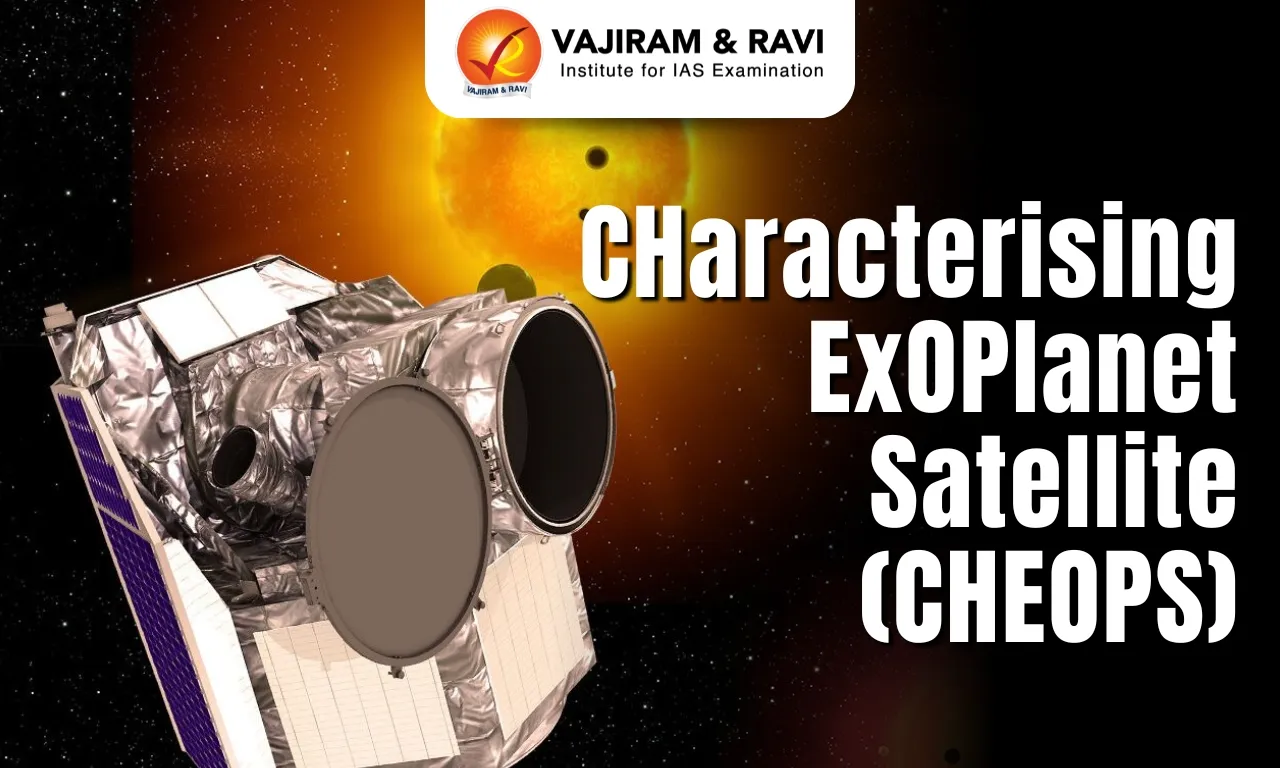
  • It is a European Space Agency (ESA) spacecraft.
  • It is the first space mission dedicated to studying bright, nearby stars that are already known to host exoplanets, in order to make high-precision observations of the planet's size as it passes in front of its host star.
  • It focuses on planets in the super-Earth to Neptune size range.
  • Launch date: 18 December 2019
  • Orbit: Sun-synchronous, dusk-dawn orbit at 700 km above Earth.
  • The spacecraft has a single science instrument: a specialized camera called a photometer.
  • CHEOPS observes transits of Earth-to-Neptune-sized exoplanets and measures their diameters within 10 percent. 
  • When combined with mass data from ground telescopes, it helps calculate planet density.
  • A planet’s density provides vital clues about its composition and structure, indicating, for example, if it is predominantly rocky or gassy, or perhaps harbours significant oceans.

Source: SCI

CHaracterising ExOPlanet Satellite (CHEOPS) FAQs

Q1: What is CHaracterising ExOPlanet Satellite (CHEOPS)?

Ans: It is a space mission of the European Space Agency designed to study known exoplanets.

Q2: What is the primary objective of CHaracterising ExOPlanet Satellite (CHEOPS)?

Ans: To make high-precision measurements of the sizes of known exoplanets.

Q3: When was CHEOPS launched?

Ans: 18 December 2019.

Q4: What is the main scientific instrument onboard CHaracterising ExOPlanet Satellite (CHEOPS)?

Ans: A specialized photometer (camera).

Lakhpati Didi Initiative

Lakhpati Didi Initiative

Lakhpati Didi Initiative Latest News

Recently, the Union Minister for Rural Development and Agriculture & Farmers’ Welfare directed officials to formulate a special, focused strategy and work on a war footing to achieve the revised target of creating 6 crore ‘Lakhpati Didis’.

About Lakhpati Didi Initiative

  • A Lakhpati Didi is a Self-Help Group member who earns an annual household income of Rupees One Lakh (Rs. 1,00,000) or more.
    • This income is calculated for at least four agricultural seasons and/or business cycles, with an average monthly income exceeding Rupees Ten Thousand (Rs. 10,000), so that it is sustainable.
  • It focusses on the individual SHG women and not on the Self-Help Group (SHG). 
  • This initiative facilitates diversified livelihood activities, by ensuring convergence across all Government departments/ Ministries, Private sector and Market players.
  • Objective: To encourage women to start micro-enterprises within their villages.
  • The initiative has been initiated by DAY-NRLM, wherein each SHG household is encouraged to take up multiple livelihood activities coupled with value chain interventions.
  • Lakhpati Didi Strategy
    • Deepen, Strengthen and Expand Livelihood options : The households will be facilitated and enabled to take up diversified income-generating activities.
    • Capacity Building: A Cascade Training Strategy is adopted to enable training and handholding of Potential Lakhpati Didis (SHG members) from across all States and Union Territories in India.
    • Financial Assistance:  DAY-NRLM serves as a catalyst, facilitating financial assistance and providing a platform for these women to thrive.
  • Nodal Ministry: Ministry of Rural Development
  • Revised Target: 6 crore Lakhpati Didis by March 2029.

Source: PIB

Lakhpati Didi Initiative FAQs

Q1: What is the target for Lakhpati Didis by March 2029?

Ans: 6 crore

Q2: Which ministry is the nodal ministry for the Lakhpati Didi Initiative?

Ans: Ministry of Rural Development

Indian Grey hornbill

Indian Grey hornbill

Indian Grey Hornbill Latest News

In a public poll that was conducted by the Forest Department, Indian Grey Hornbill was chosen as the ‘Bird of Tirupattur’ district of Tamil Nadu by over 41,000 voters.

About Indian Grey Hornbill

  • It is a common hornbill found on the Indian subcontinent.
  • It is commonly sighted in pairs.
  • These birds are known to be arboreal, i.e. spend most of their time on tall trees, but may descend for food and to collect mud pellets for nesting. 
  • Appearance
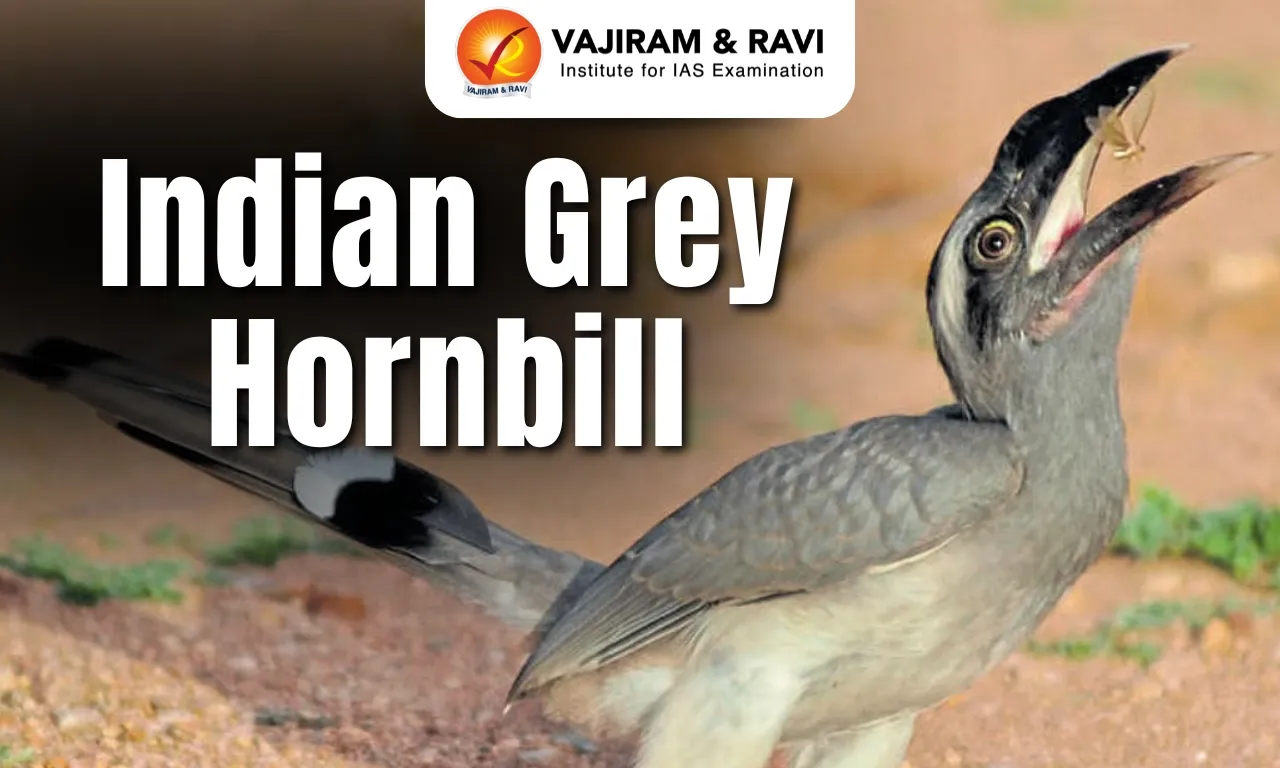
    • It has grey feathers all over the body with a light grey or dull white belly.
    • The horn is black or dark grey with a casque extending to the point of curvature of the horn.
    • Unlike a lot of other birds, the male and female look similar.
  • Habitat: Occurs in deciduous forests, open woodlands and thorn forest as well as rural cultivation and urban gardens and parks.
  • Distribution: Indian subcontinent; found from north-east Pakistan and south Nepal east to north-west Bangladesh and south throughout most of India except in Assam.
  • Diet: The food is mainly fruits, particularly figs.
  • Ecological Role: They play an essential role in the ecosystem as prime dispersers of seeds. 
  • Conservation status: IUCN: Least Concern.

Source: TH

Indian Grey Hornbill FAQs

Q1: What is the habitat of the Indian Grey Hornbill?

Ans: Forests and woodlands of India and Southeast Asia

Q2: What is distinctive about the Indian Grey Hornbill's appearance?

Ans: It has a large casque on the bill.

Enquire Now