Rapti River Latest News
The National Green Tribunal (NGT) has directed the Uttar Pradesh government to correct official records and restore the Suav, a major tributary of the Rapti river status from a “drain” to a “river” in the revenue records and gazetteer.
About Rapti River
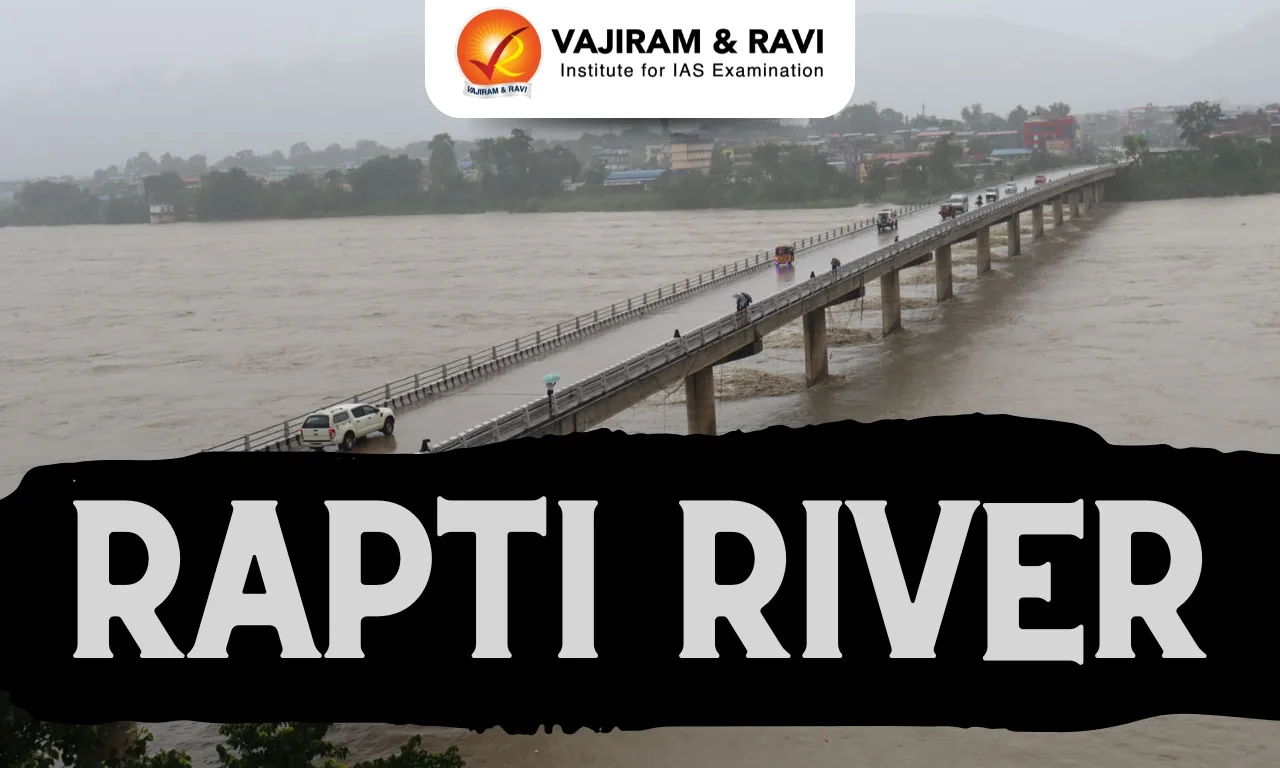
- Rapti River is the most important left bank tributary of the Ghaghra River.
- Historically, the Rapti River was known as Iravati.
- Origin: The Rapti River originates in Nepal near Rukumkot in the Mahabharat range of the lesser Himalayas.
- The river begins in Nepal's Mahabharat range at an elevation of 3,050 metres.
- Topography: The entire basin's topography is made up of lofty mountains, inner and outer Tarai, and undulating plain regions.
- It has two distinct climatic regions due to altitude differences: the mountainous region has a temperate climate, while the plain region has a subtropical climate.
- Burhi Rapti and Rohini are the major left bank tributaries of Rapti.
- After flowing through Nepal, it enters Eastern Uttar Pradesh.
Key Facts about National Green Tribunal
- It has been established under the National Green Tribunal Act, 2010.
- It is a specialized body equipped with the necessary expertise to handle environmental disputes involving multi-disciplinary issues.
- It shall be guided by principles of natural justice.
- Mandate: The Tribunal is mandated to make and endeavour for disposal of applications or appeals finally within 6 months of filing of the case.
- Locations: New Delhi is the Principal Place of Sitting of the Tribunal and Bhopal, Pune, Kolkata and Chennai shall be the other four place of sitting of the Tribunal.
Composition of NGT
- Chairperson: A retired Supreme Court judge.
- Judicial members: Retired High Court judges.
- Expert members: Professionals with at least 15 years of experience in fields related to environment or forest conservation.
Source: DTE
Rapti River FAQs
Q1: Where is the Rapti River located?
Ans: Flows through Nepal and India
Q2: Where does the river Rapti come from?
Ans: It rises in Nepal at an elevation of about 3048 m. in the Dregaunra range.