Vitamin B3

Vitamin B3

Vitamin B3 Latest News

Scientists recently discovered that vitamin B3 supplementation, when tested in mice, can successfully treat a devastating genetic disease known as NAXD deficiency.

About Vitamin B3

  • Vitamin B3, or Niacin, is a water-soluble vitamin.
  • Niacin is naturally present in many foods, added to some food products, and available as a dietary supplement.
  • There are two main chemical forms of niacin:
    • nicotinic acid
    • niacinamide (sometimes called nicotinamide)
  • Your body gets niacin through food, but it also makes small amounts from the amino acid tryptophan, which can be found in protein sources like turkey and other animal foods.
  • Function:
    • Niacin works in the body as a coenzyme, with more than 400 enzymes dependent on it for various reactions. 
    • Niacin helps to convert nutrients into energy, create cholesterol and fats, create and repair DNA, and exert antioxidant effects. 
  • Food Sources: A niacin deficiency is rare because it is found in many foods, both from animals and plants.
    • Red meat: beef, beef liver, pork
    • Poultry
    • Fish
    • Brown rice
    • Fortified cereals and breads
    • Nuts, seeds
    • Legumes
    • Bananas 
  • Deficiency:
    • A severe niacin deficiency leads to pellagra, a condition that causes a dark, sometimes scaly rash to develop on skin areas exposed to sunlight; bright redness of the tongue; and constipation/diarrhea.
    • Other signs of severe niacin deficiency include:
      • Depression
      • Headache
      • Fatigue
      • Memory loss
      • Hallucinations

What is NAD(P)HX dehydratase (NAXD)?

  • It is an essential cellular enzyme that helps repair damaged forms of key metabolic molecules, ensuring normal energy production and cell survival.
  • NAXD deficiency is a rare neurometabolic disease with infantile onset marked by repeated episodes of developmental regression and progressive neurodegeneration, often triggered by febrile illnesses. 
  • Clinical features include lethargy, hypotonia, irritability, gait ataxia, loss of speech, movement disorders, seizures, ophthalmoplegia, and hearing loss.

Source: NM

Vitamin B3 FAQs

Q1: What is Vitamin B3 commonly known as?

Ans: Vitamin B3 is commonly known as niacin.

Q2: Is Vitamin B3 water-soluble or fat-soluble?

Ans: It is a water-soluble vitamin.

Q3: In what forms does niacin exist?

Ans: The two main forms are nicotinic acid and niacinamide (nicotinamide).

Q4: Is niacin deficiency common?

Ans: No, it is rare because niacin is widely available in many foods.

Q5: What disease is caused by severe niacin deficiency?

Ans: Pellagra
Employees’ State Insurance Corporation

Employees’ State Insurance Corporation

Employees’ State Insurance Corporation Latest News

Recently, the Employees’ State Insurance Corporation (ESIC) commenced the celebration of its 75th Year of Service at Bharat Mandapam, New Delhi. 

About Employees’ State Insurance Corporation

  • It is a statutory body formed under the ESI Act 1948.
  • It is functioning under the aegis of Ministry of Labour and Employment, Government of India.
  • It manages the ESI scheme, which provides medical, maternity, and financial benefits to employees.
  • Functions: ESIC provides various social security benefits like Medical Benefit, Monetary benefits to the workmen and their family working in the private and public sector.

Genesis of ESIC

  • The first document on social insurance was "Report on Health Insurance" submitted to the Tripartite Labour Conference, headed by Prof. B.P.Adarkar who was acknowledged as Chhota Beveridge.
  • In 1948 Dr. C.L.Katial took over as the 1st Director General of ESIC
  • The ESI scheme was inaugurated in Kanpur on 24th February 1952 (ESIC Day) by then Prime Minister Pandit Jawahar Lal Nehru.

Composition of ESIC

  • The Union Minister of Labour heads the ESIC as its Chairman.
  • The Central Government appoints a Director General as the Chief Executive Officer of ESIC. 
  • The ESIC comprises members representing crucial interest groups, including employers, employees, the Central and State Governments, representatives of the Parliament and the medical profession. 

 Source: PIB

Employees’ State Insurance Corporation FAQs

Q1: What is the primary objective of ESIC?

Ans: To provide social security and health insurance to employees

Q2: What is the contribution rate for employees and employers under ESIC?

Ans: Employee: 0.75%, Employer: 3.25%

Impatiens nagorum

Impatiens nagorum

Impatiens nagorum Latest News

A team of botanists recently discovered and described a new species of flowering plant named Impatiens nagorum from Northeast India.

About Impatiens nagorum

  • It is a new species of flowering plant.
  • It was discovered in Fakim Wildlife Sanctuary in Nagaland’s Kiphire district.
  • The species name “nagorum” honours the Naga tribes of Nagaland.
  • Impatiens — commonly known as balsams or “touch-me-nots” — are flowering plants famous for their brightly coloured blooms and seed pods that burst open when touched. 
  • The Eastern Himalayas and Northeast India are among the world’s richest regions for this group of plants.
  • Found at an elevation of 2,336 metres in moist temperate broadleaf forests, the newly described species is currently known only from its type locality.
  • The plant grows up to 35 cm tall and bears distinctive purple flowers. 
  • It differs from closely related species in having serrated leaves, slightly hairy lateral sepals, and a deeper lower sepal that gradually tapers into a hooked spur.

Source: EM

Impatiens nagorum FAQs

Q1: What is Impatiens nagorum?

Ans: It is a newly discovered species of flowering plant

Q2: Where was Impatiens nagorum discovered?

Ans: It was discovered in Fakim Wildlife Sanctuary.

Q3: What are plants of the genus Impatiens commonly known as?

Ans: They are commonly known as balsams or “touch-me-nots”.

Q4: What is the colour of the flowers of Impatiens nagorum?

Ans: The plant bears distinctive purple flowers.

Smew

Smew

Smew Latest News

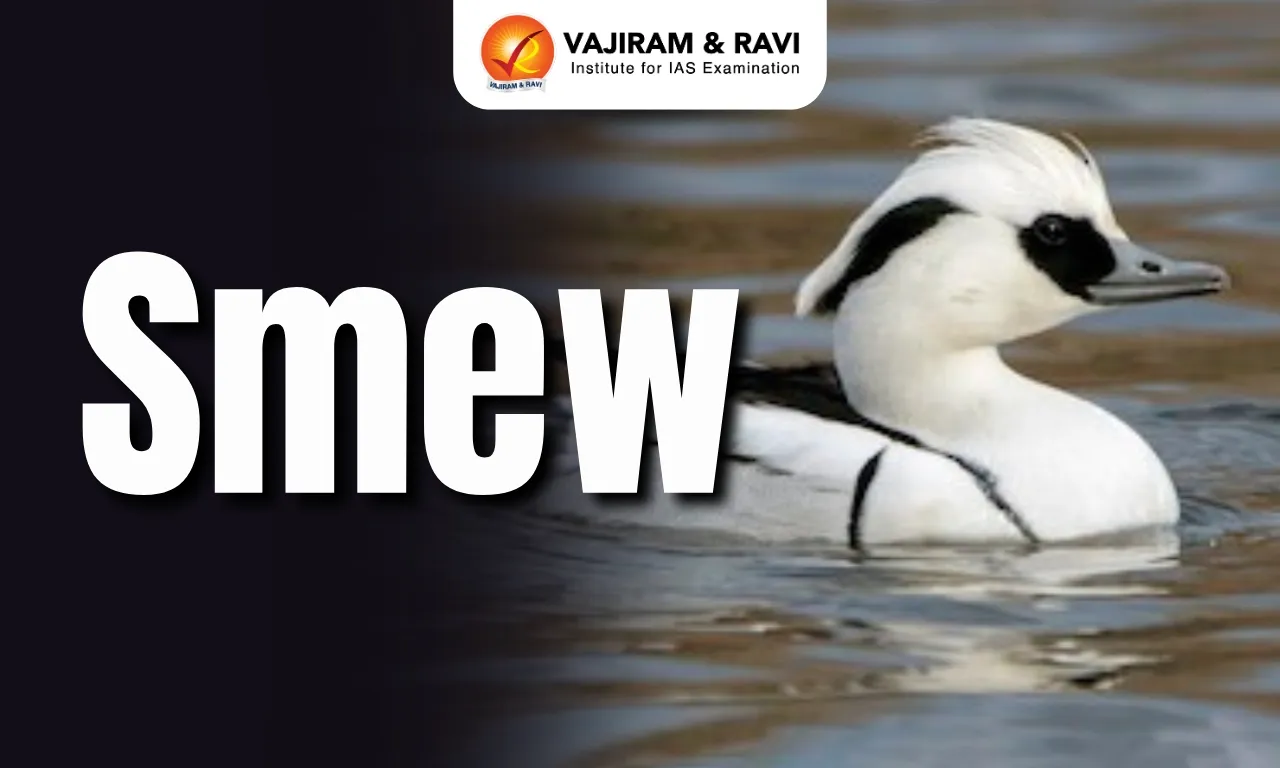
The smew was recently sighted for the first time in the Kaziranga during the 7th Waterbird Count at Rowmari-Donduwa beels (Laokhowa) buffer of Kaziranga Tiger Reserve sites.

About Smew

  • It is a small diving duck formally described in 1758 by the Swedish naturalist Carl Linnaeus. 
  • Scientific Name: Mergellus albellus

Smew Habitat and Distribution

    • Smews breed in the northern taiga of Europe and the Palearctic. 
    • They need trees for breeding and prefer to live on fish-rich lakes and slow rivers. 
    • Smews spend winters on sheltered coasts or inland lakes of the Baltic Sea, the Black Sea, northern Germany, and the Low Countries, with a small number reaching Great Britain.

Smew Features

    • It is a compact diving duck with a delicate bill. 
    • The male is white with a black mask and a black back, the female is grey with a reddish-brown head and white cheek.
    • In flight, it shows black and white wings. 
    • The smew's bill has a hooked tip and serrated edges, which help it catch fish when it dives for them.

Smew Conservation Status

It is classified as 'Least Concern' under the IUCN Red List.

Source: TOI

Smew FAQs

Q1: What type of bird is the Smew?

Ans: It is a small diving duck.

Q2: What is the scientific name of the Smew?

Ans: The scientific name is Mergellus albellus.

Q3: In which region do Smews breed?

Ans: They breed in the northern taiga of Europe and the Palearctic region.

Q4: What is the conservation status of the Smew according to the IUCN Red List?

Ans: It is listed as Least Concern.

Staphylococcus Aureus

Staphylococcus Aureus

Staphylococcus Aureus Latest News

An institute of the Department of Science and Technology (DST) based in North East India has synthesised a novel biosurfactant which has been found to act effectively against bacterium Staphylococcus aureus.

About Staphylococcus Aureus

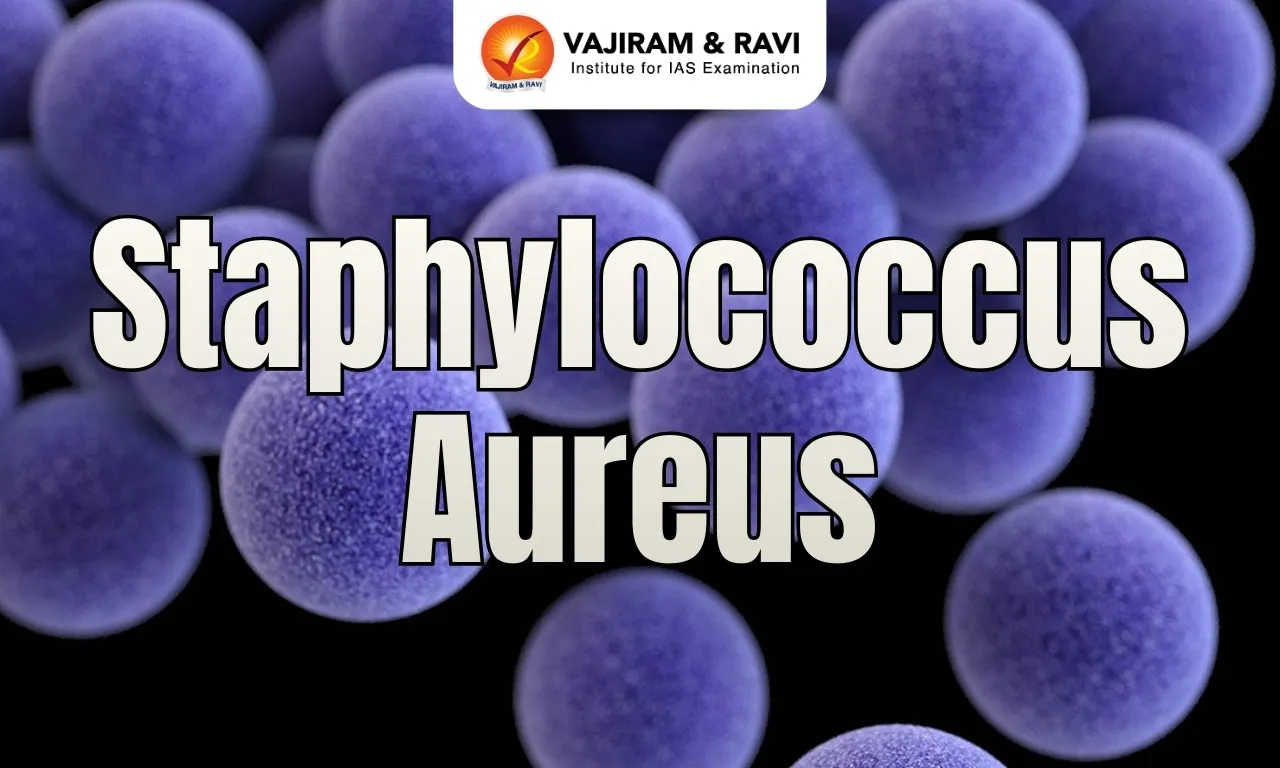
  • It is a type of bacteria belonging to the family Staphylococcaceae. 
  • It stains Gram positive and is non-moving small round shaped or non-motile cocci.
  • It is found in grape-like (staphylo-) clusters.
  • It may occur commonly in the environment. 
    • S. aureus was discovered in Aberdeen, Scotland in 1880 by the surgeon Sir Alexander Ogston in pus from surgical abscesses.
  • It affects all known mammalian species, including humans. 
  • Further due to its ability to affect a wide range of species, S. aureus can be readily transmitted from one species to another. (This includes transmission between humans and animals.)
  • It causes
    • Minor skin infections, such as pimples, impetigo etc.
    • It may cause boils (furuncles), cellulitis folliculitis, carbuncles
    • It is the cause of scalded skin syndrome and abscesses
    • It may lead to lung infections or pneumonia
  • Treatment: Healthcare providers can treat most staph infections with antibiotics.

Transmission of Staphylococcus Aureus

  • S. aureus is transmitted through air droplets or aerosol. When an infected person coughs or sneezes.
  • It can also transmit through direct contact with objects that are contaminated by the bacteria or by bites from infected persons or animals. 

Source: PIB

Staphylococcus Aureus FAQs

Q1: What is the shape of Staphylococcus aureus?

Ans: Spherical (cocci)

Q2: Which is a common disease caused by Staphylococcus aureus?

Ans: Skin infections

Epstein – Barr virus

Epstein - Barr virus

Epstein - Barr virus 

Researchers are progressing towards a vaccine against Epstein-Barr virus (EBV), which affects 95% of the global population and is linked to multiple serious diseases.

About Epstein - Barr virus

  • It is a common and highly contagious infection.
  • Transmission: It spreads through bodily fluids, especially saliva.
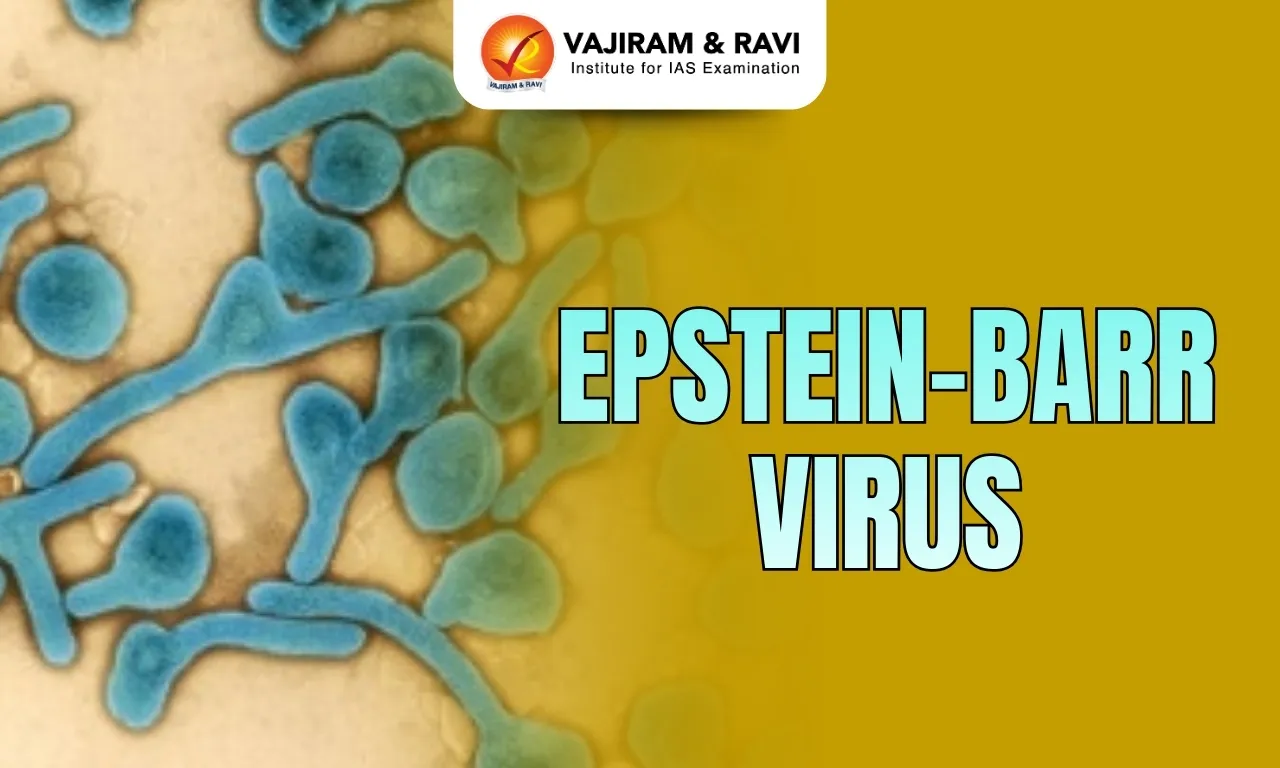
  • EBV is a type of herpesvirus called herpesvirus 4.
  • It has been found to be widely present in the human population.
    • Nearly 95% of the global population is infected with Epstein-Barr virus, with some populations at higher risk for serious complications if the virus becomes activated.
  • Most cases of Epstein-Barr virus affect children, teenagers and young adults, but anyone can get the virus.
  • It usually does not cause any harm, but the virus gets reactivated inside the body in some unusual conditions like immunological stress or immunocompetence.
  • This may further lead to various complications like a type of blood cancer called Burkitt’s lymphoma, stomach cancer, multiple sclerosis.
  • Symptoms: Sore throat and throat inflammation, Fatigue or feeling extremely tired, Fever, Swollen lymph nodes, Rashes on your skin, Enlarged spleen and liver.
  • Treatment: There is no specific treatment for EBV. However, some things like drinking fluids to stay hydrated, getting plenty of rest can be done to help relieve symptoms.

 Source: DD News

Epstein - Barr virus FAQs

Q1: What is the primary mode of transmission of EBV?

Ans: Saliva

Q2: What percentage of the global population is infected with EBV?

Ans: 95%

Coeliac Disease

Coeliac Disease

Celiac Disease Latest News

A recent study indicates that a drug already approved for use in humans could help to reduce the inflammation associated with celiac disease.

About Celiac Disease

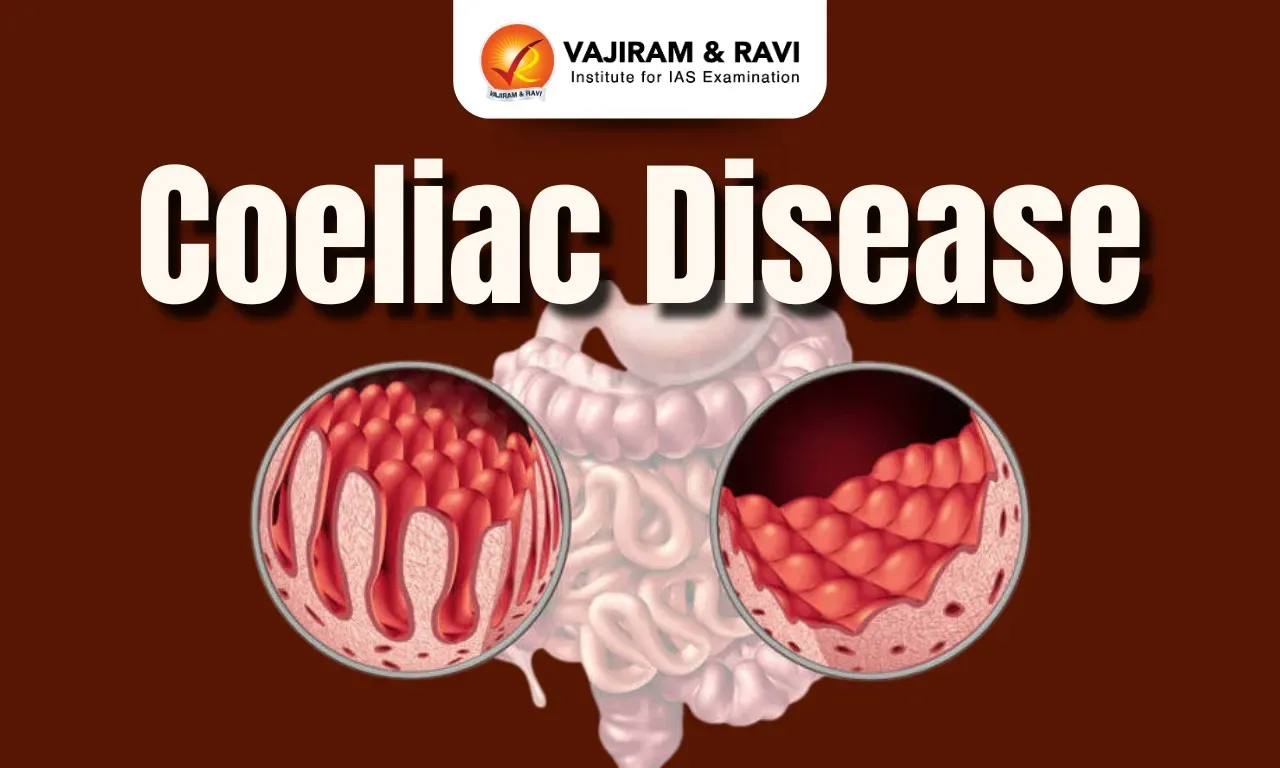
  • It is an inherited autoimmune condition where the immune system reacts to gluten, sometimes causing damage to the small intestine.
    • Gluten is a protein found in foods containing wheat, barley, or rye.
  • If you have celiac disease, eating gluten triggers an immune response to the gluten protein in your small intestine. 
  • Over time, this reaction can damage your small intestine's lining and prevent it from absorbing nutrients. This condition is called malabsorption.
  • The intestinal damage often causes symptoms such as diarrhea, fatigue, weight loss, bloating, or anemia
  • It also can lead to serious complications if it is not managed or treated. 
  • In children, malabsorption can affect growth and development in addition to gastrointestinal symptoms.
  • It can develop at any age after people start consuming gluten.
  • It is estimated to affect 1 in 100 people worldwide.
  • There's no definite cure for celiac disease. But for most people, following a strict gluten-free diet can help manage symptoms and help the intestines heal.

Source: NM

Celiac Disease FAQs

Q1: What is celiac disease?

Ans: It is an inherited autoimmune disorder in which the immune system reacts to gluten and damages the small intestine.

Q2: What substance triggers celiac disease?

Ans: Gluten.

Q3: What happens when a person with celiac disease consumes gluten?

Ans: The immune system attacks the small intestine.

Q4: How does celiac disease affect nutrient absorption?

Ans: It damages the lining of the small intestine, leading to malabsorption.

Q5: Is there a permanent cure for celiac disease?

Ans: No, there is no definite cure.

Peatlands

Peatlands

Peatlands Latest News

Researchers found that two lakes namely Mai Ndombe and Tumba in the Democratic Republic of Congo are releasing carbon that has been locked away for thousands of years in surrounding peatlands.

About Peatlands

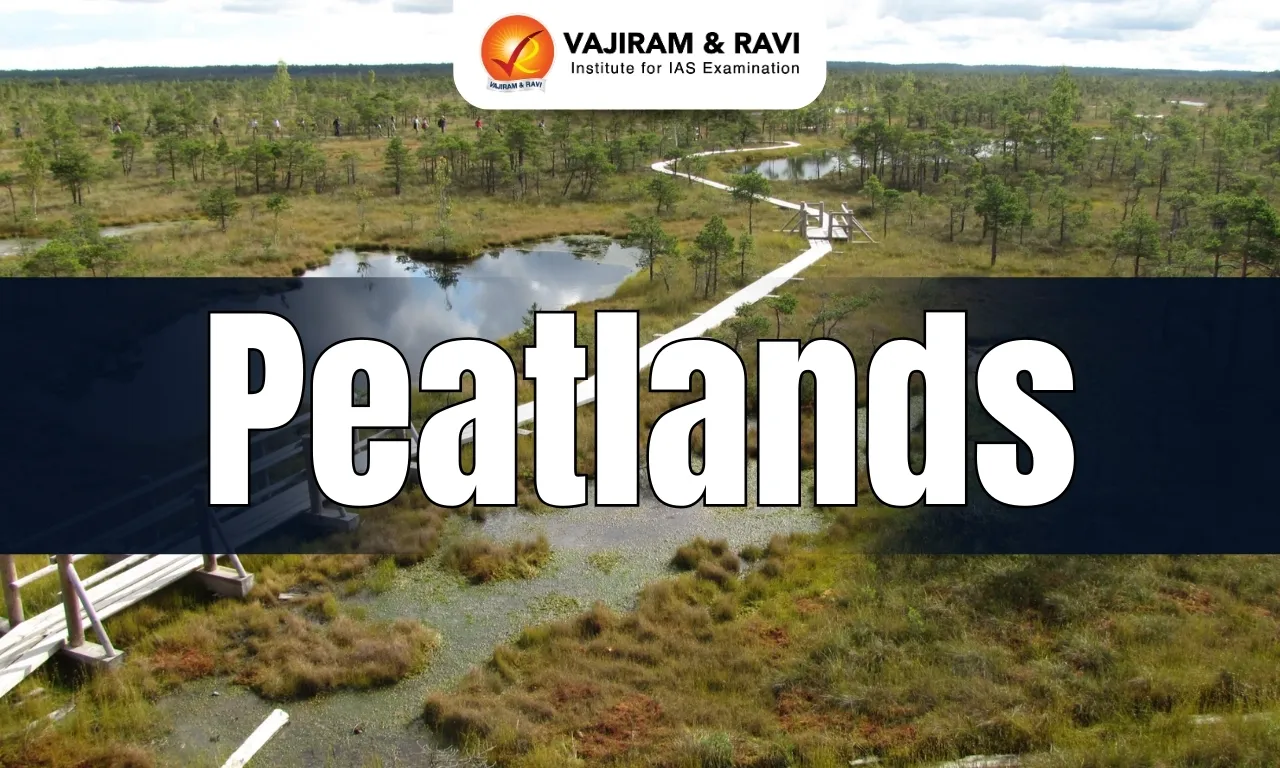
  • Peatlands are terrestrial wetland ecosystems in which waterlogged conditions prevent plant material from fully decomposing.
  • Consequently, the production of organic matter exceeds its decomposition, which results in a net accumulation of peat.
    • Peat, formed from the accumulation of dead plant material, does not decompose in a water-logged state but when it dries, the organisms that break down plant material revive and the carbon seeps back into the atmosphere.
    • In cool climates, peatland vegetation is mostly made up of Sphagnum mosses, sedges and shrubs and are the primary builder of peat,
    • In warmer climates graminoids and woody vegetation provide most of the organic matter.
  • The swamps and peatlands of the Congo Basin cover only 0.3% of the earth’s land surface, yet hold one-third of the carbon stored in its tropical peatlands.
  • Distribution: The majority of the world’s peatlands occur in boreal and temperate parts of the Northern Hemisphere.
  • Types
    • Northern and temperate peatlands: Found especially, Europe, North America and Russia where they have formed under high precipitation-low temperature climatic regimes.
    • Tropical peatlands: Found in Southeast Asia, mainland East Asia, the Caribbean, Central America, South America, Africa, parts of Australasia and a few Pacific Islands.

Source: DD News

Peatlands FAQs

Q1: What are peatlands?

Ans: Terrestrial wetland ecosystems with accumulated plant material

Q2: Where are the majority of the world's peatlands located?

Ans: Boreal and temperate parts of the Northern Hemisphere

RAMP Programme

RAMP Programme

RAMP Programme Latest News

Recently, the Ministry of Micro, Small and Medium Enterprises, Government of India organised the fifth meeting of the National MSME Council to review progress of World Bank–Supported RAMP Programme in New Delhi.

About RAMP Programme

  • The Raising & Accelerating MSME Performance (RAMP) programme was launched in 2022.
  • It aims at improving access to market and credit, strengthening institutions and governance at the Centre and State, improving Centre-State linkages and partnerships, addressing issues of delayed payments and greening of MSMEs.
  • It is assisted by the World Bank.
  • Objectives of RAMP Programme
    • Improving access to market and credit for MSMEs
    • Strengthening institutions and governance at the central and state levels
    • Improving center-state linkages and partnerships
    • Addressing issues of delayed payments
    • Greening of MSMEs
  • The National MSME Council has been set up by the Ministry to work as an administrative and functional body of the RAMP Programme.
  • It is implemented by the Ministry of Micro, Small and Medium Enterprises (MoMSME) over the five year period 2022-23 to 2026-27.
  • It provides grants to States for preparation of Strategic Investment Plan (SIP).

Sub schemes under RAMP

  • MSME GIFT Scheme: MSME Green Investment and Financing for Transformation Scheme intends to help MSMEs adopt green technology with interest subvention and credit guarantee support.
  • MSE SPICE Scheme: The MSE Scheme for Promotion and Investment in Circular Economy aims to support circular economy projects which will be done through credit subsidy and will lead to realising the dream of MSME sector towards zero emissions by 2070.
  • MSE ODR Scheme: The MSE Scheme on Online Dispute Resolution for Delayed Payments is a first of its kind scheme to synergise legal support with modern IT tools and Artificial Intelligence to address the incidences of delayed payments for Micro and Small Enterprises.

Source: PIB

RAMP Programme FAQs

Q1: What does RAMP stand for?

Ans: Raising and Accelerating MSME Performance

Q2: What is the objective of the RAMP Programme?

Ans: To support MSMEs in digital transformation and innovation

Enquire Now