Dusky Eagle Owl

Dusky Eagle Owl

Dusky Eagle Owl Latest News

Recently, a pair of rare dusky eagle owls has been sighted in the Phato tourism zone of the Terai West forest division, adjacent to the Corbett Tiger Reserve in Uttarakhand after 15 years.

About Dusky Eagle Owl

  • It is an owl species in the family Strigidae.
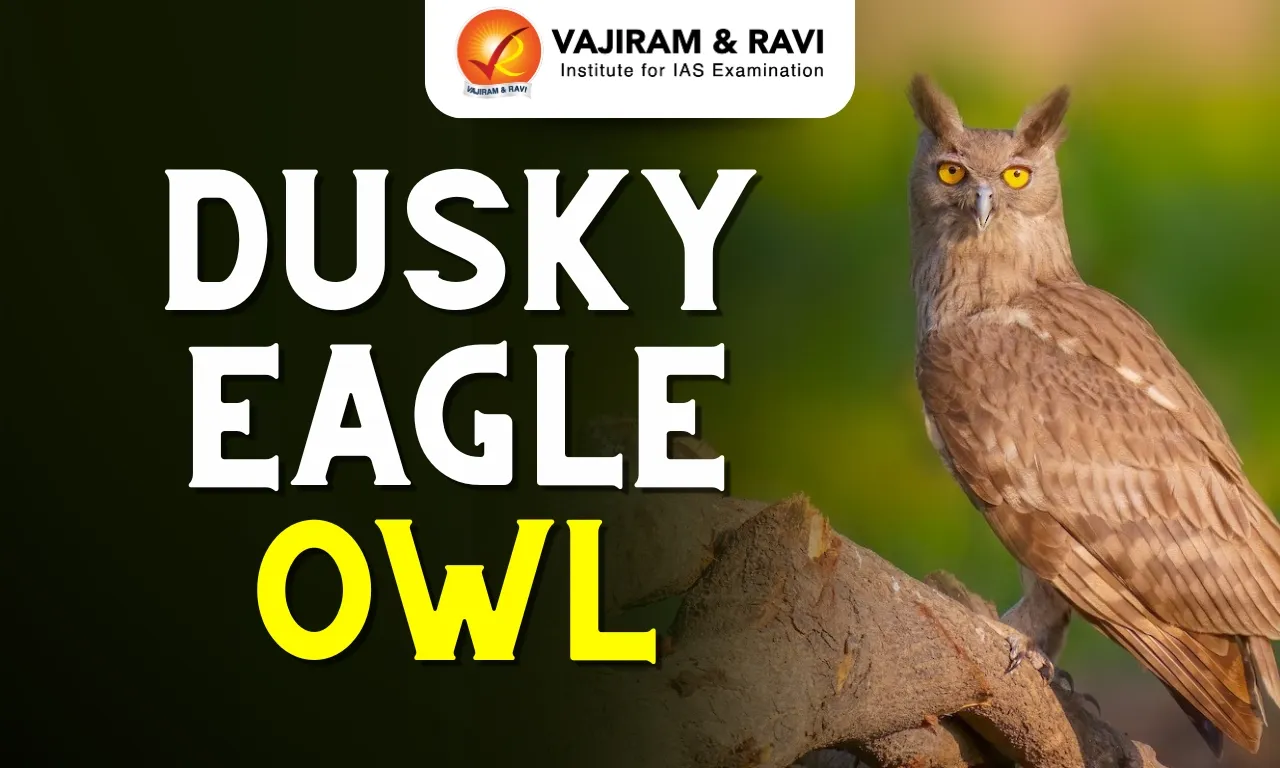
  • Appearance: It is a large greyish-brown owl with prominent ear tufts. Its underparts are greyish white with some dark brown streaks, and its dark brown wings have some whitish streaks.
  • Habitat: The dusky eagle owl typically inhabits thick riverside forests and old-growth trees, preying on small mammals and birds.
  • Distribution: It is mainly found in Pakistan, India, Nepal and Bangladesh to Myanmar, Thailand, Malaysia into China.
  • Features of Dusky Eagle Owl
    • Size: About 48-53 cms. The females are larger than males.
    • It usually spends the daytime in the seclusion of a shady bough or foliage, becoming active about an hour before sunset.
    • The dusky eagle owl is a powerful bird, often active by day in cloudy weather.
    • It has powerful feet and strong flight making them effective hunters. 
    • It tends to use old stick nests built by other birds in which to lay its eggs. It might use nests built by other raptors, such as kites, vultures or eagles.
  • Conservation Status: IUCN Red List: Least Concern

Source: NIE

Dusky Eagle Owl FAQs

Q1: Where is the Dusky Eagle Owl primarily found?

Ans: Himalayan foothills and parts of India

Q2: What is the conservation status of the Dusky Eagle Owl?

Ans: Least Concern

Moonshot Project

Moonshot Project

Moonshot Project Latest News

Recently, the Indian Institute of Science (IISc) launched a moonshot project.

About Moonshot Project

  • It is to develop brain co-processors that combine neuromorphic hardware and AI algorithms to enhance or restore brain function.
    • Brain co-processors are an emerging technology aimed at enhancing the human brain’s natural abilities in ways relevant to real-life situations. 
  • The project aims to build an AI-powered, closed-loop device that connects to different parts of the brain in order to help restore smooth, coordinated movement.
  • It is a multidisciplinary endeavour that evolved from a pilot project seeded by IISc’s Brain, Computation and Data Science initiative. 
  • It is funded by the Pratiksha Trust.
  • Objective: To develop both implantable and non-invasive brain co-processors that can decode brain activity from neural recordings, process it with an AI algorithm, and re-encode signals back into the brain via neural stimulation or neurofeedback.
    • It will lay the foundation for a first-of-its-kind brain co-processor that restores complex sensorimotor function after stroke.
  • Significance: The co-processors will be deployed towards cognitive rehabilitation of stroke survivors, to restore critical functions such as goal-directed reach and grasp abilities.

Source: TH

Moonshot Project FAQs

Q1: What is the primary goal of the Moonshot Project?

Ans: Develop brain co-processors to restore brain function

Q2: What is the expected outcome of the Moonshot Project?

Ans: Cognitive rehabilitation for stroke survivors

New Fish Species

New Fish Species

New Fish Species Latest News

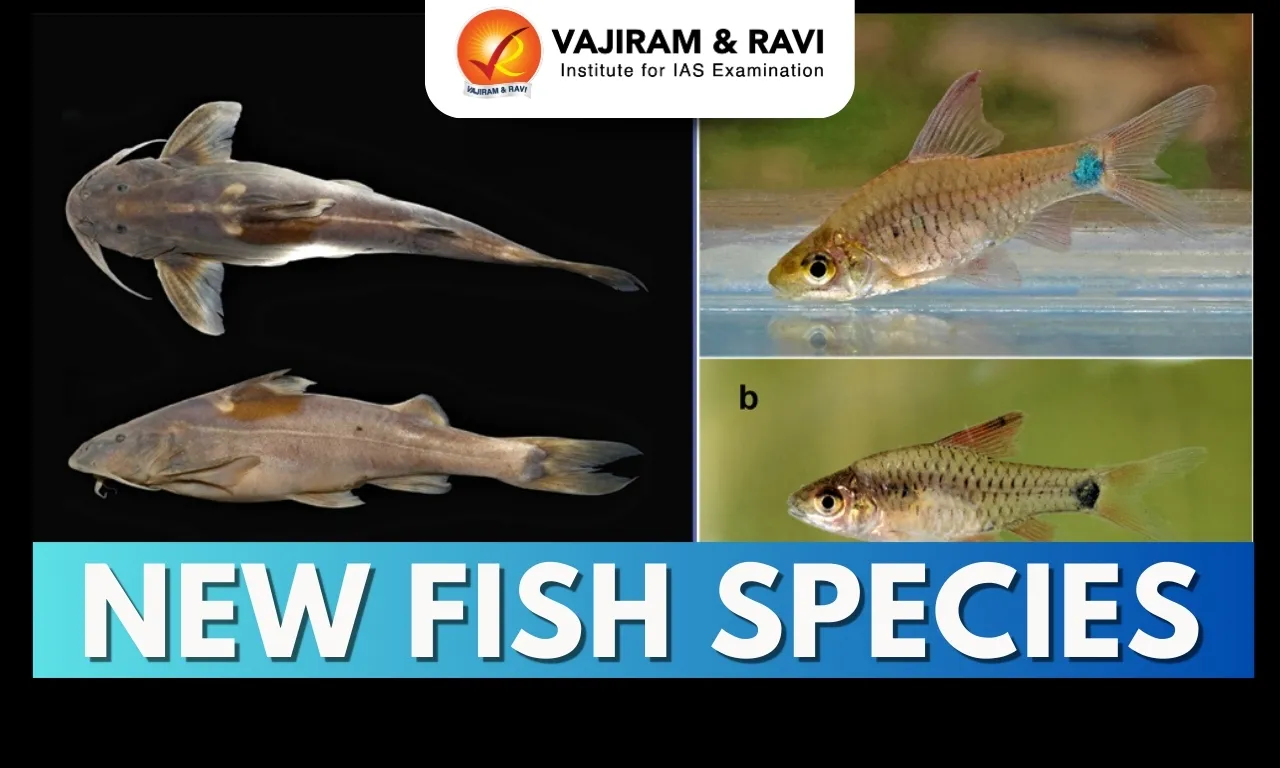
In a significant scientific breakthrough from Northeast India, researchers recently described two new species of freshwater fish named Glyptothorax sentimereni and Oreichthys elianae from Nagaland.

About Glyptothorax sentimereni and Oreichthys elianae

  • They are two new species of freshwater fish.
  • They were discovered during ichthyological surveys in tributaries of the Brahmaputra River in the Mokokchung district, Nagaland.

Glyptothorax sentimereni

  • It was discovered in the rocky stretches of the Dikhu River.
  • It belongs to a group of torrent-dwelling catfishes known for their ability to cling to fast-flowing streams.
  • It possesses a specialised adhesive structure on its underside that helps it cling to rocks in strong currents.
  • It also possesses serrations on its dorsal-fin spine and a plicate (folded) ventral surface on its pectoral and pelvic fins — features that separate it from closely related species across the Ganges–Brahmaputra–Meghna basin.

Oreichthys elianae

  • It was found in a tributary of the Tsurang River.
  • Measuring just over 2.5 cm in length, the tiny fish is distinguished by its bright red fins and a prominent black blotch at the base of its tail.
  • It has an incomplete lateral line with only five pored scales and 14–15 pores on the cheek.

Source: NEN

New Fish Species FAQs

Q1: What are Glyptothorax sentimereni and Oreichthys elianae?

Ans: They are two newly discovered species of freshwater fish.

Q2: Where were Glyptothorax sentimereni and Oreichthys elianae discovered?

Ans: In tributaries of the Brahmaputra River in Mokokchung district, Nagaland.

Q3: In which river was Glyptothorax sentimereni discovered?

Ans: In the Dikhu River.

Q4: What type of fish group does Glyptothorax sentimereni belong to?

Ans: Torrent-dwelling catfishes adapted to fast-flowing streams.

Q5: What are the distinguishing physical features of Oreichthys elianae?

Ans: Bright red fins and a prominent black blotch at the base of its tail.

Golestan Palace

Golestan Palace

Golestan Palace Latest News

Amid escalating tensions in the Middle East, Iran’s capital Tehran was recently reported to have suffered significant structural damage, including to the historic Golestan Palace, a UNESCO World Heritage Site.

About Golestan Palace

  • It is a historically significant site located at the heart of Iran’s capital, Tehran.
  • Stemming from the Persian word "Golestan" which means "rose garden" or "flower garden", the palace is otherwise known as the "Rose Garden Palace".
  • Dating back to the 16th century, it is a crucial part of the Persian royal heritage, representing the long and influential reign of the Qajar dynasty, followed by the Pahlavi dynasty. 
  • Originally built as a citadel for Safavid rulers, it was transformed over centuries into a sprawling royal complex with gardens, palatial buildings, and collections of Persian and European artefacts.
  • It became the seat of government of the Qajar family, which came into power in 1779 and made Teheran the capital of the country. 
  • It is a UNESCO World Heritage Site.

Golestan Palace Features

  • It is especially known for its bright and vibrant tile work. 
  • As is typical in Persian art, use of rich colors like yellow, turquoise, cobalt blue, pink, and white features in intricate floral patterns, geometric designs, and calligraphy
  • The palace's tiles highlight the importance of detail, symmetry, and balance in Persian tiles which also serve as a vessel for storytelling.
  • It is also renowned for its breathtaking ceremonial halls such as the Mirror Hall, Brilliant Hall, Ivory Hall, Salam Hall, Reception Hall, and more. 
  • These rooms combine Persian and European aesthetics in reflection of the Qajar and Pahlavi dynasties.

Source: ET

Golestan Palace FAQs

Q1: Where is Golestan Palace located?

Ans: Golestan Palace is located in Tehran, the capital city of Iran.

Q2: From which century does Golestan Palace date back?

Ans: Golestan Palace dates back to the 16th century.

Q3: Which dynasty primarily used Golestan Palace as the seat of government?

Ans: The Qajar dynasty used Golestan Palace as its seat of government.

Q4: For what artistic feature is Golestan Palace especially famous?

Ans: It is especially famous for its bright and vibrant tile work.

Sharavathi Pumped Storage Hydroelectric Project

Sharavathi Pumped Storage Hydroelectric Project

Sharavathi Pumped Storage Hydroelectric Project Latest News

The High Court of Karnataka recently ordered an issue of notice to the Centre and State government on a PIL petition, which had questioned the legality of the approval granted by the State Wildlife Board and the in-principle approval granted by the Standing Committee of the National Board for Wildlife for the Sharavathi PSHP.

About Sharavathi Pumped Storage Hydroelectric Project

  • It is a PSHP proposed on the Sharavathi River in the Shivamogga district, Karnataka.
  • This project, with its aim to generate 2,000 MW of power, will be the biggest of its kind in the country.
  • It is being developed by Karnataka Power Corporation Limited (KPCL).
  • The project involves building a pumped storage power plant between two existing reservoirs. 
  • The Talakalale dam, which stands at 62.48 meters tall, will be the upper reservoir.  This dam currently helps balance water for the existing Sharavathy hydroelectric project.  
  • The Gerusoppa dam will be the lower reservoir, and it is about 64 meters tall. 
  • Water will be pumped uphill during off-peak hours and released downhill to generate electricity during peak demand.
  • The project aims to utilise renewable energy sources and reduce carbon emissions. 
  • Modelled on the lines of Telangana’s Kaleshwaram project, it also aims to supply drinking water to Bengaluru. 
  • Five tunnels and eight pumping stations are critical parts of the plan.
  • The project falls within the Eco-Sensitive Zone (ESZ) of the Sharavathi Wildlife Sanctuary, which is home to the endangered lion-tailed macaque, hornbills, king cobras, and numerous endemic plant species of the Western Ghats.

Key Facts about Sharavathi River

  • It is a river in the western Karnataka state.
  • It is one of the few rivers in India, which flows in the west direction. 
  • A large part of the river basin lies in the Western Ghats.
  • Course: Rising in the Western Ghats, it flows in a northwesterly direction and empties into the Arabian Sea at Honnavar, near the Uttara Kannada district.
  • Total Length: 128 km
  • On its way, the Sharavathi forms the Jog Falls, one of the highest waterfalls in India, where the river falls from a height of 253 m. 
  • Diverse geological features mark the river’s course, including rocky outcrops, fertile plains, and deep gorges.
  • Major Tributaries: Nandihole, Haridravathi, Mavinahole, Hilkunji, Yennehole, Hurlihole, and Nagodihole.

Source: TH

Sharavathi Pumped Storage Hydroelectric Project FAQs

Q1: What is the Sharavathi Pumped Storage Hydroelectric Project (PSHP)?

Ans: It is a proposed pumped storage hydroelectric power project on the Sharavathi River in Karnataka.

Q2: What is the planned power generation capacity of the Sharavathi PSHP?

Ans: The project aims to generate 2,000 MW of electricity.

Q3: Which dam will act as the upper reservoir for the Sharavathi Pumped Storage Hydroelectric Project (PSHP)?

Ans: The Talakalale Dam will act as the upper reservoir.

Q4: Which dam will serve as the lower reservoir in the Sharavathi Pumped Storage Hydroelectric Project (PSHP)?

Ans: The Gerusoppa Dam will serve as the lower reservoir.

Raisina Dialogue 2026

Raisina Dialogue

Raisina Dialogue Latest News

Prime Minister recently inaugurated the 11th edition of the Raisina Dialogue in New Delhi.

About Raisina Dialogue

  • It is India’s flagship conference on geopolitics and geo-economics, committed to addressing the most challenging issues facing the international community.
  • It is modeled on the lines of the Munich Security Conference and Singapore’s Shangri-La Dialogue.
  • It is held annually since 2016 in New Delhi.
  • It is structured as a multi-stakeholder, cross-sectoral discussion, involving heads of state, cabinet ministers, and local government officials, who are joined by thought leaders from the private sector, media, and academia.
  • The conference is hosted by the Observer Research Foundation (ORF) in partnership with the Ministry of External Affairs, Government of India. 
  • This effort is supported by a number of institutions, organisations, and individuals who are committed to the mission of the conference.

Raisina Dialogue 2026

  • It is the 11th edition of the dialogue.
  • Theme: "Saṁskāra – Assertion, Accommodation, Advancement”.
  • Around 2700 participants from 110 countries will be joining the dialogue in person.
  • Over the course of three days, decision makers and thought leaders of the world will engage each other across conversations in various formats over six thematic pillars: 
    • Contested Frontiers: Power, Polarity, and Periphery; 
    • Repairing the Commons: New Groups, New Guardians, New Avenues; 
    • White Whale: The Pursuit of Agenda 2030; 
    • The Eleventh Hour: Climate, Conflict, and the Cost of Delay; 
    • Tomorrowland: Towards a Tech-topia; 
    • Trade in the Time of Tariffs: Recovery, Resilience, Reinvention

Source: NOA

Raisina Dialogue FAQs

Q1: What is the Raisina Dialogue?

Ans: It is India’s flagship conference on geopolitics and geo-economics addressing major global issues.

Q2: Since when has the Raisina Dialogue been held annually?

Ans: Since 2016.

Q3: Where is the Raisina Dialogue held every year?

Ans: In New Delhi, India.

Q4: Who hosts the Raisina Dialogue?

Ans: The Observer Research Foundation (ORF) in partnership with the Ministry of External Affairs, Government of India.

Q5: What is the theme of the Raisina Dialogue 2026?

Ans: “Saṁskāra – Assertion, Accommodation, Advancement.”

Kappatagudda Wildlife Sanctuary

Kappatagudda Wildlife Sanctuary

Kappatagudda Wildlife Sanctuary Latest News

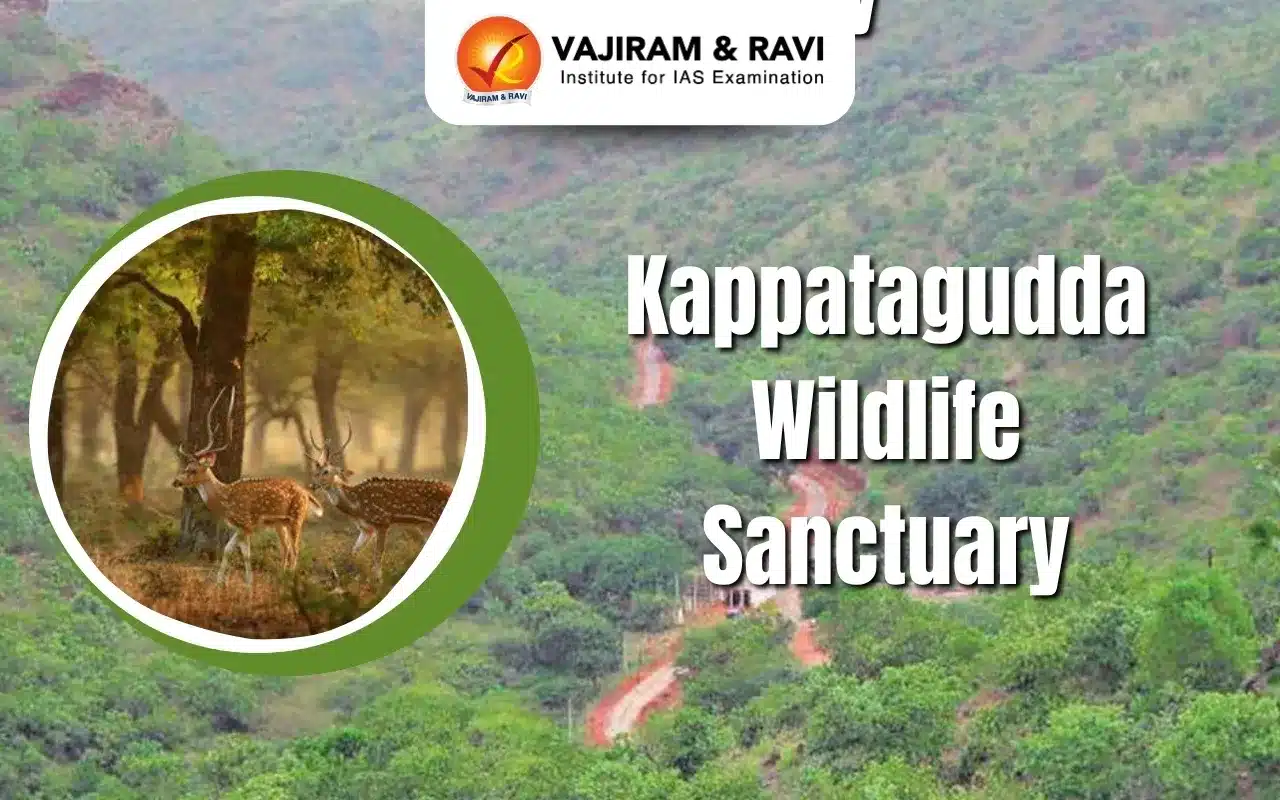
Recently, the High Court of Karnataka has directed the State government to issue a further notification to include the left-out areas of the Kappatagudda reserve forest as part of the Kappatagudda Wildlife Sanctuary.

About Kappatagudda Wildlife Sanctuary

  • Location: It is located in the state of Karnataka.
  • The sanctuary features diverse habitats—dry deciduous forests, grasslands, scrublands, and riverine zones—earning it the nickname “Western Ghats of North Karnataka”.
  • The sanctuary’s historical significance traces back centuries, evident in the remnants of ancient temples and ruins that dot the hillsides.
  • These structures are adorned with intricate carvings and tell tales of dynasties that once ruled the land, such as the Chalukyas and Rashtrakutas.
    • It mainly consists of architectural marvels strewn across Kappatagudda, such as the Kappatagudda Jain Basadi, Brahma Jinalaya, Trikuteshwara Temple, and the Dambala Temple, stand testament to the craftsmanship and religious diversity of the region. 
  • The Sanctuary forms the major catchment for the River Tungabhadra in the district.
  • Vegetation: The sanctuary supports diverse vegetation typical of dry-scrub and deciduous ecosystems.
  • Flora:  The forest has about 400 medicinal plant species.
  • Fauna:  Leopards, Hyenas, Wolves, Foxes, Jackals, Four Horned Antelopes, Blackbucks, Monitor Lizards, Jungle Cats and various reptiles and birds. 

Source: TH

Kappatagudda Wildlife Sanctuary FAQs

Q1: What is Kappatagudda Wildlife Sanctuary known for?

Ans: Dry deciduous forests and medicinal plants

Q2: Where is Kappatagudda Wildlife Sanctuary located?

Ans: Gadag district, Karnataka

Shahed Drones

Shahed Drones

Shahed Drones Latest News

The United States recently raised serious concerns about the capabilities of Iran's Shahed attack drones.

About Shahed Drones

  • Shahed (meaning witness in Farsi) drones are low-cost, one-way-attack unmanned aerial vehicles (UAVs) developed by Iran
  • Often referred to as "kamikaze" or "suicide" drones, they function essentially as guided missiles that fly towards a pre-designated target and explode on impact. 
  • Most widely used variants: Shahed-131 and Shahed-136 
  • Russia refers to the Shahed-131 and Shahed-136 as “Geran-1” and “Geran-2,” respectively.
  • Each Shahed is reported to have an estimated cost between $20,000 and $50,000, making them cheaper than most other long-range, OWA UAVs. 
  • Ballistic and cruise missiles, by contrast, can cost millions of dollars each.
  • This low cost, along with a low-altitude flight profile and self-sacrificial nature, has seen Shaheds labelled “the poor man’s cruise missile”.
  • Produced in large numbers, swarms of Shahed drones can overwhelm air defences by saturating them from multiple directions at once. 

Shahed Drones Features

  • The Shahed-131 has a range of 700–900 km, while the Shahed-136 has the longer range, i.e., between 2,000 and 2,500 kilometres.
  • They are between 2.5 and three metres long and weigh around 200 kg at launch, most of which is the fuel and payload.
  • They are launched using a disposable rocket booster fitted to their underside. Shortly after launch, the booster is jettisoned, and a piston-driven engine takes over to provide propulsion.
  • They can be launched from both static rail mounts as well as vehicles.
  • For navigation, it uses a combination of civilian GPS/GLONASS and an inertial navigation system (INS) often pre-programmed with coordinates before launch.
  • They can be equipped with various warheads, including high-explosive fragmentation, thermobaric, and shrapnel-filled munitions, maximising damage to both personnel and equipment.

Source: TOI

Shahed Drones FAQs

Q1: What are Shahed drones?

Ans: They are low-cost, one-way-attack unmanned aerial vehicles developed by Iran.

Q2: Why are Shahed drones often called “kamikaze” or “suicide” drones?

Ans: Because they fly toward a target and explode on impact.

Q3: What is the estimated cost of a typical Shahed drone?

Ans: Around $20,000 to $50,000.

Q4: What is the approximate range of the Shahed-136 drone?

Ans: Around 2,000–2,500 km.

Q5: What navigation systems are used by Shahed drones?

Ans: It uses a combination of civilian GPS/GLONASS and an inertial navigation system (INS) often pre-programmed with coordinates before launch.

Key Facts about Portugal

Key Facts about Portugal

Portugal Latest News

Recently, a Parliamentary Delegation led by the Vice President of the Portuguese Parliament, called on the Hon’ble Deputy Chairman, Rajya Sabha in Parliament.

About Portugal

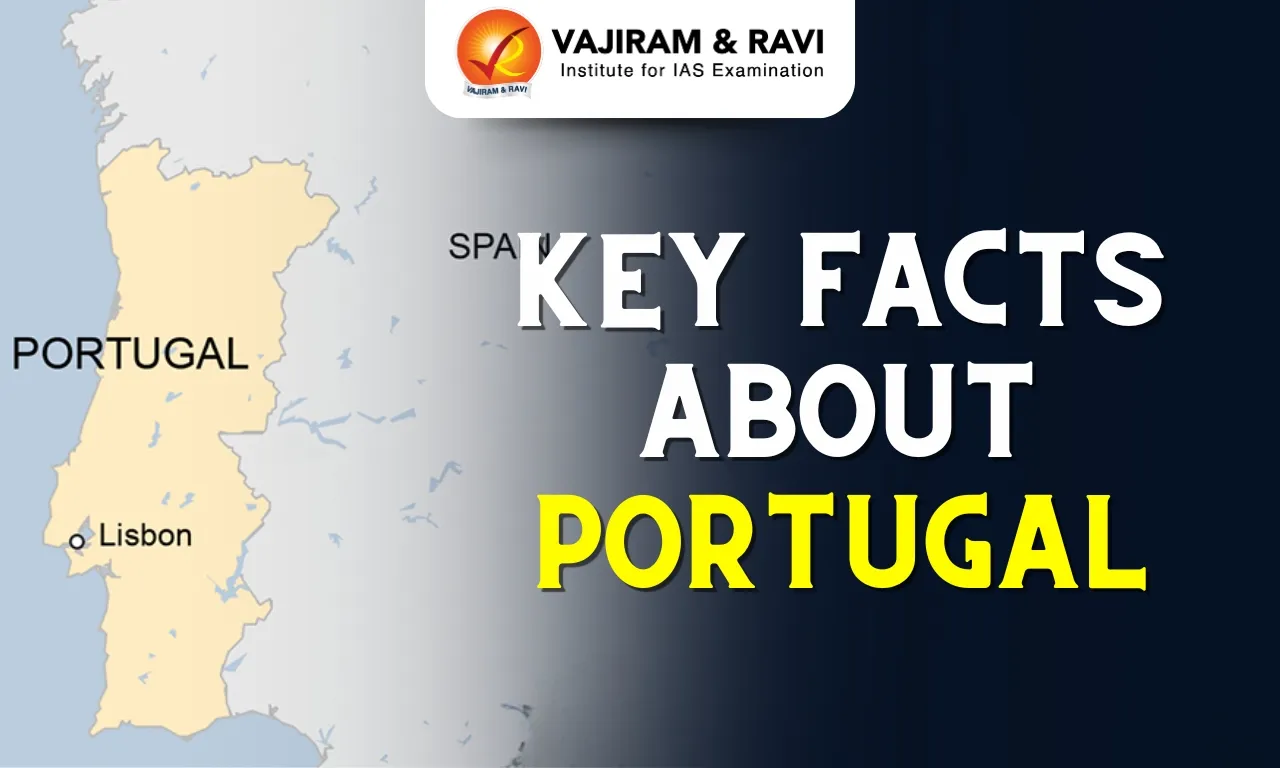
  • Location: It is the westernmost country of mainland Europe, located on the Iberian Peninsula.
  • Bordering Countries: It shares land border with Spain (north and east),
  • Maritime border: It is bounded by the North Atlantic Ocean to the south and west.
  • It also administers two autonomous regions: the Madeira and Azores archipelagos, located in the Atlantic Ocean.
  • Capital city: Lisbon.

Geographical Features of Portugal

  • Climate: Its climate is very much like that of most Mediterranean countries. This means it’s hot in the summer and temperate in the winter.
  • Rivers: The Tagus River, flowing west into the Atlantic ocean, divides Portugal into mountainous northern regions and rolling plains in the south.
  • Highest Point: Ponta do Pico (Pico Alto), located in the Azores.
  • Natural Resources: It mainly consists of iron ore, copper, zinc, tin, tungsten, silver, gold, uranium, marble, clay, gypsum.

Source: PIB

Portugal FAQs

Q1: What is the capital of Portugal?

Ans: Lisbon

Q2: What is the official language of Portugal?

Ans: Portuguese

GPS Spoofing

GPS Spoofing

GPS Spoofing Latest News

Recently, it was observed that GPS spoofing is creating a digital fog of war for aircraft flying near the UAE and Iran. 

About GPS Spoofing

  • GPS spoofing, also known as GPS simulation, refers to the practice of manipulating or tricking a GPS receiver by broadcasting false GPS signals.
  • It involves manipulating navigation data with malicious intent.
  • Unlike jamming, which blocks GPS signals, spoofing involves transmitting fake satellite signals to override genuine ones.
  • The aircraft’s navigation systems pick up these counterfeit signals and calculate wrong data for position, altitude, time, and speed.
  • The aim is for the target to act on false navigation information. The fake signals over-ride the genuine satellite signals using specialised hardware or software. 
  • Since GPS satellite signals are weaker, the receiver considers the amplified spoofed signals as authentic.
  • It involves sending a fake signal to an aircraft that the onboard computers believe is real. Instead of the navigation system failing, it shows the pilot a completely false location.
  • Spoofing is often reported in
    • Conflict zones like the Black Sea region
    • West Asia and the Middle East
    • Military action areas or electronic warfare zones

Source: IT

GPS Spoofing FAQs

Q1: What is GPS Spoofing?

Ans: A type of cyberattack that manipulates GPS signals

Q2: How does GPS Spoofing work?

Ans: By transmitting fake GPS signals to override real ones

Enquire Now