Broadcast Audience Research Council (BARC)

Broadcast Audience Research Council

Broadcast Audience Research Council (BARC) Latest News

The Ministry of Information and Broadcasting recently asked the Broadcast Audience Research Council (BARC) to suspend publication of Television Rating Points (TRPs) for TV news channels for four weeks or until further direction.

About Broadcast Audience Research Council (BARC)

  • It is a joint industry company founded by stakeholder bodies that represent Broadcasters, Advertisers and Advertising & Advertising Agencies. 
  • It owns and manages a transparent, accurate, and inclusive TV audience measurement system. 
  • Established in 2010, the BARC has since been the sole body which can measure and publish television audience data in the country.
  • It is based in Mumbai, India.

What is Television Rating Point (TRP)?

  • It is a metric used to measure the popularity and viewership of television programs.
  • The more viewers a program has, the higher its TRP rating. 
  • It is calculated by measuring the viewership of a particular program over a period of time, usually a week. 
  • TRP ratings are used by broadcasters and advertisers to determine the popularity of different TV programs.
  • According to the TRP of a TV channel or programme, advertisers decide where to display their advertisements, and investors will decide about the investment of the money.

How is TRP Calculated in India?

  • In India, TRP is calculated by BARC using “BAR-O-meters”, that are installed in televisions in selected households. 
  • It uses audio watermark technology to measure viewership of TV channels, and it also measures time-shifted viewing and simulcasts. 
  • BARC has installed “BAR-O-meters” in over 58,000 impanelled households. 
  • These gadgets record data about the channel or programme watched by the family members or selected people. This method is called the People meters.
  • In this way, some thousand viewers are surveyed in the form of justice and sampling. 
  • The data is then extrapolated to estimate the viewership of the entire population.
  • Another method is known as picture matching, where the people meter records a small portion of the picture that is being watched on the TV. 
    • This data is collected from a set of homes in the form of pictures and later on is analysed to calculate the TRPs.
  • The BARC releases weekly TRP results every Thursday ranking all TV channels and TV programmes.

Source: TH

Broadcast Audience Research Council (BARC) FAQs

Q1: What is the Broadcast Audience Research Council (BARC)?

Ans: It is a joint industry company that measures and publishes television audience data in India.

Q2: Which stakeholder groups founded the Broadcast Audience Research Council (BARC)?

Ans: It was founded by stakeholder bodies representing broadcasters, advertisers, and advertising agencies.

Q3: When was the Broadcast Audience Research Council (BARC) established?

Ans: It was established in 2010.

Q4: Where is the headquarters of the Broadcast Audience Research Council located?

Ans: It is based in Mumbai, India.

Precision Strike Missile (PrSM)

Precision Strike Missile (PrSM)

Precision Strike Missile (PrSM) Latest News

The United States used Precision Strike Missiles (PrSMs) for the first time during its ongoing war with Iran, US Central Command (CENTCOM) said recently.

About Precision Strike Missile (PrSM)

  • It is a surface-to-surface guided ballistic missile to strike targets at long distances with high precision.
  • It is being developed and manufactured primarily for the US Army by Lockheed Martin (a US aerospace and defence company).
  • It entered US service in late 2023.

Precision Strike Missile (PrSM) Features

  • It features an open systems architecture and a modular design.
  • It is launched from existing artillery platforms, including the M142 High Mobility Artillery Rocket System (HIMARS) and the M270A2 Multiple Launch Rocket System (MLRS).
  • The missile uses solid rocket propellant and advanced navigation systems, including GPS and inertial guidance, to hit targets accurately over long distances, even in challenging weather conditions.
  • It has a range of at least 500 km.
  • It has a hypersonic-class ballistic trajectory that can even be integrated with satellites, drones and radar systems. 
  • It is equipped with an Insensitive Munitions (IM) energetic payload, designed to reduce the risk of accidental detonation.

Source: ALJ

Precision Strike Missile (PrSM) FAQs

Q1: What is the Precision Strike Missile (PrSM)?

Ans: It is a surface-to-surface guided ballistic missile designed to strike targets at long distances with high precision.

Q2: Precision Strike Missile (PrSM) is developed by which country?

Ans: United States

Q3: What is the range of the Precision Strike Missile?

Ans: It has a range of at least 500 km.

Q4: Which navigation systems are used by the Precision Strike Missile for accurate targeting?

Ans: It uses GPS and inertial guidance systems.

Mumps

Mumps

Mumps Latest News

Health officials in Maryland, United States recently issued an alert after confirming an uptick in mumps cases.

About Mumps

  • It is a contagious disease caused by the mumps virus, which belongs to a group of viruses known as paramyxoviruses. 
  • It can cause painful swelling in your parotid salivary glands (parotitis). 
  • Transmission:
    • Humans are the only known host for the mumps virus, which is spread from person to person by drops of moisture from the nose and mouth, such as through sneezing. 
    • It is also spread through direct contact with items that have infected saliva on them.
  • Mumps occurs worldwide and usually affects children and young adults.
  • Incubation period: Typically 16 to 18 days; ranging from 12 to 25 days.
  • Symptoms:
    • Face pain
    • Fever
    • Headache
    • Sore throat
    • Loss of appetite
    • Swelling of the parotid glands (the largest salivary glands, located between the ear and the jaw)
    • Swelling of the temples or jaw (temporomandibular area)
  • Normally mumps is a mild, self-limiting disease and disappears without sequelae.
  • However, complications may occur, such as encephalitis or sensorineural deafness.
  • Orchitis (a painful inflammation of the testes) occurs in 20% of young adult males who develop mumps.
  • Treatment: There is no specific treatment for mumps. The various symptoms may be relieved with medicines.
  • Prevention
    • Vaccination is the main preventive measure against mumps.
    • MMR immunization (vaccine) protects against measles, mumps, and rubella.

Source: CNN

Mumps FAQs

Q1: What is mumps?

Ans: Mumps is a contagious viral disease caused by the mumps virus belonging to the paramyxovirus group.

Q2: Which glands are commonly affected in mumps?

Ans: The parotid salivary glands are commonly affected, leading to swelling (parotitis).

Q3: Which age groups are most commonly affected by mumps?

Ans: Mumps usually affects children and young adults.

Q4: What are the common symptoms of mumps?

Ans: Common symptoms include fever, headache, sore throat, face pain, loss of appetite, and swelling of the parotid glands.

Q5: What is the main method of preventing mumps?

Ans: Vaccination is the main method of prevention.

Sambar Deer

Sambar Deer

Sambar Deer Latest News

The Wildlife Wing of the Himachal Pradesh Forest Department recently recorded the presence of sambar deer (Rusa unicolor) in high-altitude protected areas of Chamba district through camera traps for the first time.

About Sambar Deer

  • It is a large deer native to the Indian Subcontinent, southern China and Southeast Asia.  
  • Scientific Name: Rusa unicolor
  • Several races of sambar are recognized, among them the large Indian sambar and the smaller Malayan sambar.

Sambar Deer Habitat and Distribution

  • They are native to India, Pakistan, Ceylon, Sri Lanka, Burma, the Philippines, southern China, Taiwan, Borneo, Malaysia, Sumatra, and Java. 
  • Sambars inhabit both gently sloping and steep forested hillsides. 
  • They reside preferably near cultivated areas, such as gardens and plantations, in order to acquire food, but are also found in thick forests, swamp forests, and open scrub.

Sambar Deer Features

  • A large, relatively long-tailed deer, it stands 1.2–1.4 m (47–55 inches) at the shoulder. 
  • It is the largest oriental deer, with some adult males reaching 550 kg in weight.
  • Its body is covered with a hairy coat that is colored yellowish brown to dark gray. 
  • Its underside is usually dark or chestnut in color.
  • Its hairs are generally long and more so around the neck particularly in males. 
  • It has a long black tail. The underside of this tail is usually white in color. 
  • Males have antlers and tend to be heavier and darker. Their antlers can grow up to 42 inches long and have 3 or 4 tines (points) and are shed periodically. 

Sambar Deer Conservation Status

It is classified as 'Vulnerable' under the IUSN Red List

Source: TI

Sambar Deer FAQs

Q1: Where is the Sambar deer native to?

Ans: The Sambar deer is native to the Indian Subcontinent, southern China, and Southeast Asia.

Q2: Do male Sambar deer have antlers?

Ans: Yes, males have antlers.

Q3: What is the conservation status of the Sambar deer according to the IUCN Red List?

Ans: The Sambar deer is listed as Vulnerable on the IUCN Red List.

Striped Hyena

Striped Hyena

Striped Hyena Latest News

Recently, the Tajikistan and Uzbekistan have urged the inclusion of the striped hyena (Hyaena hyaena) in Appendix I and II of the Convention of Migratory Species (CMS) at the upcoming Convention on the Conservation of Migratory Species of Wild Animals (CMS COP15).

About Striped Hyena

  • It is one of four species belonging to the family Hyaenidae.
    • Other three are the Spotted Hyena, the Brown Hyena and the Aardwolf.
  • Appearance: It is a bit smaller than the spotted hyenas and has stripes all over their bodies. 
  • Habitat: It inhabits savannas, grasslands, semi-deserts, open woodlands, and mountainous regions.
  • Distribution: It is mainly found in South Asia (India, Nepal, Afghanistan), North Africa, Sub-Saharan Africa, Western Asia, and Central Asia.
  • It ranges across Africa (North as well as Sub-Saharan), the Middle East (West Asia) as well as Asia (Central and South Asia).

Characteristics of Striped Hyena

  • They are territorial creatures and scent-mark their territorial boundaries as a warning to their rivals.
  • Diet: Striped hyenas are primarily scavengers and eat mainly carrion and human refuse
  • Adult Striped hyena females are dominant over males and aggressive toward other females.
  • The striped hyena is generally considered solitary, but has some social organization.
  • Movements: 
    • It exhibits diverse movement patterns including long-distance dispersal events and seasonal or nomadic movements in response to prey availability and environmental conditions.
    • In arid and semi-arid regions, where resources are scarce and patchily distributed, striped hyenas may range widely and crossing international borders in search of food and water.

Conservation Status of of Striped Hyena 

  • IUCN: Near Threatened.
  • Wildlife Protection Act, 1972: Schedule I

Source: DTE

Striped Hyena FAQs

Q1: What is the scientific name of the Striped Hyena?

Ans: Hyaena hyaena

Q2: What is the conservation status of the Striped Hyena ?

Ans: Near Threatened

Dudhwa Tiger Reserve

Dudhwa Tiger Reserve

Dudhwa Tiger Reserve Latest News

Recently, in a rare incident a female one-horned rhinoceros was killed by two tigers in Sonaripur forest range of Rhino Rehabilitation Enclosure-I in Dudhwa Tiger Reserve (DTR). 

About Dudhwa Tiger Reserve

  • Location: It is located on the Indo-Nepal border in the district of Lakhimpur-Kheri in Uttar Pradesh.
    • It includes the Dudhwa National Park and two nearby sanctuaries, viz. Kishanpur and Katerniaghat.
  • Topography: It is a typical Tarai-Bhabar habitat of the upper Gangetic plains biogeographic province.
  • Rivers: The Sharda River flows by the Kishanpur WL Sanctuary, the Geruwa River flows through the Katerniaghat WL Sanctuary, and the Suheli and Mohana streams flow in the Dudhwa National Park, all of which are tributaries of the mighty Ghagra River.
  • Vegetation: The vegetation is of the North Indian Moist Deciduous type, containing some of the finest examples of Sal forests in India.
  • Flora: It mainly consists of Sal Forest along with its associate tree species like Terminalia alata (Asna), Lagerstroemia parviflora (Asidha), Adina cordifolia (Haldu), etc.
  • Fauna: Tiger, leopard, Swamp deer, Rhinoceros, chital, hog deer, barking deer, Sambhar, wild boar, and Ratel.
    • There are about 400 species of birds in the park, such as the Florican and black-necked storks.

Source: IE

Dudhwa Tiger Reserve FAQs

Q1: What is Dudhwa Tiger Reserve known for?

Ans: Part of the Terai Arc Landscape

Q2: Where is Dudhwa Tiger Reserve located?

Ans: Uttar Pradesh

SWAYATT Initiative

SWAYATT Initiative

SWAYATT Initiative Latest News

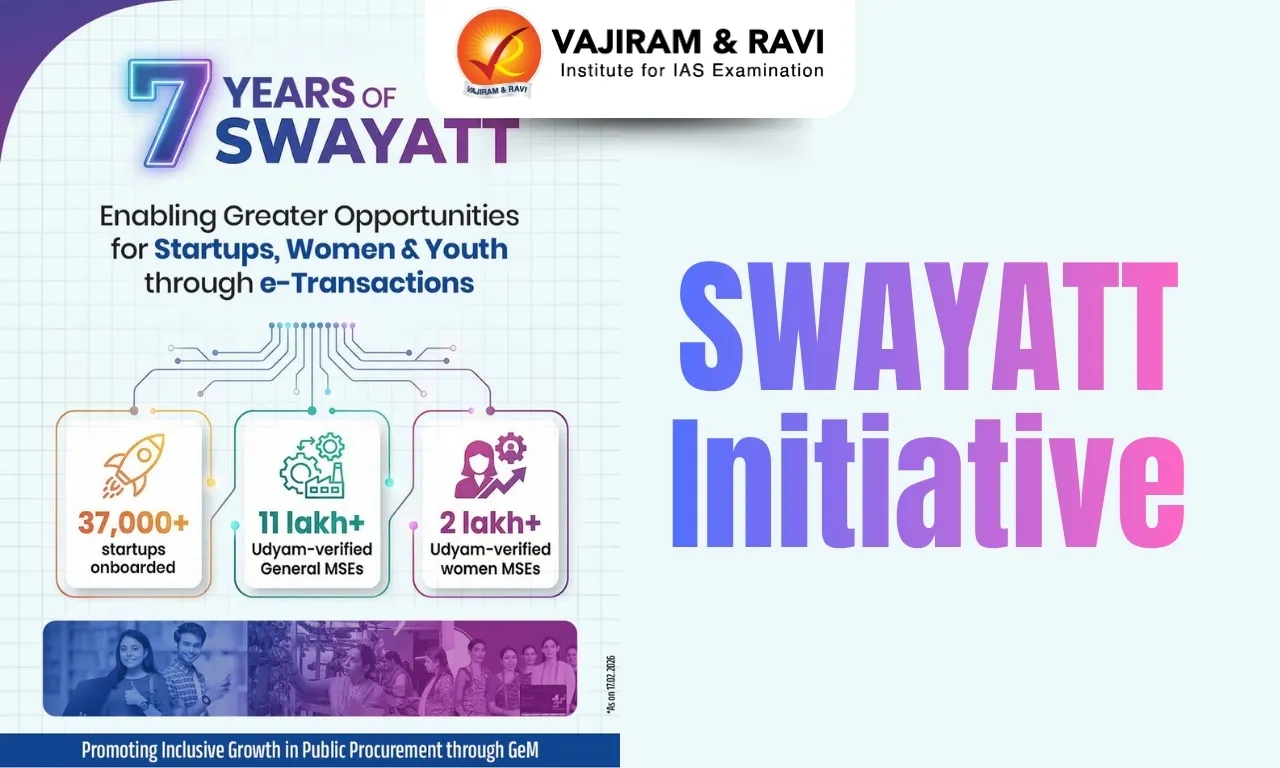
Recently, the Government e-Marketplace (GeM) celebrated the seven-year journey of its flagship initiative, SWAYATT – Startups, Women and Youth Advantage through e-Transactions.

About SWAYATT Initiative

  • It was launched in February 2019.
  • It was conceptualised with a clear objective of invigorating participation of women-led enterprises and youth in public procurement.
  • It democratizes government procurement by enabling startups, women entrepreneurs, youth, Micro and Small Enterprises (MSEs), Self Help Groups (SHGs) and last-mile sellers to directly participate in the public procurement ecosystem through Government e-Marketplace.
  • It is rooted in GeM’s foundational pillar of social inclusion.
  • SWAYATT focuses on addressing three critical challenges often faced by emerging enterprises—access to markets, access to finance and access to value addition.

Key Facts About Government e Marketplace

  • It is an Online Market platform that was set up in 2016.
  • It facilitates the procurement of goods and services by government ministries, departments, public sector undertakings (PSU) etc.
  • It has been envisaged as the National Procurement Portal of India.
  • It was developed by the Directorate General of Supplies and Disposals (Ministry of Commerce and Industry) with technical support from the National e-governance Division (Ministry of Electronic and Information Technology).
  • GeM is a completely paperless, cashless and system-driven e-marketplace that enables procurement of common-use goods and services with minimal human interface.

Source: PIB

SWAYATT Initiative FAQs

Q1: What does SWAYATT stand for?

Ans: Startups, Women & Youth Advantage Through e-Transactions

Q2: Which platform is SWAYATT integrated with?

Ans: Government e-Marketplace (GeM)

Dark Oxygen

Dark Oxygen

Dark Oxygen Latest News

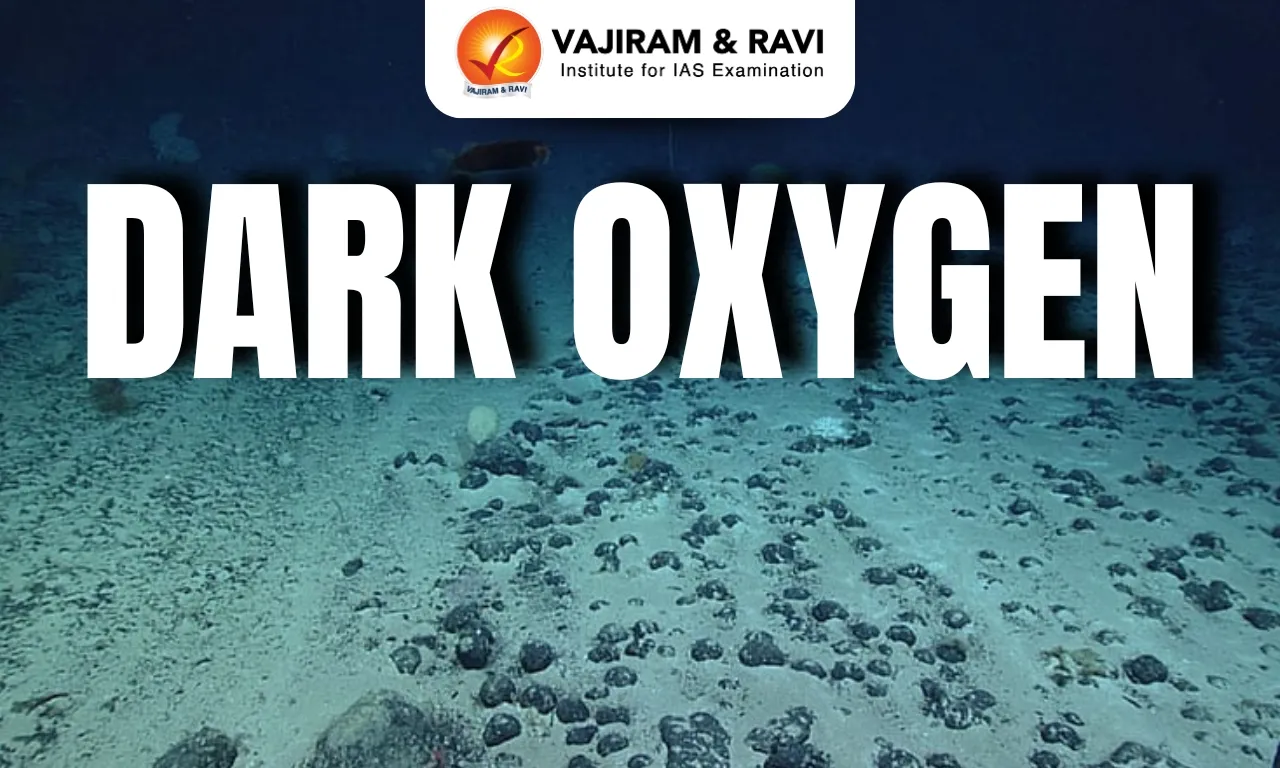
Scientists exploring the Pacific Ocean seafloor have reported the presence of what they describe as “dark oxygen” in an environment where sunlight does not reach.

About Dark Oxygen

  • It is the oxygen that is being produced thousands of feet below the ocean surface, without any light or photosynthesis.
  • The phenomenon was first observed in 2013 while studying the Clarion-Clipperton Zone, an area in the Pacific Ocean between Mexico and Hawaii. 

Why is the Discovery Important?

  • Until now, it was thought that oxygen was created only through photosynthesis, a process that requires sunlight. 
  • Oceanic plankton, drifting plants, algae, and some bacteria are the primary elements attributed to the production of oxygen in the ocean. All these organisms are capable of photosynthesis. 
  • The production of oxygen at such depths is thought to be impossible because there isn’t enough sunlight for plants to do photosynthesis.
  • However, in this case, oxygen is not being produced by plants.
  • The oxygen comes out of polymetallic nodules that are similar in resemblance to lumps of coal.
  • These nodules, made up of metals like manganese, iron, cobalt, nickel, copper, and lithium, produce oxygen without the process of photosynthesis. 
  • These nodules generate enough electricity to drive electrolysis, which splits water molecules apart and releases oxygen.
  • The researchers think the same process-battery-powered oxygen production that requires no light and no biological process - could be happening on other moons and planets, creating oxygen-rich environments where life could thrive.

Source: TOI

Dark Oxygen FAQs

Q1: What is Dark Oxygen?

Ans: Dark Oxygen is oxygen produced deep below the ocean surface without sunlight or photosynthesis.

Q2: Why is the discovery of Dark Oxygen important?

Ans: It challenges the earlier belief that oxygen can only be produced through photosynthesis.

Q3: Is Dark Oxygen produced by plants?

Ans: No, Dark Oxygen is not produced by plants.

Q4: What geological objects are responsible for producing Dark Oxygen?

Ans: Polymetallic nodules are responsible for producing Dark Oxygen.

Q5: How do polymetallic nodules produce oxygen?

Ans: They generate electricity that drives electrolysis, splitting water molecules and releasing oxygen.

Low-temperature Thermal Desalination Technology

Low-temperature Thermal Desalination Technology

Low Temperature Thermal Desalination Technology Latest News

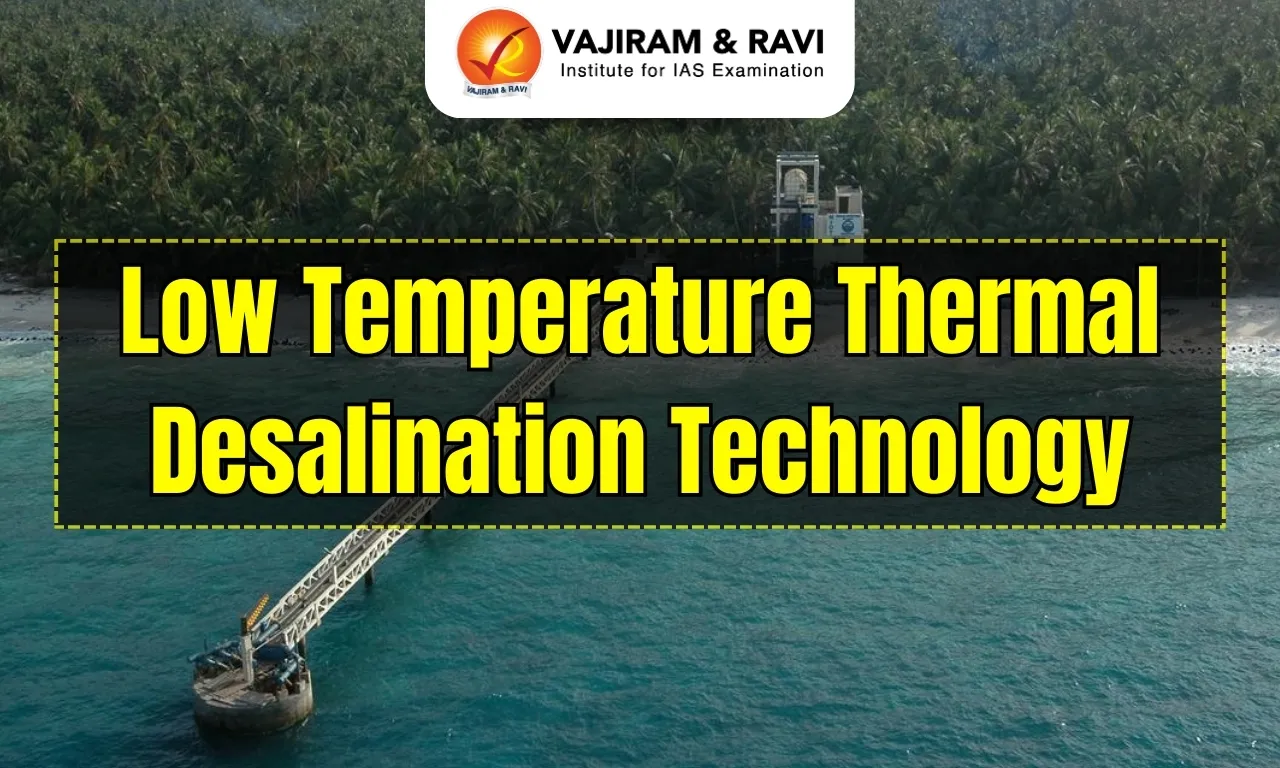
Recently, the union Minister for Earth Sciences visited the Low Temperature Thermal Desalination (LTTD) plant at Kavaratti in Lakshadweep and reviewed the functioning of desalination facilities.

About Low Temperature Thermal Desalination Technology

  • It is a process under which the warm surface sea water is flash evaporated at low pressure and the vapour is condensed with cold deep sea water.
  • The LTTD technology does not require any chemical pre and post-treatment of seawater and thus the pollution problems are minimal and suitable for island territories.
  • Working Principle
    • This technique works on the principle that water in the ocean 1,000 or 2,000 feet below is about 4º C to 8º C colder than surface water.
    • So, salty surface water is collected in a tank and subject to high pressure (via an external power source).
    • This pressured water vapourises and this is trapped in tubes or a chamber.
    • Cold water plumbed from the ocean depths is passed over these tubes and the vapour condenses into fresh water and the resulting salt diverted away.
    • It produces potable water without the use of chemical additives or high-pressure membranes.
  • Significance: Since no effluent treatment is required, it gives less operational maintenance problems compared to other desalination processes.
  • The first LTTD plant in Lakshadweep was commissioned in Kavaratti in 2005.

Source: PIB

Low Temperature Thermal Desalination Technology FAQs

Q1: Where was the first LTTD plant commissioned in India?

Ans: Kavaratti, Lakshadweep

Q2: How does LTTD Technology work?

Ans: Using temperature difference between surface and deep sea water

Enquire Now