Bascule Bridge

Bascule Bridge

Bascule Bridge Latest News

The Union government recently approved a Rs 117.54 crore project for the renovation of the Bascule Bridge at Syama Prasad Mookerjee Port, Kolkata.

About Bascule Bridge

  • It is a type of bridge that can be raised to provide clearance for waterway traffic and is also referred to as a lifting bridge or a drawbridge.
  • It makes use of a counterweight to balance a span or leaf through its upward trajectory. 
  • The balance of the weight is sometimes adjusted according to the frequency of waterway traffic.
  • The counterweight is usually heavier than the leaf itself, which makes lifting easier and reduces the energy needed to operate the bridge.
  • The span can be single or double, and in rare cases it may even be triple or quadruple. 
  • A pulley system helps raise and lower the bridge. 
    • Cables or chains connected to the counterweight run through pulleys and are attached to the leaf. 
    • This mechanical system helps reduce the force needed to lift the leaf, using something called "mechanical advantage.”
  • The word ‘bascule’ is French in origin and translates loosely as a seesaw or a balancing mechanical device. 
  • It is thought that bascule bridges were first designed during the mediaeval era in Europe, when they served defensive purposes.
  • The longest double-leaf bascule bridge in the world is the Broadway Bridge in Portland, Oregon, USA.

Source: DEVD

Bascule Bridge FAQs

Q1: What is a bascule bridge?

Ans: It is a movable bridge that can be raised to allow ships or boats to pass through a waterway.

Q2: What is another name for a bascule bridge?

Ans: It is also known as a lifting bridge or drawbridge.

Q3: What mechanism helps a bascule bridge lift its span?

Ans: A counterweight system helps balance and lift the span of the bridge.

Q4: What is the movable part of a bascule bridge called?

Ans: The movable part of a bascule bridge is called the leaf or span.

Q5: Which is the longest double-leaf bascule bridge in the world?

Ans: The longest double-leaf bascule bridge in the world is the Broadway Bridge in Portland, Oregon, USA.

Devon Island

Devon Island

Devon Island Latest News

NASA uses Devon Island to study Mars, primarily because it's barren and its freezing, polar desert conditions allow researchers to test next-generation rovers.

About Devon Island

  • It is located in the Canadian arctic archipelago, within the zone classified as the High Arctic. 
  • It is the world’s largest uninhabited island.
  • Ellesmere Island lies to the north of Devon Island and Baffin Bay lies to its east.
  • Although completely devoid of human settlements, a few species reside on the island
  • The short growing season of only about 40 to 55 days and the low temperatures (2° to 8°C in summer) discourage the growth of plants here.
  • Winters are extremely harsh with temperatures being as low as −50 °C. 
  • The limited solar energy input is also one of the factors influencing the existence of life on this island.
  • Little precipitation is also received on Devon Island.
  • The “out-of-the-world-like” landscape here is cold, dry, and rocky. Snow and ice blanket the island’s ice cap for the entire year.
  • Astronauts preparing for Mars missions do pay occasional visits to Devon Island to get used to extraterrestrial conditions.
  • NASA uses Devon Island to study Mars, primarily because it's barren, and its freezing, polar desert conditions allow researchers to test next-generation rovers. 
  • It is home to a 14-mile-wide Haughton Crater. It was formed when a meteorite struck millions of years ago, leaving behind terrain that resembles the surface of Mars.

Source: TOI

Devon Island FAQs

Q1: Where is Devon Island located?

Ans: Devon Island is located in the Canadian Arctic Archipelago in the High Arctic region of Canada.

Q2: What is Devon Island known for globally?

Ans: Devon Island is known as the world’s largest uninhabited island.

Q3: Why do astronauts sometimes visit Devon Island?

Ans: Astronauts visit Devon Island to train and prepare for Mars missions because its terrain resembles Mars-like conditions.

Q4: Which large crater is located on Devon Island?

Ans: Devon Island is home to the Haughton Crater.

National Leprosy Eradication Programme

National Leprosy Eradication Programme

National Leprosy Eradication Programme Latest News

The Union Minister of State for Health and Family Welfare informed the Rajya Sabha about the National Leprosy Eradication Programme.

About National Leprosy Eradication Programme

  • It is a centrally sponsored scheme under the overarching umbrella of National Health Mission (NHM).
  • Aim: The primary aim is controlling leprWhich strategy does NLEP focus on for leprosy control?osy through early detection and treatment.
  • Goal: Its goal is to make India leprosy-free by interrupting transmission, eliminating stigma, and ensuring dignified care for all affected individuals.
  • The programme offers free-of-cost services for prevention, diagnosis, treatment, and rehabilitation of leprosy through all public health facilities across India.
    • It provides both technical and financial support to all States and Union Territories for implementation of activities related to prevention, early detection, case confirmation, treatment, disability prevention, and post-treatment care.
    •  It also facilitates convergence with other national health programmes and deploys digital platforms such as Nikusth 2.0 for surveillance and reporting.
    • The programme is aligned with the Sustainable Development Goals (SDGs) and the WHO Global Leprosy Strategy.
  • WHO Global Leprosy Strategy aims to achieve zero transmission, zero disability, and zero discrimination by 2027.
  • It was declared as a Notifiable Disease

Objectives of National Leprosy Eradication Programme

  • To reduce Prevalence rate less than 1/10,000 population at sub national and district level.
  • To reduce Grade II disability % < 1 among new cases at National level.
  • To reduce Grade II disability cases < 1 case per million populations at National level.
  • Zero disabilities among new Child cases.
  • Zero stigma and discrimination against persons affected by leprosy.

Source: PIB

National Leprosy Eradication Programme FAQs

Q1: Which strategy does NLEP focus on for leprosy control?

Ans: Early detection and treatment

Q2: What is the primary objective of NLEP?

Ans: To eliminate leprosy cases in India

Blue-and-White Flycatcher

Blue-and-White Flycatcher

Blue-and-White Flycatcher Latest News

A male blue-and-white flycatcher, a small and striking migratory bird rarely seen in India, was recently spotted on Pavagadh Hills, Gujarat.

About Blue-and-White Flycatcher

  • It is a migratory songbird in the Old World flycatcher family, Muscicapidae.
  • Scientific Name: Cyanoptila cyanomelana
  • It is also known as the Japanese flycatcher.

Blue-and-White Flycatcher Distribution

  • It breeds in Japan, Korea, and in parts of northeastern China and the Russian Far East. 
  • It winters in Southeast Asia, especially in Vietnam, Cambodia, Thailand, Sumatra, and Borneo.
  • Habitat
  • It lives in wooded areas in lowlands and submontane forests such as taiga, wooded slopes, and gullies at up to 1200 metres of elevation. 
  • It can also be found in scrub, bushes, and plantations.

Blue-and-White Flycatcher Features

  • Adult males have most of the upperparts cobalt-blue, including upperwing coverts, flight feather edges, and tail. 
  • On the underparts, the chin, throat, breast, and flanks are black, whereas the belly and vent are white.
  • The bill is black. Eyes are dark brown.
  • Female is different. She has grey-brown upperparts, including head and face. Wings are blackish, with broad rufous-brown edges on tertials.
  • On the underparts, the chin and throat are grey to grey-brown, with distinct creamy throat patches.

Blue-and-White Flycatcher Conservation Status

It is classified as 'Least Concern' under the IUCN Red List.

Source: TOI

Blue-and-White Flycatcher FAQs

Q1: What is the Blue-and-White Flycatcher?

Ans: It is a migratory songbird in the Old World flycatcher family, Muscicapidae.

Q2: Where does the Blue-and-White Flycatcher mainly breed?

Ans: It breeds in Japan, Korea, northeastern China, and the Russian Far East.

Q3: Where does the Blue-and-White Flycatcher spend the winter?

Ans: It winters in Southeast Asia, including Vietnam, Cambodia, Thailand, Sumatra, and Borneo.

Q4: What are the distinctive colour features of the male Blue-and-White Flycatcher?

Ans: The male has cobalt-blue upperparts with black chin, throat, breast, and flanks, and a white belly and vent.

Q5: How does the female Blue-and-White Flycatcher differ from the male?

Ans: The female has grey-brown upperparts, blackish wings with rufous-brown edges, and greyish underparts with creamy throat patches.

PB-SHABD Platform

PB-SHABD Platform

PB-SHABD Platform Latest News

Prasar Bharati’s Shared Audio-Visuals for Broadcast and Dissemination (PB-SHABD) will provide free access to logo-free daily news content till March next year. 

About PB-SHABD Platform

  • Prasar Bharati-Shared Audio-Visuals for Broadcast and Dissemination (PB-SHABD) was launched in March, 2024.
  • It is a news feed service from Prasar Bharati.
  • It provides access to logo free, daily news items across various formats including video, audio, text, and photos to media organizations.
  • PB-SHABD offers the latest news from every corner of India.
    • Daily 1000 stories, covering varied news categories such as agriculture, technology, foreign affairs, and political developments, are uploaded daily in all major Indian languages from the Regional News Units (RNUs) and headquarters combined.

Key Facts about Prasar Bharti

  • It is the Public Service Broadcaster of the country.
  • It is a statutory autonomous body established in 1997 under the Prasar Bharati Act.
  • Objective: To conduct public broadcasting services intended to inform and entertain the public.
  • It comprises the Doordarshan Television Network and All India Radio, which were earlier media units of the Ministry of Information and Broadcasting.
  • Headquarter: New Delhi

Source: PIB

PB-SHABD Platform FAQs

Q1: What is PB-SHABD?

Ans: A digital news platform by Prasar Bharati

Q2: What is the primary objective of PB-SHABD?

Ans: To provide news content to media outlets

Sharavathi Lion-Tailed Macaque Sanctuary

Sharavathi Lion-Tailed Macaque Sanctuary

Sharavathi Lion-Tailed Macaque Sanctuary Latest News

Recently, the Karnataka High Court directed the state government that no activities on the ground should be carried out within the Sharavathi Lion-Tailed Macaque Sanctuary and its Eco-Sensitive Zone.

About Sharavathi Lion-Tailed Macaque Sanctuary

  • Location: It is located in the state of Karnataka.
  • It is part of the Western Ghats, a UNESCO World Heritage Site.
  • It was formed by combining the existing Sharavathi Valley Wildlife Sanctuary, Aghanashini Lion-Tailed Macaque Conservation Reserve, and the adjoining reserve forest blocks. 
  • The sanctuary shares its southwestern boundary with the Mookambika Wildlife Sanctuary.
  • Terrain: The overall terrain of the sanctuary is highly undulating, with altitude ranging from 94 m to 1102 m.
  • Vegetation: It mainly consists of tropical evergreen to semi-evergreen types of forests, moist deciduous forests, and grasslands and savanna.
  • Flora: The sanctuary is immensely rich in species like Dhoopa, Gulmavu, Surahonne, Mavu, Nandi, etc.
  • Fauna: It is home to the endangered lion-tailed macaque (Macaca silenus), tiger, leopard, wild dog, jackal, sloth bear, spotted deer, sambar,barking deer, mouse deer etc.

Source: NIE

Sharavathi Lion-Tailed Macaque Sanctuary FAQs

Q1: Where is Sharavathi Lion-Tailed Macaque Sanctuary located?

Ans: Karnataka

Q2: What is the primary species protected in Sharavathi Lion-Tailed Macaque Sanctuary?

Ans: Lion-Tailed Macaque

Central Industrial Security Force (CISF)

Central Industrial Security Force (CISF)

Central Industrial Security Force (CISF) Latest News

India marked the Raising Day of the Central Industrial Security Force on March 10, recognising the vital role the force plays in protecting the country’s most important infrastructure and industrial assets.

About Central Industrial Security Force (CISF)

  • It is a Central Armed Police Force (CAPF) in India operating under the Ministry of Home Affairs.
  • It provides security to various critical infrastructures, including 70 airports and 361 important national installations.
  • Headquarters: New Delhi
  • Motto: “Protection and Security”.

Central Industrial Security Force (CISF) Establishment

  • The idea of forming a specialised industrial security force gained urgency after the Indo-Pakistani War of 1965, which exposed the vulnerability of vital economic assets during wartime.
  • The CISF came into existence in 1969 through the CISF Act 1968 with a sanctioned strength of only three battalions. 
  • The original charter of CISF was to provide integrated security cover to certain sensitive public sector undertakings.
  • The Act was amended in 1983, declaring the CISF as an Armed Force of the Union. 
  • The force has since grown into a premier multi-skilled organization with a present strength of more than 188,000 personnel.

Central Industrial Security Force (CISF)  Organisation Structure

  • CISF is headed by an Indian Police Service officer with the rank of Director-General, assisted by an IPS officer in the rank of Addl. Director-General.
  • The force is divided into seven sectors (Airport, North, North-East, East, West, South, and Training) and also has a Fire Service Wing.
  • The force consists of seven training institutes – six Recruit Training Centers and the National Industrial Security Academy (NISA). 

Central Industrial Security Force (CISF) Functions

  • The CISF security umbrella includes India’s most critical infrastructure facilities, like nuclear installations, space establishments, airports, seaports, power plants, etc.
  • The specialized task of airport security was assigned to CISF in the year 2000 in the wake of the hijacking of Indian Airlines Flight IC-814 to Kandahar.
  • In addition, the CISF also protects important government buildings, iconic heritage monuments, Delhi Metro, Parliament House Complex, and Central Jails of Jammu and Kashmir.
  • The CISF also has a specialized VIP Security vertical, providing round-the-clock security to important protectees.
  • CISF personnel are trained in disaster management techniques, enabling them to actively respond to natural disasters like earthquakes, floods, and cyclones. 
  • CISF is one of the largest Fire Protection Service providers in the country. CISF is the only force with a customized and dedicated fire wing.
  • Post the Mumbai terror attack in November 2008, the mandate of the CISF was broadened to provide security cover to private corporate establishments also.
  • It is a compensatory cost force, which means that it bills its clients for the services it provides.
  • The CISF is the only CAPF with a daily public interface – in the airports, in the Delhi Metro, and in the iconic monuments.

Source: ITV

Central Industrial Security Force (CISF) FAQs

Q1: What is the Central Industrial Security Force (CISF)?

Ans: CISF is a Central Armed Police Force (CAPF) under the Ministry of Home Affairs that provides security to critical infrastructure in India.

Q2: When did the Central Industrial Security Force come into existence?

Ans: CISF was established in 1969 under the CISF Act of 1968.

Q3: What is the motto of the CISF?

Ans: The motto of CISF is “Protection and Security.”

Q4: What was the original purpose of the CISF when it was created?

Ans: The original purpose was to provide security to sensitive public sector undertakings (PSUs).

Q5: Which important installations does CISF protect in India?

Ans: CISF protects airports, nuclear installations, space establishments, seaports, power plants, and other critical infrastructure.

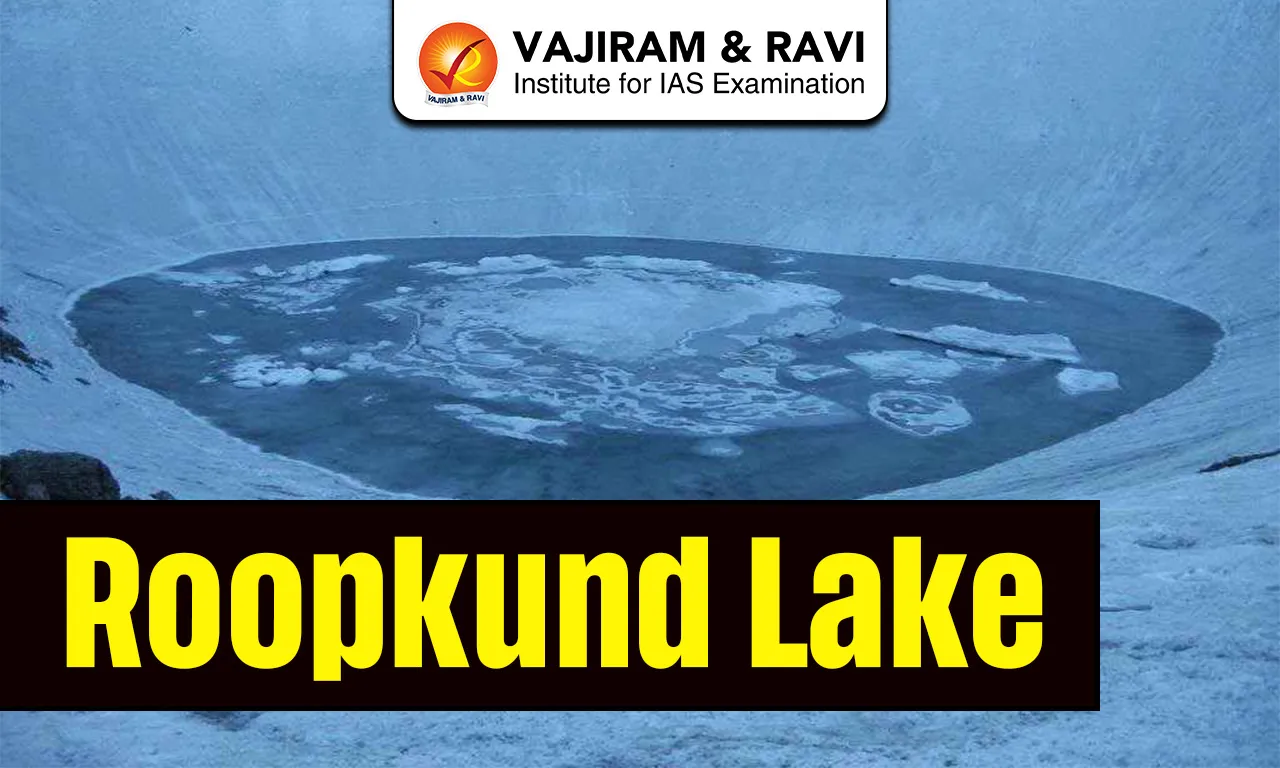
Roopkund Lake

Roopkund Lake

Roopkund Lake Latest News

Roopkund Lake, often called Skeleton Lake, is famous for the hundreds of human skeletons found around its icy waters.

About Roopkund Lake

  • Roopkund, also known as the ” lake of skeletons” is a glacial lake in Uttarakhand.
  • It is situated at 5,029 metres (16,500 ft) above sea level at the base of Mt. Trishul in the Garhwal Himalayas.
  • Measuring a mere 130 feet in width, the lake is encased in ice for the majority of the year.
  • It is surrounded by snow-capped peaks and lush green meadows.

Roopkund Lake Mystery

  • It is called the “lake of skeletons” as the glacial body conceals numbers of human skeletons, some with preserved flesh.
  • Depending on the season and weather, the lake, which remains frozen for most of the year, expands and shrinks. 
  • Only when the snow melts are the skeletons visible.
  • The skeletons in the lake were first discovered by a patrolling British forest ranger in 1942. 
  • These skeletal remains, dating back to around the 9th century AD, have led to various theories about the cause of death.
  • Scientific studies used radiocarbon dating and DNA analysis to learn more about the victims.
  • Key discoveries from scientific studies:
    • The remains belong to more than 300 individuals.
    • The skeletons came from different time periods.
    • Deaths occurred in at least two separate events.
  • Researchers identified three ancestry groups:
    • South Asian individuals who died around 800 CE
    • A Southeast Asian individual from around 1800 CE
    • A group with ancestry linked to Eastern Mediterranean regions such as Greece and Crete
    • This discovery challenged the earlier belief that all the skeletons belonged to a single disaster.

Source: MC

Roopkund Lake FAQs

Q1: What is Roopkund Lake commonly known as?

Ans: Roopkund Lake is commonly known as the “Lake of Skeletons.”

Q2: Where is Roopkund Lake located?

Ans: Roopkund Lake is located in Uttarakhand in the Garhwal Himalayas at the base of Mt. Trishul.

Q3: Why is Roopkund Lake called the “Lake of Skeletons”?

Ans: It is called the “lake of skeletons” as the glacial body conceals numbers of human skeletons, some with preserved flesh.

Amrit Bharat Station Scheme

Amrit Bharat Station Scheme

Amrit Bharat Station Scheme Latest News

A Parliamentary Committee has recommended that the Railways should conduct periodic assessments of passenger satisfaction and undertake post-redevelopment impact evaluations of stations upgraded under the flagship Amrit Bharat Station Scheme.

About Amrit Bharat Station Scheme

  • It was launched in 2022 which aims at development and upgradation of stations over the Indian Railways (IR) network.
  • The scheme envisaged development of stations with a long term vision.
  • The policy is based on Master Planning for long term and implementation of the same as per needs and demand of the station to station.
  • The ABSS has a long-term vision that involves creating master plans, promoting multimodal connectivity, better station accessibility for passengers, etc.
  • The goal is to make stations cleaner, more comfortable, and easier to use.

Key Features of Amrit Bharat Station Scheme

  • Amenities: It includes proving entry and exit points, waiting halls, toilets, platforms, and roofing. Facilities like lifts, escalators, and free Wi-Fi are added wherever needed.
  • There are also better signs and information systems to help passengers. Some stations will have executive lounges and special areas for business meetings.
  • Local Economy Support: Local products will be sold at kiosks under the ‘One Station One Product’ scheme, and efforts will be made to make stations look greener and more attractive.

Source: IE

Amrit Bharat Station Scheme FAQs

Q1: What is the primary objective of the Amrit Bharat Station Scheme?

Ans: To redevelop railway stations into modern transport hubs

Q2: How many railway stations are targeted for redevelopment under the scheme?

Ans: 1,309

Enquire Now