Prambanan Temple

Prambanan Temple

Prambanan Temple Latest News

India and Indonesia have partnered for the restoration of the Prambanan Temple complex in the Special Region of Yogyakarta in southern Java.

About Prambanan Temple

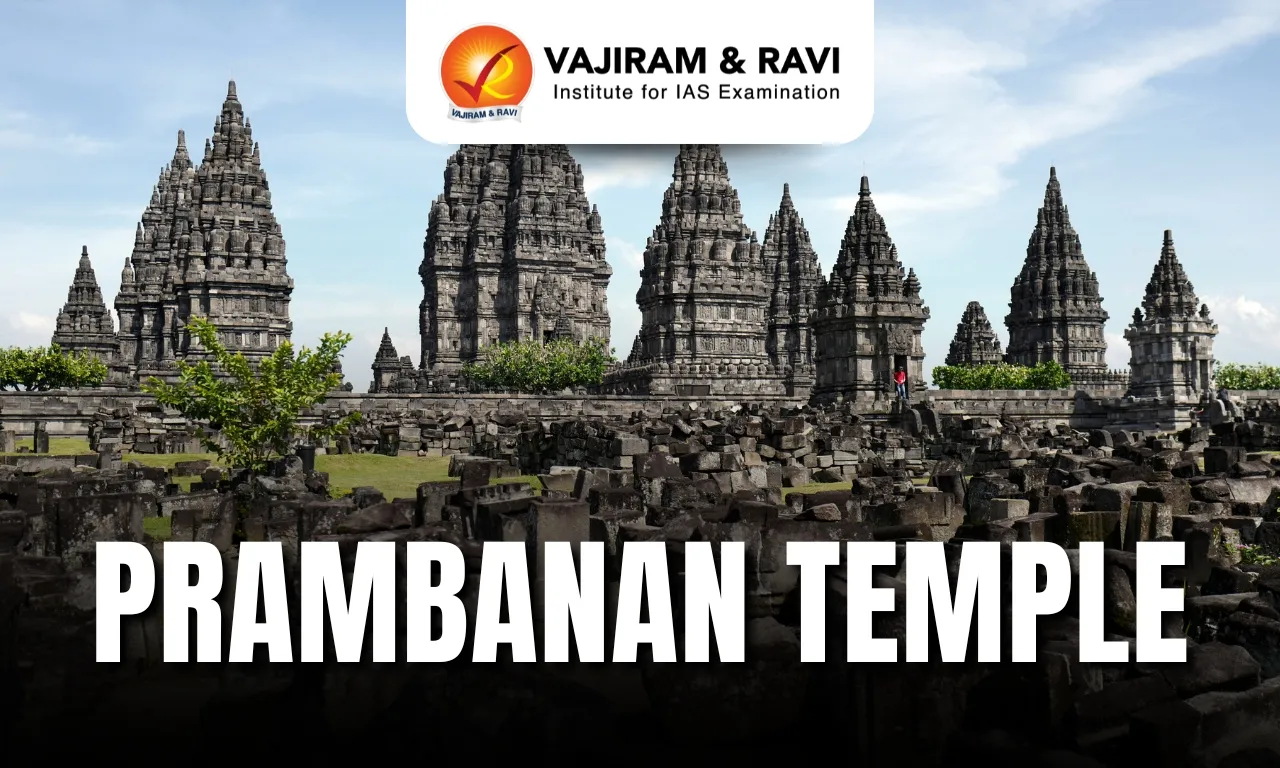
  • It is the largest Hindu temple complex in Indonesia, located in Sleman, Yogyakarta, Southern Java.
  • It is known locally as the Temple of the Slender Virgin (Roro Jonggrang).
  • It was built in the 9th century by the Sanjaya dynasty, a Hindu kingdom that ruled over central Java. 
  • It is dedicated to the Hindu Trimurti, the three main gods of Hinduism: Shiva, Vishnu, and Brahma.
  • The temple complex was buried for centuries before being rediscovered and restored in the 19th century.
  • In 1991, UNESCO designated Prambanan Temple as a World Heritage Site.

Prambanan Temple Architecture

  • The architectural style of Prambanan reflects the influence of both indigenous Javanese traditions and elements borrowed from South India, specifically the Pallava style.
  • The towering structures, adorned with intricate carvings depicting scenes from the Ramayana epic and other Hindu narratives, showcase the sophisticated craftsmanship of the era.
  • The main temple complex consists of 240 temples.
  • The highlight is the central compound, where eight main and eight minor temples are assembled on a raised platform. 
  • The three main temples are the Shiva Temple, Brahma Temple, and Vishnu Temple.
  • Shiva’s temple is the biggest and centrally located. It soars to a height of 47 meters, making it one of the tallest temples in Southeast Asia.
  • While the main temple complex is dedicated to Hindu gods, Buddhist temples and shrines surround the area.

Source: TP

Prambanan Temple FAQs

Q1: Where is the Prambanan Temple located?

Ans: It is the largest Hindu temple complex in Indonesia, located in Sleman, Yogyakarta, Southern Java.

Q2: By which dynasty was Prambanan Temple built?

Ans: The Sanjaya dynasty.

Q3: In which century was Prambanan Temple constructed?

Ans: 9th century CE.

Q4: How many temples are there in the main Prambanan temple complex?

Ans: 240 temples.

Exercise Sea Dragon 2026

Exercise Sea Dragon 2026

Exercise Sea Dragon Latest News

The Indian Navy along with multiple partner nations is participating in Exercise Sea Dragon 2026, a United States Navy-led multinational anti-submarine warfare drill.

About Exercise Sea Dragon

  • It is a United States Navy-led multinational anti-submarine warfare (ASW) drill conducted annually to strengthen maritime security and cooperation among allied nations in the Indo-Pacific region.
  • It has been held annually since 2019 at Andersen Air Force Base in Guam in the Western Pacific.
  • Participating countries deploy long-range maritime patrol aircraft, such as the P-8 Poseidon.
  • It provides a structured environment to test interoperability between near-identical platforms operated by different nations, standardizing data links, communication protocols, and tactical procedures that would be essential in any real-world combined ASW operation.
  • Sea Dragon 2026:
    • The exercise includes forces from the United States Navy, the Indian Navy, the Royal Australian Air Force, the Japan Maritime Self-Defence Force, and the Royal New Zealand Air Force.
    • Participants will be challenged on speed, accuracy, and coordinated mission execution, strengthening ASW proficiency and enhancing interoperability among partner forces. 
    • It advances aircrew proficiency in ASW by progressing from track-simulated targets to detecting and tracking a live submarine.
    • During the exercise, each event is graded, and the nation scoring the highest total points will receive the coveted Dragon Belt award.

Source: HBL

Exercise Sea Dragon FAQs

Q1: What is Exercise Sea Dragon?

Ans: It is a United States Navy-led multinational anti-submarine warfare (ASW) exercise conducted annually in the Indo-Pacific region.

Q2: Which organization leads Exercise Sea Dragon?

Ans: The United States Navy.

Q3: Where is Exercise Sea Dragon usually conducted?

Ans: Andersen Air Force Base in Guam in the Western Pacific.

Q4: What is the main objective of Exercise Sea Dragon?

Ans: To strengthen maritime security, improve ASW capabilities, and enhance interoperability among participating nations.

Floating LiDAR Buoy System

Floating LiDAR Buoy System

Floating LiDAR Buoy System Latest News

Recently, the National Institute of Ocean Technology (NIOT) has successfully tested an indigenously developed Floating LiDAR Buoy System off the coast of Muttom in Tamil Nadu.

About Floating LiDAR Buoy System

  • It is a high-tech ocean-based instrument used to measure wind conditions over the sea.
  • It combines a floating platform (buoy) with LiDAR technology, short for Light Detection and Ranging.
  • It uses laser pulses to measure atmospheric conditions with high precision.
  • Purpose: It is designed to measure wind profiles and atmospheric conditions over the ocean. It can track wind speed and direction and changes in wind at different heights.

Working of Floating LiDAR Buoy System

  • The system uses LiDAR (Light Detection and Ranging) technology. 
  • The buoy in this floats on the ocean surface and emits laser pulses into the atmosphere.
  • These pulses bounce back after hitting particles in the air and the returned signals are analysed to measure wind movement and patterns.
  • This allows scientists to gather highly accurate, real-time data from areas where traditional instruments may struggle.
  • Unlike traditional instruments, this buoy can capture detailed wind data up to 300 metres above sea level.
  • Significance: Better weather prediction, improved storm and cyclone tracking and understanding climate change impact will help scientists to know how the sea works. 

Source: IT

Floating LiDAR Buoy System FAQs

Q1: What is the primary purpose of a Floating LiDAR Buoy System?

Ans: To measure wind speeds for offshore wind energy

Q2: What does LiDAR stand for in Floating LiDAR Buoy System?

Ans: Light Detection and Ranging

24 Speed Post

24 Speed Post

24 Speed Post Latest News

Recently, the Department of Posts launched the 24 Speed Post service guarantee delivery services.

About 24 Speed Post

  • It provides guaranteed next-day delivery (D+1) service for urgent and time-sensitive consignments. 
    • ‘D’ means the day of booking of the article.
  • It is developed under the Speed Post category and introduced to meet urgent & bulk customer needs.
  • It is available in identified metro city pairs Delhi, Mumbai, Bengaluru, Chennai, Kolkata and Hyderabad.
  • Nodal Ministry: It is launched by the Department of Posts, Ministry of Communications.

Features of 24 Speed Post

  • The new services will also include one-time password (OTP)-based delivery verification, along with comprehensive end-to-end tracking supported by real-time messaging alerts.
  • Additionally, businesses will be offered features such as “Book Now, Pay Later” (BNPL), centralized billing, and API integration.
  • It operates 7 days a week including Sundays.
  • It offers full postage refund guaranteed as compensation if the D+1 delivery is not met, which is claimable online within 7 days.
  • Parcel Limit: Up to 5 Kg only.       

Source: PIB

24 Speed Post FAQs

Q1: What is 24 Speed Post?

Ans: A postal service by Indian Post

Q2: What is the primary feature of 24 Speed Post?

Ans: Same-day delivery

United States Commission on International Religious Freedom (USCIRF)

United States Commission on International Religious Freedom (USCIRF)

United States Commission on International Religious Freedom (USCIRF) Latest News

India recently rejected the latest report by the USCIRF, calling it “motivated and biased”, after the US panel recommended sanctions against Indian entities and again sought to designate the country as a “country of particular concern”.

About United States Commission on International Religious Freedom (USCIRF)

  • It is an independent, bipartisan U.S. federal government commission established under the International Religious Freedom Act of 1998.
  • USCIRF monitors the universal right to freedom of religion or belief (FoRB) abroad; makes policy recommendations to the President, Secretary of State, and Congress; and tracks the implementation of these recommendations. 
  • USCIRF's nine Commissioners are appointed by either the President or Congressional leaders of each political party, supported by a non-partisan professional staff. 
  • USCIRF issues an annual report that assesses the US government’s implementation of IRFA, highlights “Countries of Particular Concern” engaging in severe religious freedom violations, documents the conditions of religious freedom in many countries, and provides policy recommendations.
  • USCIRF recommendations are not binding on the U.S. government.
  • It uses international standards to monitor religious freedom violations globally.
  • Article 18 of the Universal Declaration of Human Rights affirms that: 
    • Everyone has the right to freedom of thought, conscience, and religion; this right includes freedom to change his religion or belief, and freedom, either alone or in community with others and in public or private, to manifest his religion or belief in teaching, practice, worship, and observance.”

Source: TI

United States Commission on International Religious Freedom (USCIRF) FAQs

Q1: What is the United States Commission on International Religious Freedom (USCIRF)?

Ans: It is an independent, bipartisan U.S. federal government commission that monitors religious freedom around the world.

Q2: Under which law was United States Commission on International Religious Freedom (USCIRF) established?

Ans: International Religious Freedom Act of 1998

Q3: To whom does United States Commission on International Religious Freedom (USCIRF) make policy recommendations?

Ans: The President, the Secretary of State, and the U.S. Congress.

Q4: Are United States Commission on International Religious Freedom (USCIRF) recommendations binding on the U.S. government?

Ans: No, its recommendations are advisory and not binding.

Melanoma

Melanoma

Melanoma Latest News

A recent study led by scientists in the U.S. National Institutes of Health reported THAT cholesterol in the membrane around the cell nucleus helps in spreading melanoma.

About Melanoma

  • Melanoma is a kind of skin cancer that starts in the melanocytes.
  • Melanocytes are cells that make the pigment that gives skin its color. The pigment is called melanin.
  • It typically starts on skin that's often exposed to the sun. This includes the skin on the arms, back, face and legs.
  • Rarely, it can happen inside the body, such as in the nose or throat.

Cause of Melanoma

  • The exact cause of all melanomas isn't clear.
  • Most melanomas are caused by exposure to ultraviolet light. Ultraviolet light, also called UV light, comes from sunlight or tanning lamps and beds.

Symptoms of Melanoma

  • The first melanoma signs and symptoms often are:
    • A change in an existing mole.
    • The development of a new pigmented or unusual-looking growth on the skin.
    • It doesn't always begin as a mole. It also can happen on otherwise healthy skin.

Treatments for melanoma

  • Melanoma Surgery: In the early stages, surgery has a high probability of being able to cure melanoma.
  • Lymphadenectomy: In cases where melanoma has spread, removal of the lymph nodes near the primary diagnosis site may be required.
  • Metastasectomy: It is used to remove small melanoma bits from organs.

Source: TH

Melanoma FAQs

Q1: What is melanoma?

Ans: A type of skin cancer

Q2: What is the primary cause of melanoma?

Ans: UV radiation from the sun

Hindon River

Hindon River

Hindon River Latest News

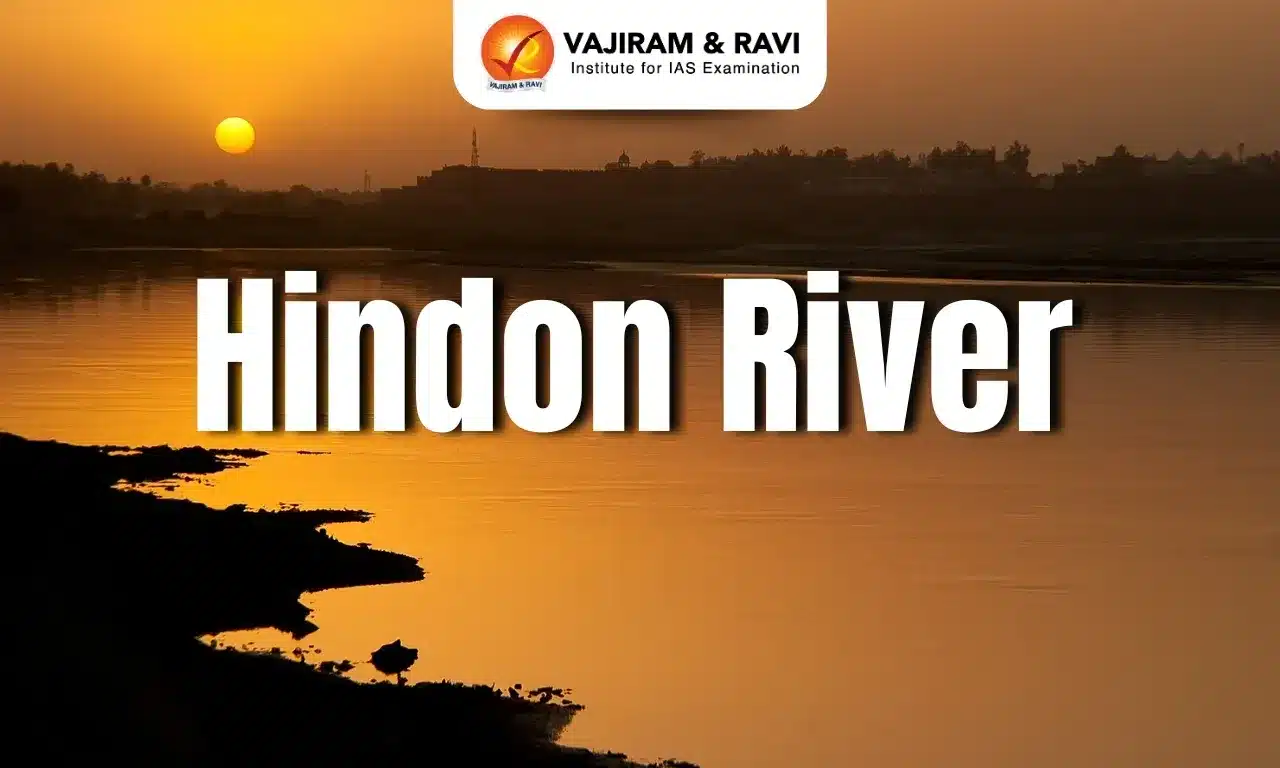
A recent survey of the Hindon river has raised serious concerns about water quality, with preliminary tests showing zero dissolved oxygen (DO) levels at several locations, rendering the water "uninhabitable" for most aquatic life.

About Hindon River

  • It is a tributary of the Yamuna River.
  • Course:
    • It originates in the Saharanpur district of Uttar Pradesh, in the Siwalik Hills, at an elevation of about 800 meters (2,625 feet) above sea level.
    • It flows across the industrial belt of Western Uttar Pradesh and Haryana before merging with the Yamuna River near Noida.
  • Total Length: 400 km
  • The river is entirely fed by rain, with a significant increase in water flow during the monsoon season.
  • Tributaries: The Kali (West) River and Krishni River are the main tributaries of River Hindon.
  • It is on the banks of this river that archeologists found traces of the Harappan civilization with sites dating back to as long as 2500 BC. 
  • Due to urban, agricultural, and industrial waste which is being released without sufficient treatment into its waters, the Hindon is now one of the most polluted stretches in the Ganga basin.
  • In 2015, the Central Pollution Control Board (CPCB) found the Hindon’s pollution levels were so severe that it was declared a ‘dead river’ and ‘unfit’ even for bathing in several sections of the river.

Source: TOI

Hindon River FAQs

Q1: Hindon River is tributary of which major river?

Ans: Hindon River

Q2: Where does the Hindon River originate?

Ans: It originates in the Saharanpur district of Uttar Pradesh, in the Siwalik Hills

Q3: In which state does the Hindon River primarily flow?

Ans: Uttar Pradesh.

Q4: What is the total length of the Hindon River?

Ans: About 400 km.

Ladakh Magmatic Arc

Ladakh Magmatic Arc

Ladakh Magmatic Arc Latest News

Recently, scientists have traced the evolution of the Ladakh Magmatic Arc (LMA) in North West Himalaya.

About Ladakh Magmatic Arc

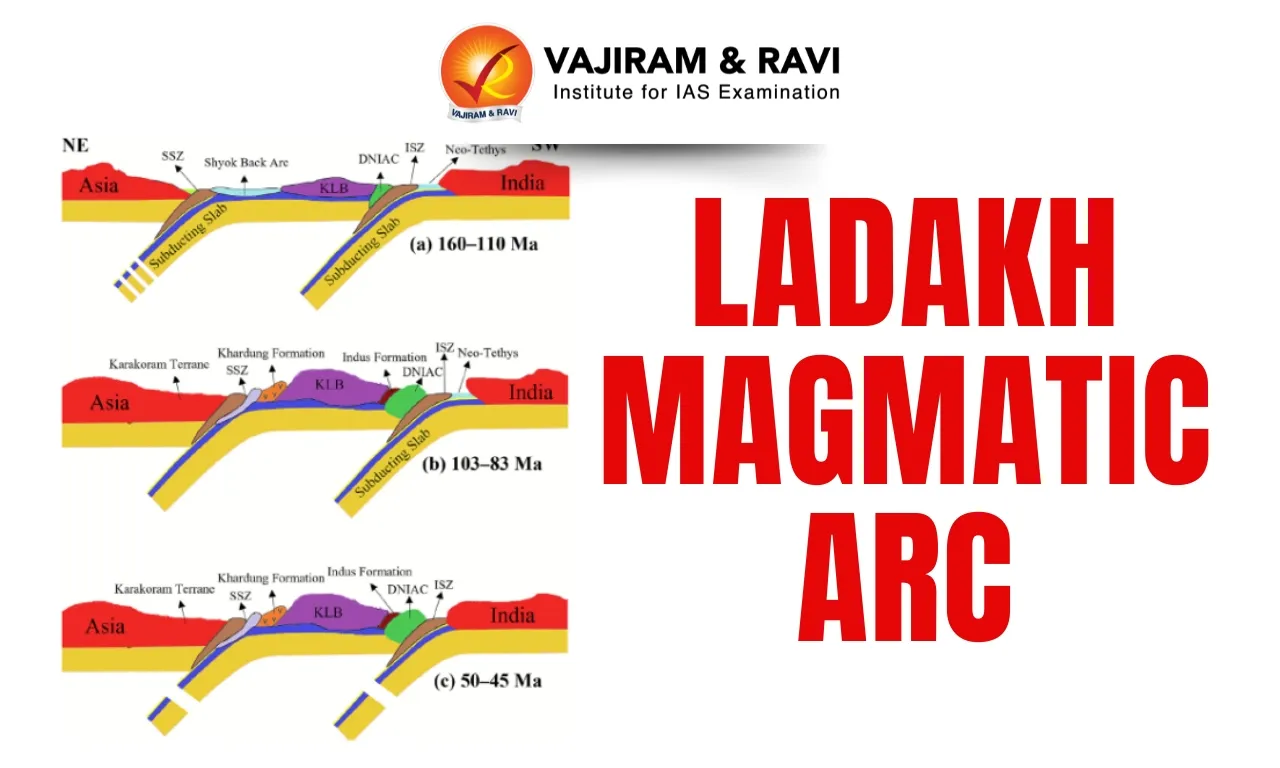
  • It is a belt of igneous rocks in the Trans-Himalaya formed in the period Jurassic to Eocene- 201.3 million years ago to 33.9 Million Year (Ma).
  • The LMA is a long-extinct volcanic system evolved through three major phases of geological activity over tens of millions of years.
    • 160–110 million years ago: Early island arc formation
    • 103–45 million years ago: Intensified magmatism during plate convergence
    • Less than 45 million years ago: Post-collisional magmatic activity

Process of Formation of Ladakh Magmatic Arc

  • Millions of years before the region that is now called Ladakh lay above an ocean called the Neo-Tethys Ocean.
  • Below that ancient sea, giant slabs of Earth’s crust slowly plunged into the mantle in a process known as subduction leading to the formation of the Ladakh Magmatic Arc (LMA).

Phases of Formation of Ladakh Magmatic Arc

  • Island Arc Formation: In its earliest stage, Ladakh resembled a chain of volcanic islands rising from the Neo-Tethys Ocean.
    • Represented by the Dras–Nidar Island Arc Complex (DNIAC)
    • Magma primarily originated from the mantle
    • Minimal contribution from subducted sediments
  • Crustal Enrichment and Batholith Formation: As tectonic plates converged, the system evolved:
    • Formation of large granite bodies known as the Ladakh Batholith (LB)
    • Increased input from continental crust and recycled sediments
    • Chemical signatures indicate deep crustal processes and magma mixing
    • This phase coincides with the approaching collision between India and Eurasia.
  • Post-Collision Magmatism: After the plates collided and the Neo-Tethys Ocean closed, tectonic activity continued:
    • Formation of mafic dykes—vertical sheets of volcanic rock
    • Magma derived from a previously enriched mantle source
    • Indicates lingering tectonic and magmatic activity even after collision

Source: PIB

Ladakh Magmatic Arc FAQs

Q1: Which tectonic process is associated with the Ladakh Magmatic Arc?

Ans: Oceanic-continental convergence

Q2: What is the Ladakh Magmatic Arc?

Ans: A volcanic arc in Ladakh, India

Kalinjar Fort

Kalinjar Fort

Kalinjar Fort Latest News

The hill region surrounding the Kalinjar Fort in Banda was officially declared a National Geo-Heritage Site by the Geological Survey of India (GSI) recently.

About Kalinjar Fort

  • It is located in the Banda district of Uttar Pradesh.
  • It is situated on an isolated hilltop, surrounded by the Vindhya Mountains and the Ken River.
  • It is one of the oldest and most impressive forts in the country.
  • Many decisive battles were fought for the possession of this strategically located fort in ancient, medieval, and modern times.
  • History:
    • The history of Kalinjar Fort is more than 1500 years old
    • Historical documents and inscriptions indicate that a strategic fort was established during the Gupta period (4th-6th century). 
    • Later, Kalinjar came under the Chandela dynasty (9th-13th century) and became one of their capitals.
    • During the rule of the Chandela kings, the fort developed into a military fort on one side and a religious centre on the other. 
    • Mahmud Ghaznavi, Qutubuddin Aibak, and Humayun attacked it and wanted to win it but could not succeed. 
    • Finally, in 1569 AD, Akbar won this fort and gifted it to Birbal. After Birbal, this fort came under the Bundel king Chhatrasal. 
    • After them, the fort was occupied by Hardev Shah of Panna. 
    • In 1812, this fort became under the British.
  • The fort also houses mosques, temples, palaces, and stepwells.
  • One of the main attractions of Kalinjar is the Neelkanth Temple. 
    • It was built by Chandela ruler Paramaditya Dev. 
    • The Shiva lingam is of blue stone in addition to the giant 18-arm statue in the temple.

Source: TOI

Kalinjar Fort FAQs

Q1: Where is Kalinjar Fort located?

Ans: Where is Kalinjar Fort located?

Q2: In Banda district.

Ans: The Vindhya Mountains.

Q3: Which river flows near Kalinjar Fort?

Ans: The Ken River.

Q4: How old is the history of Kalinjar Fort?

Ans: More than 1500 years old.

Q5: Which dynasty later made Kalinjar one of its capitals?

Ans: The Chandela dynasty.

MXene

MXene

MXene Latest News

Recently, the IIT Guwahati research team developed a MXene-based catalyst that can both produce hydrogen efficiently from water and act as a photocatalyst for desalination.

About MXene

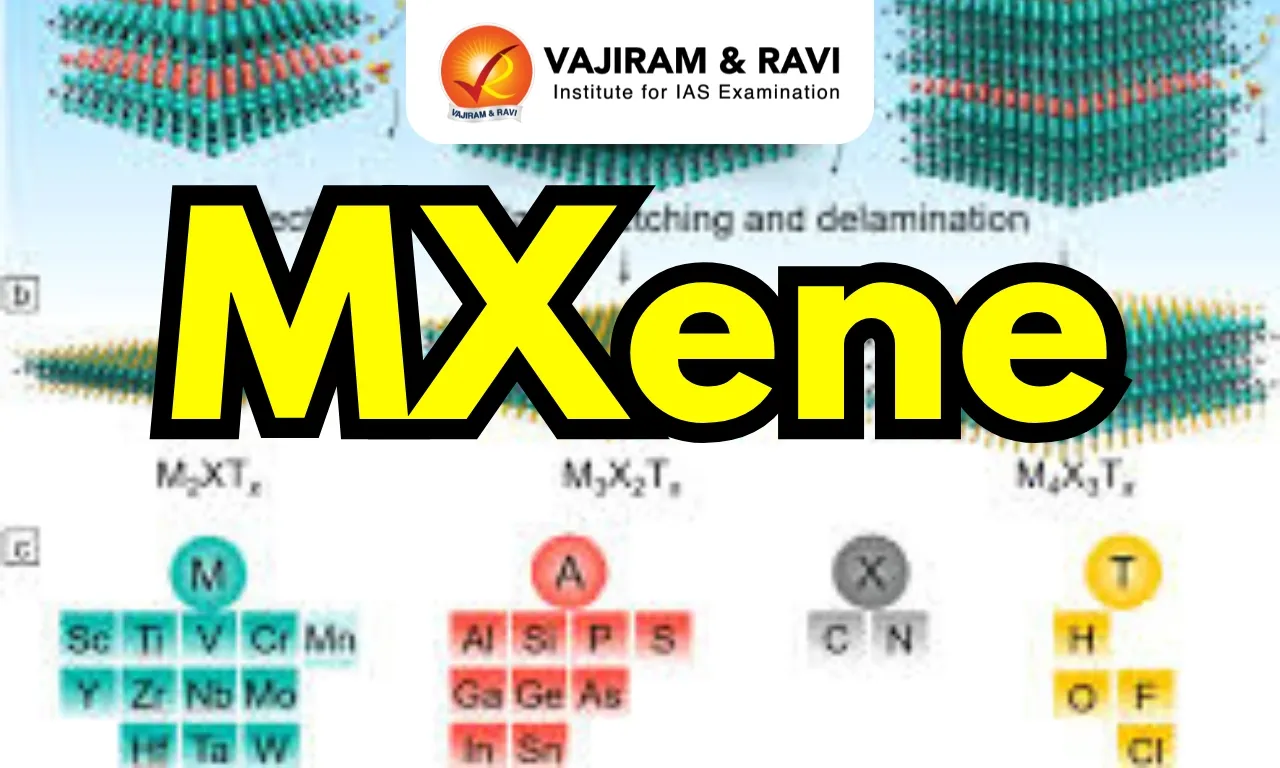
  • MXenes are a group of two-dimensional materials first discovered in 2011.
  • They are made from a bulk crystal called MAX. 
    • They have the general formula of Mn+1XnTx, where M is an early transition metal, X is carbon and/or nitrogen, and T is a functional group on the surface of an MXene (typically O, OH, and F).
  • Among various types of MXenes, titanium carbide (Ti3C2Tx) is the most widely used. 
  • Properties of MXenes: They show high electrical conductivity, excellent mechanical strength, good chemical stability, remarkable hydrophilicity, and tunable surface chemistry.

Applications of MXenes

  • Energy Storage Devices: MXene could be used in energy storage devices such as electrodes of Li-ion batteries, pseudo capacitors, etc. 
  • Desalination and waste-water treatment: These can be used in in water desalination and wastewater treatment.
  • Separation and Filtration Applications:  Because of remarkable properties such as hydrophilicity, conductivity, and high flexibility these can be used in separation and filtration processes in industries.

Source: DD News

MXene FAQs

Q1: What is MXene?

Ans: A type of 2D material

Q2: What is MXene typically used for?

Ans: Energy storage, Electronics and Biomedical applications

Enquire Now