Coconut Latest News
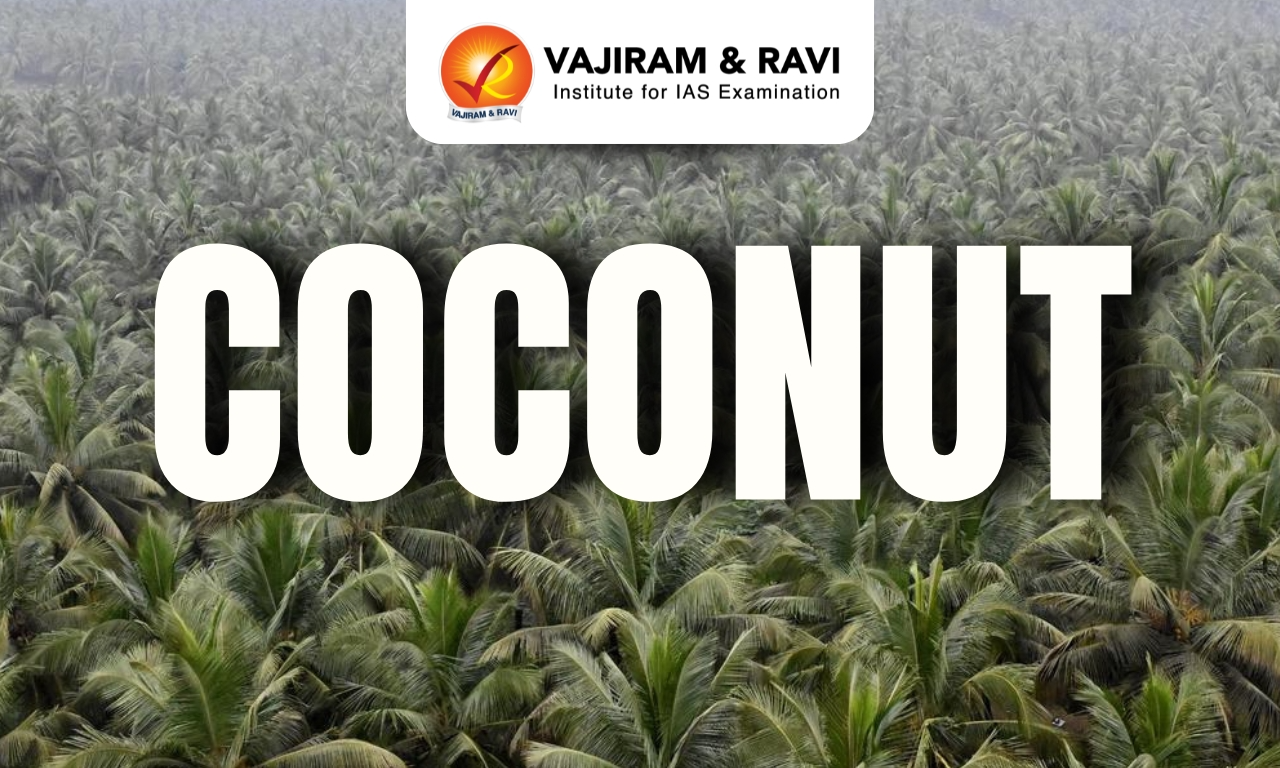
Recently the Minister of State for Agriculture and Farmers Welfare informed the Lok Sabha that India is the world’s largest producer of coconuts contributing to 30.37% of the Global coconut production.
About Coconut
- Coconut (Cocos nucifera) is a large palm of the family Arecaceae.
- It grows in the subtropical coastal regions of Asia (India, Philippines, Sri Lanka, Thailand, Indonesia) and Oceania.
- It originated in Southeast Asia, and was transported throughout the Pacific either by migrating Indonesians and Polynesians.
- Distribution in India: It is majorly grown in Kerala, Tamil Nadu, Karnataka, Andhra Pradesh, Odisha, Goa, and West Bengal.
- Uses: Coconuts are used as whole fruits or, conversely, by their parts: mesocarp fibers, milk, kernel (or flesh), husk.
Required Climatic Conditions for Coconut
- Rainfall: 1000-3000 mm per year. Prefers evenly distributed rainfall
- Temperature: Optimum 27°C with a diurnal variation of 6-7 0C Cold spells are more limiting than high temperatures. Light- Coconut palm requires maximum sunlight.
- Altitude: Up to 600 m above mean sea level.
- If temperature remains favourable, the palm grows well up to an altitude of 800 m.
- Humidity: Needs warm and humid conditions
- Soils: It is particularly adapted to the coastal light sandy and sandy loam type soils. Coconuts also thrive well in laterite soils.
Source: PIB
Coconut FAQs
Q1: Which part of the coconut is used to produce coconut oil?
Ans: Coconut flesh
Q2: What is the scientific name of the coconut palm?
Ans: Cocos nucifera