Immigration, Visa, Foreigners Registration & Tracking (lVFRT) Scheme

Immigration, Visa, Foreigners Registration & Tracking (lVFRT) Scheme

Immigration, Visa, Foreigners Registration & Tracking (lVFRT) Scheme Latest News

Recently, the Union cabinet approved the continuation of the Immigration, Visa, Foreigners Registration & Tracking (lVFRT) Scheme.

About Immigration, Visa, Foreigners Registration & Tracking (lVFRT) Scheme

  • The IVFRT platform is aimed at integrating and streamlining immigration, visa issuance, and foreign registration processes in India through a secure, technology-driven framework.
  • It was approved for a period of five years from 01 April, 2026 to 31 March, 2031.
  • It was originally approved in 2010; the project has undergone multiple phases of expansion and extension.
  • The latest approval comes in the backdrop of the recently enacted Immigration and Foreigners Act, 2025, 
  • Features of lVFRT Scheme
    • The scheme will concentrate on three broad areas
      • Emerging technology innovations, transformation of core infrastructure and optimisation of technology-enabled service delivery
    • The scheme will modernize the immigration and visa ecosystem through adoption of emerging technologies, including mobile-based services and self-service kiosks for seamless and secure passenger movement.
    • It will upgrade and expand core infrastructure across Immigration Posts, FRROs, and Data Centres to build a resilient and scalable system nationwide.
    • It will optimize technology and service delivery by introducing unified digital platforms, revamping core application architecture, and strengthening network and deployment frameworks for improved efficiency and user experience.

Source: PIB

Immigration, Visa, Foreigners Registration & Tracking (lVFRT) Scheme FAQs

Q1: What is the objective of the IVFRT Scheme?

Ans: It is to modernization and up-gradation of Immigration and Visa services.

Q2: Which organization handles immigration in India?

Ans: Ministry of Home Affairs and Ministry of External Affairs

PRISM-SG Portal

PRISM-SG Portal

PRISM-SG Portal Latest News

Recently, the Minister for Road Transport and Highways launched the PRISM-SG Portal in New Delhi.

About PRISM-SG Portal

  • PRISM-SG (Portal for Rail-Road Inspection & Stages Management – Steel Girders) Portal aimed at enhancing efficiency, transparency, and inter-agency coordination in infrastructure development.
  • Features
    • It has been developed to digitise key approval and inspection processes related to the construction of
    • Road Over Bridges (ROBs) and also includes Quality Assurance Plan (QAP), Welding Procedure Specification Sheet (WPSS) and fabrication stage inspection of steel girders.
    • The portal enables end-to-end online submission of documents, scrutiny, raising and resolution of queries, approvals, scheduling of inspections, and uploading of inspection reports, photographs, test results, supported by a complete audit trail and real-time monitoring capabilities.
    • It addresses challenges by providing an integrated digital platform that brings together all key stakeholders, including Road Owning Departments, Indian Railways, contractors, fabricators, and inspection agencies.
  • Significance
    • It will help to reduce the approval and inspection timeline from approximately 12 months to about 3 to 4 months.
    • It will play a critical role in ensuring timely completion of RoBs and Railway Bridges, strengthening infrastructure delivery and enhancing connectivity across the country.

Source: PIB

PRISM-SG Portal FAQs

Q1: What does PRISM-SG stand for?

Ans: Portal for Rail-Road Inspection & Stages Management – Steel Girders

Q2: What is the purpose of the PRISM-SG Portal?

Ans: To monitor and manage steel girder inspections for rail-road projects

Lebanon

Lebanon

Lebanon Latest News

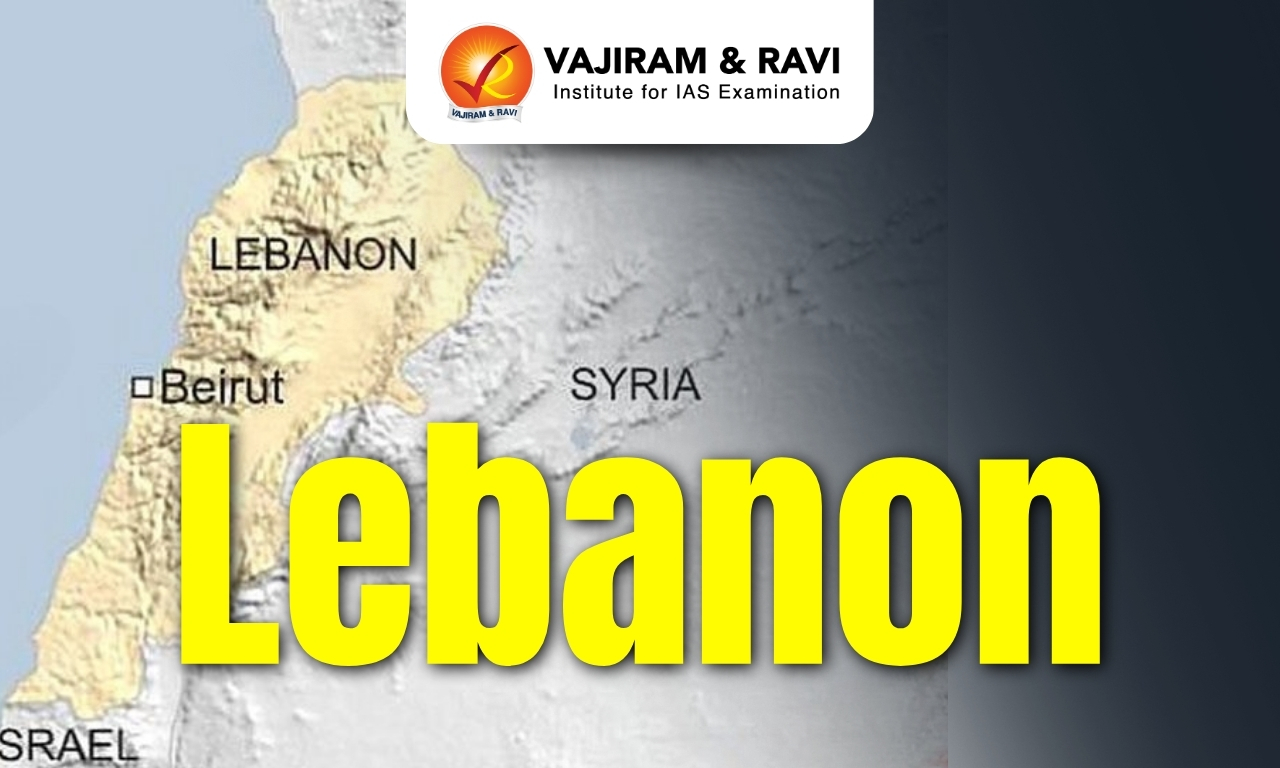
Recently, Israel said that its military would take control of southern Lebanon up to the Litani River to create a “security zone”.

About Lebanon

  • Location: It is situated on the eastern coast of the Mediterranean Sea in Western Asia.
  • Borders: It is bounded in the northern and eastern parts by Syria; in the southern part by Israel; in the western part by the Mediterranean Sea.
  • The country shares its maritime borders with Cyprus. 
  • Capital City: Beirut

Geographical Features of Lebanon

  • Climate: Its Mediterranean climate brings mild, wet winters and hot, dry summers.
  • Mountains: Its major mountains are Lebanon Mountains (Jabal Lubnan), Hermon Ranges.
  • Highest Peak: The highest point of Lebanon is Qurnat as Sawda' which peaks at 10,128 ft. (3,087 m) in the Lebanon Mountains.
  • Major Valley: Bekaa (Al-Biqa)
  • River: The Litani the most significant river which irrigates the heart of the fertile Bekaa Valley.
  • Natural Resources: Lebanon has various mineral products which include limestone, gypsum, oil, natural gas, and salt. Other important commodities include semiprecious gemstones.
  • Economy: Services, including banking and tourism, are Lebanon’s most important economic activities.

Source: TOI

Lebanon FAQs

Q1: What is the capital of Lebanon?

Ans: Beirut

Q2: Where is Lebanon located?

Ans: Middle East

Amrabad Tiger Reserve

Amrabad Tiger Reserve

Amrabad Tiger Reserve Latest News

Recently, the Telangana government has taken up the rehabilitation and relocation of tribal families living in the Amrabad Tiger Reserve as part of its efforts to balance the development of tribal families with wildlife conservation.

About Amrabad Tiger Reserve

  • Location: It is located in the Nallamala hills of the Eastern Ghats in Telangana state.
  • It was originally part of the larger Nagarjunasagar-Srisailam Tiger Reserve before the bifurcation of Andhra Pradesh and Telangana in 2014.
  • Terrain: The reserve is renowned for its rugged terrain, deep valleys, and dense forests.
  • Rivers: The Krishna River and its perennial streams originating within the reserve contribute to the water supply of major reservoirs such as the Srishailam Dam and Nagarjunsagar Dam.
  • Tribal Community: The Chenchu tribe is one of the major tribal communities that live in the ATR.
  • Flora: 
    • Amrabad is characterized by dry deciduous forests, primarily made up of sal, teak, bamboo, and acacia trees. 
    • The forest is rich in medicinal plants and shrubs, which have long been used by local tribes for traditional remedies.
  • Fauna: 
    • It is home to leopards and wild cats, along with herbivores like sambar deer, chital (spotted deer), nilgai (blue bull), wild boar, and the Indian bison (gaur). 
    • Over 303 bird species have been identified in this region. Some important groups include Eagles, Pigeons, Doves, Cuckoos, Woodpeckers, Drongos, etc.

Source: TOI

Amrabad Tiger Reserve FAQs

Q1: Which river flows through Amrabad Tiger Reserve?

Ans: Krishna

Q2: What is unique about Amrabad Tiger Reserve?

Ans: It's the second-largest tiger reserve in India

QS World University Rankings

QS World University Rankings

QS World University Rankings Latest News

The Indian Institute of Management-Kozhikode (IIM-K) has achieved a global milestone by breaking into the Top 100 of the prestigious QS World University Rankings by Subject 2026 for the first time. 

About QS World University Rankings

  • It is published annually by global higher education consultancy Quacquarelli Symonds.
  • The QS rankings evaluate universities on several parameters, including academic reputation, overall score, employer reputation, and employment outcomes.
  • It uses a structured approach to assess institutions across the globe. Each ranking is built on a set of measurements that help evaluate different aspects of university performance. These measurements are grouped as follows:
    • Lens: A collection of indicators linked by a common theme, such as research or employability.
    • Five Lenses: Research and Discovery, Employability and Outcomes, Global Engagement, Learning Experience, Sustainability.
    • Indicator: A specific area of performance, such as Citations per Faculty or Employer Reputation. Institutions are scored and ranked on each indicator, which contributes to their overall rank.
    • Metric: A detailed calculation within an indicator, used to generate precise scores.

Key Highlights of QS World University Rankings

  • India recorded 120 new entries this year, placing it fourth globally for fresh appearances, behind only the US (287), China (181), and the UK (159).
  • The country now holds the fourth-largest presence in these rankings by institution count, after the US, China, and the UK.
  • Six Indian institutions now feature in the global top 100 for computer science, all improving from last year.
  • The Indian Institute of Technology (ISM) Dhanbad and the Indian Institute of Management Ahmedabad, both securing the country's highest global rank of 21.
  • IIT-ISM Dhanbad has retained its stronghold in mineral and mining engineering.
  • IIM Ahmedabad has broken into the top 25 globally in business and management studies as well as marketing.

Source: TH

QS World University Rankings FAQs

Q1: What percentage of the QS World University Rankings is based on Academic Reputation?

Ans: 40%

Q2: What is the weightage given to Sustainability in the QS World University Rankings?

Ans: 5%

Enquire Now