Qader Cruise Missile

Qader Cruise Missile

Qader Cruise Missile Latest News

Recently, Iran  fired Qader cruise missiles at the USS Abraham Lincoln aircraft carrier.

About Qader cruise Missile

  • It is a medium-range shore-based anti-ship cruise missile developed by Iran and deployed by its naval forces.
  • Features
    • It is used by naval forces to target ships.
    • It is an upgraded version of the Noor missile, which is based on Chinese missile design.
    • Range: The missile has a reported range between 120 and 300 kilometres.
    • It is designed for sea targets such as warships and tankers.
    • It carries a warhead of about 200 kilograms of high explosive.
  • Working
    • It uses a turbojet engine.
    • It flies at low altitude over the sea. This is called sea-skimming.
    • This flight path helps the missile avoid radar detection.
    • It flies only a few metres above the sea surface. This reduces the reaction time for defence systems.

What are Cruise Missiles?

  • A cruise missile is a guided missile that flies at low altitudes, often following the contours of the terrain to avoid radar detection.
  • Features
    • It flies at low altitude, powered by jet engines, can maneuver around obstacles
    • Guidance System: GPS, terrain contour matching, inertial navigation
    • Speed: Subsonic to supersonic (Mach 0.8-3);
    • Range Short to medium (50-2,500 km)
    • Launch Platforms: Air, sea, and land platforms.
    • Examples: BrahMos, Nirbhay, Tomahawk

Source: ET

Qader Cruise Missile FAQs

Q1: What is the warhead capacity of the Qader cruise missile?

Ans: 200 kg

Q2: What is the primary purpose of the Qader cruise missile?

Ans: Anti-ship warfare

Organisation for Economic Cooperation and Development

Organisation for Economic Cooperation and Development

Organisation for Economic Cooperation and Development Latest News

Recently, the Organisation for Economic Cooperation and Development (OECD)  projected India’s economy to grow at 6.1% in 2026-27.

About Organisation for Economic Cooperation and Development

  • The OECD was established on Dec. 14, 1960, by 18 European nations, plus the United States and Canada.
  • OECD members are typically democratic countries that support free-market economies.
  • Members: It is an international organisation of 38 countries committed to democracy and the market economy.
  • Goal: The stated goal of the OECD is to shape policies that foster prosperity, equality, opportunity and well-being for all.
  • The OECD publishes economic reports, statistical databases, analyses, and forecasts on the outlook for economic growth worldwide.
  • The organization also seeks to eliminate bribery and other financial crime worldwide.
  • The OECD maintains a so-called “black list” of nations that are considered uncooperative tax havens.
  • India is one of the many non-member economies with which the OECD has working relationships in addition to its member countries.
  • India has been an OECD Key Partner since 2007. 
  • Headquarters: Paris, France.

Source: NIE

Organisation for Economic Cooperation and Development FAQs

Q1: Where is the OECD headquartered?

Ans: Paris, France

Q2: How many member countries does the OECD have?

Ans: 38

Gruha Sugam Portal

Gruha Sugam Portal

Gruha Sugam Portal Latest News

Recently, the National Housing Bank (NHB) launched the Gruha Sugam Portal.

About Gruha Sugam Portal

  • It enables Defence / Government personnel to avail home loans with ease from the location of their posting.
  • It will accelerate digital lending adoption and financial inclusion.
  • It will facilitate increased home ownership through improved access to housing loans, strengthening the mission of promoting affordable and sustainable housing finance

Salient features of the Portal

  • Defence Personnel, Members of Paramilitary Forces, Government Employees (State and Central) can apply for housing loans digitally through their respective administrative units. 
  • No need to visit the banks and financial institutions for loan approvals and processing.
  • Unified Digital Marketplace which enables market transparency and discovery of best suited offer
  • Seamless digital integration with NHB and lending institutions to ensure ease of operations
  • Enhanced Loan Processing Efficiency
  • Grievance Redressal and Consumer Protection
  • Online Chat facility for quick query resolution
  • National Housing Bank launches Gruh Sugam Portal focusing on Defence, Paramilitary & Government Personnel

Key Facts about National Housing Bank

  • It is an apex agency established to promote housing finance companies (HFCs) in India. 
  • It is an All-India Financial Institution (AIFl) wholly owned by the Government of India (GoI).
  • NHB supervises HFCs, while regulation of HFCs is with the Reserve Bank of India (RBI).
  • NHB is wholly owned by the GoI post the 24 April 2019 notification of RBI i.e. The entire paid-up capital of NHB is held by the government.
  • Functions of NHB
    • Supervision and grievance redressal regarding HFCs
    • Financing
    • Promotion and Development
  • Head Office: New Delhi.

Source: PIB

Gruha Sugam Portal FAQs

Q1: What is Gruha Sugam Portal?

Ans: A home loan portal

Q2: Which organization launched Gruha Sugam Portal?

Ans: National Housing Bank

CALM Brain

CALM Brain

CALM Brain Latest News

Researchers at the Rohini Nilekani Centre for Brain and Mind (CBM), a partnership between the National Institute of Mental Health and Neuro Sciences (NIMHANS) and the National Centre for Biological Sciences (NCBS) - TIFR, have developed CALM-Brain.

About CALM Brain

  • It is a first-of-its-kind digital repository of data in India on brain structure and function from a range of psychiatric disorders.
  • It was initiated in 2016 as part of the Accelerator program for Discovery in Brain disorders using Stem cells (ADBS project).
  • Funding: It was jointly funded by the Department of Biotechnology and the Pratiksha Trust.
  • Goal: To better understand neuropsychiatric disorders, disease onset, progression, and underlying biological changes.
  • It will be made open source, thereby opening it up for clinicians and researchers aiming to study neuropsychiatric disorders and to better understand disease onset, progression and underlying biological changes leading to disease symptoms.
  • It collects clinical, neuro-imaging, behavioural, genetic and other datasets on five disorders – addiction, bipolar disorder, dementia, obsessive compulsive disorder (OCD) and schizophrenia.
  • CALM-Brain will help clinicians and researchers
    • To understand the onset of neuropsychiatric disease
    • Check progression
    • Decode underlying biological changes
    • Provide better diagnosis
    • Plan personalized treatments for patients.

Source: TH

CALM Brain FAQs

Q1: Who funded the CALM Brain initiative?

Ans: Department of Biotechnology and Pratiksha Trust.

Q2: How many psychiatric disorders does CALM Brain focus on?

Ans: 5

Neoloboptera Peninsularis

Neoloboptera Peninsularis

Neoloboptera Peninsularis Latest News

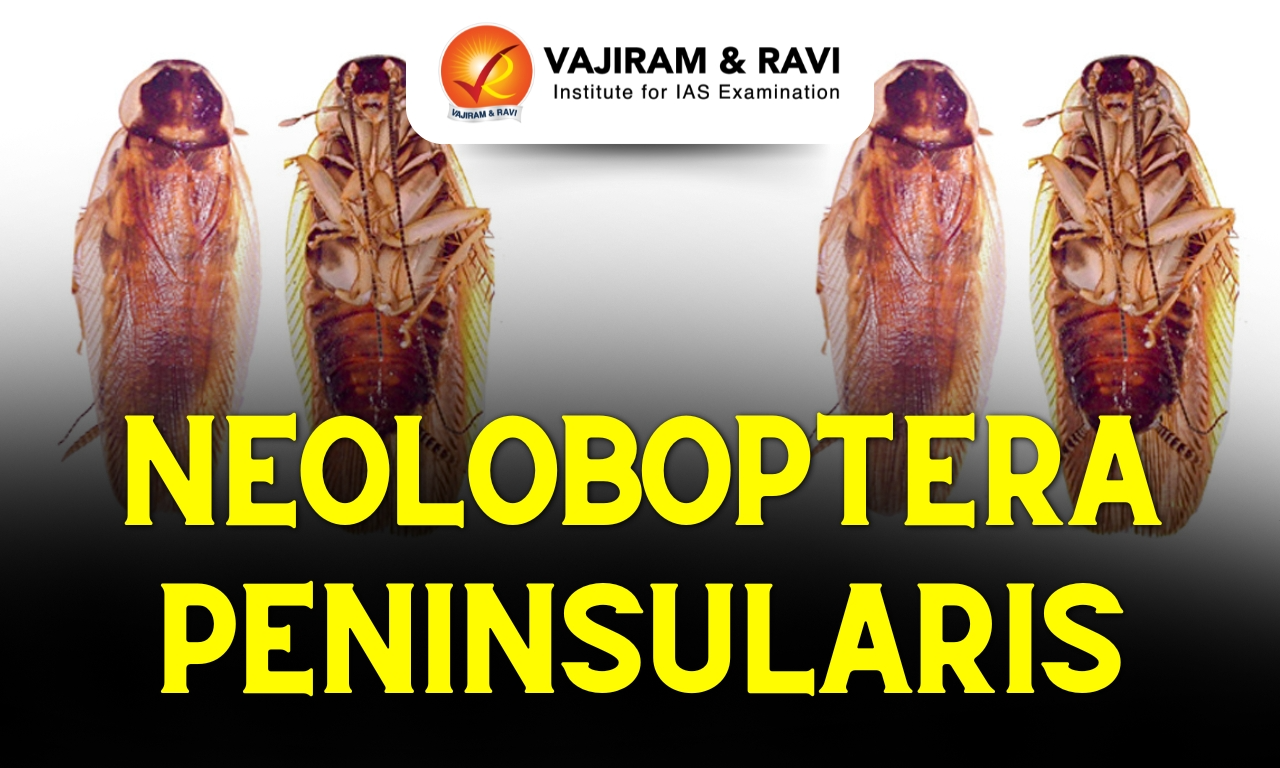
Researchers from the Zoological Survey of India (ZSI) recently uncovered a new cockroach species, Neoloboptera peninsularis, in the Deccan Peninsula.

About Neoloboptera Peninsularis

  • It is a new species of cockroach.
  • It was discovered in the Deccan Peninsula in Pune, Maharashtra.
  • The insect was found among palm shrubs and dry leaf litter near farmland in Nathachiwadi.
  • Its name, "peninsularis," serves as a nod to its native region of Peninsular India.
  • It marks the first use of modern DNA technology in India to identify a cockroach species. 
  • It is only the third known member of the genus Neoloboptera recorded from India. 
  • The other two, Neoloboptera indica (described in 1865) and Neoloboptera chakrabortyi (described in 1995), had been recorded earlier, with no new specimen-based records reported since then.
  • It is characterised by its glossy, yellowish-brown body and fully developed wings. 
  • Key features include its asymmetrical cerci (paired appendages) at the rear and a uniquely structured, whip-like male genital component.

Source: NDTV

Neoloboptera peninsularis FAQs

Q1: What is Neoloboptera peninsularis?

Ans: It is a newly discovered species of cockroach.

Q2: Where was Neoloboptera peninsularis discovered?

Ans: It was discovered in the Deccan Peninsula in Pune, Maharashtra.

Q3: What are the key physical characteristics of Neoloboptera peninsularis?

Ans: It has a glossy, yellowish-brown body and fully developed wings.

Honshu Island

Honshu Island

Honshu Island Latest News

An earthquake measuring magnitude 6.2 struck off the east coast of Japan’s largest island, Honshu, recently.

About Honshu Island

  • Honshu, historically known as Akitsushima, is the largest of the four main islands of Japan.
  • It lies between the Pacific Ocean (east) and the Sea of Japan (west). 
  • It forms a northeast–southwest arc extending about 1,287 km and varies greatly in width. 
  • It has an area of 227,898 sq.km. It is the world's seventh-largest island. 
  • It has a population of around 104 million, accounting for more than 80% of the total population of Japan.  
  • It is the second-most populous island in the world after the Indonesian island of Java.
  • It contains the main cities of Japan, including the capital Tokyo, Osaka, Hiroshima, Nagoya, Kyoto, and Yokohama. 
  • The island is dominated by the Central Trough, a central mountainous spine that contains the majority of Japan’s highest peaks. 
  • It contains Japan’s highest mountain, Mount Fuji (an active stratovolcano), and its largest lake, Lake Biwa.
  • Earthquakes often occur, as there are several tectonic plates located on this island.

Source: FP

Honshu Island FAQs

Q1: Which country does Honshu Island belong to?

Ans: Honshu belongs to Japan.

Q2: Between which two water bodies is Honshu located?

Ans: It lies between the Pacific Ocean (east) and the Sea of Japan (west).

Q3: What percentage of Japan’s population lives on Honshu?

Ans: More than 80% of Japan’s population lives on Honshu.

Q4: Which is the highest mountain in Japan located on Honshu?

Ans: Mount Fuji is the highest mountain.

Sonowal Kacharis

Sonowal Kacharis

Sonowal Kacharis Latest News

A new study has identified 39 plants used by the Sonowal Kachari community to treat ailments ranging from fever and cough to kidney stones and skin diseases.

About Sonowal Kacharis

  • They are an indigenous people who live in northeast India. 
  • The vast majority of the Sonwal live in Assam. They are the third-largest plain tribe in Assam and one of the oldest tribes of Assam. 
  • Smaller groups live in Arunachal Pradesh and Meghalaya.
  • They are recognized as a Scheduled Tribe (Plains) in Assam.
  • They are of Mongoloid origin, and linguistically, the Sonowal Kachari people belong to the Tibetan language family. 
  • The name ‘’Sonowal’’ comes from the word for gold. The traditional occupation of the Sonwal was panning for gold during the Ahom kingdom.
  • Today the Sonowal are primarily engaged in agriculture. They grow rice, betel nut, sweet potatoes, and cotton. 
  • The Sonowal are believed to have a very rich traditional knowledge of indigenous medicine.
  • The primary language of the Sonowal is Assamese. Many also speak Hindi so they can communicate with outsiders.
  • Religion
    • The Sonowal practices Hinduism strongly influenced by folk religion. 
    • They have their own village shrines and generally do not visit Hindu temples.
    • Sonowal considers Shiva, the destroyer god, to be their primary deity.

Source: TOI

Sonowal Kacharis FAQs

Q1: Who are the Sonowal Kacharis?

Ans: They are an indigenous people living in Northeast India.

Q2: In which state do the majority of Sonowal Kacharis live?

Ans: The majority live in Assam.

Q3: What is the ethnic origin of the Sonowal Kacharis?

Ans: They are of Mongoloid origin.

Q4: What was the traditional occupation of the Sonowal Kacharis?

Ans: They were engaged in gold panning during the Ahom kingdom.

Q5: What religion do the Sonowal Kacharis follow?

Ans: They practice Hinduism influenced by folk traditions.

Shaurya Squadrons

Shaurya Squadrons

Shaurya Squadrons Latest News

The Indian Army recently began fielding Shaurya Squadrons, dedicated drone sub-units embedded within armoured regiments.

About Shaurya Squadrons

  • Shaurya Squadrons are dedicated drone sub-units being inducted into the Indian Army’s armoured regiments.
  • They give tank commanders real-time surveillance and precision-strike capability at the unit level.
  • Each squadron comprises 20 to 30 personnel trained in drone and counter-drone operations. 
  • They operate a mix of surveillance drones, attack drones, swarm drones, first-person view (FPV) drones, and loitering munitions.
    • The FPV drones can strike enemy armour and logistics nodes, allowing commanders to act without routing requests up the chain of command.
  • The aim is to compress the sensor-to-shooter cycle and push drone capability down to the unit level for faster targeting and engagement.
    • The sensor-to-shooter cycle refers to the time between detecting a target and destroying it, which is the problem Shaurya Squadrons directly address.
  • The Army intends to compress this gap from minutes to seconds.
  • Five Army commands have already inducted these units, with plans to equip all 67 armoured regiments to ensure each has a dedicated drone wing. 
  • The Shaurya Squadron draws from the Army’s prior deployment of Ashni Platoons within infantry battalions. 
    • Ashni units are also 25 to 30 personnel strong and carry the same blend of surveillance drones, attack drones, and loitering munitions, and are now an integral part of all infantry battalions.

Source: MC

Shaurya Squadrons FAQs

Q1: What are Shaurya Squadrons?

Ans: They are dedicated drone sub-units being inducted into the Indian Army’s armoured regiments.

Q2: What capability do Shaurya Squadrons provide to tank commanders?

Ans: They provide real-time surveillance and precision-strike capability at the unit level.

Q3: How do Shaurya Squadrons improve battlefield decision-making?

Ans: They allow commanders to act quickly without routing requests up the chain of command.

Lyme Disease

Lyme Disease

Lyme Disease Latest News

The U.S. drugmaker Pfizer and France's Valneva recently said their experimental Lyme disease vaccine showed more than 70% efficacy in a late-stage trial.

About Lyme Disease

  • Lyme disease, also known as Lyme borreliosis, is an infectious illness caused by a type of bacteria called Borrelia burgdorferi. 
  • It primarily affects the skin, nervous system, heart, and joints.
  • It was named after the town of Lyme, Connecticut, United States, where it was first identified in children in 1976.
  • It is most commonly reported in North America, Europe, and some parts of Asia.

Lyme Disease Transmission

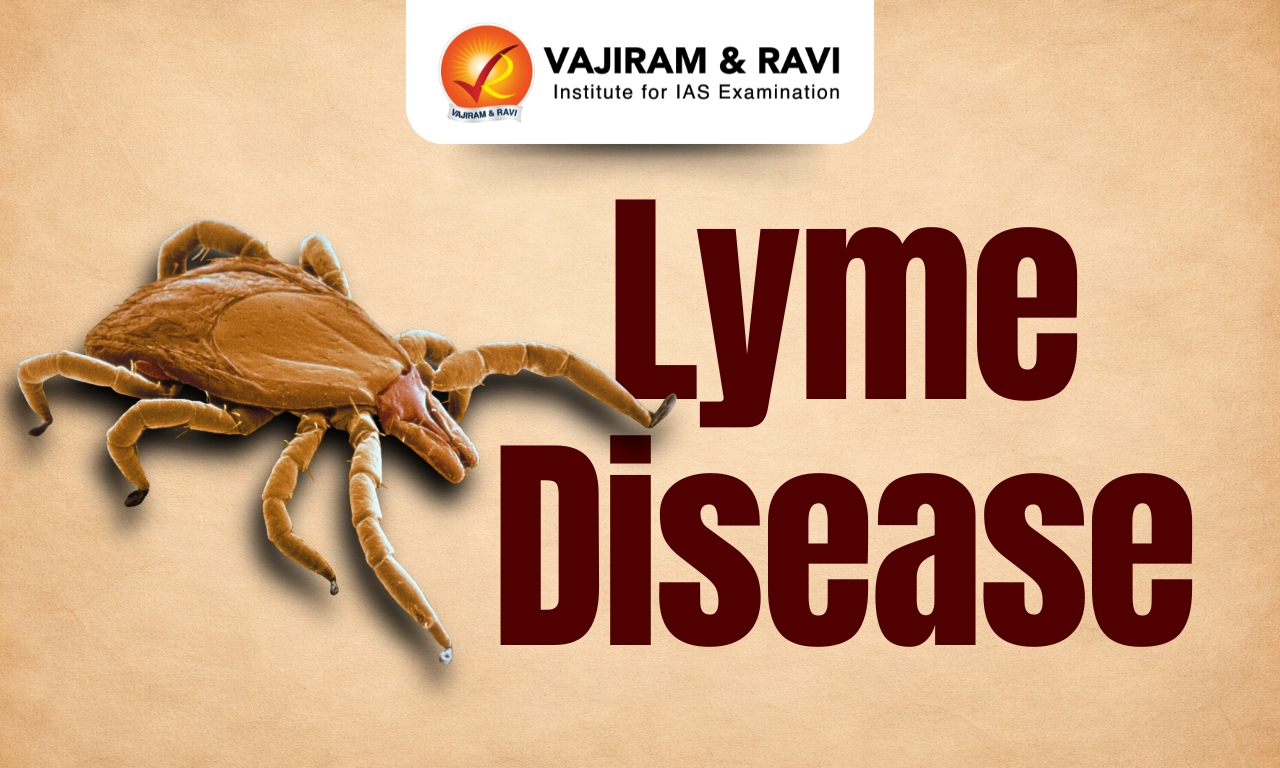
  • It’s transmitted (spread) to humans through a tick bite. 
  • Not all tick bites cause Lyme disease. Only deer ticks (also called black-legged ticks) can spread the bacteria that cause Lyme disease.
  • These ticks are often found in grassy, wooded, or bushy areas, and they can attach to the skin without being noticed.
  • Once the bacteria enter the bloodstream, they can travel to different parts of the body and cause a wide range of symptoms.
  • It cannot spread between humans or from pets to humans, through air, food, or water.  Lice, mosquitoes, fleas, and flies also do not transmit it.

Lyme Disease Symptoms

  • Lyme disease occurs in stages. The signs and symptoms of each stage can overlap.
  • In many cases, Lyme disease begins with a red circular rash around the site of the tick bite, often described as looking like a bull’s-eye. 
  • Other early signs may include fever, body aches, fatigue, and swollen lymph nodes.
  • Untreated Lyme disease can cause severe arthritis and damage the heart and nervous system.

Lyme Disease Treatment

  • Most cases are treatable with antibiotics, although recovery can take time, especially for those who are left undiagnosed in the early stages.
  • Even after treatment, some symptoms may linger.

Source: MD

Lyme Disease FAQs

Q1: What is Lyme disease?

Ans: It is an infectious illness caused by a type of bacteria called Borrelia burgdorferi.

Q2: Which parts of the body are affected by Lyme disease?

Ans: It primarily affects the skin, nervous system, heart, and joints.

Q3: How is Lyme disease transmitted to humans?

Ans: It is transmitted through the bite of infected ticks.

Q4: Which type of ticks spread Lyme disease?

Ans: Deer ticks (black-legged ticks) spread the disease.

Q5: How is Lyme disease treated?

Ans: It is treated with antibiotics.

Enquire Now