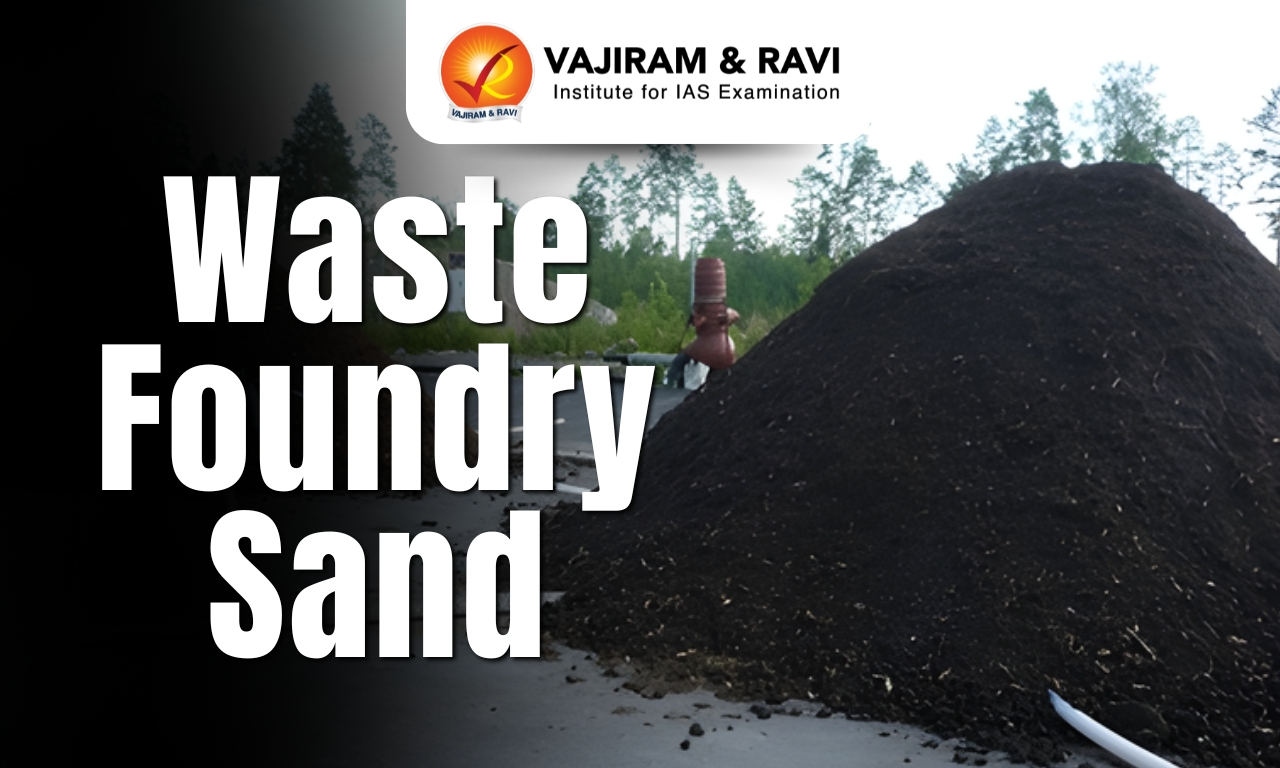
Waste Foundry Sand Latest News
Recently, the Institute of Indian Foundrymen (IIF) and CSIR-Central Road Research Institute (CSIR-CRRI) entered into an agreement to develop and facilitate solutions for the utilisation of waste foundry sand in road construction.
About Waste Foundry Sand
- It is a byproduct from the production of both ferrous and nonferrous metal castings.
- It is high quality silica sand.
- The physical and chemical characteristics of foundry sand depend upon the type of casting process and the type of industries.
- Classification of foundry sands depends upon the type of binder systems used in metal casting.
- Two types of binder systems are generally used, and on the basis of that foundry sands are categorized as: clay-bonded sands (green sand) and chemically bonded sands.
- Clay-bonded (Green) sand is composed of naturally occurring materials which are blended together; high quality silica sand (85–95%), bentonite clay (4–10%) as a binder
- Chemically bonded sands are used both in core making where high strengths are necessary to withstand the heat of molten metal, and in mold making.
- Waste Foundry Sand poses environmental challenges due to its large-scale generation and disposal requirements.
- Significance: Its reuse aligns with national priorities on resource efficiency, waste minimization, and sustainable development.
Waste Foundry Sand FAQs
Q1: What is Waste Foundry Sand (WFS)?
Ans: A by-product of metal casting industry
Q2: Is WFS hazardous?
Ans: No, non-hazardous