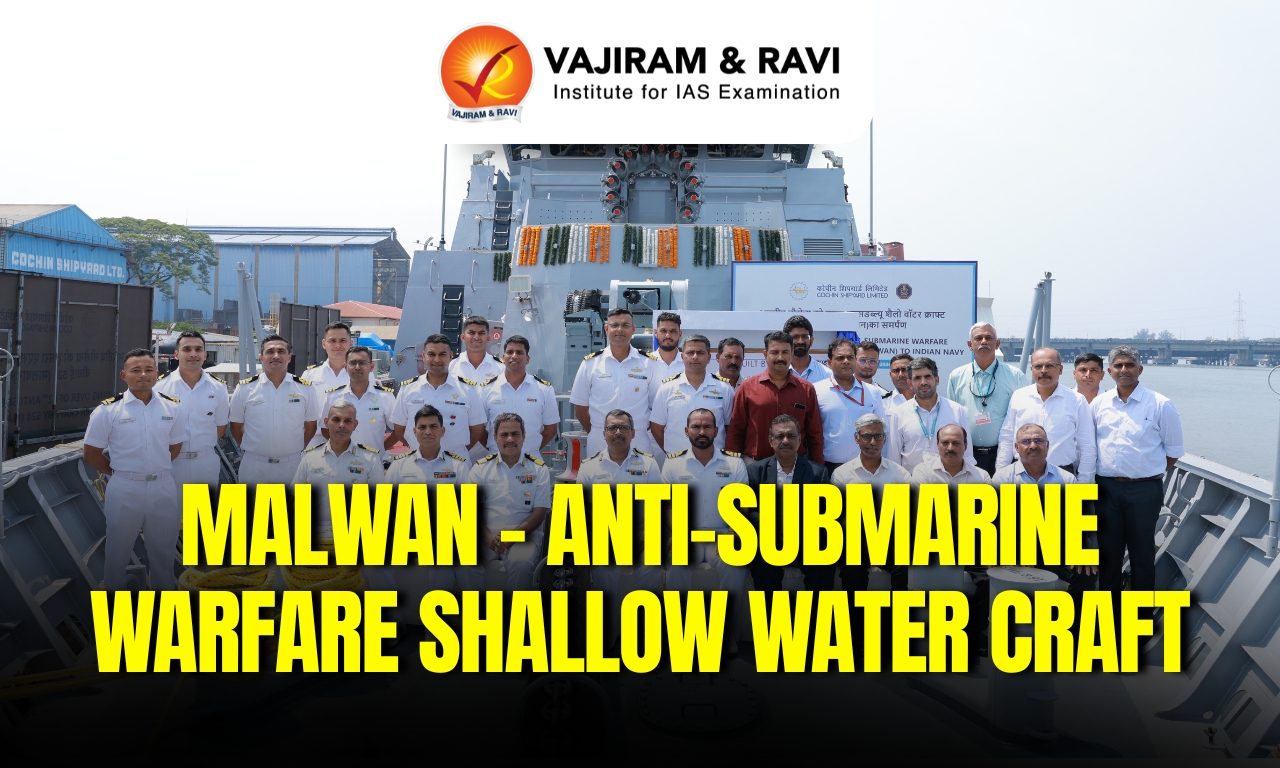
Malwan – Anti-Submarine Warfare Shallow Water Craft

Malwan - Anti-Submarine Warfare Shallow Water Craft

Malwan - Anti-Submarine Warfare Shallow Water Craft Latest News

Recently, the Malwan - Anti-Submarine Warfare Shallow Water Craft was delivered to the Indian Navy.

About Malwan - Anti-Submarine Warfare Shallow Water Craft

  • It is the second of eight Anti-Submarine Warfare Shallow Water Craft (ASW SWC) built by Cochin Shipyard Limited (CSL), Kochi.
  • It has been indigenously designed and constructed by Cochin Shipyard Limited.
  • It draws its name from the historic coastal town of Malwan in Maharashtra,
  • The ship also encapsulates the legacy of the erstwhile INS Malwan, an Indian Naval Minesweeper which remained in service till 2003.

Features of Malwan - Anti-Submarine Warfare Shallow Water Craft

  • Capacity: It has displacing capacity of 1,100 tons.
  • Propulsion: It is Waterjets propelled ASW SWCs
  • Armaments: It is equipped with torpedoes, multifunctional anti-submarine rockets, and state-of-the-art sensors including advanced radars and sonar systems.
  • The ship is equipped for underwater surveillance, Anti-Submarine Warfare (ASW) operations in coastal waters, Low Intensity Maritime Operations (LIMO) along with mine warfare capabilities.
  • It has over 80% indigenous content and marks a milestone in indigenous warship construction and reaffirms the Government of India’s vision of ‘Aatmanirbhar Bharat’.

Source: PIB

Malwan - Anti-Submarine Warfare Shallow Water Craft FAQs

Q1: What is the armament of Malwan?

Ans: Torpedoes and anti-submarine rockets

Q2: What is the propulsion system of Malwan?

Ans: Waterjet propulsion
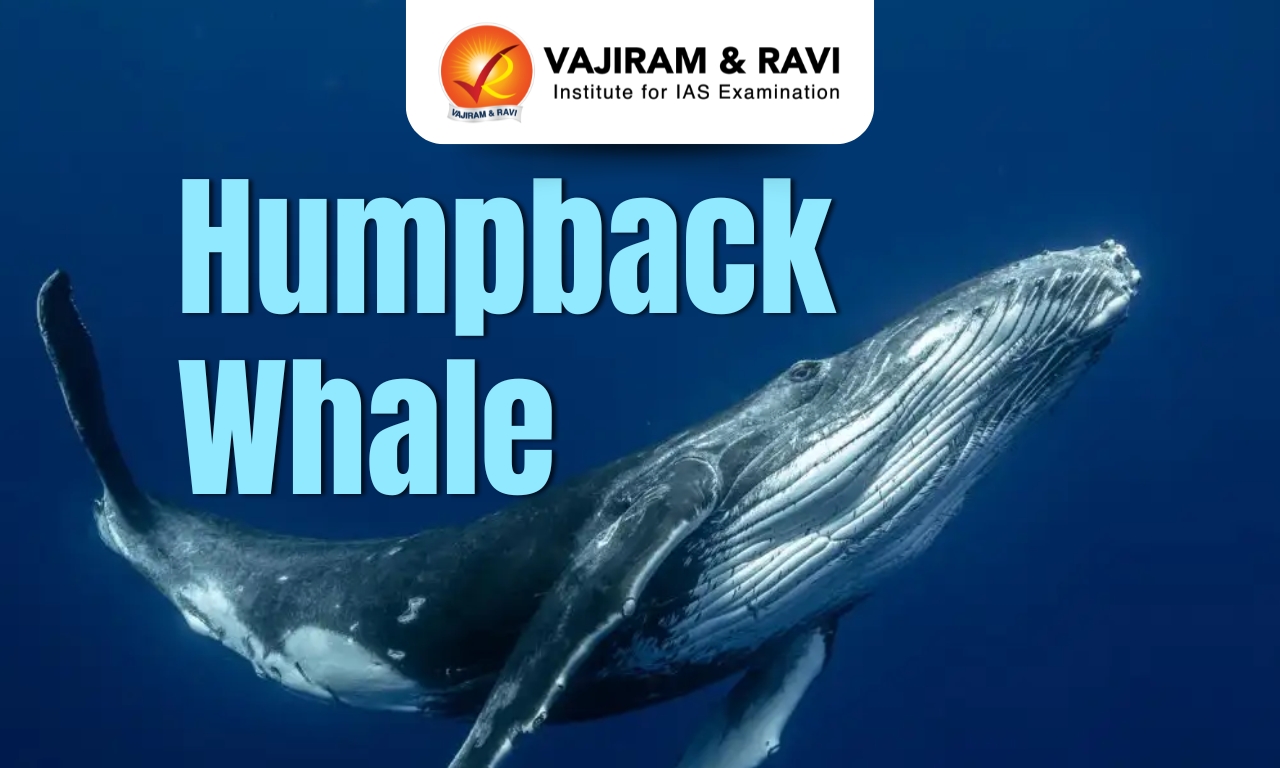
Humpback Whale

Humpback Whale

Humpback Whale Latest News

Recently, a stranded humpback whale managed to swim free in the Baltic Sea.

About Humpback Whale

  • The Humpback whale (Megaptera novaeangliae) is a species of baleen whale.
  • It is a rorqual; a member of the family Balaenopteridae.
  • Migration: They undertake long migrations between polar feeding grounds in summer and tropical or subtropical breeding grounds in winter. 
  • Appearance
    • It has the distinctive hump on its back.
    • Its long pectoral fins inspired its scientific name, Megaptera, which means “big-winged” 
    • Humpback females are larger than males.
  • Distribution: They inhabit all major oceans from sub-polar latitudes to the equator
  • Behavior: Humpbacks use a unique method of feeding called bubble netting, in which bubbles are exhaled as the whale swims in a spiral below a patch of water dense with food.
  • Diet: They filter their food through baleen plates. They strain krill, anchovies, cod, sardines, mackerel, capelin, and other schooling fish from the waters.
  • Lifespan & Reproduction: Humpback whales reach sexual maturity between the ages of 4 and 10 years. Females produce a single calf every 2 to 3 years on average.
  • Conservation status:
    • IUCN: Least concern.

Source: TOI

Humpback Whale FAQs

Q1: What is the scientific name of the Humpback Whale?

Ans: Megaptera novaeangliae

Q2: Humpback Whales are known for their acrobatic displays. What is this behavior called?

Ans: Breaching

Indian Accounting Standards (Ind AS)

Indian Accounting Standards (Ind AS)

Indian Accounting Standards (Ind AS) Latest News

Recently, the Insurance Regulatory and Development Authority of India (IRDAI) has introduced Ind AS (Indian Accounting Standards) for the Insurance Sector.

About Indian Accounting Standards (Ind AS)

  • Indian Accounting Standards (Ind AS) are a set of accounting principles notified by the Ministry of Corporate Affairs (MCA) in 2015.
  • These standards are largely converged with International Financial Reporting Standards (IFRS), bringing Indian financial reporting closer to global practices.
  • Focus:  Ind AS emphasizes a principle-based approach, focusing on fair value measurement, transparency, and enhanced disclosure.
  • History
  • Before the introduction of Indian Accounting Standards (Ind AS), India followed the Indian Generally Accepted Accounting Principles (IGAAP). Indian GAAP was primarily developed by:
    • The Institute of Chartered Accountants of India (ICAI)
    • Provisions under the Companies Act, 1956
    • Indian GAAP comprised 18 accounting standards issued by ICAI, focusing largely on historical cost accounting and legal compliance.

Key Facts about Insurance Regulatory and Development Authority of India

  • It is a statutory body formed under the Insurance Regulatory and Development Authority Act, 1999 (IRDAI Act 1999), for the overall supervision and development of the insurance sector in India.
  • It acts as an autonomous authority under the Ministry of Finance, Government of India.
  • The main goals of IRDAI are:
    • To safeguard the interest of the policyholders by fair business conduct and settlement of claims within time.
    • To regulate the business of insurance with transparency, fairness, and honest practice.
    • Facilitating financial prudence of the insurers through solvency and stability checks of insurers.
    • To regulate premium charges and policy terms for preventing unscrupulous pricing and unaffordability.
    • It is responsible for registering and/or licensing insurance, reinsurance companies, and intermediaries according to the regulations. 
    • It sets the eligibility criteria, qualifications, and capital requirements for obtaining licenses in the insurance business.
  • Head Office: Hyderabad
  • Composition: It consists of a Chairman, five full-time members, and four part-time members, all appointed by the Government of India.

Source: TH

Indian Accounting Standards (Ind AS) FAQs

Q1: What is the objective of Ind AS?

Ans: To converge with global accounting standards

Q2: Which body is responsible for issuing Ind AS?

Ans: ICAI

Kugti Wildlife Sanctuary

Kugti Wildlife Sanctuary

Kugti Wildlife Sanctuary Latest News

Recently, a rare white female albino Himalayan ‘tahr’ has been recorded in the Kugti Wildlife Sanctuary at Bharmour in Chamba district. 

About Kugti Wildlife Sanctuary

  • Location: It is the second largest sanctuary located in Himachal Pradesh .
  • It houses the famous Manimahesh temple, an attraction to thousands of pilgrims despite the difficult terrain and extreme cold conditions.
  • It has a high-altitude sanctuary between Ravi and Chenab rivers.
  • It is surrounded by Dhauladhar Wildlife Sanctuary on South-East direction and Tundah Wildlife Sanctuary in the North-West direction.
  • It is at altitudes ranging from 2,195 meters to 5,040 meters
  • Vegetation: Its vegetation consists of Alpine Pasture, Western Mixed Coniferous Forest and Moist Deodar Forest.
  • Fauna: It is home to endangered species like the Ibex, Musk deer, Monal snow Cock, Pheasants, Himalayan Tahr, Red vented Bulbul, White Cheeked Bul Bul and so on.
  • Flora:  The major floras available in the Sanctuary are deodara (Cedrus deodara), kail (Pinus wallichiana), spruce (Picea smithiana), silver fir (Abies pindrow), ban (Quercus semicarpofolia), pink burans (Rhododendron campanulatum), etc.

Source: TI

Kugti Wildlife Sanctuary FAQs

Q1: Where is Kugti Wildlife Sanctuary located?

Ans: Chamba, Himachal Pradesh

Q2: Which of the following animals is found in Kugti Wildlife Sanctuary?

Ans: Snow Leopard, Himalayan Tahr etc

eGramSwaraj Portal

eGramSwaraj Portal

eGramSwaraj Portal Latest News

India’s Gram Panchayats are witnessing a major leap in digital governance, with over ₹3 lakh crores (cumulative) in payments routed through the eGramSwaraj platform.

About eGramSwaraj Portal

  • It was launched in 2020.
  • It is an e-governance platform that enhances transparency and efficiency in Panchayati Raj institutions.
  • It is developed under the e-Panchayat Mission Mode Project and integrated with the Public Financial Management System (PFMS).
    • The Public Financial Management System (PFMS) enables real-time payments to vendors and service providers, ensuring seamless fund flow and reducing delays.
  • It aims to bring in better transparency and strengthening the e-Governance in Panchayati Raj Institutions (PRIs) across the country through decentralized planning, progress reporting and work-based accounting.

Features of  eGramSwaraj Portal

  • It will assist in enhancing the credibility of Panchayats which would induce greater devolution of funds to PRIs.
  • It encompasses all aspects of Panchayat functioning viz. planning, budgeting, accounting, monitoring, asset management etc. on a single digital platform including online payments.
  • The eGramSwaraj enables Panchayats to prepare and upload their Annual Panchayat Development Plans (GPDPs) online.
  • It has facilitated digital planning, accounting, monitoring, and online payments at the Panchayat level.
  • It supports decentralized planning, real-time progress reporting, and work-based accounting.
  • The portal empowers Gram Panchayats to manage development projects effectively, ensuring that funds are utilized properly and citizens can access detailed reports on local governance activities.
  • Launched by: Ministry of Panchayati Raj (MoPR) 

Source: PIB

eGramSwaraj Portal FAQs

Q1: What is the primary objective of eGramSwaraj Portal?

Ans: To enhance transparency and efficiency in Panchayati Raj institutions

Q2: Which system is eGramSwaraj integrated with?

Ans: Public Financial Management System (PFMS)

Sanshodhak Survey Vessel

Sanshodhak Survey Vessel

Sanshodhak Survey Vessel Latest News

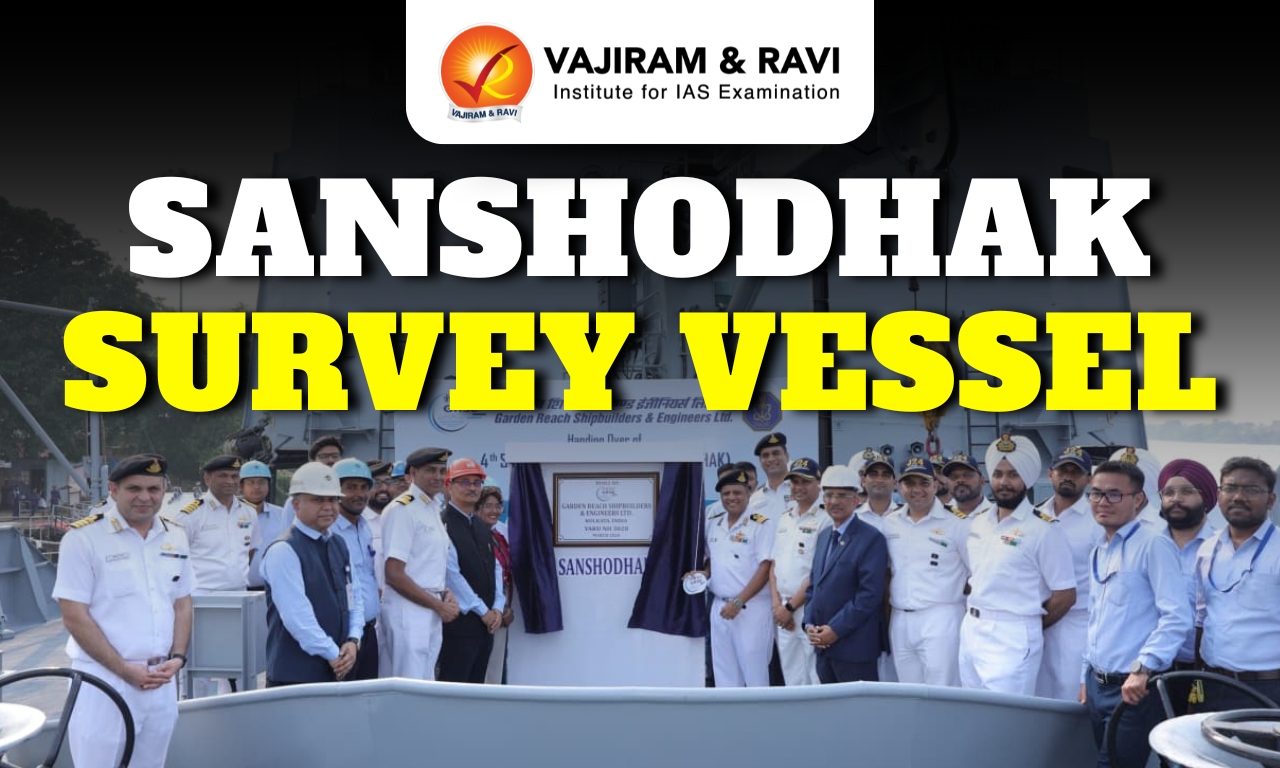
Recently, the Sanshodhak (Yard 3028) was delivered to the Indian Navy.

About Sanshodhak Survey Vessel

  • It is the fourth and final Survey Vessel (Large) built under a four-ship project at Garden Reach Shipbuilders & Engineers Ltd (GRSE) in Kolkata.
  • The contract for four Survey Vessel (Large) ships was signed on 30 Oct 2018. 
  • The previous ships of the same class, INS Sandhayak, INS Nirdeshak and INS Ikshak were commissioned.
  • The SVL ships are designed and built as per classification rules of Indian Register of Shipping by M/s Garden Reach Shipbuilders & Engineers Ltd (GRSE), Kolkata. 
  • Role: The ship is capable of full-scale coastal and deep-water Hydrographic survey of port/Harbour approaches and determination of navigational channels/ routes.
  • The ship's role also includes collecting oceanographic and geophysical data for defence and civil applications.

Features of Sanshodhak Survey Vessel

  • Capacity: It has displacement capacity of about 3400 tons 
  • It is fitted with state-of-the-art hydrographic equipment such as Data Acquisition and Processing System, Autonomous Underwater Vehicle, Remotely Operated Vehicle, DGPS long-range positioning systems, Digital Side Scan Sonar, etc.
  • Propulsion: It is powered by two diesel engines; the ship can achieve speeds in excess of 18 knots.
  • Sanshodhak has an indigenous content in excess of 80% by cost.

Source: PIB

Sanshodhak Survey Vessel FAQs

Q1: What is the primary purpose of Sanshodhak Survey Vessel?

Ans: Hydrographic survey

Q2: Which organization operates Sanshodhak Survey Vessel?

Ans: Indian Navy

Bio-Bitumen

Bio-Bitumen

Bio-Bitumen Latest News

Recently, the Council of Scientific and Industrial Research (CSIR) torganised a Technology Transfer Event for its innovative technology “Bio-Bitumen from Lignocellulosic Biomass – From Farm Residue to Roads” for large-scale industry adoption in New Delhi.

About Bio-Bitumen

  • It is made using non-petroleum-based renewable resources and can be made from vegetable oils, synthetic polymers, or both.
  • Materials used: Renewable organic materials, such as plant-based oils, agricultural waste, or biomass.
  • These materials undergo a special processing method to create a high-quality binder that is similar to traditional bitumen.
  • It is an alternative to petroleum-based bitumen that lowers both carbon emissions and import dependency,
  • Bio-bitumen production involves multiple steps, depending on the source material used.
  • Advantages
    • Sustainable: It is generated from renewable materials. This makes it a more environmentally friendly alternative to petroleum-based bitumen, which is derived from limited resources.
    • Low Carbon Footprint: As it is derived from organic materials that have absorbed carbon dioxide during their development, it often has a lower environmental impact than standard bitumen.
    • Improved environmental performance: It is less toxic and detrimental to the environment than regular bitumen. It contains fewer heavy metals and other hazardous pollutants.
  • Applications: It is versatile and may be utilised in a variety of applications, including road paving, roofing, and waterproofing.

Source: PIB

Bio-Bitumen FAQs

Q1: In which industry is Bio-Bitumen being explored for use?

Ans: Construction and road paving

Q2: Which of the following is a potential source of Bio-Bitumen?

Ans: Plant-based materials like vegetable oils or waste biomass

National Assessment and Accreditation Council

National Assessment and Accreditation Council (NAAC)

National Assessment and Accreditation Council Latest News

Not a single university or college has received fresh accreditation for the current academic year from the National Assessment and Accreditation Council.

About National Assessment and Accreditation Council

  • It was established in 1994 as an autonomous institution of the University Grants Commission (UGC).
  • Its primary objective is to ensure and enhance the quality of higher education through a rigorous accreditation process.
  • It conducts assessment and accreditation of Higher Educational Institutions (HEI) such as colleges, universities or other recognised institutions to derive an understanding of the ‘Quality Status’ of the institution. 
  • Parameters for Evaluation: NAAC evaluates institutions based on various parameters such as curricular aspects, teaching-learning processes, infrastructure, governance, and innovation. 
  • The NAAC functions through its General Council (GC) and Executive Committee (EC), comprising educational administrators, policymakers, and senior academicians from a cross-section of the Indian higher education system.
  • Composition: The Chairperson of the UGC is the President of the GC of the NAAC; the Chairperson of the EC is an eminent academician nominated by the President of the GC (NAAC). 
  • At present the Assessment and Accreditation by NAAC is done on a voluntary basis.
  • Headquarters: Bengaluru.

Source: NIE

National Assessment and Accreditation Council FAQs

Q1: When was NAAC established?

Ans: 1994

Q2: What is the primary objective of NAAC?

Ans: To assess and accredit higher education institutions

Spain

Spain

Spain Latest News

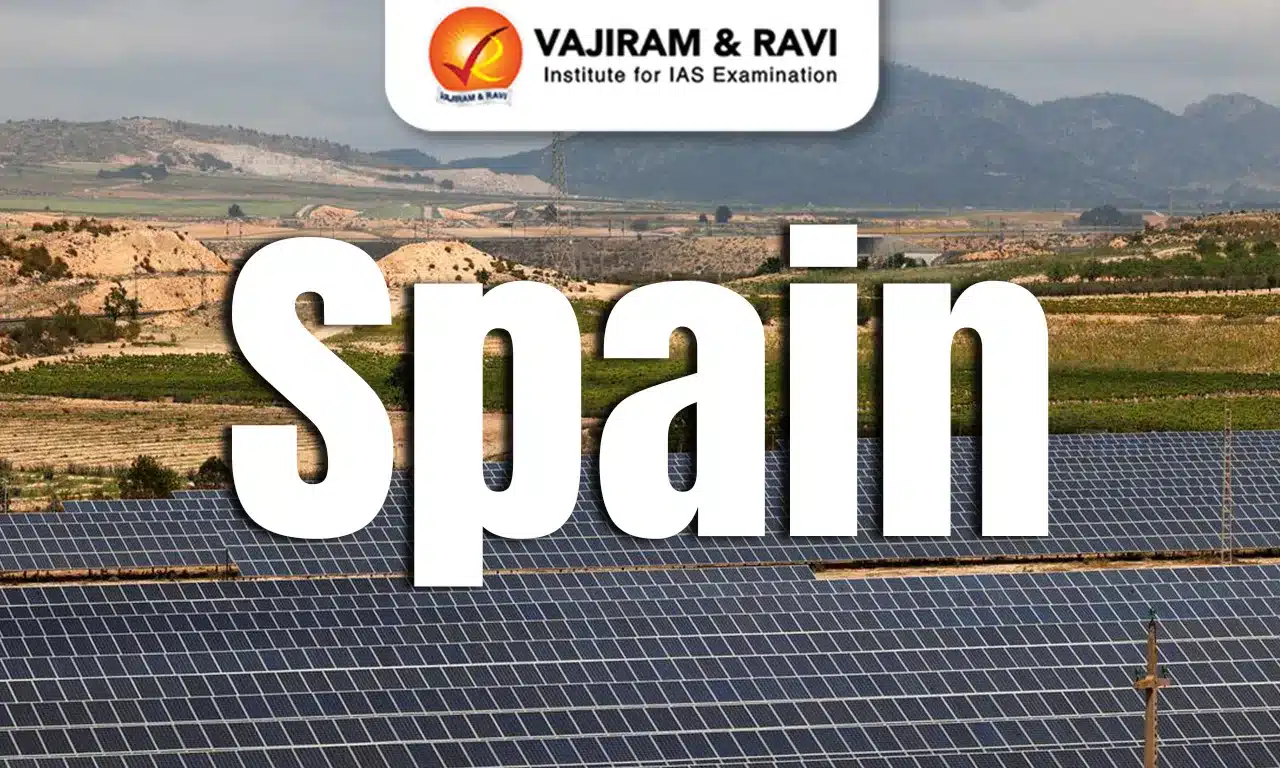
Recently, Spain has closed its airspace to American aircraft involved in military operations against Iran.

About Spain

  • Location: It is located on the Iberian Peninsula in southwestern Europe.
  • Bordering Countries: Spain shares its borders with Portugal (to the west), France and Andorra (to the northeast), and the British Overseas Territory of Gibraltar (to the south).
  • Maritime borders: Spain is bounded by the Mediterranean Sea (to the southeast and east), the Bay of Biscay (to the north), and the Atlantic Ocean (to the northwest and southwest).
  • Capital City: Madrid

Geographical Features of Spain

  • Mountain ranges: The Pyrenees Mountains form a natural barrier between Spain and France.
  • Plateaus: The Meseta Central is a vast interior plateau, dominating the central part of Spain.
  • Rivers: Spain is traversed by important rivers such as:
    • Ebro River – flows into the Mediterranean.
    • Tagus River – shared with Portugal.
  • Desert feature: Spain hosts the Tabernas Desert in Andalusia, recognized as the only true desert in mainland Europe.
  • Natural Resources: It mainly consists of copper, fluorspar, gypsum, iron ore, kaolin, lead, magnesite, mercury, pyrites, sepiolite, tungsten, uranium, and zinc.

Source: IE

Spain FAQs

Q1: What is the official language of Spain?

Ans: Spanish

Q2: What is the capital of Spain?

Ans: Madrid

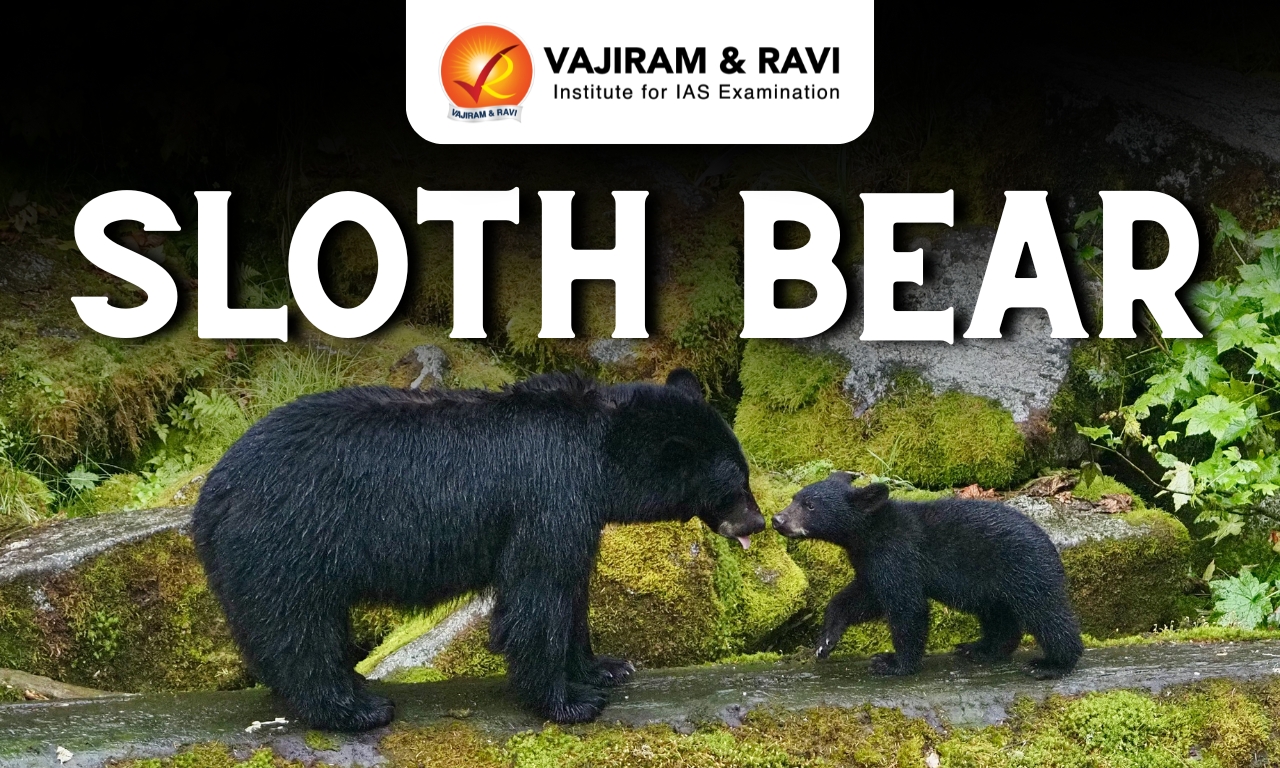
Sloth Bear

Sloth Bear

Sloth Bear Latest News

Recently, Karnataka Forest Department officials captured a sloth bear that had been roaming in villages around Shivamogga airport. 

About Sloth Bear

  • Sloth bears are one of the eight bear species found across the world.
  • They are myrmecophagous, meaning, they find bugs and termites to be their most sought after meal.
  • Appearance
    • They have long, shaggy dark brown or black fur and curved claws, which are the longest out of any of the bear species.
    • Sloth bears have been called "labiated bears" because of their long lower lip and palate used for sucking insects.
  • Habitat: They live in a variety of dry and moist forests and in some tall grasslands, where boulders, scattered shrubs and trees provide shelter.
  • Distribution: They mainly inhabit the region of India, Nepal, Sri Lanka and presumably Bhutan.
  • These bears are mostly nocturnal, foraging for food at night and resting in secluded locations
  • Sloth Bear Sanctuaries in India: Daroji Sloth Bear Sanctuary (Karnataka), Jessore Sloth Bear Sanctuary (Gujarat).
  • Conservation Status
    • IUCN: Vulnerable
    • CITES: Appendix I
    • Wildlife Protection Act, 1972: Schedule 1

Source: TH

Sloth Bear FAQs

Q1: What is the scientific name of Sloth Bear?

Ans: Melursus ursinus

Q2: Where are Sloth Bears primarily found?

Ans: India and Sri Lanka

Enquire Now