Shellear fish

Shellear fish

Shellear fish Latest News

Recently, scientists have confirmed that shellear fish climb vertical waterfall 15 metres (50 feet) tall in the Democratic Republic of Congo in a behaviour ​that illustrates the surprising and ingenious ways animals can adapt to extreme environments.

About Shellear fish

  • Shellear fish, whose scientific ‌name is Parakneria thysi.
  • It is found in the upper Congo Basin, (Particularly Luvilombo Falls on the Luvilombo River)
  • Habitat: It is a benthopelagic; freshwater species.
  • Size: These fish are tiny 37–48 mm-long that can grow up to a size of around 96 mm.
  • It scales the Luvilombo Falls in the upper Congo Basin.
  • Shellear's climbing abilities are made possible by tiny, hook-like projections on specialized pads on their pectoral and pelvic fins, along with hypertrophied muscles that enable them to carry their weight.
  • Why do they do it?
    • The researchers said the fish may climb upstream to find suitable living conditions and areas of the waterway with less competition and fewer predators.
  • The researchers identified two major human threats to the species:
    • Illegal fishing using fine-mesh mosquito nets that can easily catch the fish,
    • Water extraction for irrigation which has in some years depleted the Luvilombo River

Source: Reuters

Shellear fish FAQ's

Q1: What is a notable characteristic of Shellear Fish?

Ans: Rich in omega-3 fatty acids

Q2: Where is the Shellear Fish found in relation to the Congo Basin?

Ans: Upper Congo Basin

Oak Tree

Oak Tree

Oak Tree Latest News

Recently, the Uttarakhand High Court stayed the felling of oak trees in Mussoorie for construction by the Municipal Council.

About Oak Tree

  • Oak belongs to the genus Quercus in the Fagaceae family.
  • Geographic Range: Oaks are found in diverse habitats around the world, with a broad distribution in North America, Europe, Asia, and parts of Africa.
  • They can adapt to various climates, from temperate to subtropical regions.
  • These are the dominant, climax tree species of the moist temperate forests in the Indian Himalayan region.
    • In these regions, 35 species of oaks have been reported between 800 and 3,000 metres above sea level.
    • Oaks found in Uttarakhand are Banj oak, Moru oak, Kharsu oak, Rianj oak, and Phaliath oak.

Required Climatic Conditions for Oak Tree

  • Climate: Oaks thrive in a variety of climates but are commonly found in temperate zones. They can endure cold winters and warm summers.
  • Soil: Well-drained soil is essential for oaks. They can tolerate different soil types, including sandy, loamy, and clayey soils.

Ecological Role of Oak Tree

  • Conservation Service: The species are providers of numerous ecosystem services such as conservation of soil, water, native flora and fauna, and serve as a lifeline for the local communities.
  • Watershed Protection: Oak forests assist watershed protection by promoting the recharge of springs.
  • Biodiversity Support: Oak forests support a remarkably diverse web of life. Their trees host lichens, bryophytes, pteridophytes (all three being moss-like plants).

Source: IE

Oak Tree FAQ's

Q1: What kind of organisms do Oak Trees host?

Ans: Lichens, bryophytes, pteridophytes, orchids, and other flowering plants

Q2: What type of forest ecosystem do Oak Trees often support?

Ans: Temperate forest ecosystem with diverse web of life

Sanderling

Sanderling

Sanderling Latest News

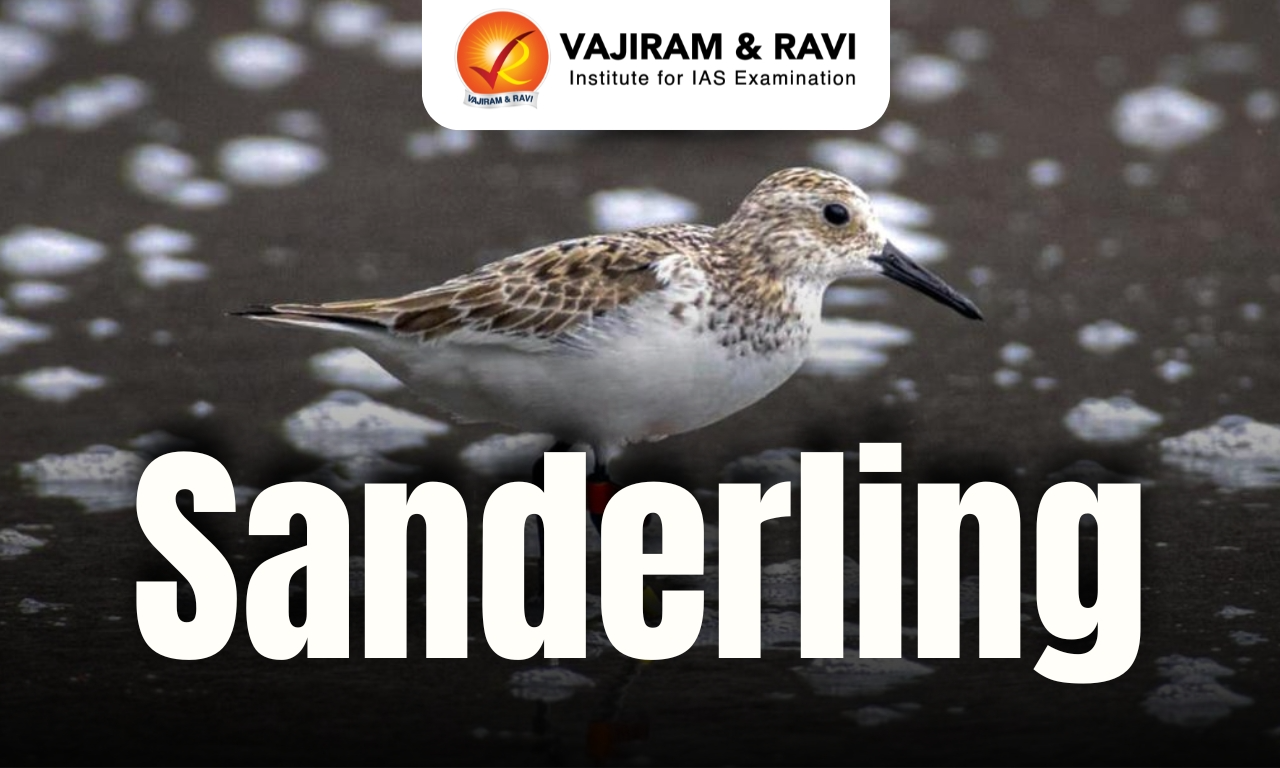
Recently, a tagged shorebird Sanderling that flew more than 7,400 km from South Australia has been spotted on the remote Narcondam Island in the Andaman and Nicobar archipelago.

About Sanderling

  • The sanderling (Calidris alba) is a small plump wading bird.
  • Its name comes from Old English sand-yrðling and means "sand-ploughman".
  • Appearance: During the winter the sanderling is very pale, almost white apart from a dark shoulder patch. Later in the summer, the face and throat become brick-red. 
  • Habitat: Its habitat ranges from moist sites with lots of vegetation to well-drained clay or gravel slopes, to the tops of stony ridges.
    • It can also be found on tidal sand flats, mud flats, and the shores of lakes and rivers. 
  • Distribution: It is mainly found in North America, Europe, Asia, South America, Africa, and Oceania.
  • Migration: These are complete migrants and travel between 3,000 to 10,000 km from their breeding grounds to their wintering sites.
  • Diet: Sanderlings are carnivores (mollusciovres, insectivores). They eat small crabs and other small invertebrates.
  • Threats: Loss of wetland habitats, pollution of the environment as well as the pollution from pesticides.
  • Conservation Status: IUCN Red List: Least Concern

Source: TH

Sanderling FAQ's

Q1: Where do Sanderlings typically breed?

Ans: Arctic tundra

Q2: What do Sanderlings primarily feed on?

Ans: Small invertebrates

Umred–Pauni–Karhandla Wildlife Sanctuary

Umred-Pauni-Karhandla Wildlife Sanctuary

Umred–Pauni–Karhandla Wildlife Sanctuary Latest News

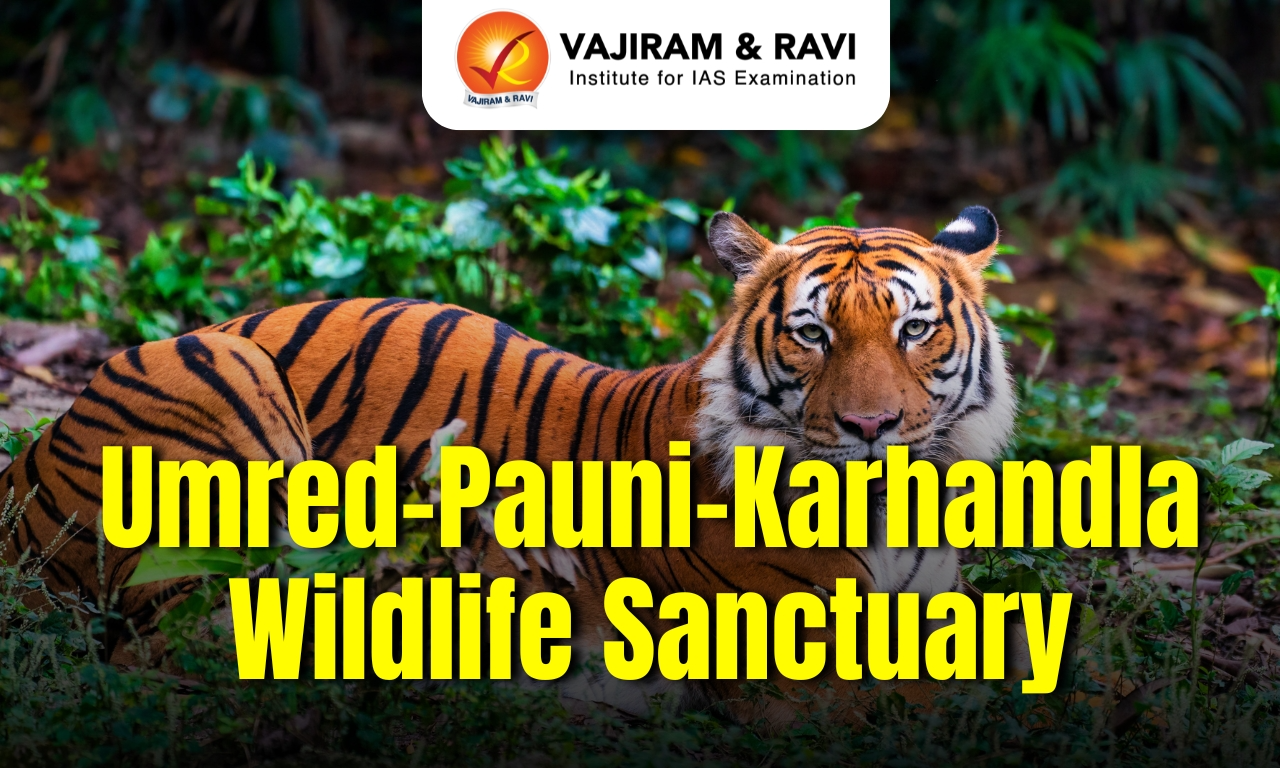
Recently, a melanistic (black-colored) spotted deer, commonly known as a chital, has been spotted at the Umred–Pauni–Karhandla Wildlife Sanctuary near Nagpur.

About Umred–Pauni–Karhandla Wildlife Sanctuary

  • Location: It is spread over Pauni tehsil in Bhandara district and Umred, Kuhi, and Bhivapur Taluka of Nagpur district in Maharashtra.
  • It was established in 2013 and is spread across an area of 189 sq. km. 
  • It is surrounded by the Wainganga River and the Gose Khurd Dam along the northeast boundaries of the sanctuary, while State Highway 9 and Bhiwapur Town bound the southern side.
  • The forest along the Wainganga River connects this sanctuary to the Tadoba Andhari Tiger Reserve
  • It lies 80 km from Pench Tiger Reserve and 50 kilometers southwest of Nagzira Wildlife Sanctuary.
  • Flora:
    • The forest is made up of teak, bamboo, tendu, mahua, and other indigenous tree species.
    • Teak makes up 60 percent of the crop composition. 
  • Fauna: The sanctuary is home to resident breeding tigers, herds of Gaur, wild dogs, and also rare animals like flying squirrels, pangolins, and honey badgers

Source: TLN

Umred–Pauni–Karhandla Wildlife Sanctuary FAQ's

Q1: Where is the Umred-Pauni-Karhandla Wildlife Sanctuary located?

Ans: Maharashtra

Q2: Which river forms the northeastern boundary of the sanctuary?

Ans: Wainganga River

Pradhan Mantri Mudra Yojana

Pradhan Mantri Mudra Yojana

Pradhan Mantri Mudra Yojana Lates News

Recently, the Pradhan Mantri Mudra Yojana (PMMY) — completed 11 Years of empowering Small and Micro Entrepreneurs.

About Pradhan Mantri Mudra Yojana

  • It was launched on April 8, 2015.
  • It is the Flagship Programme of the central government aimed at funding the Unfunded microenterprises and small businesses.
  • Any Indian citizen who has a business plan for a non-farm sector income generating activity such as manufacturing, processing, trading or service sector canavail loans under this yojana.

Features of Pradhan Mantri Mudra Yojana

  • MUDRA loans are being offered in four categories namely, ‘Shishu’, ‘Kishor’, ‘Tarun’ and ‘TarunPlus’
    • Shishu: covering loans upto Rs. 50,000/-
    • Kishor: covering loans above Rs. 50,000/- and up to Rs. 5 lakhs
    • Tarun: covering loans above Rs.5 lakh and upto Rs.10 lakhs
    • TarunPlus: covering loans above Rs.10lakh and upto Rs.20 lakhs
  • Loans cover term financing and working capital needs across manufacturing, trading and service sectors, including activities allied to agriculture like poultry, dairy, and beekeeping, etc.
  • These loans are given by Commercial Banks, RRBs, Small Finance Banks, MFIs and NBFCs. 
  • The interest rate is governed by RBI guidelines, with flexible repayment terms.
  • MUDRA, which stands for Micro Units Development & Refinance Agency Ltd, is a financial institution set up by the Government of India under PMMY for development and refinancing micro unit enterprises.

Source: PIB

Pradhan Mantri Mudra Yojana FAQs

Q1: Who is eligible for a loan under Pradhan Mantri Mudra Yojana?

Ans: Micro and small enterprises, including individuals and businesses

Q2: What is the primary objective of Pradhan Mantri Mudra Yojana?

Ans: Provide collateral-free loans to micro and small enterprises

Angola

Angola

Angola Latest News

Angola emerges as an important alternative to West Asia in gas supplies to India 

About Angola

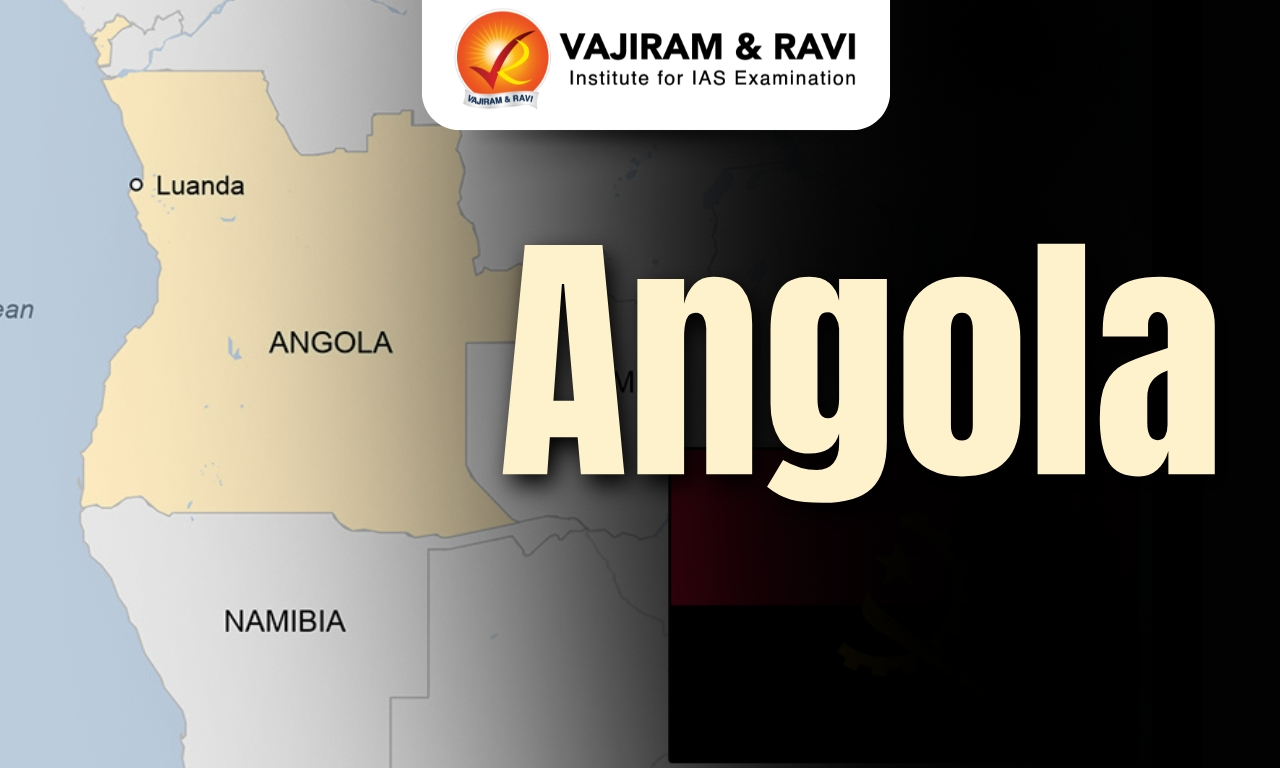
  • Location: It is located on the southwestern Atlantic Coast of Africa.
  • Bordering Countries: It is bordered by the Republic of the Congo (Northwest), Democratic Republic of the Congo (North & Northeast), Zambia (Southeast) and Namibia (South)
  • Maritime Boundary: It shares a border with the Atlantic Ocean.
  • Capital City: Luanda

Geographical Features of Angola

  • Climate: It has a tropical climate with a marked dry season. The climate is largely affected by the northward flow of the cold Benguela Current off the coast, and elevation.
  • Major rivers: Cuango River and Cuanza River, vital for hydropower and inland water transport.
  • Major Water Falls:  The largest is the Calandula Waterfalls (also known as the Kalandula Falls) on the Lucala River. 
  • Highest peak: Mount Moco, the tallest mountain in Angola.
  • Natural Resources: Petroleum, diamonds, iron ore, phosphates, copper, feldspar, gold, bauxite, uranium.

Source: THB

Angola FAQs

Q1: What is the capital of Angola?

Ans: Luanda

Q2: Where is Angola located?

Ans: Southern Africa

Telecom Regulatory Authority of India

Telecom Regulatory Authority of India

Telecom Regulatory Authority of India Latest News

The Telecom Regulatory Authority of India (TRAI) has released the Draft Telecom Consumer Protection (Thirteenth Amendment) Regulation, 2026.

About Telecom Regulatory Authority of India

  • It was established under the Telecom Regulatory Authority of India Act, 1997, passed by Parliament.
  • Mandate: To regulate telecom services in India, including tariff fixation/revision, this was earlier the domain of the Central Government.
  • TRAI's mission is to create and nurture conditions for growth of telecommunications in the country in a manner and at a pace which will enable India to play a leading role in emerging global information society.
  • Functions of TRAI
    • Scope of regulation: Covers areas like tariffs, quality of service, interconnection, spectrum management, and consumer protection in the telecom sector.
    • Policy role: Issues regulations, recommendations, and orders that guide telecom policy-making and market practices.
  • Composition of TRAI
    • Chairman: It consists of a Chairperson, a maximum of two full-time members, and two part-time members.
    • Tenure: Members serve for three years or until the age of 65 years, whichever is earlier.
    • Appointments are made by the Central Government.
  • The TRAI Act was amended by an ordinance, effective from 24 January 2000 and established a Telecommunications Dispute Settlement and Appellate Tribunal (TDSAT).
    • TDSAT was set up to adjudicate any dispute between a licensor and a licensee, between two or more service providers, between a service provider and a group of consumers, and to hear and dispose of appeals against any direction, decision or order of TRAI.

Source: News On Air

Telecom Regulatory Authority of India FAQs

Q1: What is the primary objective of the Telecom Regulatory Authority of India (TRAI)?

Ans: To regulate telecom services and ensure fair competition

Q2: When was TRAI established?

Ans: 1997

INS Sunayna

INS Sunayna

INS Sunayna Latest News

Recently, the Indian Navy’s offshore patrol vessel INS Sunayna reached Male as part of its deployment under the Indian Ocean Ship (IOS) SAGAR initiative.

About INS Sunayna

  • It is the second Saryu-class offshore patrol vessel of the Indian Navy.
  • It was designed and constructed indigenously by the Goa Shipyard Limited.
  • It was commissioned at Kochi on 15th October 2013. 
  • It is based under Southern Naval Command.
  • Functions: It is designed to undertake fleet support operations, coastal and offshore patrolling, ocean surveillance and monitoring of sea lines of communications and offshore assets, and escort duties.

Features of INS Sunayna

  • Propulsion: Two diesel engines propel INS Sunayna and enable it to achieve speeds in excess of 25 knots.
  • The ship also has an automatic power management system and is fitted with the latest navigation, communication, and electronic support systems.
  • Armament: The armament fit includes one 76 mm gun with an electro-optic fire control system, Close-in Weapon Systems (CIWS) and CHAFF launchers.
  • It can also carry a helicopter.

Source: DD News

INS Sunayna FAQs

Q1: What is the speed of INS Sunayna?

Ans: Over 25 knots

Q2: What is INS Sunayna?

Ans: A Saryu-class offshore patrol vessel

Poshan Pakhwada

Poshan Pakhwada

Poshan Pakhwada Latest News

The Ministry of Women and Child Development will commemorate the 8th edition of Poshan Pakhwada from 9th to 23rd April 2026.

About Poshan Pakhwada

  • It is celebrated in the month of March/April for 15 days. 
  • Aim: It aims to raise awareness about the importance of nutrition and promote healthy eating habits through Jan Andolan and Jan Bhagidari.
  • Nodal Ministry: Ministry of Women and Child Development
  • The theme for Poshan Pakhwada 2026 is “Maximizing Brain Development in the First Six Years of Life”,
  • The key focus areas under this year’s theme include:
    • Maternal and Child Nutrition: Promoting optimal nutrition during pregnancy, exclusive breastfeeding, and age-appropriate complementary feeding.
    • Early Stimulation for Brain Development (0–3 years): Encouraging responsive caregiving and early learning interactions.
    • Play-Based Education in Early Years (3–6 years) : Supporting holistic development and school readiness.
    • Role of Parents and Community in Minimising Screen Time: Promoting healthy habits and active engagement.
    • Strengthening Anganwadi Centres through Community Participation: Enhancing infrastructure and service delivery through Jan Bhagidari and CSR

 Source: PIB

Poshan Pakhwada FAQs

Q1: What is the theme of Poshan Pakhwada 2026?

Ans: Maximizing Brain Development in the First Six Years of Life

Q2: When is Poshan Pakhwada 2026 scheduled?

Ans: April 9-23

Enquire Now