ALH MK-III Helicopter

ALH MK-III Helicopter

ALH MK-III Helicopter Latest News

Recently, the Hindustan Aeronautics Limited (HAL) handed over four Advanced Light Helicopter (ALH) Mk III Maritime Role (MR) helicopters to the Indian Coast Guard.

About ALH MK-III Helicopter

  • It is the maritime variant of the indigenous Dhruv Advanced Helicopter.
  • These have been indigenously manufactured by Hindustan Aeronautics Limited (HAL).
  • Features of ALH MK-III Helicopter
    • It is a multi-role twin-engine helicopter equipped for demanding maritime operations.
    • It is equipped with advanced avionics, a modern glass cockpit, and night operation capability.
  • Uses: It is used for maritime surveillance, search and rescue, casualty evacuation, coastal security, law enforcement, VIP travel, troop transport, logistics, and anti-piracy.
  • Significance: The ALH Mk III (MR) significantly strengthens the Indian Coast Guard’s operational readiness across diverse maritime scenarios.

Key Facts about Indian Coast Guard

  • It is a maritime armed force operating under the Ministry of Defence, Government of India. 
  • It was raised on February 1, 1977.
  • It was formally established in 1978 by the Coast Guard Act, 1978 as an independent armed force of India.
  • Functions: The ICG was envisioned to address emerging maritime challenges and safeguard India’s expanding marine interests.
  • The Headquarters of the ICG is located in New Delhi, and is under the command of the Director General Indian Coast Guard.
  • Moto: “VAYAM RAKSHAMAH” – WE PROTECT.

Source: TH

ALH MK-III Helicopter FAQs

Q1: What is the primary role of the ALH MK-III helicopter?

Ans: Maritime reconnaissance and search and rescue

Q2: What is the engine type used in ALH MK-III helicopters?

Ans: Shakti-1H turboshaft engines
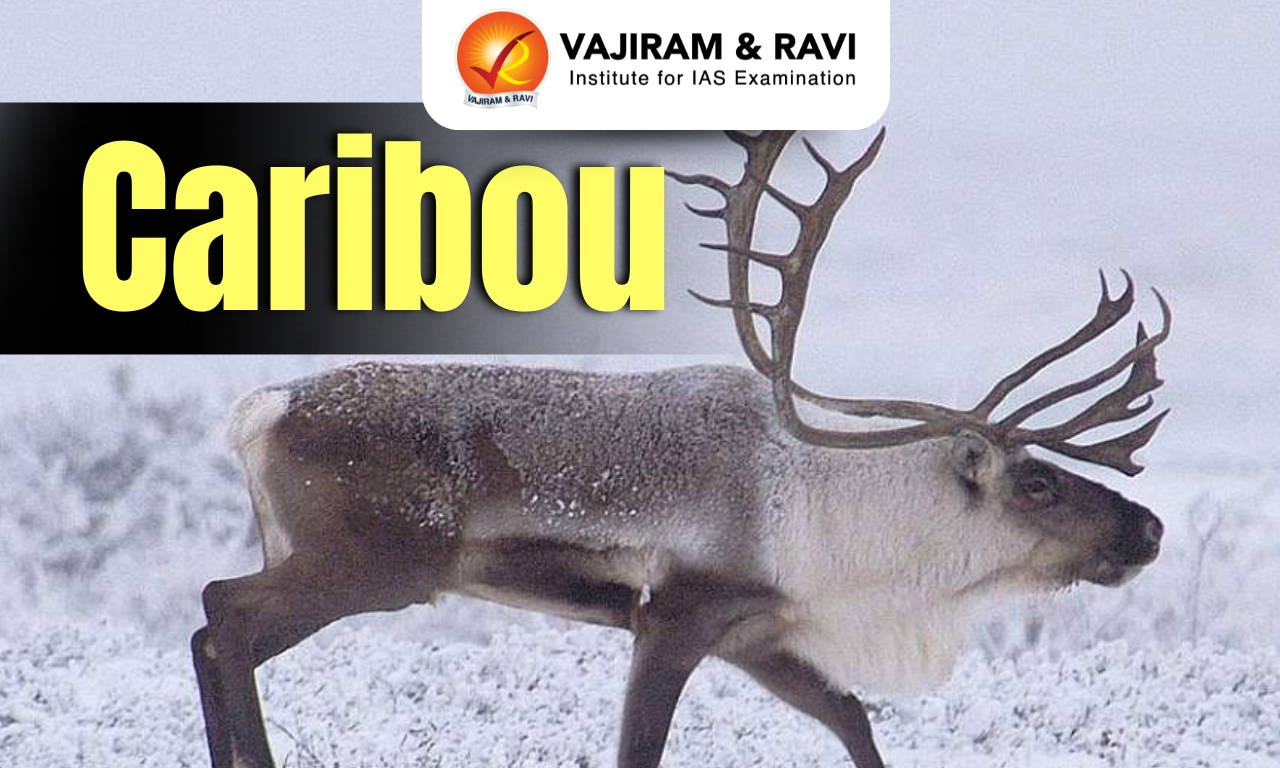
Caribou

Caribou

Caribou Latest News

According to a study by researchers Lichen continues to decline across the Arctic and caribou populations could struggle to survive the winter.

About Caribou

  • It is a species of cervidae or deer family. 
  • Scientific Name: Rangifer tarandus
  • Habitat: It survives in Arctic, subarctic, tundra, boreal, and mountainous regions.
  • Distribution: It is found in Greenland, Scandinavia, Russia, Alaska, and Canada. 
  • Features
    • Physical adoption: They have nasal turbinate bones which serve to increase the surface area in their nostrils. Cold air can thus be warmed up by their body heat prior to entering their lungs.
    • Both male and female caribou grow antlers, which they shed and regrow every year.
    • Diet: Caribou (called reindeer in Eurasia) are one of the few animals that can eat and digest lichen
    • Caribou dig through snow in a behavior known as 'cratering'
    • Migration: They travel distances that are greater than those traveled by any other terrestrial mammal.
    • They have the ability to see ultraviolet light – helps them to recognize predators in time and find food.

Conservation Status of Caribou

  • IUCN Red List: Vulnerable
  • Threats: Habitat destruction and Climate change

Source: DTE

Caribou FAQs

Q1: What do Caribou primarily eat?

Ans: Lichens and mosses

Q2: Where are Caribou primarily found?

Ans: It is found in Greenland, Scandinavia, Russia, Alaska, and Canada. 

Shree Chamundeshwari Temple

Shree Chamundeshwari Temple

Shree Chamundeshwari Temple Latest News

The Karnataka High Court has taken strong exception to the State defying judicial orders prohibiting construction activities in Sree Chamudeshwari Temple, Mysuru.

About Shree Chamundeshwari Temple

  • It is a Hindu temple located on the top of Chamundi Hills, about 13 km from the palace city of Mysuru in the state of Karnataka.
  • It is dedicated to Goddess Chamundeshwari, who is an avatar of Durga.
  • The original shrine is considered to be built by the Hoysala rulers from the 12th century and later by the Vijayanagara Empire in the 17th century.
  • Notable though are the 1000-odd, stone stairway steps that lead to the temple carved sometime in mid-17th CE by Maharaja Dodda Devaraja of Mysuru.
  • It is considered as Shakti Peetha and is one among the 18 Maha Shakti Peethas.

Shree Chamundeshwari Temple Architecture

  • The temple is of a quadrangular structure. 
  • Built in Dravidian style, it consists of the main doorway, entrance, Navaranga Hall, Antharala Mantapa, Sanctum Sanctorum, and Prakara.
  • There is a beautiful seven-tier Gopura, or pyramidal tower, at the entrance and a ‘Vimana’ (small tower) atop the sanctum sanctorum. 
  • The gopuram, adorned with colourful sculptures of gods, goddesses, and mythical figures, is visible from miles away.
  • The tower at the entrance has a small image of Lord Ganesha on the doorway.
  • The doorway is silver-plated and has the images of the Goddess in different forms.

Source: LL

Shree Chamundeshwari Temple FAQs

Q1: Where is the Shree Chamundeshwari Temple located?

Ans: It is located on the top of Chamundi Hills, about 13 km from the palace city of Mysuru in the state of Karnataka.

Q2: Who originally built the shrine of the Shree Chamundeshwari Temple?

Ans: The original shrine is considered to be built by the Hoysala rulers from the 12th century.

Q3: Who built the stone stairway leading to the Shree Chamundeshwari Temple?

Ans: The stairway was built by Dodda Devaraja Wodeyar.

Q4: What is the prominent feature at the entrance of the Shree Chamundeshwari Temple?

Ans: A seven-tier gopuram (pyramidal tower).

Canary Islands

Canary Islands

Canary Islands Latest News

A man has died and 27 others were injured after a bus carrying British tourists veered off a mountain road and crashed into a ravine in Spain’s Canary Islands.

About Canary Islands

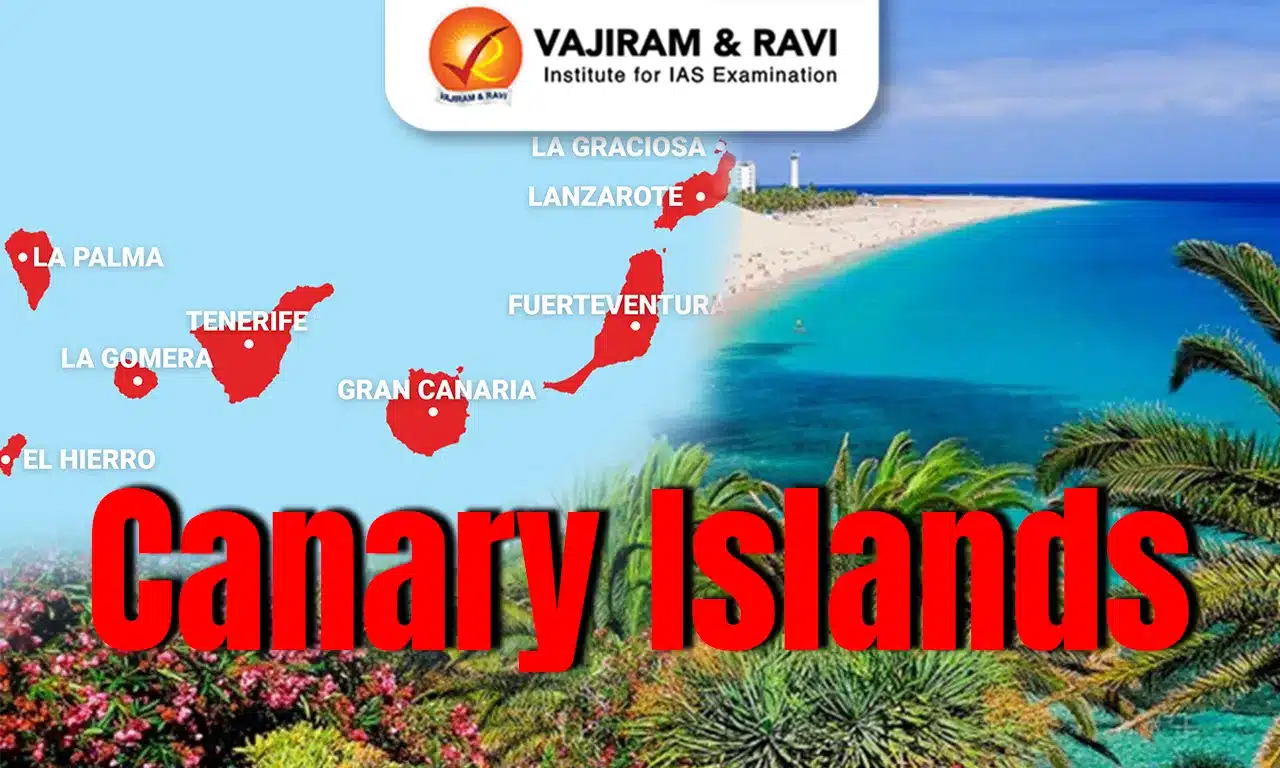
  • The Canary Islands are an archipelago located off the northwest coast of Africa in the Macaronesia region of the North Atlantic Ocean.
  • Geographically, the archipelago is part of continental Africa, but politically and economically it is part of Europe.
  • The archipelago is a Spanish territory and is its southernmost autonomous community. 
  • It is approximately 100 km from Morocco and southwest of Spain.
  • It is Macaronesia’s largest and most populated archipelago. 
  • Some of the largest islands in the archipelago are Lanzarote, Fuerteventura, Gran Canaria, and Tenerife.
  • Tenerife is the largest island, spanning 2,034 sq.km. It is the second-largest island in Spain and also Spain’s most populated island.
  • The Canary Islands’ capital, Santa Cruz de Tenerife, is located on the island. Tenerife also hosts Teide, Spain’s highest point.
  • The Canary Islands formed millions of years ago through volcanic eruption, and some of the volcanoes are still active. 
  • The archipelago is the only Spanish region where a volcanic eruption has taken place in the modern era.
  • Most beaches along the Canaries have black sand due to their volcanic composition.
  • Climate: Desertic and tropical, moderated by trade winds and the surrounding sea.
  • The islands’ location in the Atlantic Ocean and their proximity to four continents (Africa, Europe, and the Americas) make them a popular tourist destination.

Source: TOI

Canary Islands FAQs

Q1: What are the Canary Islands?

Ans: They are an archipelago located off the northwest coast of Africa in the North Atlantic Ocean.

Q2: Politically, the Canary Islands belong to which country?

Ans: They are a territory of Spain.

Q3: Which is the largest island in the Canary Islands?

Ans: Tenerife is the largest island.

Q4: What is the capital of the Canary Islands?

Ans: Santa Cruz de Tenerife is one of the capitals.

Woolly-Necked Stork

Woolly-Necked Stork

Woolly-Necked Stork Latest News

Rare sightings of the woolly-necked stork are being reported from the paddy fields near Thanjavur, Tamil Nadu.

About Woolly-Necked Stork

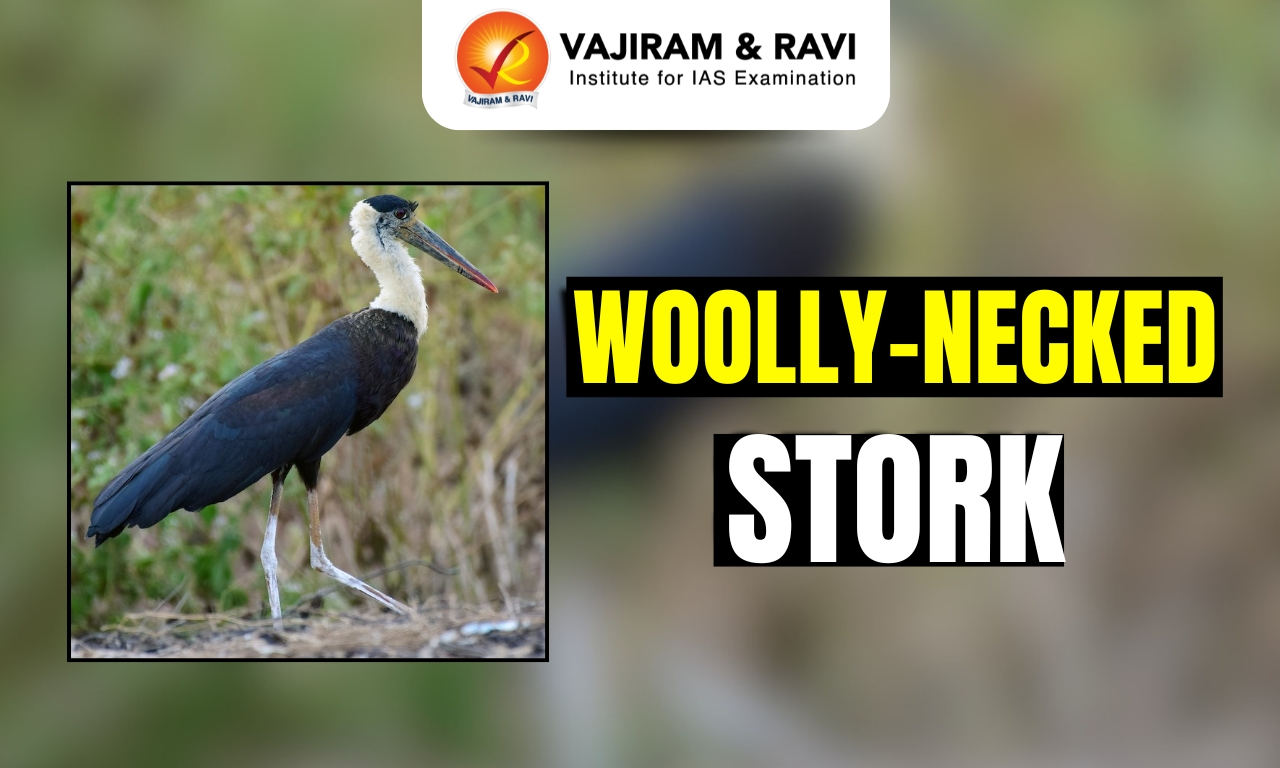
  • Woolly-Necked Stork,  also known as the White-necked Stork or Bishop Stork,  is a large wading bird belonging to the stork family, Ciconiidae.
  • Scientific Name: Ciconia episcopus

Woolly-Necked Stork Habitat and Distribution

  • It is a widespread tropical species, which breeds in Africa and in Asia from India to Indonesia.
  • In India, it is most commonly found in the northern states.
  • It typically inhabits open grasslands, paddy fields, riverbanks, ponds, and other wetland areas.

Woolly-Necked Stork Features

  • It is a broad-winged soaring bird, which relies on moving between thermals of hot air for sustained long-distance flight.
  • It is all black except for the woolly white neck and white lower belly. 
  • The upperparts are glossed dark green, and the breast and belly have a purple hue. 
  • Juvenile birds are duller versions of the adult. 
  • It breeds singly or in small loose colonies. 
  • It is predominantly carnivorous, its diet consisting of fish, frogs, toads, snakes, lizards, large insects and larvae, crabs, molluscs, and marine invertebrates. 
  • It forages by slowly walking through water or vegetation, stabbing at prey.

Woolly-Necked Stork Conservation Status

It is classified as 'Near Threatened' under the IUCN Red List.

Source: TOI

Woolly-Necked Stork FAQs

Q1: What is the Woolly-Necked Stork?

Ans: It is a large wading bird belonging to the stork family Ciconiidae.

Q2: Where is the Woolly-Necked Stork distributed?

Ans: It is found in Africa and Asia from India to Indonesia.

Q3: What type of habitats does the Woolly-Necked Stork prefer?

Ans: It inhabits open grasslands, paddy fields, riverbanks, ponds, and wetlands.

Q4: What is the distinctive feature of the Woolly-Necked Stork’s appearance?

Ans: It has an all-black body with a woolly white neck and white lower belly.

Q5: What is the conservation status of the Woolly-Necked Stork?

Ans: It is listed as IUCN Red List: Near Threatened.

Hwasong-11Ga

Hwasong-11Ga

Hwasong-11Ga Latest News

North Korea recently conducted a series of weapons tests including the launch of a Hwasong-11ga fitted with a cluster munition warhead.

About Hwasong-11Ga

  • The Hwasong-11Ga, known as the KN-23 in the West, is a short-range ballistic missile.
  • It was developed by North Korea.

Hwasong-11Ga Features

  • It is a single-stage, solid-fuel missile fitted with a cluster munition warhead.
  • It is approximately 7.3 meters long with a diameter of 0.9 meters. 
  • It can carry a nuclear, chemical, or conventional warhead weighing around 500 kg. 
  • With a range of 600-700 km and a circular error probable (CEP) of 5 to 30 meters, the missile is notably accurate. 

What Makes Cluster Bombs the ‘devil’s weapon’?

  • Cluster munitions are widely considered among the most controversial weapons in modern warfare. 
  • A single missile or bomb releases dozens to hundreds of smaller submunitions in mid-air, dispersing them across a wide target area.
  • This characteristic has earned them the nickname “devil’s weapon” due to their indiscriminate nature. 
  • Unlike conventional precision strikes, cluster bombs do not distinguish between military and civilian targets.
  • Many submunitions also fail to explode on impact, remaining on the ground as unexploded ordnance, posing long-term threats to civilians.

Source: TOI

Hwasong-11Ga FAQs

Q1: What is the Hwasong-11Ga?

Ans: It is a short-range ballistic missile (SRBM).

Q2: Which country developed the Hwasong-11Ga missile?

Ans: It was developed by North Korea.

Q3: What type of warhead is fitted on the Hwasong-11Ga?

Ans: It is fitted with a cluster munition warhead.

Q4: What is the range of the Hwasong-11Ga missile?

Ans: Its range is about 600–700 km.

Morchella Mushroom

Morchella Mushroom

Morchella Mushroom Latest News

Recently, the Sheri Kashmir University of Agriculture and Sciences (SKUAST) in Srinagar has cultivated the Morchella mushroom for the first time in controlled condition.

About Morchella Mushroom

  • It is an edible mushroom from the Ascomycota group.
  • Morels or Morchella is locally known as Kangaech or Gucchi mushroom.
  • It grows naturally in specific high elevation forest ecosystems during a narrow rainy season.
  • It traditionally belongs to the family morchellaceae of the Ascomycota.
  • Properties: It is a highly valued gourmet mushroom known for its intense and distinct flavour, superior nutritional profile and medicinal properties.
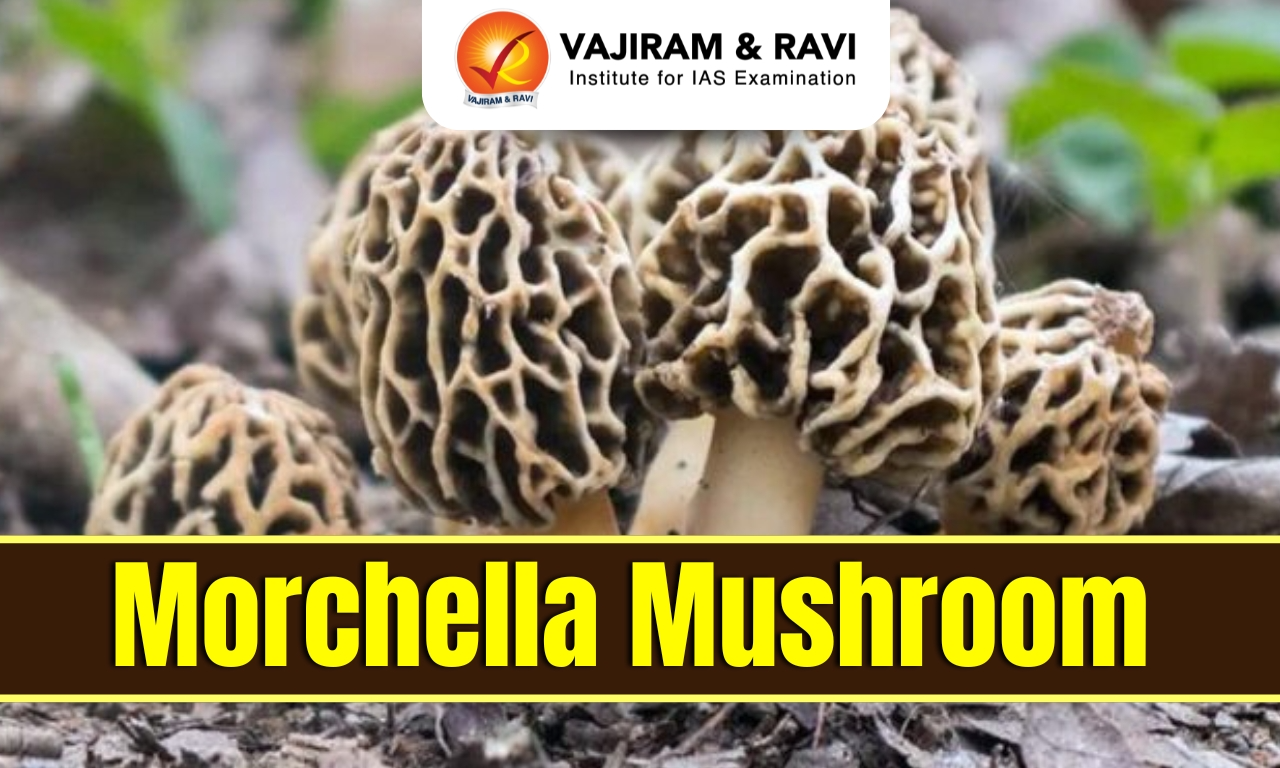
  • Appearance: They are pale yellow in colour with large pits and ridges on the surface of the cap, raised on a large white stem.
  • Climatic conditions for Growth: Ideal weather conditions for the great morel are daytime temperature is between 15 and 20 Celsius and night-time temperatures are in the five to nine.
  • Distribution: They grow in conifer forests across temperature regions, and the foothills in Himachal Pradesh, Uttaranchal, and Jammu and Kashmir. 
  • These mushrooms usually grow in clusters on logs of decaying wood, leaves or humus soil.
  • They may or may not grow in the same spot the next season, which only makes the process of collection more tedious.
  • It is known to be one of the most expensive mushrooms.

Source: IE

Morchella Mushroom FAQs

Q1: What is another name for Morchella mushroom?

Ans: Morel

Q2: What is unique about Morchella mushroom's appearance?

Ans: Its honeycomb-like cap

Methanol

Methanol

Methanol Latest News

Recently, the Deendayal Port Authority (Kandla Port) has advanced its methanol bunkering capabilities, positioning itself as a key player in India’s energy transition efforts and global green shipping corridors. 

About Methanol

  • It is also known as wood alcohol is the simplest alcohol (CH3OH).
  • Production
    • This fuel is generally produced by steam-reforming natural gas to create a synthesis gas. Feeding this synthesis gas into a reactor with a catalyst produces methanol and water vapor.
  • Properties
    • It appears as a colorless fairly volatile liquid with a faintly sweet pungent odor like that of ethyl alcohol.
    • It can completely mix with water.
    • It has a high-octane, clean-burning fuel that is a potentially important substitute for gasoline in automotive vehicles.
  • Applications: Used to make chemicals, to remove water from automotive and aviation fuels, as a solvent for paints and plastics, and as an ingredient in a wide variety of products.

Benefits of Methanol

  • Methanol can be an alternative to conventional transportation fuels.
  • Lower production cost: Methanol is cheap to produce relative to other alternative fuels.
  • Improved safety: Methanol has a lower risk of flammability compared to gasoline.
  • Increased energy security: Methanol can be manufactured from a variety of domestic carbon-based feedstocks, such as biomass, natural gas, and coal.

Source: PIB

Methanol FAQs

Q1: What is the primary method of methanol production?

Ans: Synthesis from syngas

Q2: What is methanol commonly used as?

Ans: Fuel and solvent

PACE Satellite

PACE Satellite

PACE Satellite Latest News

Researchers recently found that NASA’s PACE satellite can now detect nitrogen dioxide pollution at a fine enough scale to isolate emissions from individual factories and highway corridors.

About PACE Satellite

  • The Plankton, Aerosol, Cloud, and ocean Ecosystem (PACE) is a NASA satellite mission that studies global ocean biology, aerosols, and clouds. 
  • It was launched in February 2024 into a Sun-synchronous orbit.
  • It provides the world’s first and only hyperspectral coverage of the globe every 1-2 days.
  • PACE's primary instrument is the Ocean Color Instrument (OCI), a highly advanced optical spectrometer to measure the ocean’s colour across a spectrum from ultraviolet to shortwave infrared.
    • It enables continuous measurement of light at finer wavelength resolution than previous NASA satellite instruments, extending key system ocean color data records for climate studies.
  • It also features two polarimeters – the Spectro-polarimeter for Planetary Exploration (SPEXone) and the Hyper Angular Research Polarimeter (HARP2).
    • These are used to measure how the oscillation of sunlight within a geometric plane - known as its polarization - is changed by passing through clouds, aerosols, and the ocean.
  • The data from PACE allows researchers to study microscopic life in the ocean and particles in the air, advancing the understanding of issues including fisheries health, harmful algal blooms, air pollution, and wildfire smoke.
  • With PACE, scientists also can investigate how the ocean and atmosphere interact with each other and are affected by a changing climate.

Source: EARTH

PACE Satellite FAQs

Q1: Which organization launched the PACE satellite?

Ans: The PACE satellite was launched by NASA.

Q2: What is the primary objective of the PACE mission?

Ans: To study global ocean biology, aerosols, and clouds.

Q3: What is the primary instrument onboard PACE?

Ans: The primary instrument is the Ocean Color Instrument (OCI).

Q4: When was the PACE satellite launched?

Ans: It was launched in February 2024.

Mauritius

Key Facts about Mauritius

Mauritius Latest News

India and Mauritius concluded agreements to implement projects under a $680 million economic assistance package provided by New Delhi.

About Mauritius

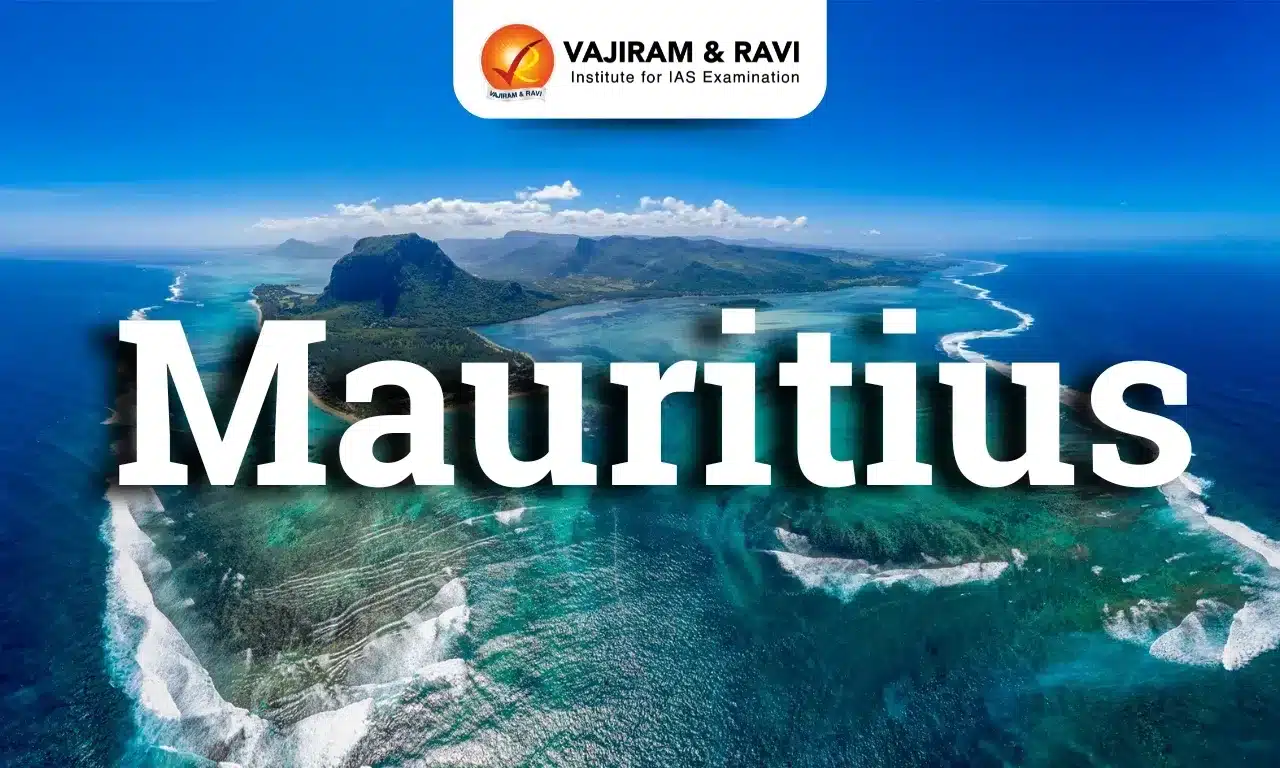
  • Location: It is an island country located off the southeast coast of Africa in the Indian Ocean.
  • It is a member of the Common Market for Eastern and Southern Africa (COMESA) and the Southern African Development Community (SADC).
  • Both the Indian Ocean Rim Association and the Indian Ocean Commission have their headquarters in Mauritius.
  • Capital City: Port Louis

Geographical Features of Mauritius

  • Terrain: It is made up of the main island of Mauritius and several outlying islands, like Ambre Island, Est Island, Cerfs Island, Benitiers Island, etc.
  • The island of Mauritius is a volcanic island formed by volcanic activity around 8 million years ago. 
  • Climate: The climate is maritime subtropical, with fairly uniform temperatures throughout the year.
  • Highest peak: Mount Piton, is located in the southwest of the plateau.
  • Lakes: Lake Vacoas, which is a main water source.
  • Major Rivers: Grand River South East and the Black River.

Source: HT

Mauritius FAQs

Q1: What is the capital of Mauritius?

Ans: Port Louis

Q2: Where is Mauritius located?

Ans: Indian Ocean, east of Madagascar

Enquire Now