Jute Crop

Jute Crop

Jute Crop Latest News

Recently, the government has reduced Jute Stock Limits for Raw Jute Traders and Balers to zero. 

About Jute Crop

  • The Jute crop is the second most important fibre crop in India after cotton.
  • It is a crop of humid tropical climates.
  • It is used in multiple ways like for making ropes, gunny bags, rugs, carpets, tarpaulins and many other products.

Required Climatic Conditions for Jute Crop

  • Climate: Relative humidity between 40-90%.
  • Soil: It can grow in a wide range of soil but fertile loamy alluvial soil is better suitable.
  • Temperature: Between 17° C and 41°C
  • Rain: It requires well distributed rainfall over 1200 mm which is ideal for cultivation and growth of jute.
  • Generally sown in February and harvested in October; the crop matures in 8–10 months.

Jute Distribution in India

  • Over 99% of India’s jute is produced in five states including West Bengal, Bihar, Assam, Odisha, and Andhra Pradesh.
  • West Bengal (81% share), Bihar, Assam, Odisha and Andhra Pradesh (delta regions are important contributors).

Source: News On Air

Jute Crop FAQs

Q1: Which organization is the nodal agency for MSP operation in jute?

Ans: Jute Corporation of India

Q2: Jute is known as which fibre?

Ans: Golden fibre
Salween River

Salween River

Salween River Latest News

Recent discoveries have indicated severe arsenic pollution along the Salween River, with unregulated mines in Myanmar, especially Shan State, being the prime suspects.

About Salween River

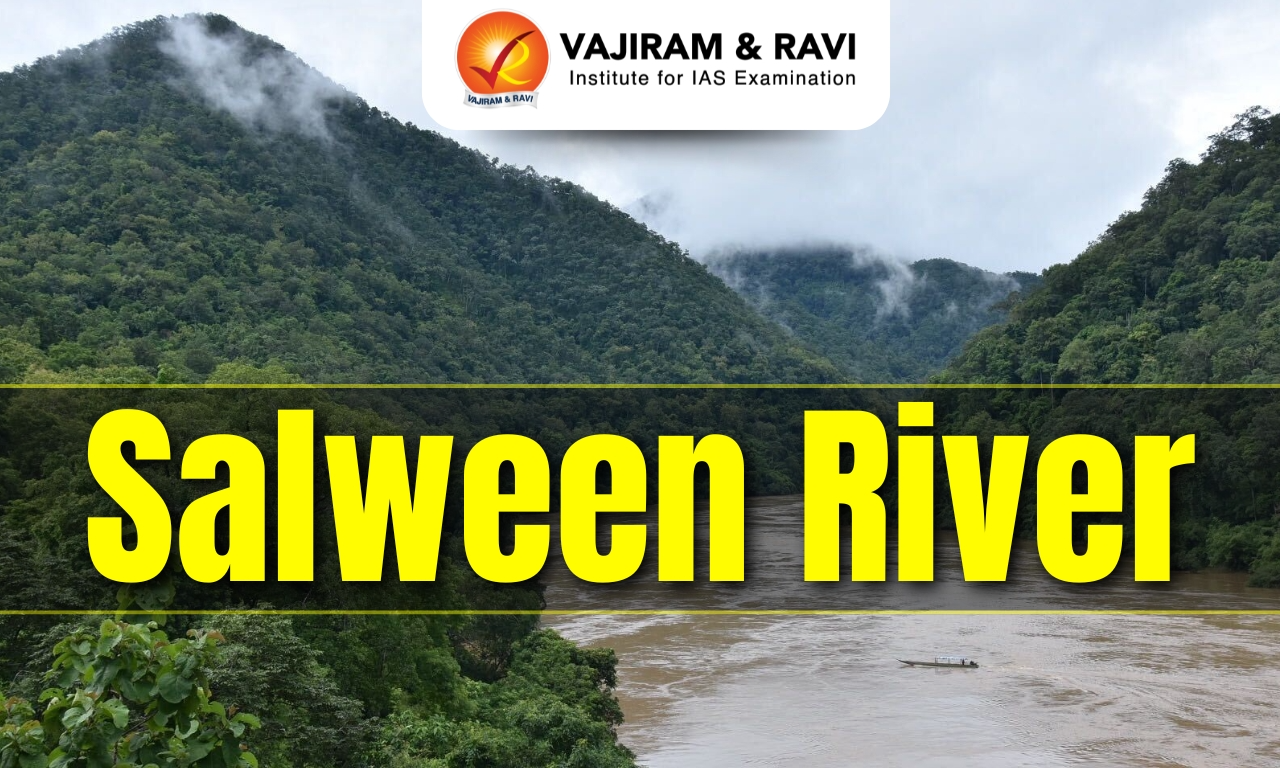
  • The Salween River, also known as the Nu River in China and Thanlwin River in Myanmar, is a transboundary river in Asia, shared by China, Thailand, and Myanmar. 
  • Approximately 2400 km long, it is the longest undammed/free-flowing river in mainland Southeast Asia.
  • Course
    • The Salween River originates approximately 4,000 m above sea level in the Tibetan range of the eastern Himalayas. 
    • The river passes through western Yunnan, China, Myanmar, and then forms the border between Myanmar and Thailand before it turns west and drains into the Gulf of Martaban in the Andaman Sea. 
  • The upstream portion of the Salween flows in parallel with two of Asia’s mightiest rivers, the Mekong and the Yangtze.
  • The location where three gorges carved by these rivers come together – the Three Parallel Rivers of Yunnan – was designated as a World Heritage Site by the UN in 2003.
  • Since Salween flows primarily through rugged terrain with dangerous rapids along its course, only small parts of the river are navigable by large water vessels. 
  • Its major economic use is in floating teak logs from the forests of southeastern Myanmar to the sea.
  • More than 10 million people live in the Salween basin, and the river is home to more than a dozen ethnic minorities. Some of the major groups include the Shan, Karen (or Kayin), Karenni (or  Kayah),  Wa,  Lisu,  Lahu,  Kokang,  Akha,  and  Hmong.
  • In the Salween basin, there are over 200 species of fish, a third of which are found nowhere else in the world.
  • It is believed to support over 25% of the world’s and over 50% of China’s animal species.

Source: TOI

Salween River FAQs

Q1: Which countries share the Salween River?

Ans: China, Myanmar, and Thailand.

Q2: What is the approximate length of the Salween River?

Ans: About 2400 km.

Q3: Where does the Salween River originate?

Ans: In the Tibetan region of the eastern Himalayas.

Q4: Into which water body does the Salween River drain?

Ans: Gulf of Martaban in the Andaman Sea.

Scarlet Fever

Scarlet Fever

Scarlet Fever Latest News

A DNA analysis of pathogens from a pre-Hispanic mummy revealed that the bacterium that causes scarlet fever and strep throat was present in the Americas prior to European colonization.

About Scarlet Fever

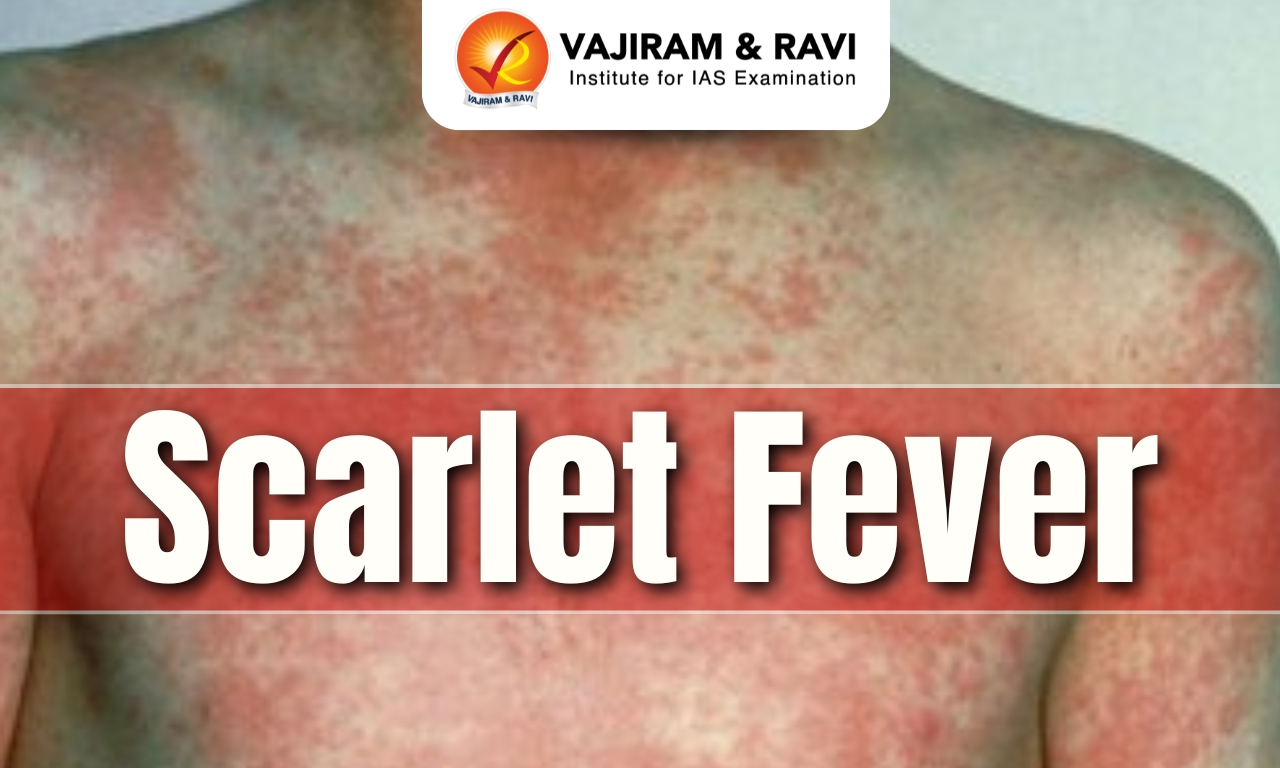
  • Scarlet fever, also known as scarlatina, is a bacterial infection caused by group A streptococci bacteria — the same type of bacteria that cause 'strep throat', skin infections (impetigo), wound infections, and rheumatic fever.
  • It is most common in children 5 to 15 years of age.
  • Scarlet fever features a bright red rash that covers most of the body. 
  • It almost always includes a sore throat and a high fever.
  • Scarlet Fever may also cause:
    • red bumps on the tongue (this can look like a strawberry) or a whitish coating on the tongue
    • headache
    • abdominal pain, nausea, and vomiting
    • very sore throat and tonsils — swallowing can be difficult
    • swollen glands in the neck
    • muscle aches and chills
  • If left untreated, scarlet fever can result in more-serious conditions that affect the heart, kidneys, and other parts of the body.
  • Is Scarlet Fever Contagious?
    • Yes, the bacteria that cause scarlet fever are contagious (spread from person to person). 
    • People who are infected can easily spread it by coughing or sneezing, which sends tiny droplets that contain the bacteria into the air.
    • People can get scarlet fever more than once.
    • There is no vaccine to prevent scarlet fever. 
  • Treatment
    • It is treated with antibiotics (usually penicillin). 
    • The fever will usually subside within 24 hours of starting antibiotics, but it is important to take the whole course to completely clear the germs from your throat.

Source: LS

Scarlet Fever FAQs

Q1: What causes scarlet fever?

Ans: Group A streptococci bacteria.

Q2: Which age group is most commonly affected by scarlet fever?

Ans: Children aged 5 to 15 years.

Q3: What is the characteristic rash of scarlet fever?

Ans: A bright red rash covering most of the body.

Q4: Is scarlet fever contagious?

Ans: Yes.

Q5: What is the standard treatment for scarlet fever?

Ans: Antibiotics, usually Penicillin.

R-37M Missile

R-37M Missile

R-37M Missile Latest News

In a major development for India’s air superiority, Moscow recently greenlit the sale of its formidable R-37M ultra-long-range air-to-air missile to New Delhi.

About R-37M Missile

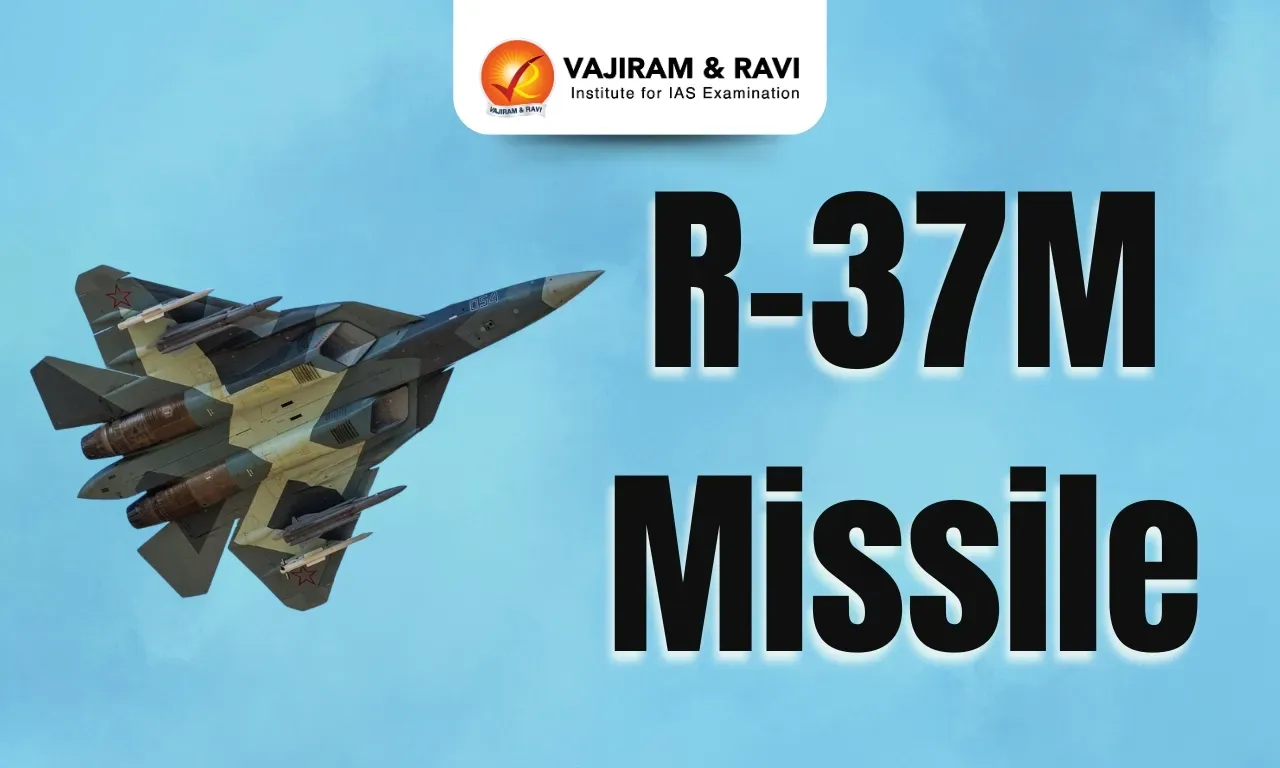
  • The R-37M missile, known by its NATO reporting name AA-13 Axehead, is a long-range air-to-air missile developed by Russia.
  • It is designed to eliminate enemy fighter jets and drones beyond visual range (BVR).
  • People often call the R-37M an “AWACS Killer” because it can go after large and important enemy aircraft. These include radar planes like AWACS, refuelling tankers, and even jamming aircraft that help enemy fighters. 
  • Indian engineers expect the missile to fit smoothly onto the IAF’s Su-30MKI fighters because the weapon is already approved for the Russian Su-30SM, which is almost the same type of aircraft.

R-37M Missile Features

  • Measuring approximately 4.2 metres long and weighing nearly 600 kilograms, the R-37M carries a 60-kilogram high-explosive fragmentation warhead intended for large airborne targets.
  • Its guidance architecture combines inertial navigation, mid-course data-link updates, and active radar homing during the terminal phase, allowing the launching aircraft to adjust targeting information dynamically.
  • It also employs a lofted trajectory profile, enabling the missile to climb before descending toward its target, thereby conserving energy and extending effective engagement range.
  • It features a jettisonable rocket booster that allows it to achieve a range of 300 to 400 kilometers, making it one of the longest-reaching air-to-air missiles in service globally.
  • Its speed can reach hypersonic levels, up to Mach 6, which is crucial for intercepting fast-moving targets. It is the world’s fastest known air-to-air missile class.

Source: DEF

R-37M Missile FAQs

Q1: What type of missile is the R-37M?

Ans: A long-range air-to-air missile.

Q2: Which country developed the R-37M missile?

Ans: Russia.

Q3: What is the NATO reporting name of the R-37M missile?

Ans: AA-13 Axehead.

Q4: What is the primary role of the R-37M missile?

Ans: To destroy enemy aircraft beyond visual range (BVR).

Q5: What is the range of the R-37M missile?

Ans: Approximately 300 to 400 kilometers.

Vishwa Sutra Initiative

Vishwa Sutra Initiative

Vishwa Sutra Initiative Latest News

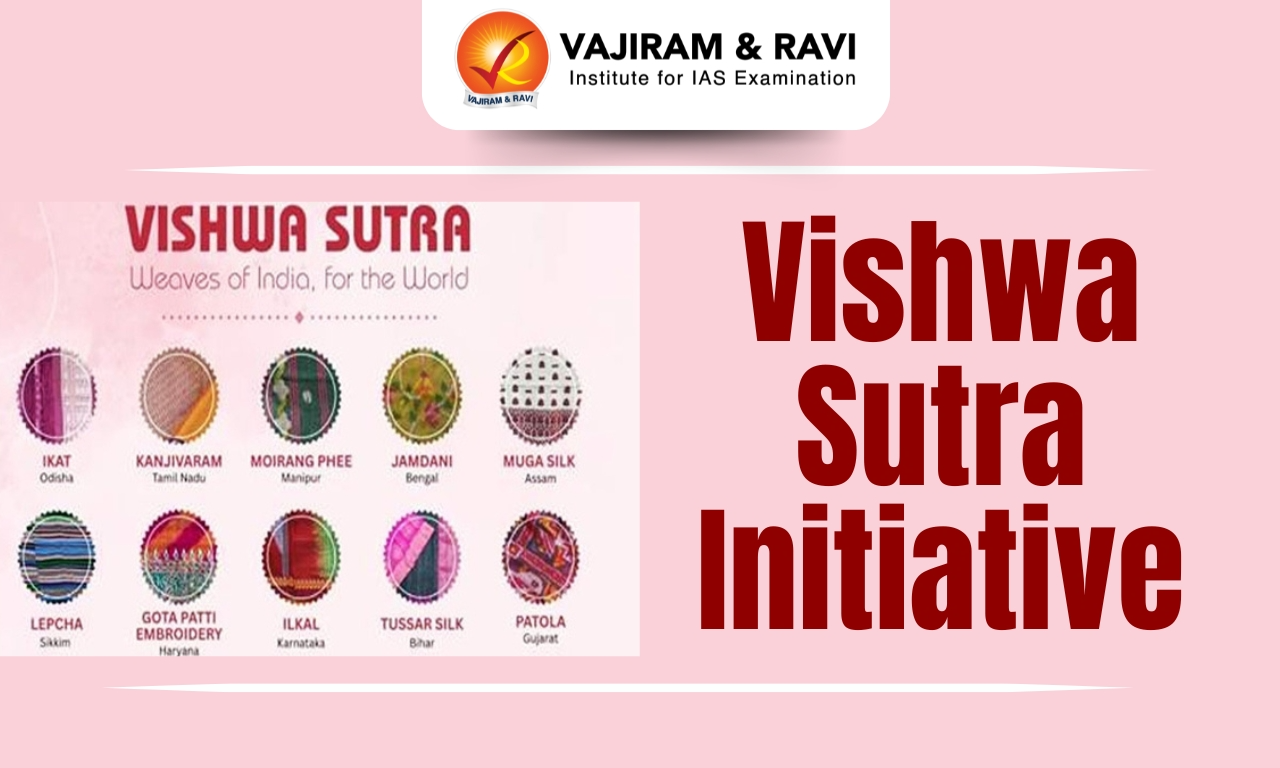
Recently, the Ministry of Textiles has launched an initiative called ‘Vishwa Sutra –  Weaves of India for the World’.

About Vishwa Sutra Initiative

  • It is an initiative of the Office of the Development Commissioner (Handlooms) in collaboration with the National Institute of Fashion Technology.
  • Aim: It aims to present Indian handlooms in a contemporary global design framework.
  • Under this initiative, 30 distinct handloom weaves from across the country have been brought together, each representing a different state.
  • These weaves have been creatively reinterpreted with design inspirations drawn from 30 countries, reflecting diverse cultures and modern fashion sensibilities.
  • It also reflects the depth and continuity of India’s handloom traditions—techniques preserved and refined across generations
  • Example: Odisha Ikat with Greek forms, Kanchipuram with Norwegian lines, Muga with Egyptian elements, Patola with Spanish influences, and Banarasi with UAE-inspired ensembles.
  • Significance
    • Vocal for Local to Global: It reflects the Government of India’s commitment to transforming traditional industries into globally competitive sectors.
    • 5F framework: It supports Farm to Fibre to Factory to Fashion to Foreign. 

Source: News On Air

Vishwa Sutra Initiative FAQs

Q1: What is the core aim of Vishwa Sutra initiative?

Ans: Make Indian handlooms globally relevant & design-forward while retaining authenticity

Q2: Which two organizations collaborated to develop Vishwa Sutra?

Ans: Office of Development Commissioner (Handlooms) and NIFT

SMILE Scheme

SMILE Scheme

SMILE Scheme Latest News

Recent data shows that for 2021-2026, ₹390 crore was allotted by the government for the SMILE scheme.

About SMILE Scheme

  • The Support for Marginalized Individuals for Livelihood and Enterprise scheme (SMILE) scheme is a Central Sector Scheme launched on 12th February 2022.
  • It includes two sub-schemes
    • Central Sector Scheme for Comprehensive Rehabilitation for Welfare of Transgender Persons’
    • ‘Central Sector Scheme for Comprehensive Rehabilitation of persons engaged in the act of Begging’.
  • This umbrella scheme covers several comprehensive measures including welfare measures for both transgender persons and persons who are engaged in the act of begging.

Features of the SMILE Scheme

  • Scholarships: It provides Scholarships for Transgender Students studying in IX and till  post-graduation to enable them to complete their education.
  • Skill Development and Livelihood: It has provisions for Skill Development and Livelihood under the PM-DAKSH scheme.
  • Composite Medical Health: Through Composite Medical Health it provides a comprehensive package in convergence with PM-JAY supporting Gender-Reaffirmation surgeries through selected hospitals.
  • Garima Greh: It provides shelter homes providing safe, dignified accommodation to transgender persons who face homelessness as a result of family rejection or social stigma.
  • Transgender Protection Cells: The Provision of Transgender Protection Cell in each state will monitor cases of offences and to ensure timely registration, investigation and prosecution of offences.
  • National Portal & Helpline: The National Portal & Helpline will provide necessary information and solutions to the Transgender community and the people engaged in the act of begging when needed.

Source: PIB

SMILE Scheme FAQs

Q1: What is the full form of SMILE scheme?

Ans: Support for Marginalized Individuals for Livelihood and Enterprise

Q2: What ministry launched the SMILE scheme?

Ans: Ministry of Social Justice and Empowerment

Umiam Lake

Umiam Lake

Umiam Lake Latest News

The Meghalaya government recently announced that Lumpongdeng Island in the middle of Umiam Lake will be kept out of the proposed luxury resort project, following protests and concerns raised by local stakeholders.

About Umiam Lake

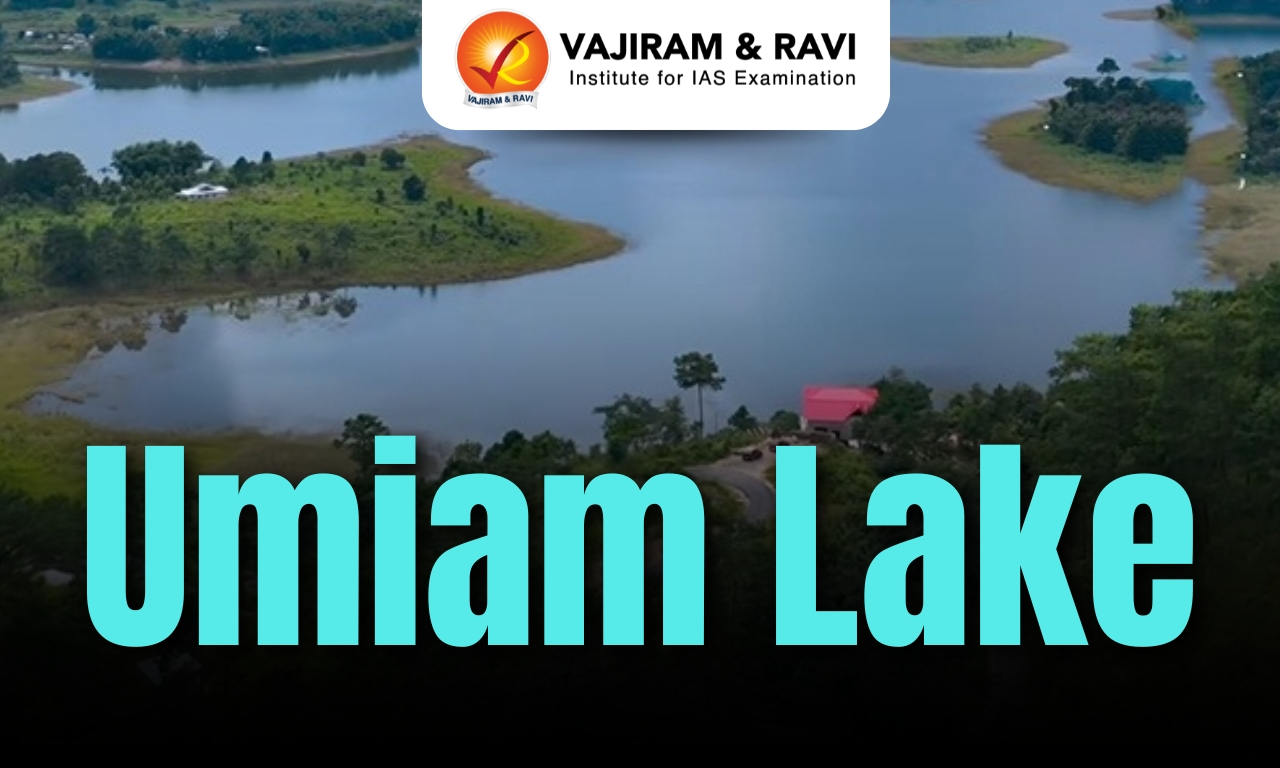
  • Umiam Lake, also known as Barapani Lake, is a man-made reservoir in the state of Meghalaya 15 km north of Shillong, the capital of Meghalaya.
  • It is encircled by lush green East Khasi hills.
  • History
    • It was created in 1965 as part of the Umiam Umtru Hydroelectric Power Project, which was the first hydroelectric project in Northeast India. 
    • The project was initiated by the Assam State Electricity Board (ASEB) with the assistance of the Government of India and the Canadian International Development Agency (CIDA).
    • The project involved the construction of a dam across the Umiam River, which is a tributary of the Brahmaputra River. 
    • The dam is 2200 feet long and 95 feet high. It has four turbines that generate 60 MW of electricity. 
  • Source of Water: The confluence of the two streams, Umkhrah and Umshvrpi, forms the Wah Ro-ro stream in the northwest of the town and joins River Umiam, the main source of water for the lake.
  • The principal catchment area of the lake and dam is spread over 220 square km, which includes Shillong and its adjoining areas.
  • It is a popular venue for the water sport and adventure facilities.

Source: TP

Umiam Lake FAQs

Q1: Where is Umiam Lake located?

Ans: In Meghalaya, about 15 km north of Shillong.

Q2: Which hills surround Umiam Lake?

Ans: East Khasi Hills.

Q3: Umiam Lake was created as part of which project?

Ans: Umiam Umtru Hydroelectric Power Project.

Q4: Umiam River is a tributary of which major river?

Ans: Brahmaputra River.

Market Intervention Scheme

Market Intervention Scheme

Market Intervention Scheme Latest News

Recently, the Union Agriculture Ministry announced the procurement of 20 lakh metric tonnes (LMT) of potatoes under the Market Intervention Scheme (MIS).

About Market Intervention Scheme

  • It is a component of the Pradhan Mantri Annadata Aay Sanrakshan Abhiyan (PM-AASHA).
  • It is implemented on the request of the State/UT Government for the procurement of various perishable agricultural commodities such as Tomato, Onion and Potato etc. for which Minimum Support Price (MSP) is not fixed 
  • Objective: To intervene in the market to protect the growers of their commodities from making distress sale in the event of a bumper crop during the peak arrival period when the prices tend to fall below economic levels and cost of production.
  • Pattern of Assistance: The amount of loss is shared on 50:50 basis between the Central government and the State government (on 75:25 basis in case of North-Eastern States)
  • Implementation: By Department of Agriculture and Farmers Welfare 
  • MIS will be implemented only when
    • There is a minimum reduction of 10% in the prevailing market price as compared to the previous normal year.
    • The procurement/coverage limit of production quantity of crops is 25 percent.

Source: TH

Market Intervention Scheme FAQs

Q1: Market Intervention Scheme is a component of which umbrella scheme?

Ans: PM-AASHA

Q2: What is the maximum procurement limit under MIS as per revised 2024 guidelines?

Ans: 25% of production

International Air Transport Association

International Air Transport Association

International Air Transport Association (IATA) Latest News

As per IATA’s Global Feedstock Assessment for SAF Production Outlook to 2050, India, U.S., Brazil and Europe were likely to dominate Sustainable Aviation Fuel (SAF) biomass feedstock for SAF with 105 million tonne (mt) available by 2030 and 154 mt by 2050 out of a total requirement of 500 mt.

About International Air Transport Association (IATA)

  • It is the global trade association of airlines (for both freight and passenger carriers) that regulates the aviation industry by developing standards, procedures, and practices.
  • It was founded in Havana, Cuba, on 19 April 1945.
  • It is the successor to the International Air Traffic Association, founded in the Hague in 1919.
  • It was created with the goal of promoting cooperation among airlines, as well as facilitating the development of regulations and procedures that ensure the safety, efficiency, and sustainability of air transport.
  • Although the formal regulation of international civil aviation is the responsibility of bodies such as the International Civil Aviation Organization (ICAO), IATA acts primarily as an industry association that develops operational standards and best practices widely adopted by airlines and logistics operators.
  • In practice, its activity focuses on three main areas:
    • Standardization of processes and documentation used in international air transport.
    • Development of technical regulations for the transport of goods, especially in sensitive areas such as dangerous goods or perishable products.
    • Financial cooperation and settlement systems that enable airlines to operate global transportation networks.
  • Members
    • At its founding, IATA had 57 members from 31 nations, mostly in Europe and North America. 
    • As of today, it has 350 airline members in 126 countries and territories, comprising around 82 percent of total air traffic.
  • Head Office: Montreal, Canada.

Source: TH

International Air Transport Association (IATA) FAQs

Q1: What is the primary role of International Air Transport Association (IATA)?

Ans: To develop standards, procedures, and practices for the aviation industry.

Q2: When was International Air Transport Association (IATA) founded?

Ans: It was founded in Havana, Cuba, on 19 April 1945.

Q3: How many airline members does International Air Transport Association (IATA) have today?

Ans: It has 350 airline members in 126 countries and territories, comprising around 82 percent of total air traffic.

Q4: Where is the headquarters of IATA located?

Ans: Montreal, Canada.

Enquire Now