
Binsar Wildlife Sanctuary

Binsar Wildlife Sanctuary

Binsar Wildlife Sanctuary Latest News

The forest department has begun preparations for a scientific wildlife census in Binsar Wildlife Sanctuary to assess the population and movement of key species, including tigers, leopards, bears, deer, and foxes.

About Binsar Wildlife Sanctuary

  • It is situated in the Kumaon region of the Himalayas, in the Almora district of Uttarakhand.
  • It is perched at an altitude ranging from 900 to 2,500 meters.   
  • From Zero Point, also known as Jhandi Dhaar, which is the highest point in the sanctuary, the Himalayan peaks of Kedarnath, Chaukhamba, Shivling, Trisul, and Nanda Devi, are visible among many others. 
  • Apart from protecting wildlife, the sanctuary was established with an aim to conserve the broadleaf oak forests, mainly located in the Central Himalayan region. 
  • History:
    • Binsar was the erstwhile summer capital of the Chand Dynasty rulers, who ruled Kumaon from the 7th to 18th century AD.
    • It was later converted to a summer retreat for British bureaucrats.
    • It is named after the Bineshwar Mahadev temple, a 16th-century temple dedicated to Lord Shiva. 
  • Flora: It is covered by oak and rhododendron forests at higher altitudes and by chir pine forests at a lower height.
  • Fauna:
    • It is home to Barking Deer, Himalayan bear, leopard, fox, musk deer, langur, porcupine, flying squirrel, chital, jungle cat, etc. 
    • It has been declared an Important Bird Area by Bird Life International, as there are more than 200 species of birds in the sanctuary, including Fork tail, Blackbirds, Laughing Thrush, Pheasant, Nuthatches, Parakeets, and Monal. 

Source: TOI

Binsar Wildlife Sanctuary FAQs

Q1: Where is Binsar Wildlife Sanctuary situated?

Ans: It is situated in the Kumaon region of the Himalayas in the Almora district of Uttarakhand.

Q2: What is the altitude range of Binsar Wildlife Sanctuary?

Ans: It is located at an altitude ranging from 900 to 2,500 meters.

Q3: Why was Binsar Wildlife Sanctuary established?

Ans: It was established to protect wildlife and conserve broadleaf oak forests of the Central Himalayan region.

Q4: Which dynasty used Binsar as its summer capital?

Ans: The Chand Dynasty used Binsar as its summer capital.
Melanoseris Pendryi

Melanoseris Pendryi

Melanoseris Pendryi Latest News

A team of botanists has discovered a new plant species in the Sikkim Himalayas named Melanoseris pendryi. 

About Melanoseris Pendryi

  • It is a new plant species found at altitudes over 4,000m in Sikkim.
    • Melanoseris is a genus of flowering plants belonging to the family Asteraceae.
    • Its native range is Iran to Southern Central China and Northern Central Indo-China, Java.

Features of Melanoseris Pendryi

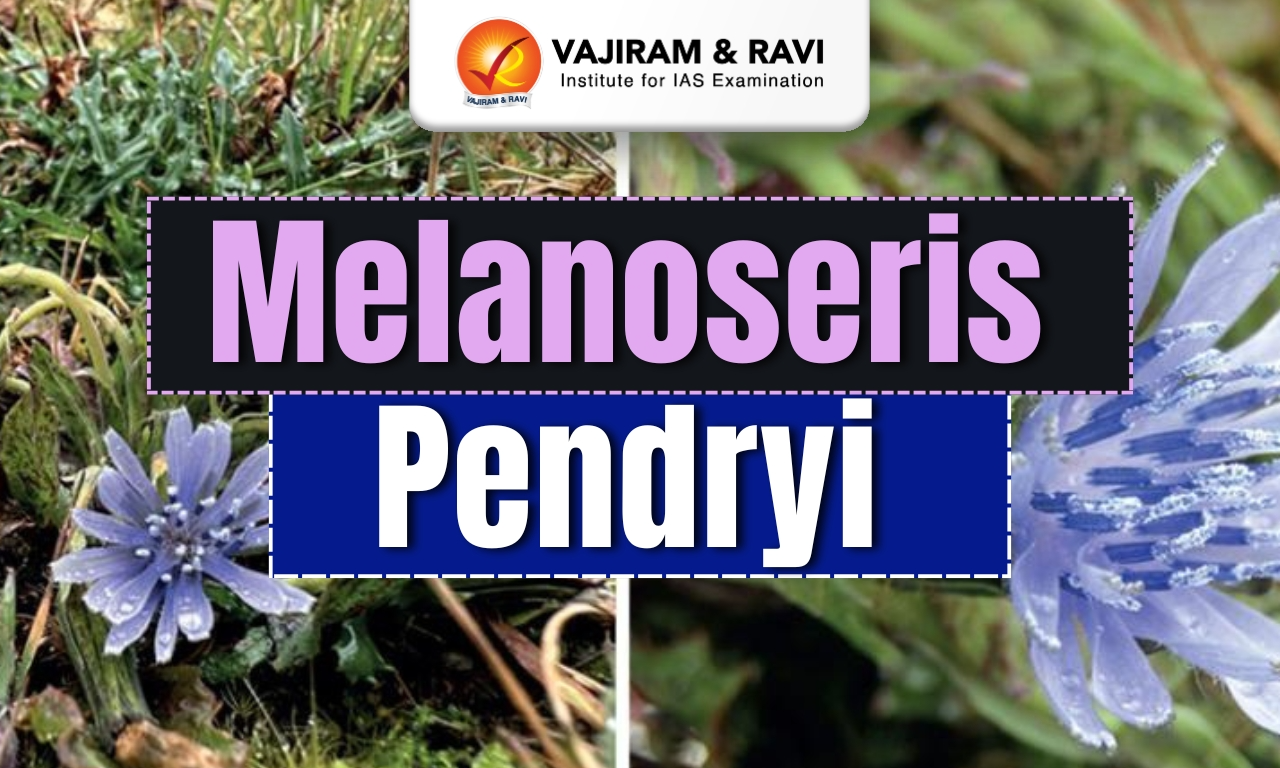
  • It has uniquely hairy purple petals high in the alpine grasslands of India.
  • It has lavender-coloured petals, known as ligules, which are covered in long, white hairs on their undersides.
  • It has a shorter reproductive tube and a distinctly stout seed structure,
  • It grows close to the ground amongst cushion-like shrubs, the plant relies on a fleshy, branching root system to survive the harsh alpine conditions.
  • Researchers have suggested it be classified as Critically Endangered due to habitat pressure from tourism and grazing.

Source: RM

Melanoseris Pendryi FAQs

Q1: Melanoseris pendryi is a newly discovered species of?

Ans: Alpine plant from Asteraceae family

Q2: Melanoseris pendryi was discovered in which Indian state?

Ans: Sikkim

Indian Ocean Rim Association

Indian Ocean Rim Association

Indian Ocean Rim Association Latest News

Recently, the 10th edition of the Indian Ocean Dialogue was organised by the Ministry of External Affairs in collaboration with the Indian Ocean Rim Association (IORA) Secretariat.

About Indian Ocean Rim Association

  • It was established in 1997 as an intergovernmental organisation of States on the rim of the Indian Ocean.
  • It was formerly known as the Indian Ocean Rim Initiative and the Indian Ocean Rim Association for Regional Cooperation (IOR-ARC).
  • Objectives of IORA 
    • To promote sustainable growth and balanced development of the region and member states.
    • To focus on those areas of economic cooperation which provide maximum opportunities for development, shared interest and mutual benefits.
    • To promote liberalisation, remove impediments and lower barriers towards a freer and enhanced flow of goods, services and investment within the Indian Ocean Rim.
  • Member countries
    • It has members from Africa, West Asia, South Asia, Southeast Asia,Europe and Oceania.
    • It currently comprises 23 member states and 12 dialogue partners.
    • Asia: India, Bangladesh, Indonesia, Iran, Malaysia, Maldives, Oman, Singapore, Sri Lanka, Thailand, United Arab Emirates and Yemen.
    • Africa: Kenya, Madagascar, Mozambique, Somalia , South Africa, Tanzania, Comoros, Mauritius, Seychelles.
    • Oceania: Australia.
    • Europe: France
    • Dialogue Partners: China, Egypt, the European Union, Germany, Italy, Japan, Russia, Saudi Arabia, South Korea, Türkiye, the United Kingdom, and the United States.
  • Six priority areas of IORA: Trade and Investment, Maritime Safety and Security, Fisheries Management, Disaster Risk Management and Blue Economy. 
  • Governance of Indian Ocean Rim Association 
    • Its apex body is the Council of Foreign Ministers (COM) which meets annually.
    • The secretariat is based in Ebène Mauritius and is overseen by a secretary-general who is appointed for a three-year period.

Source: MEA

Indian Ocean Rim Association FAQs

Q1: IORA was established in which year?

Ans: 1997

Q2: Where is the IORA Secretariat located?

Ans: Ebene, Mauritius

International Fund for Agricultural Development, Membership, Latest News

International Fund for Agricultural Development

International Fund for Agricultural Development Latest News

Recently, the Government of India and International Fund for Agricultural Development (IFAD) launched a new eight-year Country Strategic Opportunities Programme (COSOP) for 2026–2033. 

About International Fund for Agricultural Development

  • It is an international financial institution and a specialized agency of the United Nations.
  • It was established as an international financial institution in 1977 through United Nations General Assembly Resolution.
  • Objective: It is dedicated to eradicating poverty and hunger in rural areas of developing countries.
  • IFAD is the only UN agency exclusively dedicated to transforming agriculture, rural economies and food systems.
  • It seeks to empower rural people to increase their food security, improve the nutrition of their families.
  • Its projects and programmes are carried out in remote and environmentally fragile locations, including least-developed countries and Small Island developing States.
  • It is a member of the United Nations Development Group (UNDP).
  • Grants: IFAD extends two types of grants, depending on the nature of the innovation and the scope of intervention: global or regional grants and country-specific grants.
    • IFAD grants support research, innovation, institutional change, and pro-poor technologies.
  • Membership: Currently, IFAD has 180 Member States, including India. (India is a founding member of IFAD).
  • Governance: Its Governing Council is the highest decision-making body which meets every three years.
  • Headquarter: Rome, Italy.

What is the Country Strategic Opportunities Programme (COSOP)?

  • It is aimed at strengthening rural incomes, improving resilience and expanding sustainable livelihood opportunities across India.
  • It focuses on two major priorities
    • Enhancing the social, economic and climate resilience of rural communities
    • Strengthening knowledge systems to scale successful development models across India and other countries of the Global South.
  • Time Period: for 2026–2033

Source: DD News

International Fund for Agricultural Development FAQs

Q1: Where is IFAD headquartered?

Ans: Rome

Q2: What is the main focus of IFAD?

Ans: Smallholder farmers & rural poverty

National Florence Nightingale Award

National Florence Nightingale Awards

National Florence Nightingale Award Latest News

Recently, the President of India conferred the National Florence Nightingale Awards for the year 2026.

About National Florence Nightingale Award

  • It was instituted by the Ministry of Health and Family Welfare, Government of India in the year 1973.
  • It is a prestigious award given to outstanding nursing personnel employed in Central, State/UTs and Voluntary Organizations.
  • It honours the dedication, compassion, and resilience of the nursing profession.
  • These prestigious awards are presented to Registered Nurses, Midwives, Auxiliary Nurse Midwives, and Lady Health Visitors serving across Central and State Governments, Union Territories, and voluntary organizations.
  • Award: Each award includes a Certificate of Merit, a cash prize of ₹1,00,000, and a medal

Who is Florence Nightingale?

  • Florence Nightingale was an English social reformer, statistician and the founder of modern nursing.
  • Nightingale came to prominence while serving as a manager and trainer of nurses during the Crimean War, in which she organised care for wounded soldiers at Constantinople.
  • Contribution: Her efforts to formalize nursing education led her to establish the first scientifically based nursing school—the Nightingale School of Nursing, at St. Thomas’ Hospital in London.

Source: PIB

National Florence Nightingale Award FAQs

Q1: National Florence Nightingale Award is given by which ministry?

Ans: Ministry of Health & Family Welfare

Q2: National Florence Nightingale Awards are announced on?

Ans: International Nurses Day (12 May)

National Technology Day

National Technology Day

National Technology Day Latest News

The Prime Minister recently greeted people on National Technology Day.

About National Technology Day (NTD)

  • It is celebrated in India on May 11 every year, commemorating the successful nuclear tests conducted at Pokhran in 1998. 
  • This day also acknowledges the country's scientific achievements and technological advancements, honouring the contributions of scientists, engineers, and innovators. 
  • History:
    • On May 11, 1998, India marked a significant milestone with successful nuclear tests at the Pokhran range in Rajasthan, led by Dr. A.P.J. Abdul Kalam. 
    • India conducted three underground nuclear tests on May 11, followed by two additional tests on May 13. 
    • These tests, known as Operation Shakti, established India as the sixth country to join the 'Nuclear Club'.  
    • On the same day, India performed a successful test firing of the Trishul Missile (a surface-to-air short-range missile) and had test-flown the first indigenous aircraft, ‘Hansa – 3’.
  • The day was officially declared by then Prime Minister Atal Bihari Vajpayee in 1998, and since 1999, it has been celebrated as NTD.
  • Every year, the Technology Development Board of India (a statutory body under the Ministry of Science and Technology) celebrates the day by awarding individuals with the National Award for their contribution to science and technology in India.
  • NTD 2026 Theme: ‘Responsible Innovation for Inclusive Growth’

Source: TH

Enquire Now