Anaimangalam Copper Plates

Anaimangalam Copper Plates

Anaimangalam Copper Plates Latest News

The Netherlands returned the 11th-century Anaimangalam Copper Plates (Leiden Plates) to India during the Prime Minister’s recent visit, restoring a monumental Chola-era record of maritime trade and religious pluralism.

About Anaimangalam Copper Plates

  • The Anaimangalam Copper Plates, also known as the Leiden Plates, are 11th-century inscriptions associated with the Chola Empire. 
  • The plates are 21 in number and weigh about 30 kg. They are held together by a bronze ring locked with the royal seal of Rajendra Chola I. 
  • The inscriptions on the copper plates date to the reign of Emperor Rajaraja Chola I (985–1014 CE) and his son Rajendra.  
  • The plates are divided into two sections: one has texts in Sanskrit; the other, in Tamil. 
    • The initial plates are in Sanskrit, offering a detailed genealogy of the Chola rulers and linking them to mythological figures.
    • The majority of plates are in Tamil, documenting administrative and grant details. 
  • The Tamil section records Rajaraja’s grant of land revenues and taxes to the Chudamani Vihara, a Buddhist monastery in Nagapattinam. 
    • The monastery was built by Sri Mara Vijayotunga Varman, the ruler of the Srivijaya kingdom in present-day Indonesia
    • The land grants were originally issued by Rajaraja Chola I, but his son, Emperor Rajendra Chola I, later had the order engraved onto the copper plates to preserve it.  
  • The inscriptions provide a rare insight into the maritime links, religious pluralism, and cultural exchanges that existed between South India and Southeast Asia during the peak of the Chola period.  
  • The plates’ journey abroad began around 1700 when Dutch missionary Florentius Camper acquired them during the Dutch East India Company’s control of Nagapattinam. 
  • They eventually found their way to Leiden University Library, Netherlands, where they have been studied by scholars but are largely inaccessible to the public.

Source: WION

Anaimangalam Copper Plates FAQs

Q1: What are the Anaimangalam Copper Plates?

Ans: The Anaimangalam Copper are 11th-century inscriptions associated with the Chola Empire.

Q2: What are the Anaimangalam Copper Plates also known as?

Ans: The Leiden Plates.

Q3: How many copper plates are there in the Anaimangalam collection?

Ans: 21 plates.

Q4: What does the Sanskrit section of Anaimangalam Copper Plates contain?

Ans: The genealogy of the Chola rulers and links to mythological figures.

Q5: What does the Tamil section of the Anaimangalam Copper Plates mainly record?

Ans: Administrative and land grant details.

Red-Necked Falcon

Red-Necked Falcon

Red-Necked Falcon Latest News

Recently, a rare Red-necked falcon was sighted in Kawal Tiger Reserve. 

About Red-Necked Falcon

  • The red-necked falcon (Falco chicquera ) is a bird of prey in the falcon family.
  • It has two disjunctive populations, one in India and the other in Africa.
  • Appearance: It is a medium-sized bird of prey recognised for its distinctive reddish-brown crown and neck, bluish-grey upperparts, sharp talons, and agile flight.
  • Habitat: The species is usually found in open woodlands, dry deciduous forests, scrublands, and agricultural fields.
  • Distribution: India up to Himalayan foothills and terrai; Nepal, Pakistan and Bangladesh, South of Sahara in Africa.
  • Characteristics
    • It is known for its hunting abilities. It usually hunts in pairs, often at dawn and dusk.
    • They are mostly resident but may make nomadic movements in response to weather. 
    • Diet: It feeds on small birds, insects, reptiles, and rodents.
  • Threats: Habitat degradation, deforestation, pesticide usage, and disturbance in nesting areas are among the major threats.
  • Conservation Status
    • IUCN: Near Threatened

Source: TT

Red-Necked Falcon FAQs

Q1: Wildlife Protection Act, 1972 listing of Red-Necked Falcon is?

Ans: Schedule I

Q2: What is the Scientific name of Red-Necked Falcon ?

Ans: Falco chicquera

Nordic Countries

Nordic Countries

Nordic Countries Latest News

In the fourth leg of his visit, the Prime Minister will reach Norway for the 3rd India-Nordic Summit and bilateral engagements. 

About Nordic Countries

  • The Nordic countries, also known as the Nordic region, are a group of countries in northern Europe consisting of Denmark, Finland, Iceland, Norway, and Sweden. 
  • The designation includes the Faroe Islands and Greenland, which are autonomous island regions of Denmark, and the Åland Islands, an autonomous island region of Finland. 
  • The term is sometimes used interchangeably with Scandinavia, a peninsular region of northern Europe that serves as the geographic core of the Nordic countries. 
    • Scandinavia is typically defined more restrictively, however, and refers primarily to Norway, Sweden, and Denmark. 
  • Sweden is the largest and most populous of the Nordic countries. Iceland is the least populous. Denmark is the smallest.
  • The countries have many similarities in that they rank highly worldwide in such areas as education, civil liberties, quality of life, and economic competitiveness.  
  • Language: 
    • Most inhabitants of the Nordic region speak North Germanic languages (also called Nordic or Scandinavian languages): Danish, Norwegian, and Swedish, as well as Faroese and Icelandic.  
    • Native non-Germanic languages include Greenlandic, Finnish, and Sami languages.  
  • Political System: 
    • Denmark, Sweden, and Norway are constitutional monarchies and parliamentary democracies
    • Finland and Iceland are democratic republics.
    • Iceland's parliament, the Althing, is the oldest parliament in the world.
  • Cooperation
    • There is close cooperation between the countries through the Nordic Council and the Nordic Council of Ministers.
    • Denmark, Sweden, and Finland are members of the European Union (EU).
    • Norway and Iceland are European Economic Area (EEA) members. 
      • EEA includes EU countries and also Iceland, Liechtenstein, and Norway.

Source: NOA

Nordic Countries FAQs

Q1: What are the Nordic Countries?

Ans: A group of countries in northern Europe consisting of Denmark, Finland, Iceland, Norway, and Sweden.

Q2: Which is the largest Nordic country by area and population?

Ans: Sweden.

Q3: Which is the smallest Nordic country?

Ans: Denmark.

Q4: Which Nordic countries are constitutional monarchies?

Ans: Denmark, Sweden, and Norway.

Q5: Which Nordic countries are democratic republics?

Ans: Finland and Iceland.

Model Collapse

Model Collapse

Model Collapse Latest News

Researchers recently showed that adding just one outside data point or prior knowledge to training can reliably prevent collapse in tested models.

About Model Collapse

  • Model collapse is what happens when AI models are trained on data that includes content generated by earlier versions of themselves, known as synthetic data or model-generated data. 
  • Over time, this recursive process causes the models to drift further away from the original data distribution, losing the ability to accurately represent the world as it really is.
  • This means that large language models (LLMs) and other complex AI systems are increasingly ingesting generated data that is statistically simpler than the human-generated data on which they were originally built, leading to irreversible defects in future models. 
  • Instead of improving, the AI starts to make mistakes that compound over generations, leading to outputs that are increasingly distorted and unreliable.
  • This takes place because any errors present in one model’s output during its fitting are later included in the training of its successor.  
  • AI Model Collapse Can Cause:
    • Limited creativity: Collapsed models can’t truly innovate or push boundaries in their respective fields.
    • Stagnation of AI development: If models consistently default to “safe” responses, it can hinder meaningful progress in AI capabilities.
    • Missed opportunities: Model collapse could make AIs less capable of tackling real-world problems that require nuanced understanding and flexible solutions.
    • Perpetuation of biases: Since model collapse often results from biases in training data, it risks reinforcing existing stereotypes and unfairness.
  • Some solutions include tracking data provenance, preserving access to original data sources, and combining accumulated AI-generated data with real data to train AI models. 

Source: MSN

Model Collapse FAQs

Q1: What is AI model collapse?

Ans: It is the degradation of AI models caused by training them on AI-generated or synthetic data from earlier models.

Q2: What type of data mainly contributes to model collapse?

Ans: Synthetic or model-generated data.

Q3: What happens when AI models are repeatedly trained on their own outputs?

Ans: They drift away from the original real-world data distribution.

Q4: How can model collapse affect AI creativity?

Ans: It can limit creativity and reduce innovation.

Democratic Republic of Congo

Democratic Republic of Congo

Democratic Republic of Congo Latest News

The Democratic Republic of Congo (DRC) is planning to create a new paramilitary unit to protect critical minerals mining sites and transport routes. 

About Democratic Republic of Congo

  • Location: It is located in Central Africa with the equator passing through the country.
  • Bordering countries: Angola, Republic of the Congo, Central African Republic, South Sudan, Uganda, Rwanda, Burundi, Tanzania, Zambia.
  • Maritime Border: It has a coastline on the Atlantic Ocean to the southwest.
  • Capital City: Kinshasa

Geographical Features of Democratic Republic of Congo

  • Climate: It has an equatorial climate.
  • High Point: The highest point in the Republic of the Congo is Mount Nabemba.
  • Plateau region: Katanga. The plateaus are mostly covered in savanna grasslands, with patches of forests in the valleys and lower areas.
  • Major River: Congo River 
  • Lakes: It has famous lakes like Lake Tanganyika, Lake Albert, Lake Edward, Lake Kivu
  • Volcanoes: Mount Nyiragongo which is an active volcano located in Virunga Mountains.
  • Natural Resources: The DRC is rich in natural resources such as industrial diamonds, cobalt, and copper etc.

Source: DTE

Democratic Republic of Congo FAQs

Q1: Which major river flows through DRC?

Ans: Congo River

Q2: What is the capital of Democratic Republic of Congo?

Ans: Kinshasa

Damodar River

Damodar River

Damodar River Latest News

Recently, 2 boys were drowned while taking a bath in the Damodar River in Jharkhand’s Ramgarh district.

About Damodar River

  • Origin: It originates from the Palamau hills of Chota Nagpur in Jharkhand. 
  • It flows through the states of Jharkhand and West Bengal.
  • It is in the eastern part of the Indian subcontinent and an important part of the Ganges River System. 
  • The river is also known as the “Sorrow of Bengal” because of its devastating floods in the plains of West Bengal.
  • Course
    • From its source, the river flows in a southeastern direction, passing through the Chota Nagpur Plateau, a region known for its rich mineral deposits.
    • In its lower course, it flows through West Bengal’s plains and is joined by several tributaries. 
    • It meets the Hooghly River at Shayampur, which is 48 km from Kolkata.
  • Tributaries: Barakar River, Konar River, Jamunia River, Bokaro River, Sali River, Ghari River, Guaia River, Khadia River, Bhera River.

Source: TP

Damodar River FAQs

Q1: What is the Major tributary of Damodar River?

Ans: Barakar

Q2: Damodar River flows through which states?

Ans: Jharkhand and West Bengal

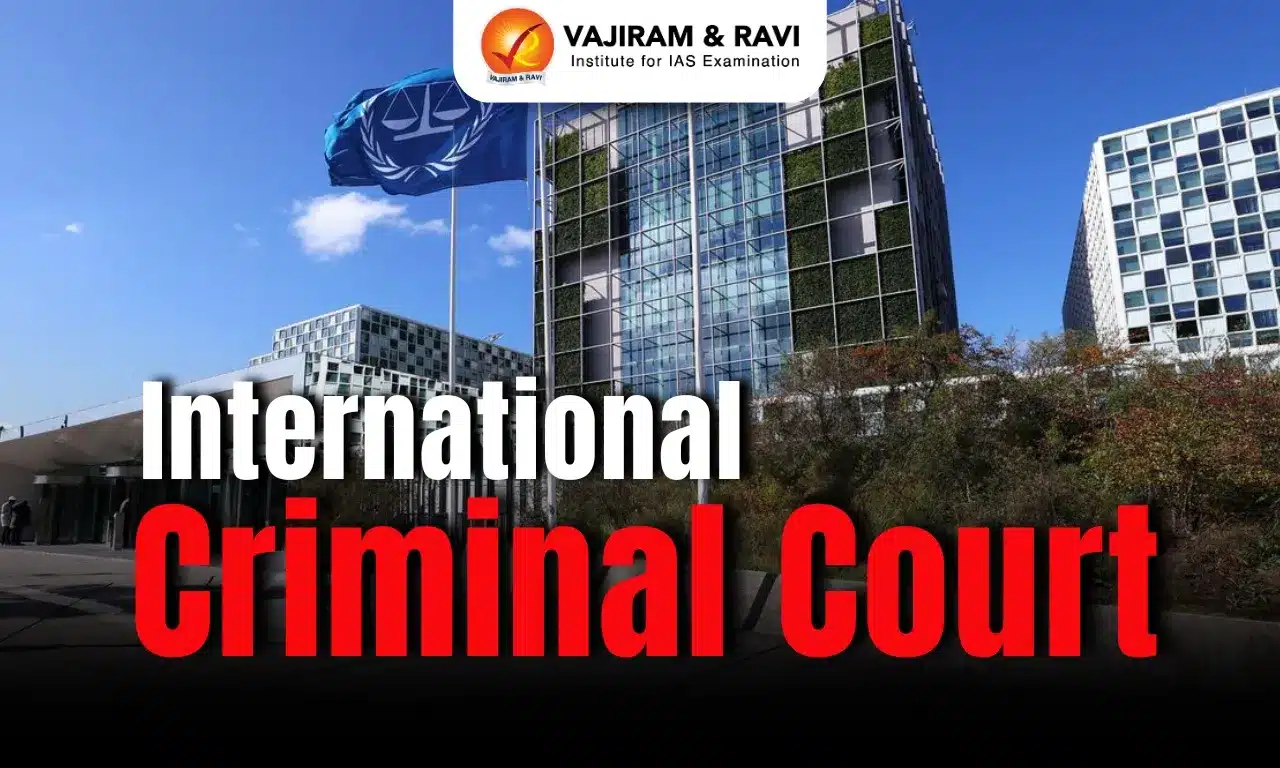
International Criminal Court

International Criminal Court

International Criminal Court 

The International Criminal Court recently unsealed an arrest warrant against Senator Ronald Dela Rosa, accusing him, along with ex-President Rodrigo Duterte and other "co-perpetrators" of the "crime against humanity of murder".

About International Criminal Court 

  • It is a permanent and independent criminal court established to prosecute offenders of serious crimes in the international community.  
  • It is the only permanent international criminal tribunal.
  • It was created by the Rome Statute, which came into force on July 1, 2002
  • Mandate: ICC investigates and, where warranted, tries individuals charged with the gravest crimes of concern to the international community.
  • Specifically, the ICC is intended to prosecute the following crimes:
    • Genocide
    • Crimes against humanity
    • War crimes
    • The crime of aggression
  • The ICC is meant to serve as a last resort when the courts of sovereign states are unwilling to prosecute. 
  • Therefore, the ICC is complementary to national criminal jurisdiction and does not supersede it. 
  • Additionally, the ICC serves a different purpose than the International Court of Justice, which resolves conflicts between nations. 
  • Members: There are 125 member countries (China, India, Israel, Russia, and the United States are not ICC parties).
  • Funding: The Court is funded by contributions from the States Parties and by voluntary contributions from Governments, international organizations, individuals, corporations, and other entities.

International Criminal Court Composition

  • Judges: The court has eighteen judges, each from a different member country, elected to non-renewable nine-year terms.
  • The Presidency:
    • Consists of three judges (the President and two Vice-Presidents) elected from among the judges.
    • It represents the Court to the outside world and helps with the organization of the work of the judges.
  • Office of the Prosecutor (OTP):
    • OTP is responsible for receiving referrals and any substantiated information on crimes within the jurisdiction of the Court.
    • OTP examines these referrals and information, conducts investigations, and conducts prosecutions before the Court.
  • Registry: It provides administrative and operational support to the Chambers and the Office of the Prosecutor.

International Criminal Court Jurisdiction

  • The ICC is only competent to hear a case if:
    • The country where the offence was committed is a party to the Rome Statute; or
    • The perpetrator’s country of origin is a party to the Rome Statute.
  • The ICC only has jurisdiction over offences committed after the Statute’s entry into force on 1 July 2002.
  • Various parties have the right to refer a case to the ICC:
    • any State Party to the Rome Statute, irrespective of any involvement in the alleged offence;
    • the Prosecutor of the ICC;
    • the United Nations Security Council (UNSC)
  • The UNSC may ask the ICC to defer investigation of a case for a limited period if it considers that the proceedings would constitute an obstruction to its powers.

Source: TH

International Criminal Court FAQs

Q1: What is the International Criminal Court (ICC)?

Ans: It is a permanent and independent international criminal court established to prosecute serious international crimes.

Q2: Which legal instrument created the International Criminal Court (ICC)?

Ans: The Rome Statute.

Q3: What is the main mandate of the International Criminal Court (ICC)?

Ans: To investigate and prosecute individuals accused of grave international crimes.

Q4: Is India a member of the International Criminal Court (ICC)?

Ans: Is India a member of the International Criminal Court (ICC)?

Q5: Who can refer a case to the International Criminal Court (ICC)?

Ans: A State Party, the ICC Prosecutor, or the United Nations Security Council.

Tungabhadra Dam

Tungabhadra Dam

Tungabhadra Dam Latest News

Nearly two years after Gate No. 19 was washed away, the historic Tungabhadra Dam near Hosapete stands renewed with all 33 crest gates replaced.

About Tungabhadra Dam

  • Tungabhadra Dam, also known as Pampa Sagar, is constructed across the Tungabhadra River, a tributary of the Krishna River.
  • It is located in Hosapete, Ballari District of Karnataka
  • The dam is about 49.5 meters in height and has about 33 crest gates.
  • The dam’s construction started as a joint project between the erstwhile Hyderabad State and Madras Presidency. 
  • It became a joint project of Karnataka and Andhra Pradesh later, which saw its completion in 1953. 
  • It is a multipurpose dam serving irrigation, electricity generation, flood control, etc. 
  • The dam creates a huge water reservoir on the river with a gross capacity of 101 tmc ft at full reservoir level.
  • The left canals of the dam serve irrigation in Karnataka only, whereas the right canals serve parts of Karnataka and areas in the Rayalaseema region of Andhra Pradesh. 
  • The Tungabhadra reservoir and the Mullaperiyar dam in Kerala hold the unique distinction of being the only two reservoirs in the country that were built using a combination of mud and limestone.

Key Facts about Tungabhadra River

  • It is the largest tributary of the Krishna River.
  • It flows through the states of Karnataka and Andhra Pradesh. 
  • It derives its name from two streams viz., the Tunga, about 147 km long, and the Bhadra, about 178 km long, which rise in the Western Ghats. 
  • The river, after the confluence of the two streams near Shimoga, runs for about 531 km till it joins river Krishna at Sangamaleshwaram in Andhra Pradesh. 
  • It runs for 382 km in Karnataka, forms the boundary between Karnataka and Pradesh for 58 km and further runs for the next 91 km in Andhra Pradesh. 
  • It is influenced chiefly by the West monsoon. 
  • Major Tributaries: Varada River and Hagari (Vedathy) River.
  • Major Dams: The Tunga Anicut Dam, the Bhadra Dam, the Hemavathy Dam, and the Tungabhadra Dam.

Source: TH

Tungabhadra Dam FAQ's

Q1: What is another name for the Tungabhadra Dam?

Ans: Pampa Sagar.

Q2: The Tungabhadra River is a tributary of which major river?

Ans: The Krishna River.

Q3: Where is the Tungabhadra Dam located?

Ans: Hosapete in Ballari district of Karnataka.

National Test House

National Test House

National Test House Latest News

Recently, the National Test House (NTH) of Northern Region in Ghaziabad, under the Department of Consumer Affairs, has established a state-of-the-art Shoe Testing Laboratory.

About National Test House

  • It is a premier scientific organization of the Government of India.
  • It was established in 1912 under the then Railway Board.
  • It is India’s largest multi-location multidisciplinary industrial central government’s testing laboratory dealing with almost all sorts of testing, calibration and quality evaluation related to industry, commerce, trade etc. as per international and national standards.
  • Functions
    • It offers technical consultancy, testing, calibration, and quality evaluation across various sectors, adhering to both national and international standards.
    • It is also actively involved in supporting the National Accreditation Board for Testing and Calibration Laboratories (NABL) and BIS by providing technical assistance in the accreditation and standard formation activities, respectively.
    • It is the pioneering governmental entity in India for drone certification.
  • Its branches are established at Kolkata, Mumbai, Chennai, Ghaziabad, Jaipur, Guwahati, and Varanasi.
  • Nodal Ministry: It is functioning under the administrative control of the Department of Consumer Affairs, Ministry of Consumer Affairs, Food & Public Distribution.

Source: News On Air

National Test House FAQs

Q1: Where is the headquarters of National Test House is located?

Ans: Kolkata

Q2: National Test House (NTH) functions under which ministry?

Ans: Ministry of Consumer Affairs, Food & Public Distribution

Indian Pharmacopoeia Commission

Indian Pharmacopoeia Commission

Indian Pharmacopoeia Commission Latest News

Recently, the Indian Pharmacopoeia Commission (IPC) organized a Scientific Conclave & Interactive Session on Indian Pharmacopoeia 2026 at the National Institute of Pharmaceutical Education and Research (NIPER), Hyderabad, Telangana.

About Indian Pharmacopoeia Commission

  • It is an autonomous Institution of the Ministry of Health and Family Welfare, Govt. of India.
  • It is created to set standards of drugs in the country.

Functions of Indian Pharmacopoeia Commission

  • Its basic function is to regularly update the standards of drugs commonly required for treatment of diseases prevailing in this region.
  • It publishes official documents for improving Quality of Medicines by way of adding new and updating existing monographs in the form of Indian Pharmacopoeia (IP).
  • It further promotes rational use of generic medicines by publishing National Formulary of India.
  • It prescribes standards for identity, purity and strength of drugs essentially required from the health care perspective of human beings and animals.
  • It also provides IP Reference Substances (IPRS) which act as a fingerprint for identification of an article under test and its purity as prescribed in IP.

What is Pharmacopoeia?

  • The Pharmacopoeias are official compendia of quality standards of the drugs being imported, manufactured for sale, stocked or exhibited for sale or distributed in India.

Source: PIB

Indian Pharmacopoeia Commission FAQs

Q1: Indian Pharmacopoeia (IP) is the official book of standards for drugs under which Act?

Ans: Drugs & Cosmetics Act, 1940

Q2: Where is Headquarters of Indian Pharmacopoeia Commission is located?

Ans: Ghaziabad

Enquire Now