
India-Africa Forum Summit

India-Africa Forum Summit

India-Africa Forum Summit Latest News

Recently, the India-Africa Forum Summit-IV postponed in wake of the Ebola virus outbreak.

About India-Africa Forum Summit

  • It is the highest apex institutional platform for dialogue and cooperation between India and African countries.
  • It was established in 2008.
  • Purpose: It aims to strengthen political dialogue, economic cooperation, trade, investment, technology transfer, capacity building and people-to-people relations between India and Africa.
  • The Summit reflects a shared commitment to South–South cooperation, inclusive development, multilateralism and sustainable partnerships.
  • The Summit has been held three times: IAFS-I in 2008 (New Delhi), IAFS-II in 2011 (Addis Ababa), and IAFS-III in 2015 (New Delhi). 

Objectives of  India-Africa Forum Summit

  • Strengthen diplomatic and strategic relations between India and African countries
  • Promote economic cooperation and increase bilateral trade and investment
  • Encourage technology transfer, innovation and industrialization
  • Enhance cooperation in health, agriculture, education and infrastructure
  • Support sustainable development and regional integration
  • Foster youth empowerment, entrepreneurship and skills development
  • Strengthen peace, security and maritime cooperation
  • Promote South–South cooperation and multilateral collaboration

Source: TH

India-Africa Forum Summit FAQs

Q1: Where was the first India-Africa Forum Summit held ?

Ans: New Delhi

Q2: How many editions of IAFS have been held till 2025?

Ans: 3
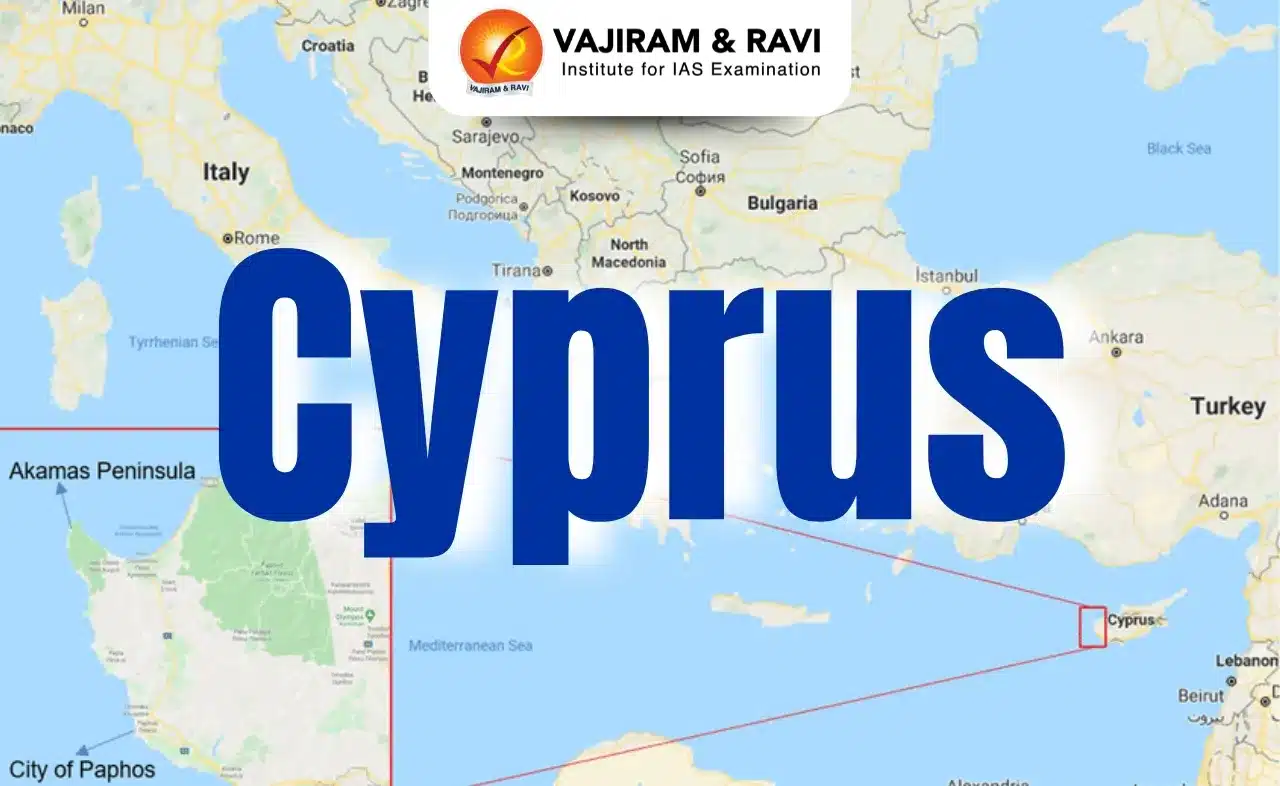
Cyprus

Cyprus

Cyprus Latest News

The Prime Minister of India will hold talks with the President of Cyprus in New Delhi.

About Cyprus

  • It is a Eurasian island country.
  • Location: It is located in the extreme northeastern corner of the Mediterranean Sea, south of the Anatolian peninsula.
  • Neighbouring Countries: Turkey (North), Syria (East), and Lebanon (Southeast).
  • It is a member of the European Union (EU).
  • Capital City: Nicosia  
  • Geographical Features of Cyprus
    • It is the third largest Mediterranean island after Sicily and Sardinia.
    • Climate: Temperate and Mediterranean with dry summers and variably rainy winters. 
    • Major Cities: Limassol, Larnaca, Famagusta, and Paphos.
    • Mountain Ranges: Kyrenia and Troodos Mountains.
    • Highest Point: Mount Olympus (1,952 m).
    • Rivers: Pedieos is the longest river in Cyprus.
    • Natural Resources: It mainly consists of Copper, pyrites, asbestos, gypsum, timber, salt, marble, clay earth pigment.

Source: News On Air

Cyprus FAQs

Q1: The 'Green Line' in Cyprus refers to?

Ans: UN Buffer Zone dividing Cyprus into Greek Cypriot south and Turkish Cypriot north

Q2: Cyprus is located in which sea?

Ans: Eastern Mediterranean Sea

Saraswati Wildlife Sanctuary

Saraswati Wildlife Sanctuary

Saraswati Wildlife Sanctuary Latest News

Haryana's first constellation garden has been developed at the Saraswati Wildlife Sanctuary in the Seonsar forest area of Pehowa.

About Saraswati Wildlife Sanctuary

  • Saraswati Wildlife Sanctuary, also known as the Seonsar Forest, is located in the districts of Kaithal and Kurukshetra, in Haryana
  • It is spread over an area of about 4452.85 hectares.
  • Culturally and ecologically significant, the sanctuary is tied to the mythical Saraswati River, believed to have flowed through the region.   
  • The sanctuary is also home to ancient archaeological remains, with bricks found here dating back to the Kushan and Gupta periods, suggesting the area was inhabited over 1,500 years ago. 
  • There is also a 400-year-old Water well made of small lakhauri bricks associated with the Mughal empire era.
  • Flora: The forest is characterized by "tropical deciduous forest" vegetation, featuring dense clusters of Kikar, Neem, Shisham, and Peepal trees.  
  • Fauna:
    • It is a critical habitat for a variety of wildlife, including the Blue Bull (Nilgai), Wild Boar, Spotted Deer, and the rare Hog Deer. 
    • It hosts over 250 species of resident and migratory birds, especially during the winter months. 

Source: MSN

Saraswati Wildlife Sanctuary FAQs

Q1: In which state is Saraswati Wildlife Sanctuary located?

Ans: Haryana

Q2: Which ancient periods are associated with the archaeological remains found in the sanctuary

Ans: Kushan and Gupta periods.

Q3: What type of forest vegetation is found in Saraswati Wildlife Sanctuary?

Ans: Tropical deciduous forest vegetation.

Ambazari Lake

Ambazari Lake

Ambazari Lake Latest News

Deployment of high-capacity harvester machines at Ambazari Lake has finally given a major push to the long-pending battle against the massive spread of water hyacinth.

About Ambazari Lake

  • It is located near the southwest border of Nagpur in Maharashtra.
  • It is the oldest, largest, and one of the eleven lakes adorning the city. 
  • It spans approximately 6.2 hectares. 
  • It was built in 1870 under the rule of the Bhonsle dynasty.
  • It was constructed as a reservoir to supply water to Nagpur, and it played a crucial role in meeting the city’s water needs for over 30 years. 
  • The lake’s origins are tied to the Nag River, which flows from it. 
  • The name “Ambazari” is derived from the Marathi word “Amba,” meaning mango, as the lake is surrounded by mango trees. 
  • A well-maintained garden was developed beside Ambazari Lake in 1958. 

Source: TOI

Ambazari Lake FAQs

Q1: Where is Ambazari Lake located?

Ans: Near the southwest border of Nagpur in Maharashtra.

Q2: What is the significance of Ambazari Lake among the lakes of Nagpur?

Ans: It is the oldest and largest of the eleven lakes in the city.

Q3: In which year was Ambazari Lake built?

Ans: It was built in 1870 under the rule of the Bhonsle dynasty.

Q4: Why was Ambazari Lake originally constructed?

Ans: As a reservoir to supply water to Nagpur.

Q5: Which river originates from Ambazari Lake?

Ans: The Nag River.

Bismarck Sea

Bismarck Sea

Bismarck Sea Latest News

A submarine volcanic eruption in the Bismarck Sea, north of Papua New Guinea has drawn attention to the poor mapping of the deep ocean floor on Earth.

About Bismarck Sea

  • It is a part of the southwestern Pacific Ocean.
  • It is bounded to the southwest by the northeast coast of Papua New Guinea and to the northwest through to the southeast by the Bismarck Archipelago, consisting of the Admiralty Islands (north), New Ireland (east), and New Britain (southeast).  
  • It has a total surface area of about 40,000 sq.km.
  • It opens to the Pacific on the north and to the Solomon Sea on the southeast through the Vitiaz and Dampier straits and St. George’s Channel.
  • The basin, with a general depth of 2,000 meters and maximum depths approaching 2,500 meters, is divided by a central ridge into the eastern New Ireland and western New Guinea sections.  
  • The sea was under German control from about 1885 until 1914 and bears the name of the German statesman Otto von Bismarck.
  • During World War II, it was the site of many important naval battles between the Allied Forces and Japanese troops. 
  • The Battle of the Bismarck Sea in March 1943 was a significant event where Allied forces stopped a Japanese convoy. 
  • Today, the area is explored by historians and divers looking for sunken ships and airplanes.

Source: NEWS9

Bismarck Sea FAQs

Q1: Of which ocean is the Bismarck Sea a part?

Ans: The southwestern Pacific Ocean.

Q2: Under whose control was the Bismarck Sea region from about 1885 to 1914?

Ans: Germany

Q3: After whom is the Bismarck Sea named?

Ans: German statesman Otto von Bismarck

Q4: When did the Battle of the Bismarck Sea take place?

Ans: March 1943.

Daishoin Temple

Daishoin Temple

Daishoin Temple Latest News

A fire destroyed part of the Daishoin Buddhist temple complex, the Reikado Hall, which housed Japan's 'eternal flame' for 1,200 years.

About Daishoin Temple

  • It is a Buddhist temple of the Shingon School located on Miyajima Island in the Chugoku region of Japan
  • It lies at the base of Mount Misen, the tallest mountain on Miyajima.
  • It was founded by Kobo Daishi in 806 on his return from China following gumonji-ho, a 100-day Buddhist training. 
  • Its vast grounds are covered in multiple unique halls, structures, and statues.

Key Facts about Miyajima Island

  • Miyajima, also known as Itsukushima, is a small island located in the Seto Inland Sea off the coast of Japan. 
  • Hiroshima is the nearest major city.
  • It is famous for its “floating” red torii gate that appears to stand on water during high tide. 
  • Itsukushima Shrine:
    • Constructed around 1168 C.E., it is the center of activity on the island of Miyajima. 
    • This shrine is unique in that it is built over water. 
    • Each of the buildings — the main hall, the prayer hall, and the Noh theater — are supported by stilts and connected by boardwalks over the water. 
    • It is listed as a UNESCO World Heritage Site.

Source: IS

Daishoin Temple FAQs

Q1: Where is Daishoin Temple located?

Ans: On Miyajima Island in the Chugoku region of Japan.

Q2: Which Buddhist school is associated with Daishoin Temple?

Ans: The Shingon School.

Q3: At the base of which mountain is Daishoin Temple situated?

Ans: Mount Misen.

Q4: Who founded Daishoin Temple?

Ans: It was founded by Kobo Daishi in 806 AD.

UMMID Programme

UMMID Programme

UMMID Programme Latest News

Recently, the Union Minister for Science & Technology dedicated the UMMID Programme.

About UMMID Programme

  • UMMID (Unique Methods of Management of Inherited Disorders) programme is launched for Rare Genetic Disorders/ Diseases.
  • It is a national initiative promoting early intervention and affordable healthcare for families affected by rare genetic disorders
  • It is aimed at improving the diagnosis and management of inherited and rare genetic disorders.
    The initiative represents India' s first comprehensive national effort to address inherited genetic disorders through an integrated approach encompassing diagnosis, counselling, prevention, training and public health awareness. 
  • The programme functions through three major pillars such as
    • NIDAN Kendras for diagnostics and counselling, outreach programmes in aspirational districts, and specialised training centres for capacity building.
  • It supports implementation of the National Policy for Rare Diseases (NPRD) 2021 by creating structured care pathways for patients suffering from inherited disorders.
  • Nodal Ministry: It is a national initiative led by the Department of Biotechnology, Ministry of Science & Technology to tackle inherited genetic disorders.

Source: PIB

UMMID Programme FAQs

Q1: NIDAN Kendras under UMMID refer to?

Ans: National Inherited Disorders Administration Kendras – for genetic testing, counselling, prenatal diagnosis

Q2: UMMID Initiative was launched by which ministry/department?

Ans: Department of Biotechnology (DBT), Ministry of Science & Technology

Kiwi Fruit

Kiwi Fruit

Kiwi Fruit Latest News

Recently, the Union Minister for Development of North Eastern Region launched the Mission on “Arunachal Kiwi: The USP of Arunachal Pradesh mission, a Cluster-based Kiwi Cultivation and Value Chain Development Mission with an outlay of nearly 167 crore rupees. 

About Kiwi Fruit

  • The Kiwi fruit (Actinidia deliciosa also known as Chinese Gooseberry ) is a small, edible, oval-shaped fruit.
  • Appearance: It has fuzzy brown skin and bright green or golden flesh with edible black seeds.
  • Required Climatic Conditions for Kiwi
    • It grows well between 900 to 1600 m above mean sea level wherever the climate is warm and humid.
    • Rain: It requires a well distributed rainfall of about 150 cm for its growth.
    • Soil: Deep, rich, well-drained sandy loam soils are ideal for cultivation of kiwi.
    • It requires 700-800 chilling hours (no. of hours during which temperature remains at or below 70 C during the winter season).
  • Nutritional Value: It is a rich source of vitamin B & C and minerals like phosphorus, potassium & calcium.
  • Distribution: It is grown widely in New Zealand, Italy, USA, China, Japan, Australia, France, Chile and Spain.
  • In India, it is mostly grown in Himachal Pradesh, Uttar Pradesh, Jammu and Kashmir, Sikkim, Meghalaya, Arunachal Pradesh and Kerala.

Source: News On Air

Kiwi Fruit FAQs

Q1: Scientific name of the most common cultivated Kiwi fruit is?

Ans: Actinidia deliciosa

Q2: Kiwi fruit originated in which country?

Ans: China

Muga Silk

Muga Silk

Muga Silk Latest News

Recently, the Prime Minister of India gifted Muga silk stole and a Shirui Lily silk stole to the Italian Prime Minister.

About Muga silk

  • It is known as the "golden silk" of Assam.
  • It is a rare and prestigious textile from the Brahmaputra Valley.
    • It is obtained from semi-domesticated multivoltine silkworm, Antheraea assamensis. These silkworms feed on the aromatic leaves of Som and Soalu plants and are reared on trees similar to that of tasar.
  • It is valued for its natural golden hue, durability and eco-friendly production without artificial dyes.
  • Muga culture is specific to the state of Assam and an integral part of the tradition and culture of that state.
  • The muga silk, a high value product is used in products like sarees, mekhalas, chaddars, etc.
  • It was received the Geographical Indication (GI) tag in 2007.

Key Facts about Shirui Lily Silk

  • It draws its inspiration from the misty heights of Shirui Kashong peak in Manipur.
  • It is inspired by the rare Shirui Lily, (a delicate bell-shaped flower with pale pinkish-white petals that blooms nowhere else in the world).
  • For the Tangkhul Naga community of Manipur, the Shirui Lily symbolises purity, identity, and cultural pride.
  • The lily also holds deep cultural resonance in Italy, where it has long symbolised purity, grace and artistic refinement, frequently appearing in Renaissance art.

Source: TH

Muga Silk FAQs

Q1: Which Indian traditional attire is most commonly made from Muga silk?

Ans: Mekhela Chador of Assam

Q2: Under which Act is Muga silk a protected GI?

Ans: Geographical Indications of Goods (Registration & Protection) Act, 1999

Enquire Now

