Machkund Hydroelectric Project

Machkund Hydroelectric Project

Machkund Hydroelectric Project Latest News

A major fire broke out at the Machkund Hydroelectric Project located on the Odisha-Andhra Pradesh border recently.

About Machkund Hydroelectric Project

  • It is a 120 MW hydropower project located in the Koraput district of Odisha along the border with Andhra Pradesh.
  • It is located on the western slopes of the Eastern Ghats near the well-known Duduma Falls, on the Machkund River (a tributary of the Godavari River system). 
  • The Jalaput Dam, along with its reservoir, supports the project.
  • It is an inter-state Project of Government of Andhra Pradesh and Government of Odisha.  
  • Construction
    • The plant was originally proposed by Maharaja Vikram Dev Varma of Jeypore to provide electricity to his villages in the 1920s.
    • The project construction commenced in 1948 and subsequently entered into commercial operation in 1955.  
    • It was formally inaugurated by Dr. Rajendra Prasad, the first President of India.  
  • Power Sharing: 
    • In the beginning, electricity distribution was divided in a 70:30 ratio between Andhra Pradesh and Odisha. 
    • Over time, with increasing demand and negotiations, the arrangement was revised to an equal 50:50 share, ensuring both states benefited fairly from the plant.

Source: TH

Machkund Hydroelectric Project FAQs

Q1: What is the installed capacity of the Machkund Hydroelectric Project?

Ans: 120 MW.

Q2: Where is the Machkund Hydroelectric Project located?

Ans: It is located in the Koraput district of Odisha along the border with Andhra Pradesh.

Q3: On which river is the Machkund Hydroelectric Project located?

Ans: Machkund River (a tributary of the Godavari River system)

Q4: Which dam supports the Machkund Hydroelectric Project?

Ans: Jalaput Dam.

BHAVYA Scheme

BHAVYA Scheme

BHAVYA Scheme Latest News

 Recently, the central government announced the launch of guidelines for the ‘BHAVYA (Bharat Audyogik Vikas Yojna) Scheme’.

Above BHAVYA Scheme

  • BHAVYA (Bharat Audyogik Vikas Yojna) is a Central Sector Scheme aimed at developing investment-ready, world-class industrial parks across the country.
  • The major focus of the Scheme is on creation of
    • Investment-ready industrial ecosystems with plug-and-play infrastructure, multimodal logistics connectivity, reliable utility systems, worker-support infrastructure, digital governance systems, and sustainable development features.
  • Target: It provides for development of 100 industrial parks.
  • Time Period:  Six years from 2026-27 to 2031-32

Features of BHAVYA Scheme

  • It has been designed to support the Centre’s Make in India and PM Gati Shakti programmes by creating integrated, investment-ready manufacturing zones equipped with plug-and-play infrastructure and multimodal logistics connectivity.
  • It provides for development of both greenfield and eligible brownfield industrial parks.
  • Minimum land requirements have been fixed at 100 acres for non-hilly states and 25 acres for hilly states, northeastern states, Union Territories, and smaller states.
  • Implementation: It will be undertaken through Special Purpose Vehicles (SPVs) incorporated under the Companies Act, 2013.

Source: BS

BHAVYA Scheme FAQs

Q1: What does 'plug-and-play' mean?

Ans: Ready-to-use sites with land, utilities, approvals in place

Q2: BHAVYA launched by which ministry?

Ans: Ministry of Commerce & Industry

Rumen Fluke

Rumen Fluke

Rumen Fluke Latest News

Around 70 cattle have died in Odisha’s Kendrapada district recently, with the chief district veterinary officer attributing most of the deaths to amphistomes, or rumen flukes disease, locally known as ‘Kurmi’.

About Rumen Fluke

  • Rumen flukes are parasites of ruminants and occur worldwide. 
  • They have a snail intermediate host. 
  • The adult parasites live in the rumen (stomach), and the immature larval forms live in the small intestine. 
  • They have been associated with significant disease (paramphistomosis) in tropical and subtropical countries.
    • The disease is due to intestinal damage caused by massive numbers of larvae in the intestine.
    • Transmission: Through ingestion of contaminated water or vegetation carrying larval stages.  
    • Symptoms
      • Key signs of rumen fluke disease are severe diarrhoea, rapid weight loss, and swelling under the jaw, known as “bottle jaw”. 
      • It includes reduced milk yield and curdling and significant loss in body mass despite the animal’s willingness to eat.
    • The disease can be treated with targeted anthelmintic medicines. Anthelmintics are medications used to eradicate parasitic worms (helminthes). 
    • Management requires proper grazing and pasture control.

Source: TOI

Rumen Fluke FAQs

Q1: What are rumen flukes?

Ans: Rumen flukes are parasitic worms that infect ruminant animals.

Q2: Do rumen flukes occur worldwide?

Ans: Yes.

Q3: Which organism acts as the intermediate host for rumen flukes?

Ans: Snails.

Q4: What mainly causes disease in rumen fluke infection?

Ans: Intestinal damage caused by large numbers of larvae.

Q5: Which medicines are used to treat rumen fluke disease?

Ans: Anthelmintic medicines.

Pyrite

Pyrite

Pyrite Latest News

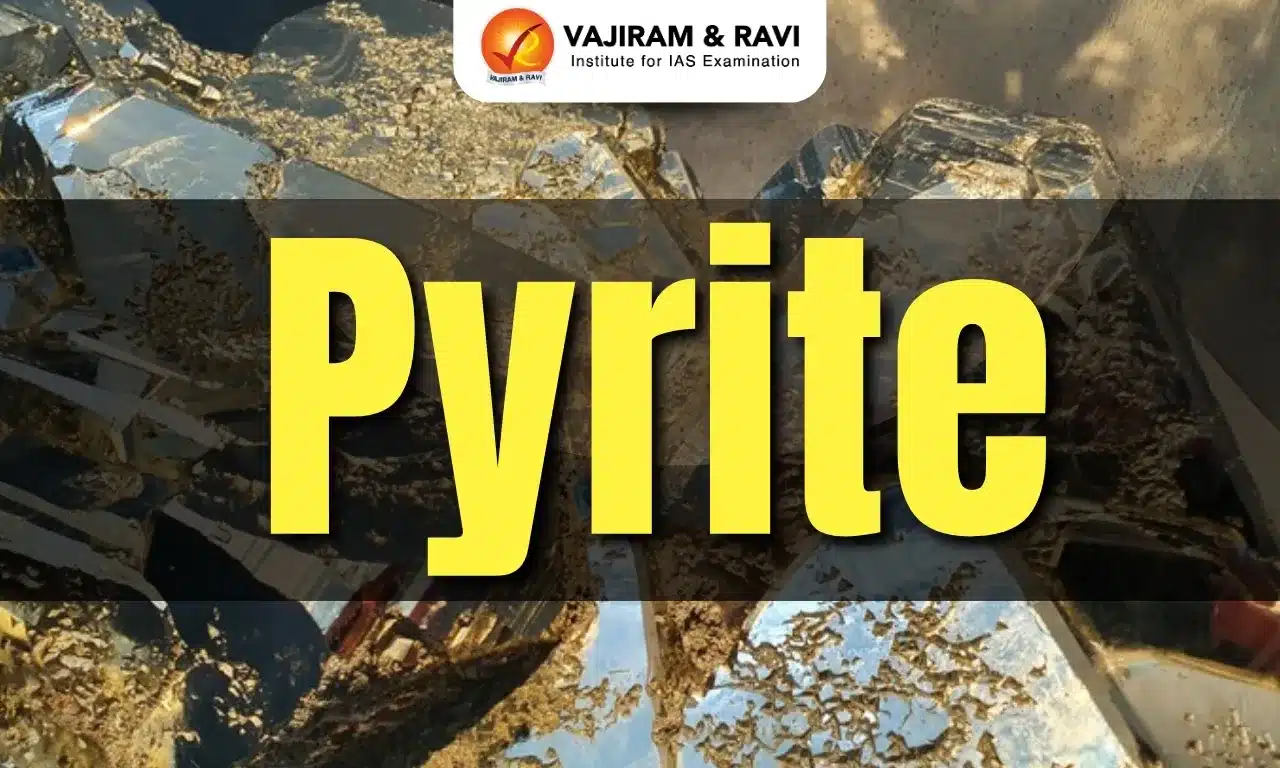
Geologists have discovered a rare, microscopic sunflower-shaped mineral, pyrite, commonly known as fool's gold, within the lignite coal reserves of Gujarat, India. 

About Pyrite

  • It is a naturally occurring iron disulfide mineral. 
  • It has the chemical formula FeS2 and is the most common sulfide mineral.  
  • It is a brass-yellow mineral with a bright metallic luster.
  • The name comes from the Greek word pyr, “fire,” because pyrite emits sparks when struck by metal.  
  • Pyrite is called fool’s gold because its colour is deceptively similar to that of a gold nugget. 
  • Nodules of pyrite have been found in prehistoric burial mounds, which suggests their use as a means of producing fire. 

Where is Pyrite Found?

  • Pyrite is found in a wide variety of geological settings, from igneous, sedimentary, and metamorphic rock to hydrothermal mineral deposits, as well as in coal beds and as a replacement mineral in fossils. 
  • It can be either disseminated throughout igneous rock or concentrated in layers, depending on the depositional mechanism and environment. 
  • It forms in sedimentary rocks in oxygen-poor environments in the presence of iron and sulfur. These are usually organic environments, such as coal and black shale, where decaying organic material consumes oxygen and releases sulfur. 
  • Pyrite often replaces plant debris and shells to create pyrite fossils or flattened discs called pyrite dollars.
  • In calcite and quartz veins, pyrite oxidizes to iron oxides or hydroxides such as limonite, an indicator that there is pyrite in the underlying rock. Such oxidized zones are called “gossan,” which appears as rusty zones at the surface.
  • Major Producers: 
    • For many years, Spain was the largest producer. 
    • Today Italy and China are the world’s largest producers, followed by Russia and Peru.  

Pyrite Uses

  • It is a source of iron and sulfur and is used for the production of sulfuric acid. 
  • It is used to create iron sulfate that is used to make nutritional supplements, ink, lawn conditioner, water treatment and flocculation, moss killer, and many other chemical processes.  
  • Iron sulfate, which comes from pyrite, is used to treat iron-deficiency anemia.  
  • Some types of pyrite contain enough microscopic gold to warrant mining them as a gold ore.

Source: RM

Pyrite FAQs

Q1: What is Pyrite?

Ans: Pyrite is a naturally occurring iron disulfide mineral.

Q2: Why is Pyrite called “Fool’s Gold”?

Ans: Because its colour closely resembles gold.

Q3: What are “Pyrite Dollars”?

Ans: Flattened disc-like pyrite fossils formed by replacement of shells or plant debris.

Q4: Which countries are currently the world’s largest producers of Pyrite?

Ans: Italy and China.

Oreshnik Missile

Oreshnik Missile

Oreshnik Missile Latest News

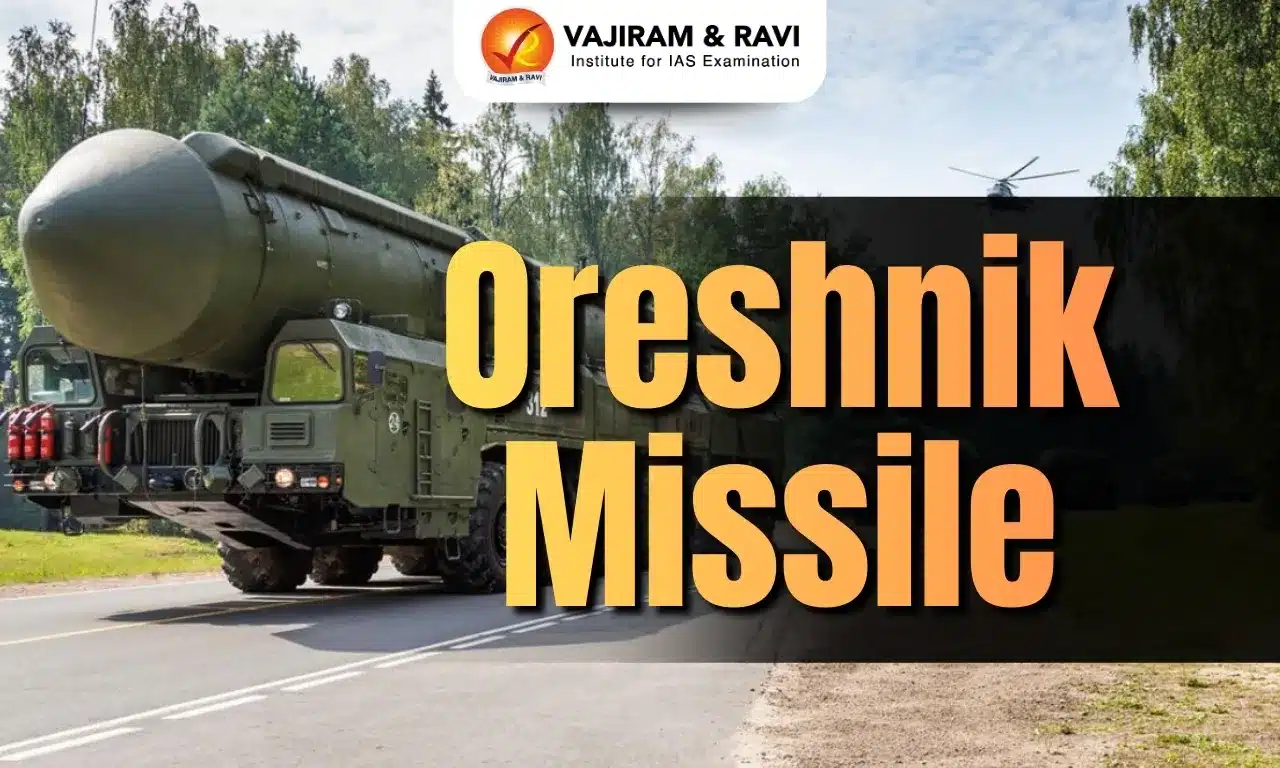
The Ukrainian President said recently that Russia used the powerful hypersonic Oreshnik ballistic missile during a mass drone and missile attack on Kyiv.

About Oreshnik Missile

  • It is a Russian-made intermediate-range hypersonic ballistic missile.
  • It was first used by Russia in November 2024 to target the Ukrainian city of Dnipro
  • The missile is based on the RS-26 Rubezh ballistic missile, and, like other Russian weapons systems, Oreshnik is capable of carrying nuclear as well as conventional warheads.

Oreshnik Missile Features

  • It is estimated to be 15 to 18.5 metres long, with a diameter of some 1.9 metres.
  • It is mounted on a mobile transporter and launcher for rapid deployment and concealment.
  • Equipped with multiple independently targetable re-entry vehicles (MIRVs), the “Oreshnik” can carry six to eight warheads, hitting multiple targets simultaneously.
  • With a reported range of 5,000 kilometres, the missile can strike targets across Europe and even reach the west coast of the United States.
  • It can travel at Mach 10, around 10 times the speed of sound or approximately 2.5 to 3 kilometres per second, making interception extremely difficult.

Source: TH

Oreshnik Missile FAQs

Q1: What is the Oreshnik missile?

Ans: It is a Russian-made intermediate-range hypersonic ballistic missile.

Q2: What types of warheads can the Oreshnik missile carry?

Ans: Nuclear and conventional warheads.

Q3: What is the reported range of the Oreshnik missile?

Ans: Around 5,000 kilometres.

Q4: What is the speed of the Oreshnik missile?

Ans: It can travel at Mach 10, around 10 times the speed of sound.

Asian Infrastructure Investment Bank

Asian Infrastructure Investment Bank

Asian Infrastructure Investment Bank Latest News

Recently, the Asian Infrastructure Investment Bank (AIIB) has launched a $10 billion fund facility to support member countries affected by ongoing Middle East conflict.

About Asian Infrastructure Investment Bank

  • It is a multilateral development bank established in 2016.
  • Objective: It focuses on promoting sustainable economic growth, enhancing regional connectivity, and mobilizing both public and private capital for infrastructure investments. 
  • Headquarters: Beijing, China
  • Membership: It has now grown to 111 approved members worldwide.
  • India is a Founding Member of AIIB and the second-largest shareholder after China. 
  • Governance
    • It is headed by a Board of Governors composed of one Governor and one Alternate Governor appointed by each of the member countries.
    • A non-resident Board of Directors is responsible for the direction and management of the Bank, such as the Bank’s strategy, annual plan and budget and establishing policies and oversight procedures.
    • The bank staff is headed by a President who is elected by AIIB shareholders for a five-year term and is eligible for re-election once.

Source: TOI

Asian Infrastructure Investment Bank FAQs

Q1: What is AIIB's core mandate?

Ans: Financing sustainable infrastructure in Asia

Q2: AIIB started operations in which year?

Ans: January 2016

Public Accounts Committee

Public Accounts Committee (PAC)

Public Accounts Committee Latest News

Recently, the reconstituted Public Accounts Committee (PAC) convened and took up certain subjects for examination.

About Public Accounts Committee

  • It is the oldest parliamentary committee in India which was established in 1921.
  • It is constituted every year.
  • The Chairperson is appointed by the Speaker from amongst its Members of Lok Sabha.
  • The Speaker, for the first time, appointed a Member of the Opposition as the Chairperson of the Committee for 1967-68.
  • Purpose: Audits the revenue and expenditure of the Government of India to ensure public funds are spent efficiently and legally.
  • Functions of PAC
    • It examines the CAG audit report on government expenditure.
    • It ensures money sanctioned by Parliament is spent properly.
    • It investigates financial irregularities, losses, and inefficiencies in government spending.
  • Membership
    • It consists of 22 members (15 from Lok Sabha, 7 from Rajya Sabha).
    • Chairperson: A Lok Sabha MP, traditionally from the Opposition.
    • Term: One year.
    • Ministers cannot be members of the PAC.

Source: TH

Public Accounts Committee FAQs

Q1: By convention, PAC Chairman belongs to?

Ans: Opposition party

Q2: Which House members are in majority in PAC?

Ans: Lok Sabha, 15 out of 22

Idu Mishmi Tribe

Idu Mishmi Tribe

Idu Mishmi Tribe Latest News

The Idu Mishmi tribal people of Arunachal have a unique cosmology rooted in conservation.

About Idu Mishmi Tribe

  • It is one of the tribal groups who have been living primarily in the Dibang Valley, lower Dibang, and Lohit districts of Arunachal Pradesh.
  • They primarily live in Mishmi Hills, bordering Tibet in Arunachal Pradesh.
  • They can be distinctively identified by their typical hairstyle, distinctive customs and artistic pattern embedded on their clothes.
  • Occupation: They are known for their weaving and craftsmanship skills.
  • Language: Their language, called ‘Idu Mishmi’, is considered endangered by UNESCO.
  • Relationship with Nature
    • Traditionally animists, the tribe has strong ties with the region’s rich flora and fauna
    • Tigers are especially important to the Idu Mishmis — according to Idu mythology, they were born to the same mother, and thus, tigers are their “elder brothers”.
    • Iyu-ena’: It is a strict belief system of myths and taboos that restrict them from hunting many animals, including a complete prohibition on killing tigers.
  • Festivals: They celebrate festivals such as Reh and Ke-Meh-Ha.
  • They brew local rice beer called Ebu.
  • Society: The Idu-Mishmi society is patriarchal and patrilineal. The property is inherited by the son from the father. 

Source: DTE

Idu Mishmi Tribe FAQs

Q1: What is the major festival of Idu Mishmi?

Ans: Reh festival, celebrated in February

Q2: Idu Mishmi tribe primarily found in which state?

Ans: Arunachal Pradesh

Enquire Now