Ayushman Sarathi

Ayushman Sarathi

Ayushman Sarathi Latest News

The Government of India recently launched Ayushman Sarathi, the official Pradhan Mantri Jan Arogya Yojana (PM-JAY) WhatsApp chatbot.

About Ayushman Sarathi

  • It is a WhatsApp chatbot that will enable beneficiaries to access key services under the Ayushman Bharat Pradhan Mantri Jan Arogya Yojana (AB PM-JAY).
  • The Chatbot is developed by the National Health Authority (NHA)
  • The chatbot is built on secure API-based integration with existing PM-JAY systems and is more than just an information bot. 
  • It is a functional tool that will deliver real-time information and perform services directly within the chat window.  
  • It provides users with quick and convenient access to essential PM-JAY services anytime and anywhere, reducing the need for physical visits to healthcare facilities. 
  • This gives beneficiaries 24/7 access to Ayushman Bharat scheme services.
  • Services Offered:
    • It lets users check their eligibility under PM-JAY, apply for and download their Ayushman Card, complete eKYC, link Aadhaar, lock or unlock their PM-JAY card, among other services.
    • As the Ayushman Bharat scheme offers Rs 5 lakh insurance to all elderly aged 70 and above, they can access their Ayushman Vaya Vandana Card, which is issued specifically to seniors, enabling them to avail of the scheme’s benefits. 
    • Users can also view their wallet balance and treatment history, locate nearby empanelled hospitals, register, track or withdraw grievances, request a callback, and submit feedback after hospital discharge.
  • To access this digital assistance, beneficiaries need to start a conversation with the official PM-JAY WhatsApp Chatbot by sending the message ‘Hi’ to the number +91 72908 23838 or by scanning the designated QR code. 

News: IT

Ayushman Sarathi FAQs

Q1: What is Ayushman Sarathi?

Ans: It is a WhatsApp chatbot that enables beneficiaries to access key services under the Ayushman Bharat Pradhan Mantri Jan Arogya Yojana (AB PM-JAY).

Q2: Which organisation has developed Ayushman Sarathi?

Ans: The National Health Authority (NHA).

Q3: What is the primary objective of Ayushman Sarathi?

Ans: To provide beneficiaries with quick and convenient access to PM-JAY services anytime and anywhere.

Q4: How is Ayushman Sarathi different from a regular information chatbot?

Ans: It provides real-time information and performs services directly within the chat window.

Malaprabha River

Malaprabha River

Malaprabha River Latest News

The Malaprabha River, which flows through parts of the Guledgudda taluk in Karnataka, has dried up recently, causing severe hardship for people living along its banks.

About Malaprabha River

  • It is one of the important tributaries of the Krishna River and flows through the state of Karnataka
  • Course
    • The river originates in the Western Ghats, specifically at an elevation of 792 meters in the Sahyadri hill range, at Kanakumbi village in the Belgaum district. 
    • The Shri Mauli Devi temple marks the birthplace of Malaprabha at Kanakumbi; the place has a long history going back to prehistoric times, and it's a pilgrimage center. 
    • From there, it flows eastward and then northeast, finally merging with the Krishna River at the confluence point known as Kudala Sangama in the Bagalkot district. 
  • Total Length: 304 km 
  • Malaprabha's main tributaries are Bennihalla, Hirehalla, and Tuprihalla.
  • There is a dam known as Renukasagar built on this river. 
  • It is home to several ancient temples and heritage sites, including the renowned Aihole, Pattadakal, and Badami temple complexes.

News: DH

Malaprabha River FAQs

Q1: The Malaprabha River is a tributary of which river?

Ans: The Krishna River.

Q2: Through which Indian state does the Malaprabha River flow?

Ans: Karnataka.

Q3: Where does the Malaprabha River originate?

Ans: In the Western Ghats at Kanakumbi village in Belagavi (Belgaum) district, Karnataka.

Q4: What is the total length of the Malaprabha River?

Ans: 304 kilometres

Q5: Which important heritage temple complexes are located along the Malaprabha River?

Ans: Aihole, Pattadakal, and Badami.

Project BRAHMANK

Project BRAHMANK

Project BRAHMANK Latest News

Recently, the Border Roads Organisation (BRO) celebrated its 16th Raising day of Project BRAHMANK at Ranaghat, Arunachal Pradesh. 

About Project BRAHMANK

  • It is an initiative of the Border Roads Organisation (BRO).
  • Historical Background: It was raised on 29 June 2011 at Ranaghat, East Siang District, Arunachal Pradesh and became fully functional on 03 December 2011.
  • It is responsible for development and maintenance of strategic road infrastructure across the Siang, East Siang, West Siang, Upper Siang and Shi-Yomi districts of Arunachal Pradesh, as well as parts of Dhemaji district in Assam.
  • It has been instrumental in providing strategic and operational connectivity to the Armed Forces while bringing remote villages into the national mainstream.

Key Facts about Border Roads Organisation

  • It is a road construction executive force in India that provides support to the Indian Armed Forces.
  • BRO was entirely brought under the Ministry of Defence in 2015.
  • Establishment: It was formed on 7 May 1960 to secure India’s borders and develop infrastructure in remote areas of the north and northeastern states of the country.
  • It develops and maintains road networks in India’s border areas and friendly neighboring countries.
  • Motto: Shramena Sarvam Sadhyam (everything is achievable through hard work).

Source: PIB

Project BRAHMANK FAQs

Q1: What is Project BRAHMANK?

Ans: Strategic infrastructure project of Border Roads Organisation (BRO) for Arunachal Pradesh border areas

Q2: How many BRO projects operate in Arunachal Pradesh?

Ans: Vartak, Arunank, Brahmank, Udayak

Interplanetary Coronal Mass Ejections

Interplanetary Coronal Mass Ejections

Interplanetary Coronal Mass Ejections Latest News

Indian astrophysicists have uncovered new insights into how large solar eruptions called Interplanetary Coronal Mass Ejections (ICMEs) evolve thermally during their journey from the Sun to the Earth. 

About Interplanetary Coronal Mass Ejections

  • These are massive blasts of magnetized plasma released from the Sun’s outer atmosphere, which then travel through interplanetary space.
  • When those ICMEs are directed towards us and encounter Earth’s magnetic field, they can disturb it and cause geomagnetic storms.
  • They produce colorful, dazzling auroras in Earth’s upper atmosphere.
  • The level of activity of the Sun has an 11-year cycle, and more ICMEs are created during the maxima of these cycles.
  • ICMEs are responsible for the severest of geomagnetic storms when they impinge upon Earth’s magnetosphere.
  • ICMEs also provide an enormous plasma laboratory to study physical processes in space.
  • Impacts of Interplanetary Coronal Mass Ejections: These storms have adverse effects on satellite operations, GPS and radio communications, aviation routes, and power grids.

Source: PIB

Interplanetary Coronal Mass Ejections FAQs

Q1: What is the main impact of ICMEs on Earth?

Ans: Geomagnetic storms disrupt GPS, radio, satellites, aviation, power grids + cause auroras

Q2: What is an Interplanetary Coronal Mass Ejection (ICME)?

Ans: These are massive blasts of magnetized plasma released from the Sun’s outer atmosphere, which then travel through interplanetary space.

Academic Bank of Credit

Academic Bank of Credit

Academic Bank of Credit Latest News

The Academic Bank of Credits (ABC) and the Automated Permanent Academic Account Registry (APAAR) are building a trusted digital ecosystem for academic records, making education more flexible, transparent, and accessible for every learner. 

About Academic Bank of Credit

  • It is a revolutionary digital platform by the Ministry of Education, Government of India.
  • It is regulated by the University Grants Commission (UGC).
  • It is built to support every learner’s journey by providing a digital platform for storing, managing, transferring, and redeeming academic credits earned by students from recognised educational institutions.
  • Objectives: The main objective of ABC is to create a flexible, learner-friendly education system in which learning achievements can be recognised, stored, and used throughout a person's life.
  • It supports the vision of the National Education Policy (NEP) 2020 and the National Credit Framework (NCrF).

How Does Academic Bank of Credit Work?

  • Students register on the ABC portal and receive a unique ABC ID or APAAR ID linked to their Aadhaar and DigiLocker account.
  • Students belonging to eligible Higher Education Institutions (HEIs) can use the ABC facility.
  • Academic institutions upload credit data directly to the ABC portal against each student's account.
  • Students can accumulate, transfer, and redeem credits across HEIs without losing academic progress.
  • Credits are valid for a maximum of 7 years or the duration prescribed by the relevant academic discipline. Once redeemed, credits cannot be reused.
  • Credit redemption and certificate issuance are handled by academic institutions via the National Academic Depository (NAD) platform.
  • The NAD serves as the backbone of ABC, securely storing all academic awards and records.

Key Features of Academic Bank of Credit

  • Academic Mobility: Students can study across multiple HEIs and transfer their credits seamlessly between programmes and institutions.
  • ABC provides students with a seamless, consent-based document exchange system that streamlines verification and significantly reduces processing time.
  • Multiple Entry and Exit (MEE): ABC enables the MEE framework under NEP 2020.
  • SWAYAM Integration: Students may avail up to 40% of credits from the SWAYAM online platform.
  • National Credit Framework (NCrF): ABC is aligned with the NCrF, covering academic, vocational, and experiential learning.

Source: PIB

Academic Bank of Credit FAQs

Q1: What is Academic Bank of Credit (ABC)?

Ans: Virtual digital repository storing academic credits earned by students from UGC-recognised HEIs

Q2: What is the shelf life of credits in ABC?

Ans: Minimum 7 years unless course-specific validity is different

Bengal Fox

Bengal Fox

Bengal Fox Latest News

Researchers and conservationists from many districts in the state of Tamil Nadu, where the Bengal fox used to thrive, have reported no sightings of the species in the last few years. 

About Bengal Fox

  • It is also known as Indian Fox or the Indian desert fox, is a small-sized carnivorous mammal. 
  • Habitat: It generally prefers foothills and non-forested regions such as open grassland, thorny scrub, semi-desert and arid environments. 
  • Distribution: It is native to the Indian subcontinent, including India, Nepal and Pakistan and is widespread throughout its range.
    • These foxes are found in the Himalayan foothills to the tip of the Indian peninsula.
  • Behaviour: It is known for their monogamous behaviour, forming lifetime bonds.
  • Bengal fox populations alter their active periods from daytime to crepuscular and nocturnal habits.
    • These foxes are ‘edge species’, inhabiting habitats between forests and agricultural areas.
  • Breeding: Its breeding season typically occurs from December to January and gestation period is 50-60 days.
  • Conservation Status
  • Threats: Habitat loss, the fragmentation of open scrubland, direct persecution during traditional festivals, and the encroachment of feral dogs bringing disease into fox territories.

Source: TH

Bengal Fox FAQs

Q1: What is the scientific name of Bengal Fox?

Ans: Vulpes bengalensis

Q2: What is IUCN status of Bengal Fox?

Ans: Least Concern

Arul Mihu Navasakthi Vinayagar Temple

Arul Mihu Navasakthi Vinayagar Temple

Arul Mihu Navasakthi Vinayagar Temple Latest News

The Prime Minister recently visited the Arul Mihu Navasakthi Vinayagar Temple during his three-day State visit to Seychelles.

About Arul Mihu Navasakthi Vinayagar Temple

  • It is a Hindu temple located in Victoria, the capital of Seychelles.
  • It is the only Hindu temple in Seychelles. 
  • The temple was built in 1992 by the Hindu community living in Seychelles, which constitutes around 2% of the population.  
  • The temple is dedicated to Lord Vinayagar (or Lord Ganesha), and is located in the heart of Victoria on Mahé Island.  

Arul Mihu Navasakthi Vinayagar Temple Architecture

  • It looks very similar to the famous temples of Tamil Nadu and other parts of South India, with its vibrant and intricate Dravidian architecture.
  • Its most striking feature is the colourful gopuram, or entrance tower, which rises nearly 100 feet into the sky. 
  • The tower is covered with beautifully carved statues of Hindu gods, goddesses, and mythological figures. 
  • Every statue is painted in bright colours, making the temple stand out against the green hills. 
  • At its centre is the garbha griha, or “womb chamber,” where a statue of the god Vinayagar is in a small bare room. 
  • The temple also has a mandapam, an open hall used for religious ceremonies, prayers, and celebrations.

News: NDTV

Arul Mihu Navasakthi Vinayagar Temple FAQs

Q1: Where is the Arul Mihu Navasakthi Vinayagar Temple located?

Ans: Victoria, the capital of Seychelles.

Q2: When was the Arul Mihu Navasakthi Vinayagar Temple built?

Ans: In 1992.

Q3: To which deity is the Arul Mihu Navasakthi Vinayagar Temple dedicated?

Ans: Lord Vinayagar (Lord Ganesha).

Q4: Which style of architecture is followed by the Arul Mihu Navasakthi Vinayagar Temple?

Ans: Dravidian architecture.

Southern Birdwing

Southern Birdwing

Southern Birdwing Latest News

The rare Southern Birdwing, one of India’s largest butterflies, has been recorded in the Kollapur Range of the  Amrabad Tiger Reserve, marking its first documented sighting in Telangana.

About Southern Birdwing

  • The Southern Birdwing, also called the 'Sahyadri Birdwing', is a large and striking butterfly endemic to South India, majorly in the Western Ghats
  • Scientific Name: Troides minos
  • It is India’s second largest butterfly species.
  • It is the state butterfly of Karnataka.

Southern Birdwing Habitat and Distribution

  • Found up to 3,000 feet (910 m) in the Western Ghats. 
  • Found in diverse habitats from lowland evergreen forests near the coast to mixed deciduous forests, dry scrub, and agricultural fields. 

Southern Birdwing Features

  • It has a wingspan of 140–190 mm. 
  • In adult butterflies, the upper side of the forewing is glossy black with white-bordered veins. 
  • The hind wings have a golden yellow colour, with black borders, spots, and veins. 
  • In females, the forewings have prominent grey-white vein stripes. On the hind wings, there are rows of large triangular black spots. 
  • They are active in the early morning hours. They have a slow flight and usually prefer to fly above the trees. 

Southern Birdwing Conservation Status

It is classified as 'Least Concern' under the IUCN Red List

News: TOI

Southern Birdwing FAQs

Q1: What is the Southern Birdwing?

Ans: It is a large and striking butterfly endemic to South India, mainly in the Western Ghats.

Q2: Which butterfly is the state butterfly of Karnataka?

Ans: The Southern Birdwing.

Q3: What is another name for the Southern Birdwing?

Ans: Sahyadri Birdwing.

Q4: What is the colour of the upper side of the forewing in an adult Southern Birdwing?

Ans: Glossy black with white-bordered veins.

Q5: What is the IUCN Red List status of the Southern Birdwing?

Ans: Least Concern.

United Nations Economic and Social Commission for Asia and the Pacific

United Nations Economic and Social Commission for Asia and the Pacific

United Nations Economic and Social Commission for Asia and the Pacific Latest News

A new United Nations Economic and Social Commission for Asia and the Pacific (ESCAP) report has warned that developing economies in the Asia-Pacific face an annual climate finance gap of nearly USD 800 billion.

About United Nations Economic and Social Commission for Asia and the Pacific

  • It is the most inclusive intergovernmental platform in the Asia-Pacific region.
  • It was established in 1947.
  • Mandate: To promote economic and social development in the Asian and Pacific region by fostering cooperation between its members and associate members.
  • Members: The Commission promotes cooperation among its 53 member States and 9 associate members in pursuit of solutions to sustainable development challenges.
  • It is one of the five regional commissions of the United Nations.
  • Functions: One of the main functions of UNESCAP is to promote economic and social development through regional and subregional cooperation and integration.
  • It carries out work in the areas like 
    • Macroeconomic Policy, Poverty Reduction and Financing for Development, Trade, Investment and Innovation, Transport, Environment and Development, Information and Communications Technology and Disaster Risk Reduction and Social Development etc.
  • Headquarters: Bangkok, Thailand.

Source: TH

United Nations Economic and Social Commission for Asia and the Pacific FAQs

Q1: Where is UNESCAP headquartered?

Ans: Bangkok, Thailand

Q2: How many members does UNESCAP have?

Ans: 53 member States and 9 associate members

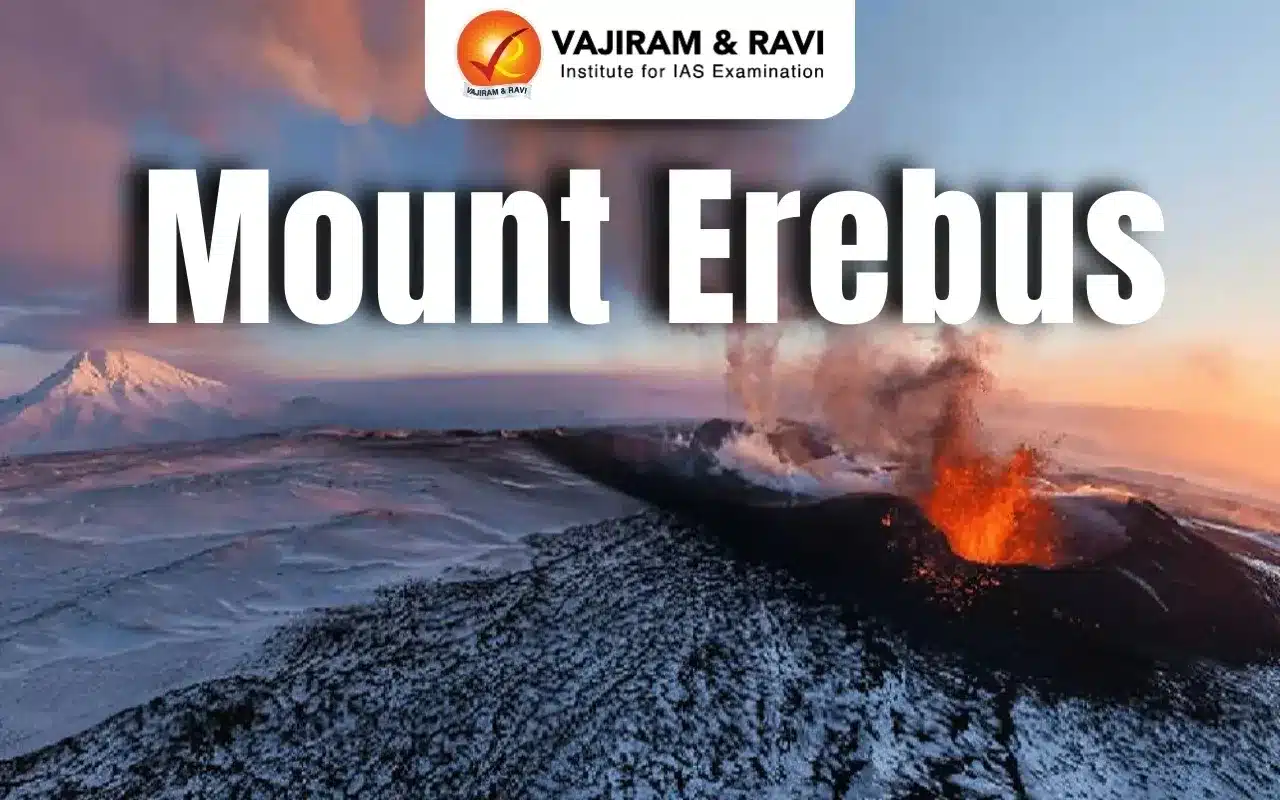
Mount Erebus

Mount Erebus

Mount Erebus Latest News

The world's southernmost active volcano, Mount Erebus, not only has a permanent lava lake, but it is also the only known volcano that releases tiny crystals of pure gold into the atmosphere.

About Mount Erebus

  • It is a stratovolcano located on the western half of Ross Island, off the coast of Antarctica in the Ross Sea. 
  • It is the world’s southernmost active volcano.
  • It is an intraplate volcano and belongs to the McMurdo Volcanic Group, located in the so-called Terror Rift, which is part of the West Antarctic Rift System. 
  • It is part of the Ring of Fire that encircles the Pacific Ocean basin.  
  • Its summit is 12,448 feet (3,794 meters) above sea level, making it the second tallest volcano in Antarctica, after Mount Sidley.  
  • It is one of only two volcanoes on the continent that are considered to be active; Deception Island is the other. 
  • It is also one of only a few volcanoes in the world that contain an active lava lake. 
  • The lava lake in the summit crater has been active since at least 1972. Most eruptions are small and Strombolian in character, tossing bombs onto the crater rim. 
  • It is also the only known volcano that releases tiny crystals of pure gold into the atmosphere. 

News: NDTV

Mount Erebus FAQs

Q1: What is Mount Erebus?

Ans: It is a stratovolcano.

Q2: Where is Mount Erebus located?

Ans: On the western half of Ross Island, off the coast of Antarctica in the Ross Sea.

Q3: Which is the world's southernmost active volcano?

Ans: Mount Erebus.

Q4: Why is Mount Erebus unique among the world's volcanoes?

Ans: It is one of the few volcanoes in the world with a persistent active lava lake.

Q5: What type of eruptions are most commonly associated with Mount Erebus?

Ans: Strombolian eruptions.

Enquire Now