Indiahandmade

Indiahandmade

Indiahandmade Latest News

India’s traditional handloom and handicraft sector is finding a stronger foothold in the digital economy through Indiahandmade.

About Indiahandmade

  • It is a government-backed dedicated digital marketplace that brings India’s handloom and handicraft traditions into the online economy. 
  • Developed by the Digital India Corporation under the Ministry of Textiles and launched in 2023, it showcases some of the world’s oldest and most traditional crafts of India. 
  • The main motive behind this online eCommerce portal is to provide a platform for Indian handloom weavers and handicraft artisans to sell their traditional products online, paving the way for their financial and social empowerment. 

Indiahandmade Salient Features

  • The platform enables artisans and weavers to sell their products directly to consumers, reducing dependence on intermediaries and improving opportunities for fair compensation.  
  • It also equips sellers with digital tools and greater online visibility, allowing them to participate more effectively in e-commerce.
  • The marketplace showcases an extensive range of handmade products spanning apparel, home décor, furnishings, paintings, furniture, religious items, stationery, musical instruments, jewellery, bags, and footwear. 
  • Alongside everyday handmade products, the platform gives prominence to region-specific crafts through dedicated sections for GI-tagged and ODOP products
  • Buyers benefit from free shipping, secure payment systems, purchase protection, and buyer support mechanisms.
  • For artisans and weavers, the platform offers a guided onboarding process to simplify participation in digital commerce. 
  • In a move aimed at making online selling more inclusive, artisans who do not have GST registration can register using an Enrolment ID, although they are permitted to sell only within their own state. 
  • This provision enables smaller artisans and first-time digital sellers to access online markets with fewer barriers. 
  • The platform also highlights the stories of artisan enterprises that continue to preserve India’s traditional crafts through digital commerce. 

News: DD

Indiahandmade FAQs

Q1: What is Indiahandmade?

Ans: A government-backed digital marketplace for Indian handloom and handicraft products.

Q2: Which ministry launched the Indiahandmade platform?

Ans: Ministry of Textiles.

Q3: What is the primary objective of the Indiahandmade platform?

Ans: To enable Indian handloom weavers and handicraft artisans to sell their products online.

Q4: What is one major advantage of Indiahandmade for artisans?

Ans: Direct market access through digital commerce.

Q5: What benefits does Indiahandmade provide to buyers?

Ans: Free shipping, secure payments, purchase protection, and buyer support.

Chief Labour Commissioner (Central)

Chief Labour Commissioner

Chief Labour Commissioner (Central) Latest News

The Chief Labour Commissioner (Central) Organisation continues to strengthen labour welfare and industrial harmony across the country through sustained awareness programmes, effective grievance redressal mechanisms, and timely conciliation efforts.

About Chief Labour Commissioner (Central)

  • The organization of the Chief Labour Commissioner (Central), also known as the Central Industrial Relations Machinery, is an apex organization in the country responsible for maintaining harmonious industrial relations mainly in the sphere of central Government.  
  • It is under the aegis of the Ministry of Labour & Employment, Government of India.  
  • Headquarters: New Delhi  

Chief Labour Commissioner (Central) Formation

  • In pursuance of the recommendation of the Royal Commission on Labour in India, the organization was set up in April 1945 by combining the former organizations of the conciliation Officer (Railways), Supervisor of Railway Labour and the Labour Welfare Advisor. 
  • It was then charged mainly with duties of prevention and settlement of industrial disputes, enforcement of labour laws, and to promote welfare of workers in the industrial establishments falling within the sphere of the Central Government. 
  • It started with a small complement of staff comprising a Chief Labour Commissioner (C) at New Delhi, 3 Regional Labour Commissioners at Bombay, Kolkata & Lahore, 8 Conciliation Officers, and 18 Labour Inspectors. 
  • The Conciliation Officers and Labour Inspector were redesignated as Assistant Labour Commissioner (C) and Labour Enforcement Officer (C).  
  • The organization was further augmented gradually by establishing regional offices at various places across India. 

Chief Labour Commissioner (Central) Functions

  • Prevention and settlement of industrial disputes through conciliation/mediation.
  • Enforcement of labour laws and rules made there under the Central Sphere.
  • Quasi-Judicial functions
  • Verification of trade union membership
  • Miscellaneous functions

News: PIB

Chief Labour Commissioner (Central) FAQs

Q1: The Chief Labour Commissioner (Central) functions under which Ministry?

Ans: Ministry of Labour & Employment.

Q2: In which year was the Chief Labour Commissioner (Central) organization established?

Ans: 1945.

Q3: Which commission recommended the establishment of the Chief Labour Commissioner (Central)?

Ans: Royal Commission on Labour in India.

Q4: Why was the Chief Labour Commissioner (Central) organization established?

Ans: To prevent and settle industrial disputes, enforce labour laws, and promote workers' welfare.

Eurasian Lynx

Eurasian Lynx

Eurasian Lynx Latest News

Recently, the elusive Eurasian lynx has been photographed for the first time in Sikkim.

About Eurasian Lynx

  • The Eurasian lynx (Lynx lynx) is a medium-sized wild cat.
  • Appearance
    • The body of the Eurasian lynx is short and it has long legs with large feet.
    • Its ears have a distinctive black tuft at its tip and its paws have retractile sharp claws.
  • Distribution: It lives in a wide range from Western Europe to Russia and Central Asia.
  • Habitat
    • They live in temperate broadleaf boreal or mixed forests with lots of undergrowth for cover.
    • These animals also inhabit the Himalayas' northern slopes, the alpine tundra, mountains in the central Asian desert area, and all of the Tibetan Plateau.
    • They can live in rocky areas, brushy spaces, and open forests.
  • Characteristics
    • Behaviour: The Eurasian Lynx is an elusive, solitary and territorial animal
    • Typically crepuscular or nocturnal, Eurasian lynxes are mainly active at dawn and dusk
    • They are good climbers and sometimes lie in trees and high rocks.
    • Diet: They are strictly carnivorous.
  • Threats: Habitat loss as a result of deforestation, loss of prey due to illegal hunting, and game hunting
  • Conservation Status
    • IUCN: Least Concern

Source: NDTV

Eurasian Lynx FAQs

Q1: What is the Range & habitat of Eurasian Lynx?

Ans: Europe, Russia, Central Asia to Tibetan Plateau; found in boreal forests, taiga, mountains up to 5500 m

Q2: What is the Eurasian Lynx & its scientific name?

Ans: Largest lynx species; Lynx lynx

National Highways Logistics Management Limited (NHLML)

National Highways Logistics Management Limited

National Highways Logistics Management Limited Latest News

The Union Minister for Road Transport and Highways recently reviewed the progress of key infrastructure projects being implemented by the National Highways Logistics Management Limited (NHLML).

About National Highways Logistics Management Limited

  • NHLML, (formerly known as Cochin Port Road Company Limited), is a 100% owned company of the National Highways Authority of India (NHAI) formed under the guidance of the MoRT&H Ministry of Road Transport and Highways (MoRTH). 
  • NHLML is responsible for spearheading pivotal initiatives aimed at improving transport logistics, infrastructure, and asset monetization. 
  • It is at the forefront of transformative projects across the country in various domains. These include 
    • The development of 35 Multimodal Logistics Parks (MMLPs)
    • Construction of ropeways
    • Deployment of Optical Fibre Cable networks
    • Establishment of Wayside Amenities
    • Facilitation of port connectivity roads
    • Creation of warehousing zones
    • Enhancement of passenger transport terminal infrastructure
    • Deployment of solarization on highways
    • Development of other allied infrastructure facilities.

News: DDN

National Highways Logistics Management Limited FAQs

Q1: Which organization wholly owns National Highways Logistics Management Limited?

Ans: National Highways Authority of India (NHAI).

Q2: What is the primary objective of National Highways Logistics Management Limited?

Ans: To improve transport logistics, infrastructure, and asset monetization.

Q3: What was the former name of National Highways Logistics Management Limited?

Ans: Cochin Port Road Company Limited.

Global Passport Index

Global Passport Index

Global Passport Index Latest News

India's ranking in the Global Passport Index (GPI) has slipped to 125th spot, one rank drop from last year.

About Global Passport Index

  • It ranks passports not only on the ease of international travel but also on the benefits they offer for living, working and investing in other countries.
  • It is a comprehensive passport ranking that goes beyond measuring the number of countries passport holders can travel to without a visa. 
  • Published by: It is published by residency and citizenship advisory firm Global Citizen Solutions (GCS).
  • It measures passports across three key categories: Enhanced Mobility (50 per cent), Investment (25 per cent) and Quality of Living (25 per cent). These are based on 14 separate indicators.
  • It draws on quantitative data from various international institutions and multilateral organisations such as the World Bank, the World Economic Forum and the Sustainable Development Report

Key Highlights of Global Passport Index 2026

  • The Strongest passports of this year's index are: Sweden, Switzerland, Finland, Germany, Denmark (joint) and Netherlands (joint).

Source: HT

Global Passport Index FAQs

Q1: What are the 2 major global passport rankings?

Ans: Henley Passport Index and Global Passport Index

Q2: What is India’s rank in Global Passport Index 2026?

Ans: 125

Nigeria

Key Facts about Nigeria

Nigeria Latest News

Nigeria's competition regulator said it was investigating major technology and AI companies over allegations of "unlawful exploitation of news content" and "unfair market practices". 

About Nigeria

  • Location: It is a country located on the western coast of Africa. It is often called the “Giant of Africa.” 
  • Boundaries: It is bordered to the north by Niger, to the east by Chad and Cameroon, and to the west by Benin. It also has a coastline on the Gulf of Guinea.
  • Capital: Abuja.

Geographical Features of Nigeria

  • Climate: Nigeria has a diverse geography, with climates ranging from arid to humid equatorial.
  • Drainage: The major drainage areas in Nigeria are the Niger-Benue basin, the Lake Chad basin, and the Gulf of Guinea basin.
  • River: The Niger River, for which the country is named, and the Benue, its largest tributary, are the principal rivers.
  • Major Mountain Range: Cameroonian Highlands
  • Natural Resources: It has abundant natural resources, notably large deposits of petroleum and natural gas.

Source: TH

Nigeria FAQs

Q1: What are major rivers & drainage system of Nigeria?

Ans: Niger River and tributary Benue River

Q2: What is the Capital & largest city of Nigeria?

Ans: Abuja

Ulhas River

Ulhas River

Ulhas River Latest News

The Ulhas river recently crossed the warning level at Mohane and Jambhulpada following continuous heavy rainfall, prompting the district administration to issue an alert for residents living close to the banks.

About Ulhas River

  • It is a prominent west-flowing river located entirely within Maharashtra. 
  • Course: Originating from the Sahyadri hill ranges in the Raigad district, the river travels westward and eventually drains into the Arabian Sea near Vasai Creek, north of Mumbai. 
  • The total length of this river from its source to its outfall is 122 kilometers
  • The Ulhas drains an area of 4,637 sq.km., which lies completely in Maharashtra. The Thane, Raigad, and Pune districts fall in the basin.
  • The river basin is bounded by the main Sahyadri hill range on the east, its offshoots to the north and south, and opens narrowly to the Arabian Sea in the west. 
  • It passes through cities such as Kalyan, Thane, and Navi Mumbai.  
  • Along its route, the Ulhas River forms several distributaries and creeks, which are vital for irrigation, drinking water supply, and local ecosystems.  
  • Important Tributaries: Pej, Barvi, Bhivapuri, Murbari, Kalu, Shari, Bhasta, Salpe, Poshir, and Shilar. 
  • Major Dams: Barvi Dam, Bhatsa Dam, Tansa Dam, and Middle Vaitarna.
  • The estuary of Ulhas houses several historical ports of Kalyan, Kopri, and Shurparaka.

News: TOI

Ulhas River FAQs

Q1: Where is the Ulhas River located?

Ans: It is located entirely within Maharashtra.

Q2: The Ulhas River flows into which sea?

Ans: Arabian Sea.

Q3: Where does the Ulhas River originate?

Ans: Sahyadri hill ranges in Raigad district, Maharashtra.

Q4: What is the total length of the Ulhas River?

Ans: 122 kilometres.

Mahabodhi Temple

Mahabodhi Temple

Mahabodhi Temple Latest News

The Mahabodhi Temple received donations worth nearly Rs 2 crore in a six-day census of donation boxes, including Rs 1.5 crore from Indian and Rs 50 lakh from foreign countries. 

About Mahabodhi Temple

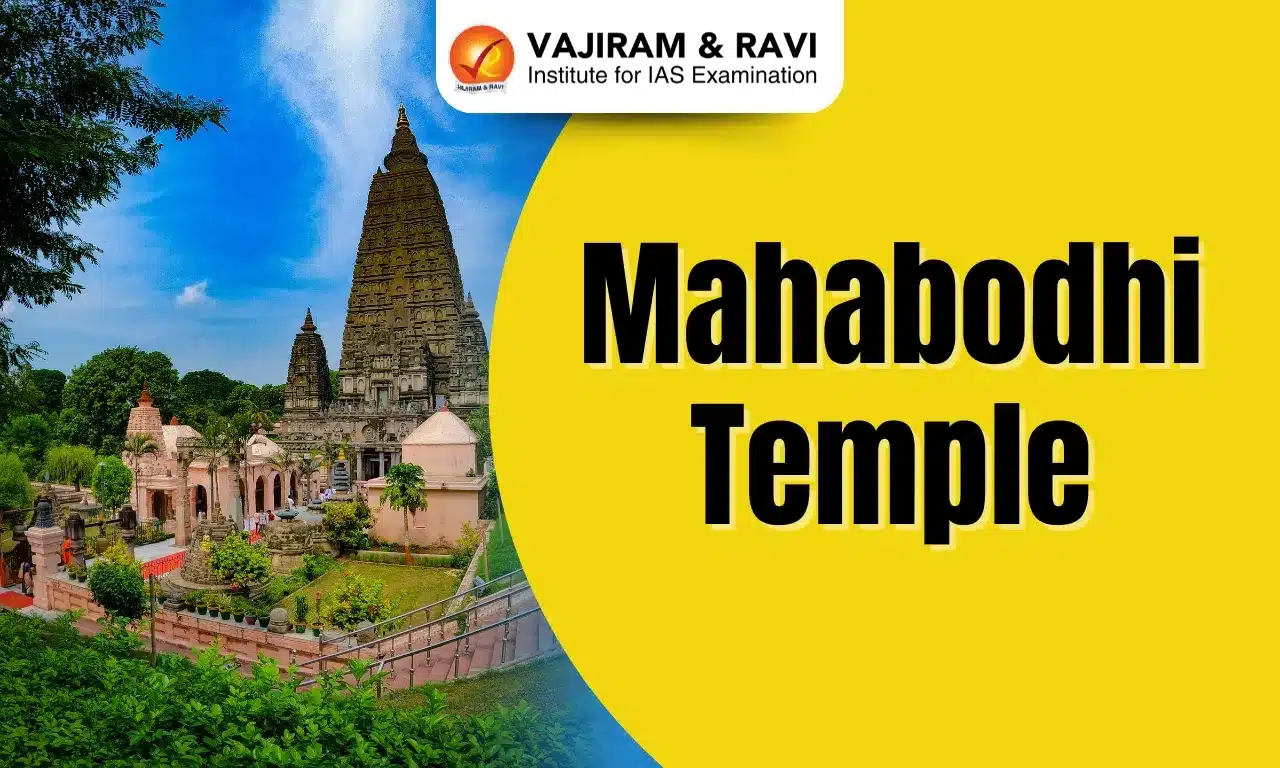
  • It is an ancient Buddhist temple located in Bodh Gaya, Bihar, on the banks of the Niranjana River. 
  • It is one of the four most sacred sites of Buddhism, marking the location where Buddha attained Enlightenment (Bodhi), along with:
    • Lumbini (Buddha’s birthplace)
    • Sarnath (Buddha’s first sermon)
    • Kushinagar (Buddha’s parinirvana)
  • The original temple was constructed by the Mauryan emperor Ashoka in the 3rd century BC. 
  • The present structure is estimated to have been erected between 5th and 6th century BC during the Gupta Period. 
  • The temple was heavily restored in the 19th century by Myanmar (Burmese) Buddhists and then by the British archaeologist Sir Alexander Cunningham.
  • It was recognized as a UNESCO World Heritage site in 2002. 

Mahabodhi Temple Architecture

  • It is constructed of brick and is one of the oldest brick structures to have survived in India.  
  • Built-in the classical style of Indian temple architecture, the temple complex spreads over 5 hectares. 
  • The temple structure is 180 feet (55 meters) in height. 
  • Its pyramidal shikhara (tower) comprises several layers of niches, arch motifs, and fine engravings. 
  • Four additional towers, each identical to the main tower but smaller in size, adorn the corners of the two-story structure
  • A shrine inside the temple holds a yellow sandstone statue of the Buddha encased in glass.
  • In 2013, the upper portion of the temple was covered with gold, as a gift from the King and devotees of Thailand. 
  • A descendant of the Bodhi tree under which the Buddha is said to have sat until he attained enlightenment stands adjacent to the temple. 
  • Vajrasana (Diamond Throne): A stone slab marking the exact spot where Buddha meditated and attained enlightenment, originally installed by Emperor Asoka. 
  • Stone railings surround the temple as well as the Bodhi tree. 
  • One of the most famous of Ashoka’s many pillars (on which he had engraved his proclamations and his understanding of religious doctrine) stands at the southeast corner of the temple.

News: JAG

Mahabodhi Temple FAQs

Q1: Where is the Mahabodhi Temple located?

Ans: Bodh Gaya, Bihar, on the banks of the Niranjana River.

Q2: Why is the Mahabodhi Temple considered sacred in Buddhism?

Ans: It marks the place where Gautama Buddha attained Enlightenment (Bodhi).

Q3: Who originally built the Mahabodhi Temple?

Ans: Emperor Ashoka.

Q4: The present structure of the Mahabodhi Temple was mainly built during which period?

Ans: Gupta Period.

Q5: What is the significance of the Bodhi Tree at the Mahabodhi Temple?

Ans: It is a descendant of the tree under which Buddha attained Enlightenment.

INS Mahendragiri

INS Mahendragiri

INS Mahendragiri Latest News

The Indian Navy is set to commission indigenous stealth frigate, Mahendragiri (F38), at Visakhapatnam on 11 Jul 2026. 

About INS Mahendragiri

  • It is the sixth ship of Nilgiri Class (Project 17A).
  • It was designed by Warship Design Bureau (WDB).
  • It was built at Mazagon Dock Shipbuilders Limited (MDSL) Mumbai.

Features of INS Mahendragiri

  • Propulsion: These ships are configured with Combined Diesel or Gas (CODOG) propulsion plants.
  • Comprising a diesel engine and a gas turbine that drive a Controllable Pitch Propeller (CPP) on each shaft, and state-of-the-art Integrated Platform Management System (IPMS)
  • Armaments: The potent weapon and sensor suite comprises anti-surface, anti-air, and anti-submarine warfare systems.
  • It is capable of undertaking anti-air, anti-surface, and anti-submarine operations.
  • It is equally suited for maritime security, power projection, Humanitarian Assistance and Disaster Relief (HADR), Search and Rescue (SAR), and sustained presence missions.

What are Project 17A Frigates?

  • These are versatile multi-mission platforms designed to address current and emerging challenges in the maritime domain. 
  • The five already delivered to the Navy are INS Nilgiri, INS Himgiri, INS Udaygiri, INS Taragiri and INS Vindhyagiri.
  • Armaments: P17A ships are fitted with an advanced weapon and sensor suite like MF-STAR active phased array radar, BrahMos supersonic cruise missiles, and Barak-8 long-range surface-to-air missiles, designed for superior anti-air, anti-surface and anti-submarine warfare.

Source: PIB

INS Mahendragiri FAQs

Q1: Who designed & built INS Mahendragiri?

Ans: Designed by Warship Design Bureau (WDB); Built by Mazagon Dock Shipbuilders Ltd (MDL), Mumbai

Q2: What is INS Mahendragiri?

Ans: 6th & final ship of Project 17A Nilgiri-class stealth guided-missile frigate of Indian Navy
Changpa Community

Changpa Community

Changpa Community Latest News

Recently, the Ladakh lieutenant governor made decisions for improving the livelihoods of indigenous Changpa pastoral communities.

About Changpa Community

  • The Changpas are a semi-nomadic people found mainly in the Changthang region of the Trans-Himalayas of the Indian subcontinent.
  • They are nomads who have been shepherding their world-class pashmina goats (or cashmere goats) for centuries.
  • The Changpa nomads are Buddhists.
  • They were granted official status in India as a scheduled tribe.
  • They can be identified by their conical yak-skin tents called reboo.
  • Each reboo invariably accommodates the family deity, and a picture of their spiritual head, in most cases, the Dalai Lama.
  • The Changpa who live nomadic lives are known as Phalpa and those who have settled down in fixed locations are called Fangpa.
  • Festival: One of the main purifying rituals of the Changpas is known as Jyabten where they make different kinds of food as an offering to Lord Padmasambhav and another festival Tangpe Chona (15th day of the first month of the lunar calendar).

Source: ET

Changpa Community FAQs

Q1: Who are the Changpa and where are they found?

Ans: Semi-nomadic pastoral tribe of Tibetan origin; mainly in Changthang plateau, Southeastern Ladakh; also parts of Tibet

Q2: What is Constitutional status of Changpa in India?

Ans: Scheduled Tribe since 1989 in Ladakh UT

Enquire Now