Costa Rica

Costa Rica

Costa Rica Latest News

Recently, India and Costa Rica held the first joint economic and trade committee meeting. 

About Costa Rica

  • Location: It is a small country located in Central America.
  • Bordered By: It is bordered by Nicaragua to the north and Panama to the south.
  • Maritime Borders: To the west, it meets the Pacific Ocean, and to the east lies the Caribbean Sea.
  • Capital City: San Jose

Geographical Features of Costa Rica

  • Mountain Ranges: Central Valley has impressive mountain ranges, which include the Cordillera Volcanica to the north and the Cordillera de Talamanca to the south.
  • Volcanoes: Arenal Volcano, the Poás Volcano, and the Irazú Volcano.
  • Highest Point: The country's highest point, Mount Chirripó, lies in the Cordillera de Talamanca and reaches a staggering height of 12,536 feet.
  • Lakes: Lake Arenal, the country's largest lake.
  • Rivers: The Reventazón River (Pours into the Caribbean Sea), Tempisque, the Sierpe, and the San Juan (forms a natural border with Nicaragua).
  • Natural Resources: It consists of copper, manganese, gold, magnetite and bauxite.

Source: PIB

Costa Rica FAQs

Q1: Where is Costa Rica located?

Ans: Central America

Q2: What are the famous geographical features of Costa Rica?

Ans: Highest point: Mount Chirripó – 3,821 m; Cordillera Volcanica & Cordillera de Talamanca

TribeX Platform

TribeX Platform

TribeX Platform Latest News

Recently, the Ministry of Tribal Affairs launched the TribeX platform.

About TribeX Platform

  • It is a first-of-its-kind digital learning platform dedicated to tribal arts, culture, traditional knowledge and skill development. 
  • Launched by: It was launched by the Ministry of Tribal Affairs.

Features of TribeX Platform

  • Digital Learning Platform: It is conceived as a comprehensive digital learning ecosystem and offers structured learning opportunities through free certificate courses and UGC-recognized Post Graduate diploma programmes in tribal languages, art forms, crafts and traditional knowledge.
  • Digital Repository: It serves as a digital repository for documenting, preserving and promoting tribal languages, oral traditions, performing arts, cultural practices and indigenous knowledge systems for future generations.
  • Courses: It currently hosts 20 free certificate courses across a diverse range of tribal art forms, including paintings, handicrafts, handloom, artefacts and traditional musical instruments.
  • It integrates a robust Learning Management System (LMS), and a Repository Management System providing a secure and seamless digital ecosystem for learning, knowledge management and progress tracking. 
  • It also has a Heritage Archive which hosts more than 5000 multimedia resources, including audio, video and literature documenting tribal festivals, socio-cultural practices and oral traditions from across India.

Source: PIB

TribeX Platform FAQs

Q1: What is the purpose of TribeX Platform ?

Ans: To promote online learning, documentation, preservation & skill development of tribal heritage

Q2: What does the Heritage Archive of TribeX document?

Ans: Tribal languages, oral traditions, festivals, performing arts, socio-cultural practices from across India

Behali Wildlife Sanctuary

Behali Wildlife Sanctuary

Behali Wildlife Sanctuary Latest News

Serious allegations of illegal encroachment, large-scale tree felling, and firing on forest personnel have surfaced recently from the Behali Wildlife Sanctuary in Assam's Sonitpur.

About Behali Wildlife Sanctuary

  • It is located at the foothills of the Eastern Himalaya, in the Biswanath district of Assam.
  • Situated in the north of the Brahmaputra River, Behali is situated at a disputed border between Assam and Arunachal.  
  • With Kaziranga National Park as its close neighbour, it serves as an important elephant corridor.
  • It is part of the Sonitpur Elephant Reserve that was notified in 2003.  
  • Flora
    • The forest is Tropical Wet Evergreen and Semi-evergreen. 
    • Some fine patches of primary rainforest are still to be seen in the area. 
    • The top canopy consists of species such as Tetrameles nudiflora, an emergent deciduous species, which is widely used by hornbills for nesting.   
  • Fauna: 
    • It is home to several threatened wildlife species, including the Asian Elephant, Tiger, Bengal Slow Loris, White-winged Duck, Hog Deer, and Chinese Pangolin, along with critically endangered species such as the Black Softshell Turtle and Red-necked Vulture. 
    • It has also been declared an “Important Bird Area”. Common bird species include the Wreathed Hornbill, Rufous-necked Hornbill, Great Hornbill, Woolly-necked Stork, Lesser Adjutant Stork, etc.

News: ETVB

Behali Wildlife Sanctuary FAQs

Q1: Where is Behali Wildlife Sanctuary located

Ans: In the Biswanath district of Assam.

Q2: At the foothills of which mountain range is Behali Wildlife Sanctuary situated?

Ans: The Eastern Himalaya.

Q3: Which famous national park is a close neighbour of Behali Wildlife Sanctuary?

Ans: Kaziranga National Park.

Q4: What type of forests are found in Behali Wildlife Sanctuary?

Ans: Tropical Wet Evergreen and Semi-evergreen forests.

Hemophagocytic Lymphohistiocytosis (HLH)

Hemophagocytic Lymphohistiocytosis (HLH)

Hemophagocytic Lymphohistiocytosis Latest News

Former Afghanistan fast bowler Shapoor Zadran died at the age of 38 recently after battling Hemophagocytic Lymphohistiocytosis (HLH), a rare immune system disorder.

About Hemophagocytic Lymphohistiocytosis 

  • It is a rare but serious condition in which the body's immune system becomes overactive. 
  • Instead of protecting the body from infections, the immune system starts attacking healthy tissues and organs. 
  • This causes severe inflammation that can affect the liver, spleen, bone marrow, brain, and other parts of the body. 
  • The condition can become life-threatening if left untreated. 
  • HLH can occur for different reasons. It is mainly divided into two types:
  • Primary (Familial) HLH: 
    • This type is caused by genetic changes passed down from parents. 
    • It usually appears during infancy or early childhood, although it can sometimes develop later in life.
    • If both parents are genetic carriers of HLH, a child has a 25% chance of having the disease, a 25% chance of not having the disease, and a 50% chance of being a carrier.  
  • Secondary (Acquired) HLH: 
    • This type develops due to medical conditions that trigger the immune system. 
    • Common triggers include:
      • Viral infections such as Epstein-Barr virus (EBV) or cytomegalovirus (CMV)
      • Certain bacterial, fungal, or parasitic infections
      • Autoimmune diseases like lupus or rheumatoid arthritis
      • Blood cancers such as lymphoma or leukemia
      • A weakened immune system due to certain medications or medical conditions

Common Symptoms Of Hemophagocytic Lymphohistiocytosis

  • The symptoms of HLH often resemble those of severe infections, making it difficult to diagnose in the early stages. 
  • Symptoms may include
  • Persistent high fever
    • Extreme tiredness and weakness
    • Enlarged liver and spleen
    • Swollen lymph nodes
    • Skin rash
    • Easy bruising or bleeding
    • Pale skin due to anemia
    • Low blood cell counts
    • Yellowing of the skin or eyes (jaundice)
    • Confusion, seizures, or other neurological symptoms in severe cases

Hemophagocytic Lymphohistiocytosis Treatment

  • HLH treatment depends on the cause, the patient's age when the disease starts, and how severe the disease is. 
  • Chemotherapy and cancer drugs, immunotherapy, steroids that fight inflammation, antibiotics, and antiviral drugs are all mentioned as part of the treatment protocol.

News: NDTV

Hemophagocytic Lymphohistiocytosis FAQs

Q1: What is Hemophagocytic Lymphohistiocytosis (HLH)?

Ans: A rare but serious condition in which the body's immune system becomes overactive and attacks healthy tissues and organs.

Q2: What causes Primary (Familial) Hemophagocytic Lymphohistiocytosis (HLH)?

Ans: Genetic changes inherited from parents.

Q3: What causes Secondary (Acquired) Hemophagocytic Lymphohistiocytosis (HLH)?

Ans: Medical conditions that trigger an overactive immune response.

Q4: Why is Hemophagocytic Lymphohistiocytosis (HLH) difficult to diagnose in its early stages?

Ans: Because its symptoms resemble those of severe infections.

Astra Mk 1

Astra Mk 1

Astra Mk 1 Latest News

Recently, India and Indonesia reached a significant milestone in their growing strategic cooperation by signing a deal for the supply of the Astra Mk 1 missiles.

About Astra Mk 1

Features of Astra Mk 1

  • Speed and Range: It has a range of 80 to 110 km, an altitude of up to 20 km and a speed of Mach 4.5 (or 4.5 times the speed of sound).
    • Astra Mk 2 has an enhanced range of 200 km.
  • The key features of this missile include inertial guidance, mid-course update and terminal active radar homing.
  • It uses a single-pulse smokeless solid-fuel motor.
  • The missile is being integrated with the IAF’s Sukhoi-30 MKI fleet and is also planned to be integrated with the indigenous Light Combat Aircraft Tejas Mk 1 and the French Rafale jets in future.

Source: IE

Astra Mk 1 FAQs

Q1: What is Astra Mk-1 and who developed it?

Ans: India’s first indigenous Beyond-Visual-Range Air-to-Air Missile (BVRAAM); Designed by DRDO.

Q2: What is the Range, speed & altitude of Astra Mk-1?

Ans: Range: ∼110 km (upgraded to 160 km+); Speed: Mach 4.5; Flight ceiling: 20 km

Khadakwasla Dam

Khadakwasla Dam

Khadakwasla Dam Latest News

With heavy rains lashing the catchment areas of Pune’s reservoirs, water is being released from the Khadakwasla Dam into the Mutha River flowing through the city, leading to waterlogging in some low-lying areas.

About Khadakwasla Dam

  • It is a dam on the Mutha River 21 km from the centre of the city of Pune in Maharashtra.
  • It is also known as the Chaskaman Dam or the Peacock Dam because of its shape and the presence of peacocks in the area.  
  • Construction:
    • In 1869, the detailed work on the dam was started by the Captain Fife RE of the British Army as a respite to severe droughts. 
    • The man made lake close to the dam, Khadakwasla Lake is therefore called Lake Fife.
  • The dam is made of stone masonry and concrete and has a length of 1.6 km and a height of 31.8 m.  
  • The dam has 11 radial type sluice gates and six irrigation outlets, flowing into two canals. 
  • The dam also provides water for drinking and industrial purposes to Pune and its neighboring areas..  
  • The dam is also an important source of hydroelectric power generation. 
    • It has two power stations that produce 12 MW and 10 MW of electricity respectively. 

News: TP

Khadakwasla Dam FAQs

Q1: On which river is the Khadakwasla Dam built?

Ans: Mutha River.

Q2: Khadakwasla Dam is located in which state?

Ans: Maharashtra.

Q3: By what other names is the Khadakwasla Dam known?

Ans: It is also known as the Chaskaman Dam or the Peacock Dam because of its shape and the presence of peacocks in the area.

Q4: In which year did the construction work on Khadakwasla Dam begin?

Ans: 1869.

Q5: What materials were used in the construction of the Khadakwasla Dam?

Ans: Stone masonry and concrete.

Hummus Trail

Hummus Trail

Hummus Trail Latest News

The Hind Rajab Foundation (HRF), a Palestinian rights organisation, recently filed a war crimes complaint against Israeli soldier Eitan Gilboa, traced in India's popular 'Hummus Trail' hotspots.

About Hummus Trail

  • It is a term coined to denote the travel route through India most frequented by Israelis, particularly post-military service. 
  • Every year, around 80,000 Israelis visit India, a large number of them young veterans who have been discharged from the mandatory Israeli army service. 
  • This trip, known as the Tiul Gadol, could last up to 6 months or a year and is mainly funded by the bonus they receive after serving in the army.
  • From the north to the south of the country, there are several areas which are frequented by Israelis, and this is colloquially known as the ‘Hummus trail in India’. 
  • The Hummus Trail starts from the Union Territory of Leh and Ladakh, moves further to Kasol (also known as mini-Israel), Bhaghshu, Dharamkot, Tosh, and Kullu in the Parvati valley of Himachal Pradesh. 
  • It also includes remote areas like Kalga, Pulga and Talga, which are known for their ‘Israeli settlements’. 
  • It connects the Hindu religious places of Mathura and Vrindavan and moves towards Pushkar in Rajasthan. 
  • In South India, South Goa and Gokarna are popular for their tropical beaches; the trail also moves to Vattakanal near Kodaikanal in Tamil Nadu.
  • In these places frequented by Israelis, one can observe several changes to the cultural landscape. 
    • It is common to see signs in Hebrew, posters promoting the Israeli Defence Forces, along with cafes, stores and hostels run by Israelis. 
    • According to a 2020 study published, drug abuse and rave parties are common along the Hummus trail, with drug peddling cases on the rise in these regions.
    • The study found that to cope with mental health challenges faced by these veterans during their service in the army, they resort to high drug consumption. 
    • Mental health workers from Israel have also been sent to India to aid these reservists.

News: TH

Hummus Trail FAQs

Q1: What is the Hummus Trail?

Ans: A travel route through India frequently visited by Israeli tourists, especially after military service.

Q2: Who are the majority of Israeli visitors travelling on the Hummus Trail?

Ans: Young veterans discharged from mandatory military service.

Q3: What cultural features are commonly observed along the Hummus Trail?

Ans: Hebrew signboards, Israeli cafés, stores, hostels, and posters promoting the Israeli Defence Forces.

INS Surat

INS Surat

INS Surat Latest News

Warship JS Takanami (DD-110) of the Japan Maritime Self Defence Force (JMSDF) recently conducted joint naval activities with the Indian Navy warship INS Surat.

About INS Surat

  • It is a state-of-the-art stealth guided missile destroyer of the Indian Navy. 
  • It is the fourth and final vessel of the Visakhapatnam-class (Project 15B Guided Missile Destroyer Project) destroyers. 
  • It was designed by the Navy’s Warship Design Bureau and built by Mazagon Dock Shipbuilders, Mumbai. It has 75 percent Indigenous content.
  • It was commissioned into the Indian Navy in January 2025.

INS Surat Features

  • With a displacement of 7,400 tonnes and length of 164m, the INS Surat is among the largest destroyers in the world. 
  • Stealth Design: Reduced radar cross-section with X-band stealth hull; integrated mast for sensors.
  • It is powered by a Combined Gas and Gas (COGAG) propulsion set comprising four gas turbines.
  • It has a top speed of 30 knots (56 km/h) and carries 300 personnel (50 officers and 250 sailors). It has an endurance of 8,500 nautical miles.  
  • It is India’s first artificial intelligence-enabled warship, utilizing indigenously developed AI solutions to enhance operational efficiency. 
  • Armament: 16 BrahMos supersonic cruise missiles (range 290-450 km), 32 Barak-8 MR SAMs (range 70 km), 2 twin torpedo tubes, 76mm SRGM gun, CIWS.
  • Aviation: Hangar for 2 ALH or 1 MH-60R helicopter; enhanced deck for operations.

News: TOI

INS Surat FAQ's

Q1: What is INS Surat?

Ans: It is a state-of-the-art stealth guided missile destroyer of the Indian Navy.

Q2: INS Surat belongs to which class of destroyers?

Ans: Visakhapatnam-class (Project 15B) guided missile destroyers.

Q3: Which shipyard built INS Surat?

Ans: Mazagon Dock Shipbuilders Limited (MDL), Mumbai.

Q4: When was INS Surat commissioned into the Indian Navy?

Ans: January 2025.

Prambanan Temple

Prambanan Temple

Prambanan Temple Latest News

Recently, the Prime Minister of India visited the UNESCO World Heritage site of Prambanan Temple in Yogyakarta along with the Indonesian President.  

About Prambanan Temple

  • Location: It is the largest Hindu temple complex in Indonesia, located in Sleman, Yogyakarta, Southern Java.
  • It is known locally as the Temple of the Slender Virgin (Roro Jonggrang).
  • Built By: It was built in the 9th century by the Sanjaya dynasty, a Hindu kingdom that ruled over central Java. 
  • Dedicated Deities: It is dedicated to the Hindu Trimurti, the three main gods of Hinduism: Shiva, Vishnu, and Brahma.
  • In 1991, UNESCO designated Prambanan Temple as a World Heritage Site.

Prambanan Temple Architecture

  • The architectural style of Prambanan reflects the influence of both indigenous Javanese traditions and elements borrowed from South India, specifically the Pallava style.
  • The galleries surrounding the temples feature beautifully preserved bas-reliefs (a sculpting technique where the figures or designs project only slightly from a flat background surface) depicting episodes from the Ramayana
  • The main temple complex consists of 240 temples.
  • The highlight is the central compound, where eight main and eight minor temples are assembled on a raised platform. 
  • The three main temples are the Shiva Temple, Brahma Temple, and Vishnu Temple.
  • Shiva’s temple is the biggest and centrally located. It soars to a height of 47 meters, making it one of the tallest temples in Southeast Asia.
  • While the main temple complex is dedicated to Hindu gods, Buddhist temples and shrines surround the area.

Source: News On Air

Prambanan Temple FAQs

Q1: To which deity/deities is Prambanan Temple dedicated?

Ans: It is dedicated to Hindu Trimurti: Shiva, Vishnu & Brahma

Q2: What reliefs are famous on Prambanan Temple walls?

Ans: Stone reliefs illustrating Indonesian version of Ramayana epic

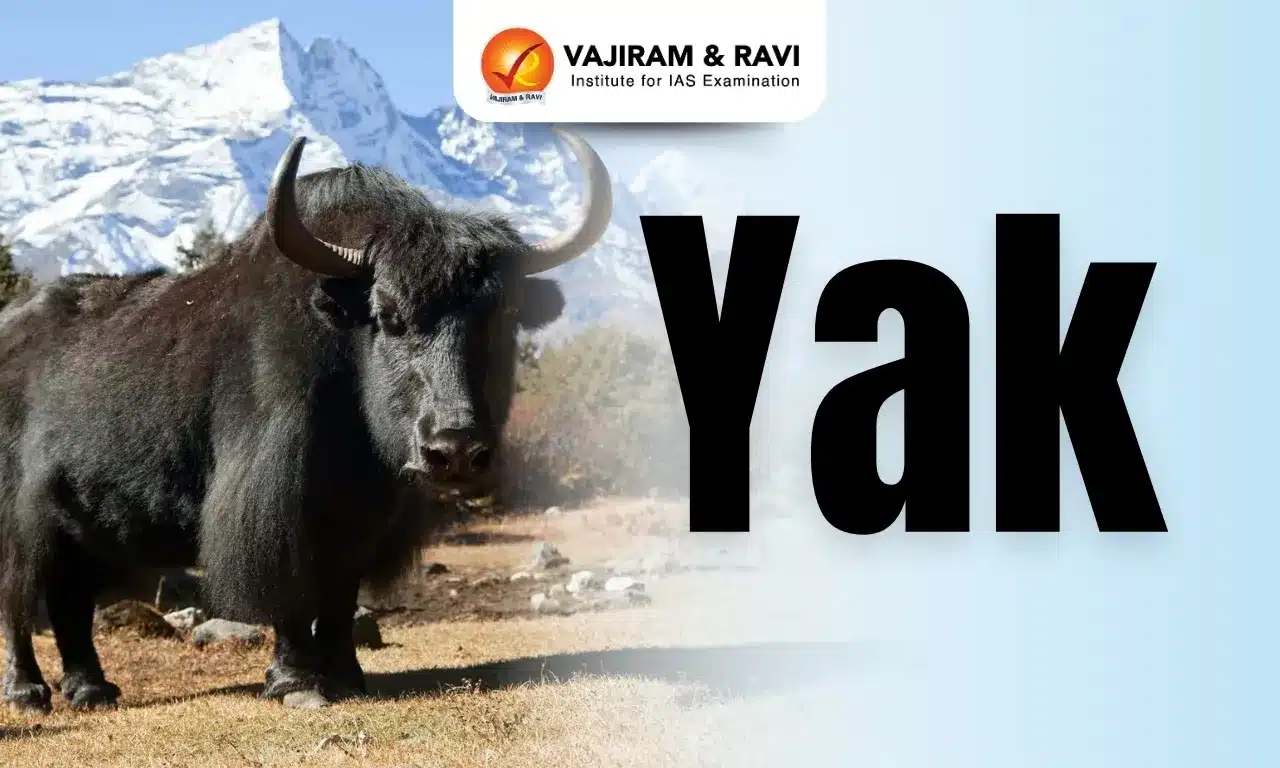
Yak

yak

Yak Latest News

A team of scientists has developed an Internet of Things (IoT)-based smart system to monitor the health of the high-altitude yaks and keep tabs on their movement near the international border in the Himalayas. 

About Yak

  • Yaks belong to the Bovini tribe, which also includes bison, buffaloes, and cattle. 
  • Habitat: Wild yaks inhabit alpine tundra at altitudes of 5000 to 7000 meters. They thrive in environments such as alpine meadows, alpine steppes, and desert steppes.
  • Distribution: Found throughout the Himalayan region, Tibetan plateau, Mongolia, and parts of South-Central Asia.
  • In India, yaks are reared in Arunachal Pradesh, Sikkim, Himachal Pradesh, Uttar Pradesh, and the union territories of Jammu & Kashmir and Ladakh.

Characteristics of Yak

  • This bovine animal has long been recognised for its resilience and adaptability to extreme conditions.
  • It features a thick, shaggy coat. This woolly fur provides insulation against the biting cold of high altitudes. 
  • They have large hearts and lungs, compact bodies, thick outer hair covering, and nonfunctional sweat glands, which help to withstand hypoxia and cold stress. 
  • Diet: Yaks are herbivorous, feeding on grasses and alpine plants.

Conservation Status of Yak

Source: TH

Yak FAQs

Q1: What is the IUCN status of Yak?

Ans: Vulnerable

Q2: What is the distribution of Yak in India?

Ans: Ladakh, J&K have highest population; Also in Arunachal Pradesh, Sikkim, Himachal Pradesh, Uttarakhand, North Bengal

Enquire Now