Senchal Wildlife Sanctuary

Senchal Wildlife Sanctuary

Senchal Wildlife Sanctuary Latest News

Recently, a black melanistic leopard cub has been spotted close to the Senchal Wildlife Sanctuary in the Darjeeling hills.

About Senchal Wildlife Sanctuary

  • Location: It is located in the state of West Bengal.
  • It is one of the oldest sanctuaries in India, having been established in 1915.
  • It is nestled in the biogeographic zone of Gangetic plain.
  • It is actually the south east extension of the Singalila National Park.
  • Vegetation: It mainly consists of temperate and alpine forest.
  • The elevation of the Sanctuary ranges from 1,500 to 2,600 m (4,900 to 8,500 ft). 
  • Flora: The forest has different kinds of trees and plantations including oak, pines and birch.
  • Fauna: It provides habitat for barking deer, wild boar, Himalayan black bear, Indian leopard, jungle cat, rhesus monkey, Assam macaque, Himalayan flying squirrel. 

What is Melanism?

  • It is the advanced version of the dark-coloured pigment called melanin found in the skin, hair, fur or feathers of various organisms.
  • It is supposedly the outcome of a genetic mutation, but can also occur due to peculiar temperature changes during gestation.
    • Melanistic Leopard is simply a leopard with a unique genetic trait which makes its coat appear almost completely black.

Source: TI

Senchal Wildlife Sanctuary FAQs

Q1: Which bird species is associated with Senchal Wildlife Sanctuary?

Ans: Tragopan

Q2: Senchal Wildlife Sanctuary was established in which year?

Ans: 1915

Impatiens Nimspurjai

Impatiens Nimspurjai

Impatiens Nimspurjai Latest News

Recently, a newly discovered Himalayan plant has been named Impatiens nimspurjai in honour of the legendary Nepali mountaineer. 

About Impatiens Nimspurjai

  • It is a new plant species of the touch-me-not family.
  • It is endemic to western Nepal and grows in temperate forests and forest margins at an elevation of 2,800-2,900 metres.
  • It was named in honour of the celebrated Nepali mountaineer Nirmal Purja.
  • Its botanical name combines "Nims Purja" with "jai", the Nepali word for jasmine.
  • Habitat: It grows on moist, humus rich slopes in temperate forest and forest-edge habitats.
  • It is closely related to Impatiens radiata, I. harae, and I. wallichii, other balsams native to the Himalayan region.
  • Characteristics of Impatiens Nimspurjai
    • It has sessile oblong-lanceolate leaves.
    • It is an annual herb reaching up to nearly a metre in height.
    • It is distinguished by its sessile, oblong to lanceolate leaves and small clusters of flowers flushed with yellow and tinged purple.

Source: TOI

Impatiens Nimspurjai FAQs

Q1: What is Impatiens nimspurjai?

Ans: It is a new plant species of the touch-me-not family.

Q2: Impatiens nimspurjai grows in which habitat?

Ans: Rocky crevices in moist shady hills

Friends of MY Bharat’ Initiative

Friends of MY Bharat’ Initiative

Friends of MY Bharat’ Initiative Latest News

Recently, the Ministry of Youth Affairs and Sports has launched a new digital initiative, ‘Friends of MY Bharat’ initiative.

About Friends of MY Bharat’ Initiative

  • It is an initiative of the Ministry of Youth Affairs and Sports.
  • It strengthens engagement with Indian-origin youth living across the world and provides them opportunities to participate in India’s nation-building and youth-led programmes.
  • It is developed through the Mera Yuva Bharat (MY Bharat) platform.

Features of Friends of MY Bharat’ Initiative

  • Global Youth Engagement: It will enable Indian-origin students, young professionals and other youth residing outside India to access information about nation-building activities, volunteering opportunities and youth programmes hosted on the MY Bharat platform.
  • Volunteering opportunities: It will also provide information on volunteering opportunities in areas such as education, environmental protection, health awareness, disaster relief and cultural preservation. 
  • A dedicated ‘Know Your India’ section will offer curated information on India’s culture, heritage, history, tourism, travel and prominent leaders. 
  • The initiative seeks to channel the ideas, skills, experiences and aspirations of global Indian youth towards India’s development journey.

What is MY Bharat Platform?

  • MY Bharat (Mera Yuva Bharat) was launched in October 2023 under the Ministry of Youth Affairs and Sports.
  • The initiative aims to place youth at the centre of nation-building by providing opportunities for volunteering, skill development, leadership and civic participation.
  • It serves as a digital platform that connects the Government, educational institutions, non-profit organisations and industry to create meaningful youth engagement.

Source: PIB

Friends of MY Bharat’ Initiative FAQs

Q1: What is the main objective of 'Friends of MY Bharat’?

Ans: Connect Indian diaspora and foreign nationals with Indian youth programs

Q2: 'Friends of MY Bharat’ is a part of which larger platform?

Ans: MY Bharat - Mera Yuva Bharat

Psammophaga holzmannae and Psammophaga sinhai

Psammophaga holzmannae and Psammophaga sinhai

Psammophaga holzmannae and Psammophaga sinhai Latest News

Scientists from Pune’s Agharkar Research Institute (ARI) recently discovered two new species of microscopic marine organisms named Psammophaga holzmannae and Psammophaga sinhai.

About Psammophaga holzmannae and Psammophaga sinhai

  • They are two new species of microscopic marine organisms that selectively pick up and swallow specific mineral grains from the seafloor.
  • They were found at Rajapuri Creek in Raigad district along Maharashtra’s Konkan coast.
  • Psammophaga is a type of foraminifera, a group of microscopic organisms commonly found in oceans.
  • The name comes from Greek words meaning 'sand eater'.
  • Unlike many foraminifera that have hard, multi-chambered shells, these organisms have just one chamber and a soft wall made mainly of very fine clay particles.
  • The newly identified organisms are extremely small. P. holzmannae measures between 103 and 246 micrometres, while P. sinhai is larger, measuring between 279 and 448 micrometres.
  • The two species also differ in shape and also in the way they store mineral grains.
    • P. holzmannae is oval to almost round and has an orange or yellowish interior. The mineral grains it swallows are mainly kept near an opening called the aperture.
    • P. sinhai is longer and may look like a droplet. Its mineral grains are spread throughout the body.
  • The most interesting discovery was what the organisms choose to eat.
    • Both species selectively take in heavy minerals containing titanium and iron. These include ilmenite and magnetite.
    • This is important because these minerals occur only in small amounts in the surrounding sediment.
  • So how do they do it? 
    • Psammophaga uses thin, temporary hair-like extensions called granuloreticulopodia
    • These extend from the aperture and help the organism interact with the surrounding sediment. 
    • Scientists believe these extensions may help the organism detect differences between mineral grains, although the exact mechanism is still not known.

News: TOI

Psammophaga holzmannae and Psammophaga sinhai FAQs

Q1: What are Psammophaga holzmannae and Psammophaga sinhai?

Ans: They are two newly identified species of microscopic marine organisms.

Q2: Where were Psammophaga holzmannae and Psammophaga sinhai discovered?

Ans: They were discovered at Rajapuri Creek in Raigad district, along Maharashtra’s Konkan coast.

Q3: What does the name Psammophaga mean?

Ans: Psammophaga comes from Greek words meaning “sand eater.”

Q4: Which minerals do the two Psammophaga species selectively consume?

Ans: They selectively consume heavy minerals containing titanium and iron, including ilmenite and magnetite.

Dimna Lake

Dimna Lake

Dimna Lake Latest News

Dimna Lake, Jamshedpur’s iconic reservoir and lifeline, was among 25 lakes across the country after which spectator galleries were named during the 80th Independence Day celebrations at Delhi’s Red Fort.

About Dimna Lake

  • It is an artificial lake located in the steel city of Jamshedpur in Jharkhand.
  • It is located in the foothills of the Dalma mountain range.  
  • Construction
    • Constructed under the Dimna Nala Water Supply Scheme by Tata Steel, the reservoir was built with a storage capacity of around 7,500 million gallons to meet the future water needs of a rapidly expanding industrial city. 
    • Work on the project began in 1940 and was completed in 1944, with water from the lake supplied to Jamshedpur for the first time on April 17, 1944. 
    • The lake was created by damming the Subarnarekha River and is spread over approximately 27 sq.km.
  • This lake is near the Dalma Wildlife Sanctuary, which is home to several species of deer and other animals like the sloth bear and the Indian wolf.  
  • The lake has facilities for water sports like jet skiing, rowing, and water scooting.

News: TOI

Dimna Lake FAQs

Q1: Where is Dimna Lake located?

Ans: It is located in the steel city of Jamshedpur in Jharkhand.

Q2: At the foothills of which mountain range is Dimna Lake located?

Ans: Dimna Lake is located at the foothills of the Dalma mountain range.

Q3: Which company constructed Dimna Lake?

Ans: Tata Steel constructed Dimna Lake.

Q4: When was the construction of Dimna Lake completed?

Ans: Construction was completed in 1944.

Q5: Which river was dammed to create Dimna Lake?

Ans: The Subarnarekha River was dammed to create Dimna Lake.

Sea Lice

Sea Lice

Sea Lice Latest News

A German biotech startup developing a feed-based nanoantibody treatment for sea lice has ambitions to use its platform technology to tackle bacterial, viral and parasitic diseases across aquaculture.

About Sea Lice

  • Sea lice are larvae from certain jellyfish and sea anemones that live in saltwater oceans and seas. 
  • Sea lice can be unpredictable because they drift with the currents. A beach that had sea lice one year may not have them the next, and vice versa. 
  • Despite the name, sea lice aren’t like head lice. But they’re about the same size (2 to 3 millimeters, about the size of a sesame seed). 
  • Because they’re so small and nearly see-through, sea lice are almost impossible to see with the naked eye. 
  • Unlike head lice, which bite and burrow into your scalp to feed on your blood, sea lice can sting. 
  • And those stings can cause a rash called seabather’s eruption. It can appear within minutes or up to a day after exposure.  
  • Although seabather’s eruption can be uncomfortable, it’s usually not a serious concern. It’s typically easy to spot and treat. 
  • A sea lice rash is usually:
    • Very itchy
    • Red and raised
    • Similar in appearance to small pimples, blisters, or welts
  • A sea lice rash tends to affect areas covered by your bathing suit. Pressure on the organisms from the bathing suit causes the stinging cells to discharge, releasing toxins into the skin.  
  • Sea lice can also get caught in hair on your head or body. While most cases are mild, some people may experience whole-body symptoms, like:
    • Abdominal pain
    • Diarrhea
    • Fever
    • Malaise (a general feeling of illness)
    • Nausea and vomiting
  • Seabather’s eruption can affect people of any age, but children often experience stronger symptoms.  
  • Most sea lice rashes improve within about two weeks, though more severe reactions may take up to a month to fully clear.

News: AN

Sea Lice FAQs

Q1: What are sea lice?

Ans: Sea lice are larvae of certain jellyfish and sea anemones that live in saltwater oceans and seas.

Q2: How do sea lice affect humans?

Ans: Sea lice can sting the skin, causing a rash known as seabather’s eruption.

Q3: Is seabather’s eruption usually a serious medical condition?

Ans: No. It is usually uncomfortable but not a serious concern.

Q4: Which parts of the body are most commonly affected by a sea lice rash?

Ans: It usually affects areas covered by a bathing suit.

National Medical Commission

National Medical Commission

National Medical Commission Latest News

The National Medical Commission (NMC) recently proposed a UID system for doctors, allowing nationwide practice without separate state registration or licenses.

About National Medical Commission

  • It is a statutory body constituted by the National Medical Commission Act, 2019, which came into force on September 25, 2020.
  • It replaced the Medical Council of India (MCI) and serves as the top regulatory authority for medical education, medical professionals, and medical institutions in India. 
  • It grants recognition of medical qualifications, gives accreditation to medical schools, grants registration to medical practitioners, monitors medical practice, and assesses the medical infrastructure in India.
  • Headquarters: New Delhi

National Medical Commission Functions

  • Establish Policies and Regulations: Laying down policies to maintain high quality and standards in medical education and making necessary regulations.
  • Regulate Medical Institutions and Professionals: Developing policies to regulate medical institutions, research, and professionals.
  • Assess Healthcare Needs: Assessing the requirements in healthcare, including human resources and healthcare infrastructure, and developing a roadmap to meet these needs.
  • Coordinate Autonomous Boards: Promoting, coordinating, and framing guidelines for the proper functioning of the Commission, Autonomous Boards, and State Medical Councils.
  • Ensure Compliance: Ensuring that State Medical Councils comply with the guidelines and regulations framed by the NMC.
  • Exercise Appellate Jurisdiction: Acting as an appellate body for decisions made by the Autonomous Boards.
  • Promote Ethical Conduct: Laying down policies and codes to ensure observance of professional ethics in the medical profession.
  • Frame Fee Guidelines: Framing guidelines for determining fees and other charges for 50% of seats in private medical institutions and deemed universities.
  • Other Powers and Functions: Performing such other functions as may be prescribed.

National Medical Commission Composition

  • It consists of 33 members, including the Chairperson (medical professionals only), 10 ex-officio members and 22 part-time members.
  • Medical Advisory Council: It provides the platform through which the States or UTs can put forth their views and concerns before the NMC and advises the NMC on measures to determine and maintain minimum standards of medical education.
  • Four autonomous boards:
    • Under-Graduate Medical Education Board
    • Post-Graduate Medical Education Board
    • Medical Assessment and Rating Board
    • Ethics and Medical Registration Board

News: TH

National Medical Commission FAQs

Q1: What is the National Medical Commission (NMC)?

Ans: The NMC is a statutory body and the apex regulatory authority for medical education, medical professionals and medical institutions in India.

Q2: Under which Act was the National Medical Commission constituted?

Ans: The NMC was constituted under the National Medical Commission Act, 2019.

Q3: Which organisation was replaced by the National Medical Commission?

Ans: The NMC replaced the Medical Council of India (MCI).

Q4: How many members does the National Medical Commission consist of?

Ans: It consists of 33 members, including the Chairperson (medical professionals only), 10 ex-officio members and 22 part-time members.

Glyphosate

Glyphosate

Glyphosate Latest News

Recently, environmentalists have raised concern over the alleged use of glyphosate on forest department land for pea cultivation in parts of Himachal Pradesh. 

About Glyphosate

  • It is a widely used herbicide that can kill certain weeds and grasses.
  • Glyphosate is a small molecule made of a linear carbon chain with weaker bonds, which makes glyphosate less persistent in the environment.
  • It is considered a broad-spectrum herbicide, meaning it can effectively control a wide variety of plants, including grasses, broadleaf plants, and woody plants.
  • Impact of Glyphosate
    • Herbicidal Action: It works by inhibiting an enzyme called EPSP synthase, which is essential for the synthesis of certain amino acids that plants need for growth.
      • It disrupts this enzyme; glyphosate interferes with the plant’s ability to produce proteins, leading to the eventual death of the plant.
    • Broad-Spectrum: It is effective only on plants that grow above the water. It will not be effective on plants that are submerged or have most of their foliage underwater, nor will it control regrowth from seed.
    • Glyphosate is degraded in soil and water by microbes and binds tightly to soil particles, which prevents the leaching of glyphosate into groundwater.
    • Glyphosate does not degrade quickly in plants. As a result, it is possible that glyphosate residues can occur in food products.

Source: DTE

Glyphosate FAQs

Q1: Glyphosate is regulated in India under which act?

Ans: Insecticides Act, 1968

Q2: What is Glyphosate?

Ans: It is a herbicide.

Sawalkote Hydroelectric Project

Sawalkote Hydroelectric Project

Sawalkote Hydroelectric Project Latest News

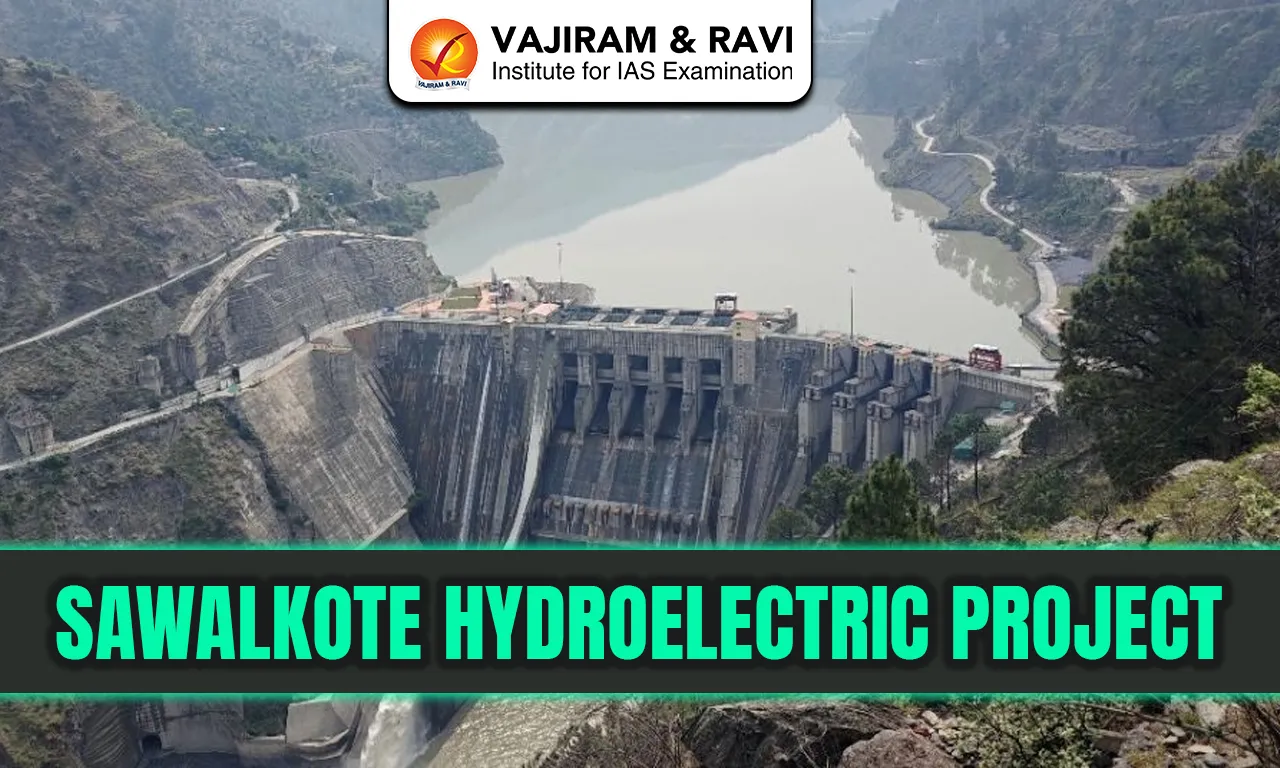
Deputy Commissioners of Udhampur and Ramban, along with senior district officials, recently visited the headquarters of the Sawalkote Hydroelectric Project at Tanger to take stock of progress made on the 1,800 MW project.

About Sawalkote Hydroelectric Project

  • It is a 1,856-MW hydropower plant on the Chenab River in the Udhampur and Ramban districts of Jammu and Kashmir. 
  • It has been designed as a run-of-the-river scheme located between the Baglihar project upstream and the Salal project downstream, making it part of a continuous chain of hydropower installations on the Chenab
  • It will be the largest hydroelectric project in the Union Territory and one of the biggest in North India.
  • The project is being built by the National Hydroelectric Power Corporation (NHPC).
  • Classified as a project of national importance, it will feature a 192.5-meter concrete gravity dam and a reservoir covering more than 1,100 hectares.  
  • It will comprise nine turbines and an underground power station. 
  • It will produce around 8000 million units of electricity every year.
  • By regulating the flow of the Chenab River, the Sawalkote project could contribute to flood mitigation downstream, while also ensuring better water management for agriculture and domestic use.
  • It is a key part of India’s plan to fully utilise its share of water from the western rivers under the 1960 Indus Waters Treaty (IWT). 
  • It is the first major hydropower project on the Indus rivers to be accorded environmental clearance following India’s suspension of the Indus Waters Treaty (IWT) on April 23, 2025, following the Pahalgam terror attack.

News: DE

Sawalkote Hydroelectric Project FAQs

Q1: Where is the Sawalkote Hydroelectric Project located?

Ans: It is located on the Chenab River in the Udhampur and Ramban districts of Jammu and Kashmir.

Q2: What is the capacity of the Sawalkote Hydroelectric Project?

Ans: The Sawalkote Hydroelectric Project has a capacity of 1,856 MW.

Q3: What type of hydropower scheme is the Sawalkote project?

Ans: It is designed as a run-of-the-river hydropower scheme.

Q4: Which organisation is constructing the Sawalkote Hydroelectric Project?

Ans: The project is being constructed by the National Hydroelectric Power Corporation (NHPC).

Methamphetamine

Methamphetamine

Methamphetamine Latest News

Recently, the Directorate of Revenue Intelligence (DRI) has foiled a major attempt to illegally export a significant quantity of Methamphetamine from India to Saudi Arabia.   

About Methamphetamine

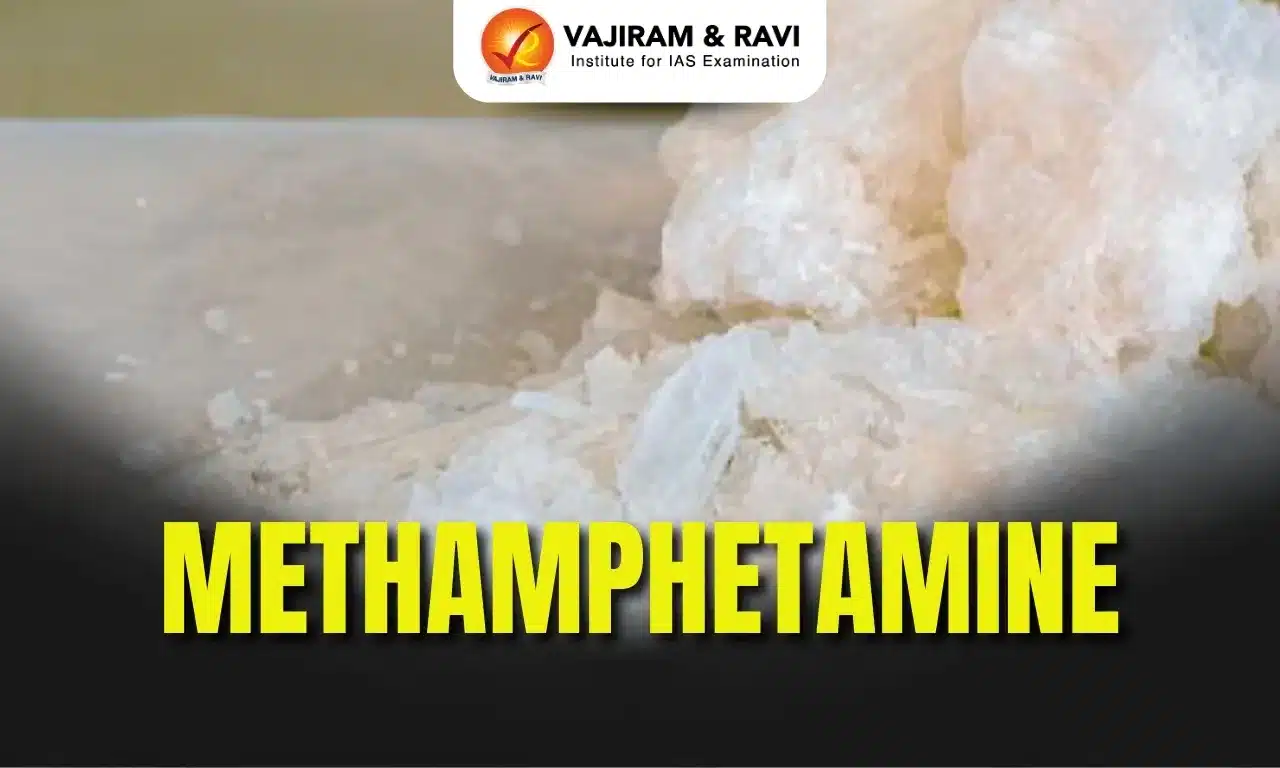
  • It is a powerful, highly addictive stimulant that affects the central nervous system.
  • It is also known as meth, chalk, ice, and crystal.
  • It was developed early in the 20th century from its parent drug, amphetamine, and was used originally in nasal decongestants and bronchial inhalers.

Properties of Methamphetamine

  • It is a member of the class of amphetamines.
  • It takes the form of a white, odorless, bitter-tasting crystalline powder that easily dissolves in water or alcohol.
  • It has a role as a neurotoxin, a psychotropic drug, a central nervous system stimulant, a xenobiotic and an environmental contaminant.

Impact of Methamphetamine on Humans

  • It causes increased activity and talkativeness, decreased appetite, and a pleasurable sense of well-being or euphoria. 
  • The use of methamphetamine in higher doses can induce psychosis, bleeding in the brain, skeletal muscle breakdown, and seizures.

Source: PIB

Methamphetamine FAQs

Q1: Which neurotransmitter is mainly affected by Methamphetamine?

Ans: Dopamine

Q2: What is Methamphetamine ?

Ans: It is a is a powerful, highly addictive stimulant that affects the central nervous system.

Enquire Now