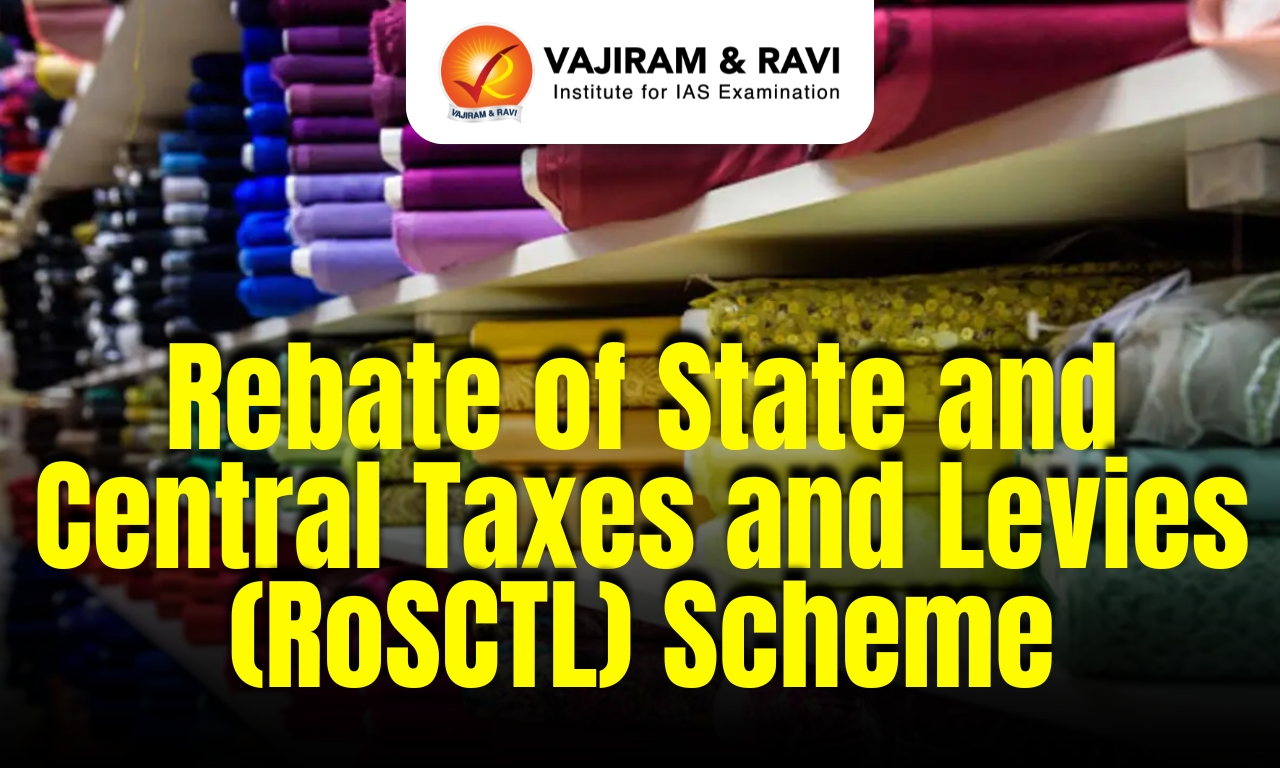
Rebate of State and Central Taxes and Levies (RoSCTL) Scheme Latest News
The government may extend the tenure of the Rebate of State and Central Taxes and Levies (RoSCTL) scheme, an export-boosting incentive for the textile sector, beyond September 30, an official aware of the matter said recently.
About Rebate of State and Central Taxes and Levies (RoSCTL) Scheme
- It is a significant export incentive framework introduced by the Ministry of Textiles in March 2019.
- Objective: To compensate for the State and Central Taxes and Levies in addition to the Duty Drawback Scheme on export of apparel/garments and Made-ups by way of rebate.
- It aims to reimburse all embedded State and Central Taxes/Levies for exports of manufactured goods and garments.
- These taxes are incurred during the production of garments and made-ups before export.
- It has been established as a successor for the old “Rebate of State Levies (RoSL) Scheme.
- The difference between the RoSL & RoSCTL Schemes is that under the RoSL Scheme, there was no benefit on the central tax and levies.
- But in the RoSCTL scheme, the exporter will get a rebate of both State and Central tax and Levies.
Why is Rebate of State and Central Taxes and Levies (RoSCTL) Scheme Important?
- Many taxes (like electricity duty, mandi tax, fuel tax, etc.) get embedded in production costs.
- These cannot be claimed through GST or duty drawback.
- RoSCTL refunds these leftover taxes, reducing production cost and increasing competitiveness.
- It is based on an internationally acceptable principle that taxes and duties should not be exported, to enable a level playing field in the international market for exports.
- Hence, not only indirect taxes on inputs are to be rebated or reimbursed, but also other un-refunded State & Central taxes and levies are to be rebated.
Rebate of State and Central Taxes and Levies (RoSCTL) Scheme Features
- It provides transferable and sellable duty credit scrips to exporters based on the Free on-board (FOB) value of their exports.
- The scrips shall be issued electronically on the Customs system.
- The duty credit scrips shall be used for payment of Basic Customs Duty on the import of goods. These scrips shall be freely transferable.
- The duty credit available in an e-scrip shall be transferred at a time for the entire amount in the said e-scrip to another person, and transfer of the duty credit in part shall not be permitted.
- Validity of e-scrip: The period of validity of the e-scrip, of one year from its creation, shall not change on account of transfer of the e-scrip.
- Eligibility: All exporters of garments/apparel and made-ups manufactured in India are eligible to take benefit under this scheme, except entities/IECs under the Denied Entity List of the Directorate General of Foreign Trade (DGFT).
- Implementing agency: It is implemented by the Department of Revenue, Ministry of Finance.
News: BS
Rebate of State and Central Taxes and Levies (RoSCTL) Scheme FAQ's
Q1: What is the Rebate of State and Central Taxes and Levies (RoSCTL) Scheme?
Ans: It is an export incentive scheme that provides rebates on embedded State and Central taxes and levies on exported apparel, garments and made-ups.
Q2: Which Ministry introduced the Rebate of State and Central Taxes and Levies (RoSCTL) Scheme?
Ans: The Ministry of Textiles introduced the scheme.
Q3: What is the main objective of the Rebate of State and Central Taxes and Levies (RoSCTL) Scheme?
Ans: Its main objective is to rebate State and Central taxes and levies embedded in the production of exported apparel, garments and made-ups.
Q4: Why is the Rebate of State and Central Taxes and Levies (RoSCTL) Scheme important for exporters?
Ans: It helps refund un-reimbursed taxes and levies embedded in production costs, thereby reducing costs and improving the competitiveness of Indian exports.
Q5: What does Rebate of State and Central Taxes and Levies (RoSCTL) Scheme provide to eligible exporters?
Ans: It provides transferable and sellable duty credit e-scrips.