Nanda Devi Biosphere Reserve

Nanda Devi Biosphere Reserve

Nanda Devi Biosphere Reserve Latest News

A new report “Nanda Devi Biosphere Decadal Monitoring Campaign 2026”,  has found that landslide-prone zones in the core have nearly doubled over the past decade. 

About Nanda Devi Biosphere Reserve

  • Location: It is one of India’s most important protected mountain ecosystems located in the Western Himalayas of Uttarakhand.
  • It includes the Nanda Devi National Park and the Valley of Flowers National Park, both of which are designated as UNESCO World Heritage Sites.
  • The reserve is recognised under UNESCO’s Man and the Biosphere (MAB) Programme.
  • Geographical Features
    • It consists of rugged mountain ranges, deep gorges, glaciers and snow-covered peaks.
    • Elevation ranges from about 1,800 metres to over 7,800 metres,
    • Glaciers: Numerous glaciers, including the Uttari Rishi, Dakshini Rishi, Trisul and Ramani glaciers.
  • Vegetation: Alpine meadows (Bugyals), temperate forests and sub-alpine vegetation dominate the landscape.
  • Rivers: The Rishi Ganga River originates from the glaciers within the Nanda Devi Sanctuary. It joins the Dhauliganga River, which is a tributary of the Alaknanda River.
  • Flora: Temperate forests contain oak, deodar, blue pine, fir, spruce and rhododendron.
  • Fauna: Snow Leopard, Himalayan Musk Deer, Himalayan Tahr, Bharal (Blue Sheep), Asiatic Black Bear and Common Leopard.

Source: NIE

Nanda Devi Biosphere Reserve FAQs

Q1: Where is Nanda Devi Biosphere Reserve located?

Ans: Uttarakhand

Q2: What type of vegetation is found in Nanda Devi Biosphere Reserve?

Ans: Alpine meadows (Bugyals), temperate forests and sub-alpine vegetation dominate the landscape.

Central Asian Flyway Digital Hub

Central Asian Flyway Digital Hub

Central Asian Flyway Digital Hub Latest News

The Central Asian Conservation Network (CACN) has launched a new Central Asian Flyway Digital Hub, according to a recent statement by the organisation. 

About Central Asian Flyway Digital Hub

  • It is developed by the Central Asian Conservation Network (CACN).
  • Its aim is to strengthen the sharing of knowledge and information for the conservation of migratory birds across one of the world’s major migration routes.
  • It brings together information on bird species, important flyway sites, conservation initiatives, educational resources and participation opportunities across the flyway.
  • It will also provide dedicated portals for recording bird collisions and sightings of marked birds.

Features of Central Asian Flyway Digital Hub

  • Collection of educational and awareness materials: These are designed to make the story of migratory birds accessible to children, teachers, communities, birdwatchers and the wider public.
  • Bird Collision Reporting Portal: It is for documenting bird deaths and injuries caused by infrastructure, and a
  • Ringing and Resighting Portal: It is for recording observations of marked birds and understanding migration routes.
  • It will continue to expand with new species information, educational resources, conservation projects and monitoring data.

Source: DIE

Central Asian Flyway Digital Hub FAQs

Q1: Who developed the Central Asian Flyway Digital Hub?

Ans: It is developed by the Central Asian Conservation Network (CACN).

Q2: What is the aim of Central Asian Flyway Digital Hub?

Ans: Its aim is to strengthen the sharing of knowledge and information for the conservation of migratory birds across one of the world’s major migration routes.

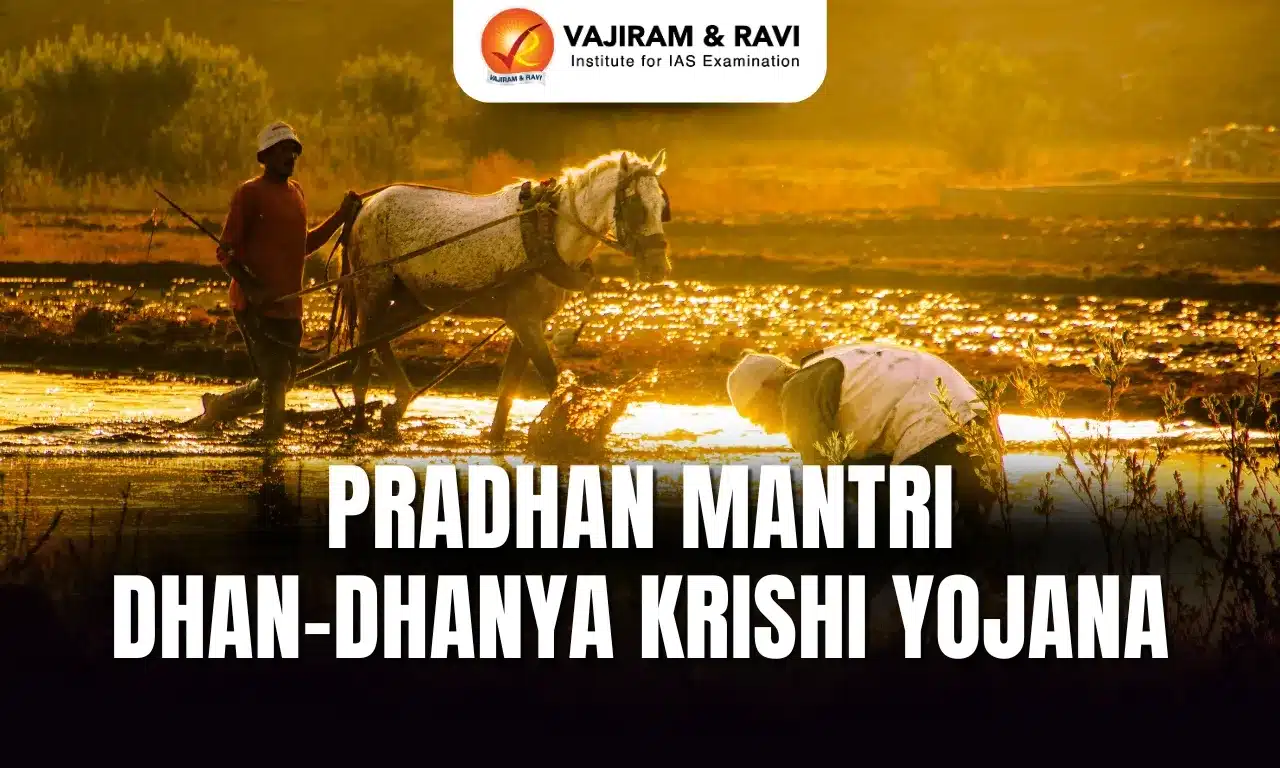
Pradhan Mantri Dhan-Dhanya Krishi Yojana

Pradhan Mantri Dhan-Dhanya Krishi Yojana

Pradhan Mantri Dhan-Dhanya Krishi Yojana Latest News

Recently, the Prime Minister Dhan-Dhanya Krishi Yojana (PMDDKY) completed its first year  marking a year of focused district-level action.

About Pradhan Mantri Dhan-Dhanya Krishi Yojana

  • It was launched in 2025 to support farmers.
  • The objective of the scheme is to
    • Enhance agricultural productivity,
    • Increase adoption of crop diversification and sustainable agricultural practices,
    • Augment post-harvest storage at the panchayat and block levels,
    • Improve irrigation facilities, and
    • Facilitate availability of long-term and short-term credit.
  • It bridges developmental gaps by integrating 36 schemes from 11 different departments, ensuring convergence in efforts and efficient resource utilisation.
  • It focuses on transforming agriculture and allied activities across 100 Aspirational Agricultural Districts.
  • These districts were identified using three key indicators: low productivity, low cropping intensity, and less agricultural credit disbursement.
  • The selection also considered the share of net cropped area and operational holdings in each State and Union Territory. Each State has at least one selected district.
  • Time Period: It is a six-year initiative, beginning with 2025-26.

Administrative Structure for Implementation

  • The PMDDKY scheme follows a three-tier implementation structure-
    • District Level: The District Dhan Dhaanya Krishi Yojana Samiti, headed by the District Collector/DM, prepares and implements the District Action Plan.
    • State Level: The State Dhan Dhaanya Krishi Yojana Samiti, headed by the Chief Secretary of the State, reviews and monitors the District Plans.
    • National Level: Two committees oversee the scheme. The National Executive Committee is headed by the Union Minister for Agriculture and Farmers Welfare. The National Monitoring Committee is headed by the Secretary, DA&FW.

Source: PIB

Pradhan Mantri Dhan-Dhanya Krishi Yojana FAQs

Q1: What is the objective of Pradhan Mantri Dhan-Dhanya Krishi Yojana?

Ans: Increase adoption of crop diversification and sustainable agricultural practices,

Q2: What is the time period of Pradhan Mantri Dhan-Dhanya Krishi Yojana?

Ans: It is a six-year initiative, beginning with 2025-26.

National Disaster Management Authority (NDMA)

National Disaster Management Authority

National Disaster Management Authority (NDMA) Latest News

Prime Minister Narendra Modi on August 29, 2025, nominated two people as new members of the National Disaster Management Authority (NDMA) and re-nominated three existing members for three years.

About National Disaster Management Authority (NDMA)

  • Establishment: The NDMA, established under the Disaster Management Act, 2005, is the country's apex body for disaster management and is chaired ex officio by the Prime Minister of India.
  • Objectives: NDMA is responsible for laying down the national policies, plans, and guidelines for disaster management, coordinating and enforcing implementation of these policies, and approving plans developed by ministries, states, and other agencies to ensure integrated responses to disasters.
  • Vision: NDMA's vision is to build a safer and disaster-resilient India through proactive, technology-driven, and sustainable strategies involving all stakeholders.

NDMA Organisation Structure

  • Composition: The NDMA is chaired by the Prime Minister of India, assisted by a Vice-Chairperson (Cabinet Minister rank) and up to eight Members (Minister of State rank).
  • Divisions: It operates through specialized divisions, including Policy & Plans, Mitigation, Operations, Communications & IT, Administration, and Finance.
  • Institutional Mechanism: At the state and district levels, State Disaster Management Authorities (SDMAs) and District Disaster Management Authorities (DDMAs) function under NDMA’s overall framework and guidelines.

NDMA Functions and Responsibilities

NDMA, as the apex body, is mandated to lay down the policies, plans and guidelines for Disaster Management to ensure timely and effective response to disasters. Towards this, it has the following responsibilities:-

  • Laying down policies, approving the National Disaster Management Plan.
  • Framing guidelines for central and state authorities, integrating mitigation measures into development plans.
  • Coordinating the enforcement and implementation of disaster management policies and plans.
  • Recommending provision of funds for mitigation efforts and capacity building.
  • Supporting international disaster relief as directed by the central government.
  • Overseeing the functioning of the National Institute of Disaster Management (NIDM).
  • Training officials, conducting preparedness drills, and developing community resilience strategies.

Source: TH

National Disaster Management Authority (NDMA) FAQs

Q1: Who heads the National Disaster Management Authority in India?

Ans: The National Disaster Management Authority of India is headed by the Prime Minister.

Q2: Under which Ministry is NDMA?

Ans: NDMA operates under the Ministry of Home Affairs.

Q3: What are the 12 natural disasters under NDMA?

Ans: NDMA covers disasters like floods, earthquakes, cyclones, droughts, landslides, avalanches, tsunamis, forest fires, pest attacks, nuclear, chemical, and biological emergencies.

Q4: Where is the headquarter of NDMA?

Ans: NDMA headquarters is located in New Delhi, India.

Epstein – Barr Virus (EBV)

Epstein - Barr virus

Epstein - Barr Virus (EBV) Latest News

According to the World Health Organization’s International Agency for Research on Cancer analysis, Epstein-Barr virus (EBV) is one of the causative agents responsible for a substantial cancer burden worldwide in 2024.

About Epstein - Barr Virus

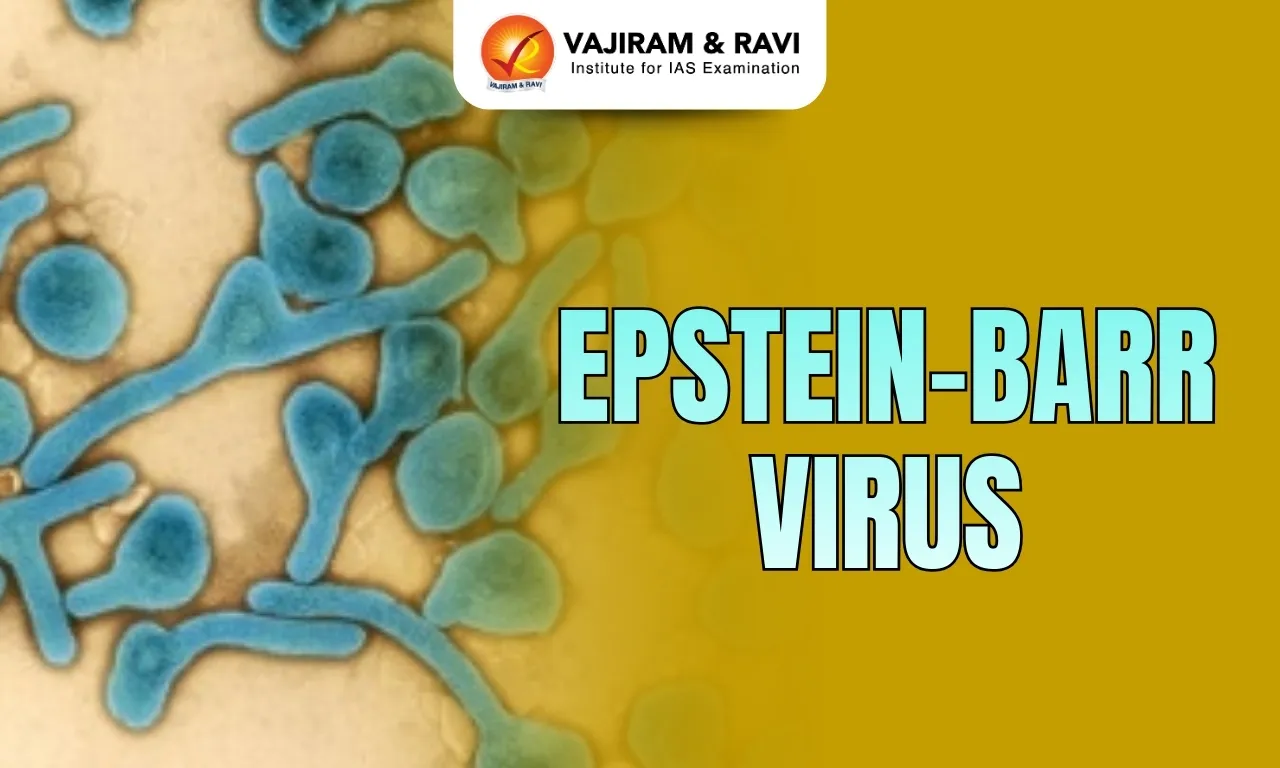
  • EBV, also known as human herpesvirus 4, belongs to the herpesvirus family.
  • Transmission: It spreads mainly through saliva, including through kissing or sharing drinks, food, eating utensils and toothbrushes.
  • Symptoms 
    • Many people infected with EBV have no symptoms. When illness occurs, symptoms can include fever, sore throat, swollen lymph nodes and marked fatigue.
    • After the initial infection, EBV remains in the body in a dormant state.
  • EBV is classified by IARC as a Group 1 carcinogen.
  • Most cases of Epstein-Barr virus affect children, teenagers and young adults, but anyone can get the virus.
  • It usually does not cause any harm, but the virus gets reactivated inside the body in some unusual conditions like immunological stress or immunocompetence.
  • This may further lead to various complications like a type of blood cancer called Burkitt’s lymphoma, stomach cancer, multiple sclerosis.
  • Treatment: There is no specific treatment for EBV. However, some things like drinking fluids to stay hydrated, getting plenty of rest can be done to help relieve symptoms.

Source: TEpstein - Barr Virus (EBV)H

Epstein - Barr Virus (EBV) FAQs

Q1: What is Epstein - Barr Virus (EBV)?

Ans: EBV, also known as human herpesvirus 4, belongs to the herpesvirus family.

Q2: How does Bpstein - Barr virus transmits?

Ans: It spreads mainly through saliva, including through kissing or sharing drinks, food, eating utensils and toothbrushes.

Project Seabird

Project Seabird

Project Seabird Latest News

Recently, the Chief of the defence staff inaugurated critical trunk utility and amenity infrastructure for the Indian Navy as part of Project Seabird Phase IIA at the naval base in Karnataka’s Karwar. 

About Project Seabird

  • It is the largest naval infrastructure project for India.
  • Location: It involves creation of a naval base at Karwar, Karnataka, on the west coast of India. 
  • It is a massive project spread over around 11,000 acres of land. With the first sealift facility in the country and a transfer system for docking and undocking ships and submarines.
  • Phases of Project Seabird
    • Phase 1: Its first phase, which included the construction of a deep-sea harbour, breakwaters dredging, a township, a naval hospital, a dockyard uplift centre and a ship lift, was commissioned in 2005.
    • Phase 2: The development of phase 2 of INS Kadamba commenced in 2011.
    • This phase is further divided into 2A and 2B. It was planned to expand the facilities to dock additional warships and a new Naval Air Station, among other projects. 
  • Once completed, it will be the largest naval base in the Eastern Hemisphere.
  • It will be able to accommodate around 32 warships, 23 submarines, and hangers for several aircraft.

Source: TOI

Project Seabird FAQs

Q1: What is Project Seabird?

Ans: It is the largest naval infrastructure project for India.

Q2: Where the Project Seabird is implementing by the Indian Navy?

Ans: It involves creation of a naval base at Karwar, Karnataka, on the west coast of India. 

Red-Headed Vulture

Red-Headed Vulture

Red-Headed Vulture Latest News

Recently, a rare red-headed vulture sighted at an altitude of about 2,650 metres in Uttarakhand's Munsiyari. 

About Red-Headed Vulture

  • The Red-headed vulture (Sarcogyps calvus) is an Old World vulture.
  • Other Names: It is also known as the Asian king vulture, Indian black vulture, or Pondicherry vulture.
  • Appearance: It is a dark, medium-sized vulture with a bare reddish head and loose flaps on the side of the neck.
  • Habitat: They are usually found in open country and in cultivated and semi-desert areas, deciduous forests, foothills, river valleys and also in mountainous regions.
  • Distribution: It is mainly found in South Asia with small disjunct populations in some parts of Southeast Asia.
    • Typically found in Central India, Nepal, Myanmar, Thailand, Vietnam, and parts of Kerala, Karnataka, and Tamil Nadu.
  • Breeding: Breeding typically takes place between November and January.
  • Diet: These are scavenging birds, feeding mostly on carcasses of dead animals which they find by sight.
  • Threats: It was extensively found in India but its numbers drastically reduced after diclofenac poisoning

Conservation Status of Red-Headed Vulture

  • IUCN Red List: Critically Endangered
  • Wildlife Protection Act, 1972: Schedule 1

Source: NIE

Red-Headed Vulture FAQs

Q1: Where do we find Red-Headed Vulture?

Ans: It is mainly found in South Asia with small disjunct populations in some parts of Southeast Asia.

Q2: What is the IUCN status of Red-Headed Vulture?

Ans: Critically Endangered

Panama

Panama

Panama Latest News  

An earthquake with a preliminary magnitude of 7.7 hit Panama causing structures to collapse and shaking the capital of the Central American country. 

About Panama  

  • Location: It is a country of Central America located on the Isthmus of Panama.
  • Bordering Countries: It is bordered by Costa Rica and Colombia.
  • Water Bodies: It is bounded by the Caribbean Sea to the north and by the Pacific Ocean to the south.
  • Capital City: Panama City.

Geographical Features of Panama

  • Climate: Panama has a moist tropical and subtropical climate. 
  • Lakes: Lake Gatun which also plays a vital role in the operation of the Panama Canal.
  • River: Tuira River is the longest river of Panama.
  • Mountain Range: The Cordillera Central, or Central Mountain Range, runs down the middle of Panama.
  • Natural Resources: It mainly consists of gold, copper, manganese, and iron.

Source: Reuters

Panama FAQs

Q1: Where is Panama located?

Ans: It is a country of Central America located on the Isthmus of Panama.

Q2: Which countries border Panama?

Ans: It is bordered by Costa Rica and Colombia.

INS Shreyas

INS Shreyas

INS Shreyas Latest News

Recently, the INS Shreyas was launched by the Garden Reach Shipbuilders and Engineers Ltd. 

About INS Shreyas

  • It is the third of four next-generation offshore patrol vessels.
  • These ships derive their names from India’s rich heritage, with this ship being named as ‘Shreyas’, meaning ‘Best’ or ‘Most Excellent’ in Sanskrit.
  • It is being built by defence PSU Garden Reach Shipbuilders and Engineers (GRSE) Ltd for the Indian Navy.

Features of INS Shreyas

  • Measure: It measures about 113 metres in length and 14.6 metres in width.
  • Speed and Capacity: It will be capable of achieving speeds of up to 23 knots and have an endurance of 8,500 nautical miles.
  • Operations: It is designed for a wide range of maritime operations, the NGOPVs will undertake coastal and offshore asset protection, maritime interdiction, surveillance, mine warfare and special operations.

Source: TOI

INS Shreyas FAQs

Q1: What is INS Shreyas?

Ans: It is the third of four next-generation offshore patrol vessels.

Q2: What is the speed and capacity of INS Shreyas?

Ans: It will be capable of achieving speeds of up to 23 knots and have an endurance of 8,500 nautical miles.

Khadi and Village Industries Commission (KVIC)

Khadi and Village Industries Commission

Khadi and Village Industries Commission (KVIC) Latest News

Khadi and Village Industries (KVI) commission has continued to play a significant role in promoting rural livelihoods, generating employment and strengthening the vision of an Atmanirbhar Bharat. 

About Khadi and Village Industries Commission

  • It is a statutory body established under the Khadi and Village Industries Commission Act of 1956.
  • Nodal Ministry: It is an apex organization under the Ministry of Micro, Small, and Medium Enterprises.
  • It is charged with the planning, promotion, organisation and implementation of programmes for the development of Khadi and other village industries in rural areas.
  • Organisation Structure: At the state level, Khadi & Village Industries Boards were set up to effectively implement the schemes of KVIC in their respective states.
  • Objectives of the KVIC are
    • Social Objective: To provide employment in rural areas
    • Economic Objective: To produce a saleable product
    • Wider Objective: To create self-reliance among the economically weaker section.

Functions of the KVIC

  • Strategic Reserve: To build a strategic reserve of raw materials and implements for supply to producers.
  • Processing: To create common service facilities for processing raw materials as semi-finished goods and provisions for facilities for marketing KVI products.
  • Marketing: To enhance the sale and marketing of Khadi and other products of village industries or handicrafts.
  • Research: To be responsible for encouraging and promoting research in the production techniques.
  • Standards: To assure the genuineness of the products and to set standards for the quality of products from Khadi and Village Industries.

Source: PIB

Khadi and Village Industries Commission FAQs

Q1: What is Khadi and Village Industries Commission?

Ans: It is a statutory body established under the Khadi and Village Industries Commission Act of 1956.

Q2: Khadi and Village Industries Commission works under which ministry?

Ans: Ministry of Micro, Small, and Medium Enterprises

Bathukamma Festival

Bathukamma Festival

Bathukamma Festival Latest News

Telangana's special festival of flowers Bathukamma, began with Engilipula Bathukamma. 

About Bathukamma Festival

  • It is a floral festival celebrated by the women folk of Telangana.
  • History Behind Bathukamma
    • The term “Bathukamma” translates to “Mother Goddess Come Alive”, reflecting the divine feminine energy and protection.
    • Folklore connects the festival to legends of Goddess Gauri and her miraculous survival as well as King Dhramangada and Queen Satyavati of the Chola dynasty. 
    • Historically, the Kakatiya dynasty emphasized Bathukamma as a celebration of feminine strength and agricultural prosperity.
  • Every year this festival is celebrated usually in September–October of the Gregorian calendar.
  • Cultural Traditions: It is celebrated for nine days during Durga Navratri and the 9-day festivities will culminate on “Saddula Bathukamma” or “Pedda Bathukamma” festival.
  • Bathukamma is followed by Boddemma, which is a 7-day festival.
  • State Festival: It has been declared as the Telangana State Festival.

Source: News On Air

Bathukamma Festival FAQs

Q1: Where is Bathukamma Festival celebrated?

Ans: Telangana

Q2: When is Bathukamma Festival celebrated?

Ans: Every year this festival is celebrated usually in September–October of the Gregorian calendar.

What is Proportional Representation?

Proportional Representation

About Proportional Representation:

  • The Proportional Representation (PR) system ensures representation of all parties based on their vote share.
  • The most commonly used PR system is the ‘party list PR’ where voters vote for the party (and not individual candidates) and then the parties get seats in proportion to their vote share.

First Past the Post System:

  • India currently uses the First Past the Post (FPTP) system, where the candidate with the most votes in a constituency wins.
  • The FPTP system is simple and provides stability to the executive, but it can lead to unrepresentative governments.

Mixed Member Proportional Representation (MMPR):

  • To balance stability and proportionate representation, the Mixed Member Proportional Representation (MMPR) system can be considered.

Under MMPR, there is one candidate elected through FPTP from each territorial constituency, and additional seats are allocated to parties proportionally based on their vote share.


Q1. What is the strength of the Rajya Sabha?

The Rajya Sabha should consist of not more than 250 members - 238 members representing the States and Union Territories, and 12 members nominated by the President. The Rajya Sabha currently has 245 members, including 233 elected members and 12 nominated.

Source: Is it time for proportional representation? | Explained

Enquire Now