
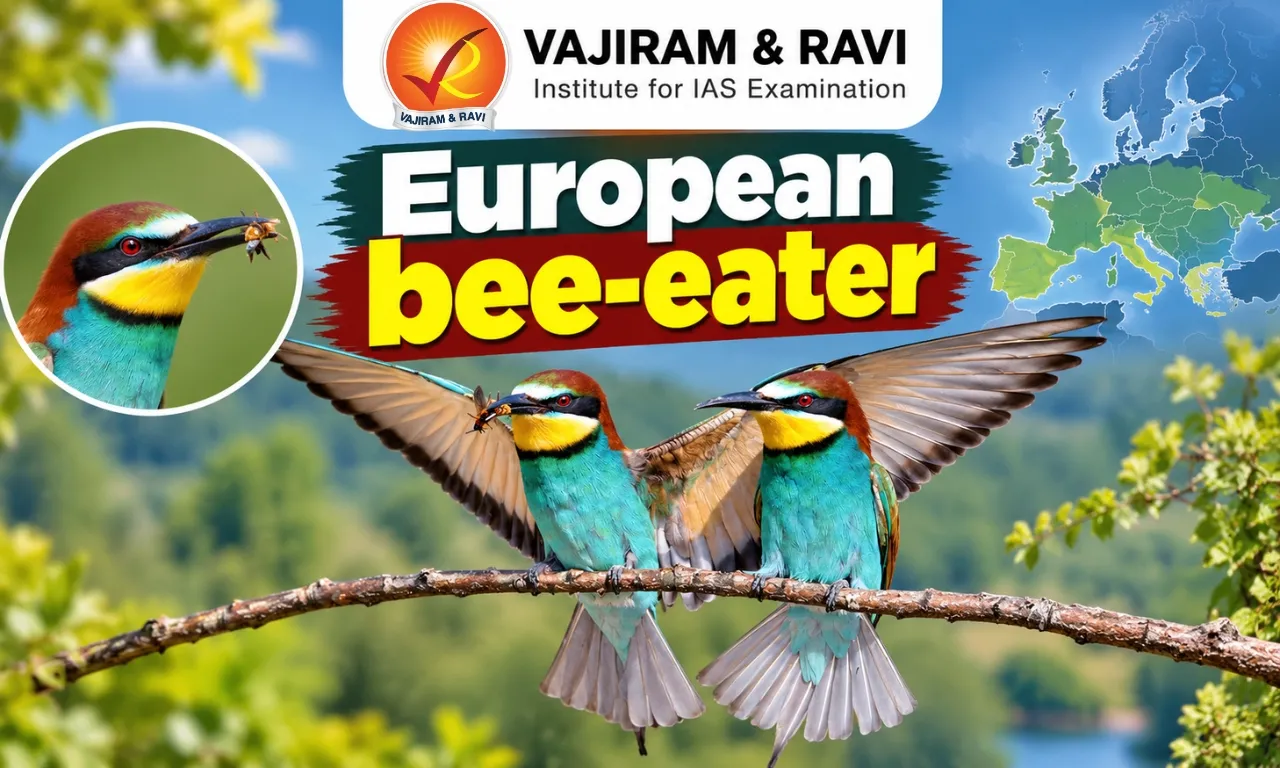
European Bee-Eater

European Bee-Eater

European Bee-Eater Latest News

Recently, for the first time recorded sightings of European Bee-eater in Chennai.

About European Bee-Eater

  • It is a near passerine bird in the bee-eater family, Meropidae. 
  • These brightly-colored birds predominantly eat flying insects, especially bees and wasps
  • It is also known as Golden Bee-eaters because of their beautiful coloration.
  • Appearance: It has dark, thick, and slightly downward curved bills.
  • Habitat: They are commonly found near freshwater systems and inhabit a variety of habitat types such as forest, savanna, shrubland, grassland, and agricultural areas.
  • Distribution: The have a broad distribution covering much of Europe and Africa.
  • Behavior: These are migratory, diurnal birds that spend most of their time foraging for food. 
  • Diet: They are carnivores (insectivores) and mainly eat insects, especially bees, wasps, and hornets.
  • Conservation Status
    • IUCN Red List: Least Concern

Source: TH

European Bee-Eater FAQs

Q1: Where do we find European Bee-Eater?

Ans: The have a broad distribution covering much of Europe and Africa.

Q2: What is the IUCN status of European Bee-Eater?

Ans: Least Concern

International Energy Agency

International Energy Agency

International Energy Agency Latest News

The head of the International Energy Agency said there is little chance of a return to normal oil market conditions next year, as the ongoing West Asia war keeps prices high. 

About International Energy Agency

  • It is an autonomous intergovernmental organisation within the OECD framework.
  • It works with governments and industry to shape a secure and sustainable energy future for all.
  • Historical Background: It was established in 1974, in the wake of the 1973-1974 oil crisis, to help its members respond to major oil supply disruptions, a role it continues to fulfill today.
  • Mandate: Tracking and analyzing global key energy trends, promoting sound energy policy, and fostering multinational energy technology cooperation.
  • Focus Area: It focuses on four main areas: energy security, economic development, environmental awareness, and engagement worldwide.
  • Headquarters: Paris, France.
  • Member Countries: It consists of 32 member countries and 14 association countries.
  • India joined this organization in 2017 as an Associate member.
  • Reports Published by IEA: World Energy Outlook, World Energy Balances, Energy Technology Perspectives, World Energy Statistics and Net Zero by 2050.

Source: TH

International Energy Agency FAQs

Q1: What is International Energy Agency?

Ans: It is an autonomous intergovernmental organisation within the OECD framework.

Q2: Where is the headquarter of International Energy Agency located?

Ans: Paris, France.

Baltic Sea

Baltic Sea

Baltic Sea Latest News 

The Nordic Council Committee for a Sustainable Nordic Region announced a new initiative to combat pollution and to protect the marine environment of the Baltic Sea. 

About Baltic Sea  

  • It is a semi-enclosed inland sea of the Atlantic Ocean, situated in Northern Europe.
  • It is often cited as the world’s largest brackish inland water body. 
  • It is the youngest sea on our planet, emerging some 10,000-15,000 years ago as the glaciers retreated at the end of the last Ice Age.
  • Surrounding Countries: It is bordered by Sweden, Poland, Lithuania, Latvia, Finland, Estonia, Germany, Denmark, and Russia. 
  • Key Branches and Basin
    • It comprises several branches and basins, which include, from northeast to southwest, the Gulf of Bothnia, the Gulf of Finland, and the Gulf of Riga; the central-southern area known as the Baltic Proper; and the Danish straits of Kattegat and Skagerrak, which connect to the North Sea, an arm of the Atlantic Ocean.
  • Its water salinity levels are lower than that of the world's oceans due to the inflow of fresh water from the surrounding land and the sea’s shallowness. 
  • Islands: It is home to over 20 islands and archipelagos. Gotland, located off the coast of Sweden, is the largest island in the Baltic Sea.
  • Issues: Algal Harmful Blooms are also one of the issues that affect the Baltic Sea.

Source: NC

Baltic Sea FAQs

Q1: How many countries shares border with Baltic Sea ?

Ans: It is bordered by Sweden, Poland, Lithuania, Latvia, Finland, Estonia, Germany, Denmark, and Russia. 

Q2: Where is Gotland Island is located?

Ans: Baltic Sea

Enquire Now

