
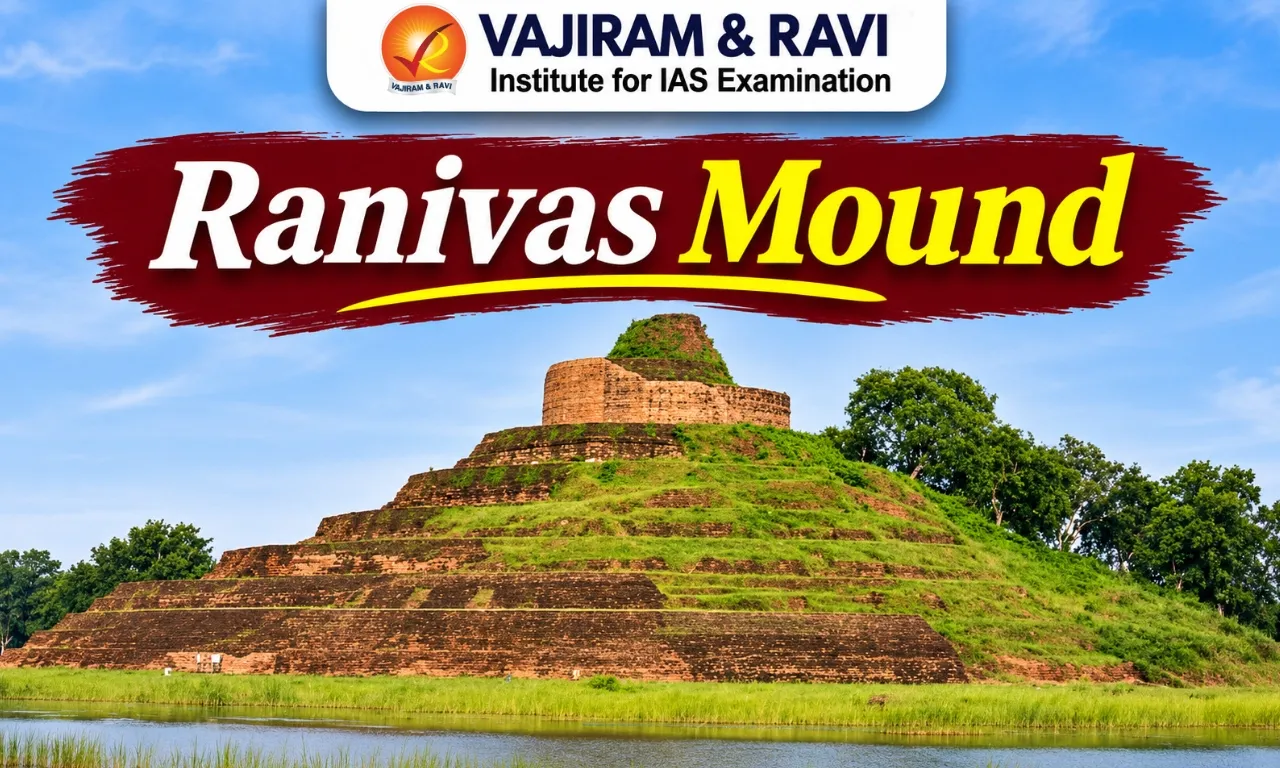
Ranivas Mound

Ranivas Mound

Ranivas Mound Latest News

Recently, Ranivas Mound has been declared an archaeological site of national importance through a central government notification.

About Ranivas Mound

  • Location: It is located in the state of Bihar and takes its name from local legends.
  • It is situated near the world famous Buddhist site of ‘Kesariya stupa’.
  • It is spread over 1.63 acres and is under the ownership of the Bihar government.
  • In 1861, Alexander Cunningham (Archaeological Survey of India (ASI) first director general), visited the site.
    • He explored the mound and conducted some excavations. In his report, he mentioned the existence of an old Buddhist establishment with a temple enshrining a huge image of Buddha.
  • Archaeological sites and ancient monuments of national importance are declared under The Ancient Monuments and Archaeological Sites and Remains Act, 1958 (AMASR Act).

Key Facts about Archaeological Survey of India (ASI)

  • It was established in 1861 under Sir Alexander Cunningham.
  • It works to protect India’s historical heritage, including ancient temples, forts, tombs, sculptures and archaeological remains.
  • It conducts scientific excavations, studies inscriptions, maintains protected monuments and helps preserve evidence of India’s past.
  • The headquarters of the Archaeological Survey of India is in New Delhi.
  • Its work is governed by important laws, including the Ancient Monuments and Archaeological Sites and Remains Act, 1958, and the Antiquities and Art Treasures Act, 1972.

Source: TH

Ranivas Mound FAQs

Q1: Where is Ranivas Mound ?

Ans: Bihar

Q2: Where is Archaeological Survey of India located?

Ans: New Delhi

Sindhudurg Fort: Nagpur Prison Inmates Recreate Shivaji Maharaj’s Historic Sea Fort

Sindhudurg Fort

Sindhudurg Fort Latest News

A replica of Sindhudurg Fort built by inmates of Nagpur Central Prison is bringing Maharashtra’s maritime heritage into an unusual setting, as more than 125 fort models across the city await inspection in the second edition of the Shivvaibhav Fort Competition.

About Sindhudurg Fort

  • It is a historical fort that occupies an islet in the Arabian Sea, just off the coast of Maharashtra.
  • It lies on Kurte Island, very near the coast of Malvan town in the Konkan region, 450 kilometres south of Mumbai.
  • The fort was built by Maratha king Shivaji Maharaj between 1664 and 1667. 
  • The main objective was to counter the rising influence of foreign colonizers (English, Dutch, French, and Portuguese merchants) and to curb the rise of the Siddis of Janjira.
  • It is recognized as a UNESCO World Heritage Site as part of the Maratha Military Landscapes of India. 

Sindhudurg Fort Features

  • It is spread over 48 acres with fortified walls that are 29 feet high and 12 feet thick and stretch for two miles.
  • The fort was built using local stone and lime mortar, with iron nails embedded in it to make it stronger.  
  • As many as 52 bastions with embrasures for cannons guard its walls.
  • One of the most ingenious features of the fort is its camouflaged entrance, strategically hidden to mislead enemies, adding an extra layer of defense. 
    • The main gate, Dilli Darwaj, is visible only from close quarters and seems to be part of the walls. 
  • A handprint and footprint of the Maratha King are embedded on a slab within the fort.
  • There is a temple dedicated to Shivaji inside the fort. 
  • Despite being encircled by seawater, the fort features several freshwater wells, a remarkable achievement of medieval engineering.

News: TOI

Sindhudurg Fort FAQs

Q1: Where is Sindhudurg Fort located?

Ans: Sindhudurg Fort is located on Kurte Island in the Arabian Sea, off the coast of Malvan in Maharashtra.

Q2: Who built Sindhudurg Fort?

Ans: The fort was built by Maratha king Shivaji Maharaj between 1664 and 1667.

Q3: What was the main objective behind the construction of Sindhudurg Fort?

Ans: To counter the influence of European colonial powers and curb the growing power of the Siddis of Janjira.

Q4: What is the distinctive defensive feature of Sindhudurg Fort's entrance?

Ans: Its camouflaged entrance, designed to mislead approaching enemies.

Enquire Now

