Urban India Latest News
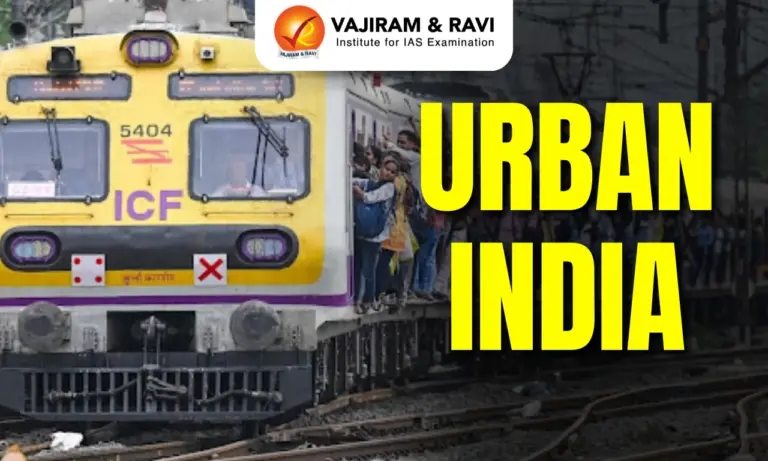
- The Union Budget 2026 has reduced central allocations for urban development by 11.6%, triggering debate on the government’s commitment to India’s cities.
Urban Development in India: Context and Importance
- Urban India is central to the country’s economic and social transformation.
- Cities contribute nearly two-thirds of India’s GDP and act as hubs for employment, innovation, and service delivery.
- Rapid urbanisation, however, has placed enormous stress on housing, transport, sanitation, water supply, and urban governance systems.
- Managing this transition requires sustained public investment, especially as urban local bodies (ULBs) remain fiscally weak and highly dependent on central and state transfers.
- The Constitution, through the 74th Constitutional Amendment Act, envisaged empowered municipalities with functional autonomy.
- In practice, inadequate devolution of funds, functions, and functionaries has limited their capacity.
- Central schemes such as PMAY-Urban, AMRUT, Swachh Bharat Mission-Urban, and investments in mass transit were designed to fill this gap and create a baseline of urban services across Indian cities.





Urban Development Financing Framework
- Urban development in India is financed through a mix of central allocations, state budgets, municipal revenues, and borrowing.
- Centrally Sponsored Schemes (CSS) play a dominant role, particularly in housing, sanitation, water supply, and mobility.
- While capital-intensive projects such as metro rail have received consistent support, everyday urban services, waste management, buses, footpaths, drainage, and informal housing depend on sustained, predictable funding.
- In recent years, climate risks such as heatwaves, floods, and water scarcity have further increased the need for resilient urban infrastructure.
- This makes budgetary prioritisation of cities not merely a welfare concern but a macroeconomic necessity.
Union Budget 2026: Overall Urban Allocation
- The Union Budget 2026 has reduced total central outlay for urban development from Rs. 96,777 crore to Rs. 85,522 crore, a nominal cut of 11.6%.
- After accounting for inflation, the real decline in urban spending is even sharper.
- This contraction comes at a time when cities are absorbing large-scale migration, facing infrastructure fatigue, and confronting climate-induced stresses.
- The reduction signals a shift in fiscal priorities, where urban development appears to be treated as a residual sector rather than a growth-critical investment area.
Skewed Spending Priorities within Urban Allocation
- Despite the overall contraction, spending remains heavily skewed towards metro rail projects.
- In 2026-27, metro and mass rapid transit systems account for Rs. 28,740 crore, about one-third of total urban allocations.
- While metro systems are important for large cities, they are capital-intensive, spatially limited, and cater mainly to formal commuters.
- By contrast, bus-based public transport, non-motorised transport, and last-mile connectivity, used by the majority of urban residents, receive relatively limited attention.
- This reflects a policy bias towards high-visibility infrastructure over inclusive and scalable mobility solutions.
Cuts in Flagship Urban Schemes
- All major urban welfare and service schemes have seen budgetary reductions:
- Pradhan Mantri Awas Yojana-Urban (PMAY-U) has faced a cut of nearly 6%, despite persistent urban housing shortages and expanding informal settlements.
- Swachh Bharat Mission-Urban (SBM-U) allocation has been halved, raising concerns about the sustainability of sanitation gains and waste processing infrastructure.
- AMRUT, critical for urban water supply and sewerage, has seen a 20% reduction, even as cities face acute water stress and ageing infrastructure.
- These cuts directly affect the quality of life in cities and risk reversing progress made in basic urban services.
Implications for Urban Governance and Growth
- The Budget does not compensate for reduced central spending through greater fiscal devolution or enhanced revenue-raising powers for municipalities.
- As a result, ULBs remain constrained in planning long-term infrastructure and responding to local needs.
- At a broader level, weakening urban investment undermines India’s growth aspirations. Globally, successful development trajectories are built on well-funded, inclusive, and productive cities.
- Treating urban development as a cost centre rather than an engine of growth risks long-term economic and social consequences.
Source: TH

 Last updated on March, 2026
→ UPSC Final Result 2025 is now out.
→ UPSC has released UPSC Toppers List 2025 with the Civil Services final result on its official website.
→ Anuj Agnihotri secured AIR 1 in the UPSC Civil Services Examination 2025.
→ UPSC Marksheet 2025 is now out.
→ UPSC Notification 2026 & UPSC IFoS Notification 2026 is now out on the official website at upsconline.nic.in.
→ UPSC Calendar 2026 has been released.
→ Check out the latest UPSC Syllabus 2026 here.
→ UPSC Prelims 2026 will be conducted on 24th May, 2026 & UPSC Mains 2026 will be conducted on 21st August 2026.
→ The UPSC Selection Process is of 3 stages-Prelims, Mains and Interview.
→ Prepare effectively with Vajiram & Ravi’s UPSC Prelims Test Series 2026 featuring full-length mock tests, detailed solutions, and performance analysis.
→ Enroll in Vajiram & Ravi’s UPSC Mains Test Series 2026 for structured answer writing practice, expert evaluation, and exam-oriented feedback.
→ Join Vajiram & Ravi’s Best UPSC Mentorship Program for personalized guidance, strategy planning, and one-to-one support from experienced mentors.
→ Shakti Dubey secures AIR 1 in UPSC CSE Exam 2024.
→ Also check Best UPSC Coaching in India
Urban India FAQs
Q1. By how much has urban development allocation been reduced in Budget 2026?+
Q2. Which urban sector continues to receive the largest share of funding?+
Q3. Which major urban schemes faced budget cuts in 2026?+
Q4. Why are cuts to sanitation and water schemes a concern?+
Q5. What is the broader implication of reduced urban spending?+
Tags: mains articles upsc current affairs upsc mains current affairs urban india