US-China Relations Latest News
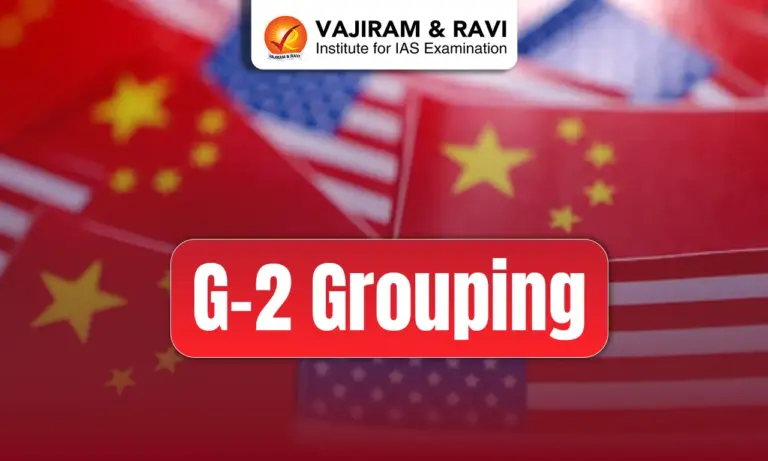
- U.S. President Donald Trump’s reference to a “G-2” with China has revived debates about a potential U.S.-China duopoly, raising concerns among allies.
Introduction
- When U.S. President Donald Trump announced before meeting Chinese President Xi Jinping that “THE G2 WILL BE CONVENING SHORTLY!”, it reignited debates about the future of U.S.-China relations and the possible sidelining of key allies.
- The reference to the G-2, a concept implying a U.S.-China duopoly in global leadership, signals a shift in tone that could unsettle Washington’s partners in Asia and beyond.
- At a time when geopolitical fault lines are already deep, this framing challenges the balance built through multilateral institutions and strategic groupings like the Quad.





The Origin of the G-2 Concept
- The idea of a “G-2” was first introduced in 2005 by economist C. Fred Bergsten, then Director of the Peterson Institute for International Economics.
- He proposed that the United States must prioritise bilateral relationships with key global actors, the European Union, China, Japan, and Saudi Arabia, to stabilise global economic systems and energy flows.
- Following the 2008 global financial crisis, the G-2 idea gained momentum, with Bergsten arguing that effective global economic recovery and climate action would be impossible without U.S.-China cooperation.
- The concept was not intended to replace the G-20 or institutions like the IMF or WTO, but to “supplement and strengthen global governance through pre-coordination” between the two biggest economies.
- Prominent thinkers also supported the idea, and even the Obama administration explored its feasibility during the early years of U.S.-China engagement under Hu Jintao.
The Changing Nature of China’s Global Posture
- Two decades later, the global order has shifted dramatically.
- China is no longer the cautious power that once adhered to Deng Xiaoping’s dictum to “hide your strength and bide your time.”
- Under President Xi Jinping, Beijing has asserted itself across multiple domains, from the South China Sea to the Taiwan Strait and global technology infrastructure.
- This transformation has redefined China’s interactions with the U.S. and its allies.
- China’s Belt and Road Initiative (BRI) has expanded its economic footprint, while its military modernisation has challenged American dominance in the Indo-Pacific.
- Consequently, the Trump administration (2017-2021) was pivotal in reframing China from a “strategic partner” to a “strategic competitor.”
- The 2017 U.S. National Security Strategy explicitly identified China’s actions as threats to the rules-based international order, leading to trade wars, tariff barriers, and renewed security cooperation in the Indo-Pacific.
Trump’s G-2 Framing: A Return to Bilateralism
- Trump’s recent embrace of the G-2 language marks a sharp contrast to his earlier confrontational stance.
- While the 2017-2021 phase was characterised by decoupling and trade hostilities, the “G-2 framing” suggests recognition of China’s great-power status and potential equal footing in global decision-making.
- For many U.S. partners, this framing raises concerns of strategic ambiguity.
- It could signal a transactional pivot, where Washington negotiates directly with Beijing on key issues such as trade, technology, and security, potentially marginalising traditional allies.
- Such bilateral prioritisation contradicts the multilateral Indo-Pacific vision promoted through the Quad (U.S., India, Japan, and Australia) and other alliances aimed at countering China’s regional assertiveness.
Global Reactions: Allies’ Concerns and Diplomatic Ripples
- India
- India faces a complex diplomatic recalibration.
- The imposition of 50% tariffs on Indian goods by the Trump administration strained bilateral trade ties, leading to the postponement of the planned Quad Leaders’ Summit.
- Diplomatic discussions even hinted at a potential Quad restructuring where the Philippines could temporarily replace India, a move that reflects both India’s independent stance on global issues and Washington’s evolving calculus.
- However, given India’s growing economic and strategic weight, many observers argue that any sustainable Indo-Pacific architecture cannot exclude India.
- Japan and Australia
- Both have expressed unease over the G-2 rhetoric.
- For them, the revival of the Quad in 2017 was a direct response to Beijing’s aggression in the South China Sea and its growing military presence.
- A U.S.-China rapprochement could dilute Washington’s commitments and leave allies vulnerable to unilateral shifts in American policy.
- ASEAN States
- Southeast Asian countries, particularly those within the ASEAN bloc, view the development cautiously.
- While they welcome reduced tensions between Washington and Beijing, they fear that a bilateral G-2 understanding could come at their expense, potentially undermining their regional autonomy and interests.
Implications for the Global Order
- If the U.S. and China move toward a G-2 model, smaller states could face strategic marginalisation.
- The rules-based order, which relies on consensus-building through global institutions, may weaken as decision-making becomes concentrated between two superpowers.
- Conversely, some analysts argue that even a temporary U.S.-China conciliation could help stabilise trade flows and de-escalate tensions, especially in areas such as semiconductor supply chains, climate negotiations, and global economic governance.

 Last updated on March, 2026
→ UPSC Final Result 2025 is now out.
→ UPSC has released UPSC Toppers List 2025 with the Civil Services final result on its official website.
→ Anuj Agnihotri secured AIR 1 in the UPSC Civil Services Examination 2025.
→ UPSC Marksheet 2025 is now out.
→ UPSC Notification 2026 & UPSC IFoS Notification 2026 is now out on the official website at upsconline.nic.in.
→ UPSC Calendar 2026 has been released.
→ Check out the latest UPSC Syllabus 2026 here.
→ UPSC Prelims 2026 will be conducted on 24th May, 2026 & UPSC Mains 2026 will be conducted on 21st August 2026.
→ The UPSC Selection Process is of 3 stages-Prelims, Mains and Interview.
→ Prepare effectively with Vajiram & Ravi’s UPSC Prelims Test Series 2026 featuring full-length mock tests, detailed solutions, and performance analysis.
→ Enroll in Vajiram & Ravi’s UPSC Mains Test Series 2026 for structured answer writing practice, expert evaluation, and exam-oriented feedback.
→ Join Vajiram & Ravi’s Best UPSC Mentorship Program for personalized guidance, strategy planning, and one-to-one support from experienced mentors.
→ Shakti Dubey secures AIR 1 in UPSC CSE Exam 2024.
→ Also check Best UPSC Coaching in India
US-China Relations FAQs
Q1. What does the term “G-2” signify?+
Q2. Who first coined the G-2 concept?+
Q3. How has Trump’s G-2 framing affected U.S. allies?+
Q4. Why is India central to the Indo-Pacific framework?+
Q5. What could be the global impact of a renewed U.S.-China G-2 alignment?+
Tags: mains articles upsc current affairs upsc mains current affairs US-China Relations