US Climate Body Exit Latest News
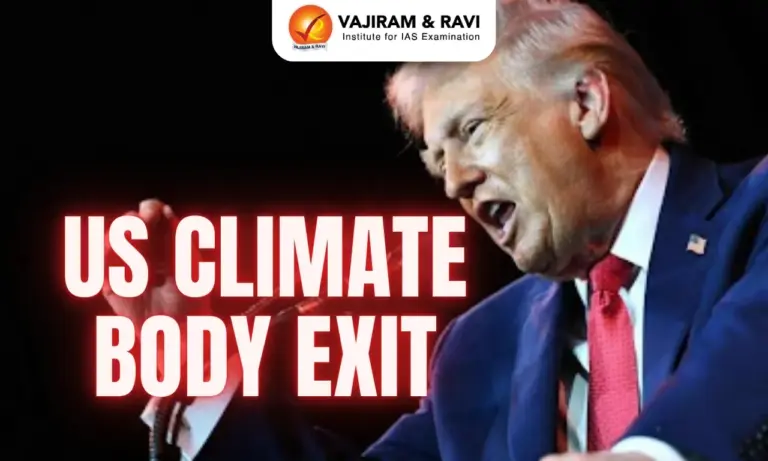
- The United States has announced its withdrawal from the UN Framework Convention on Climate Change (UNFCCC) and over 60 international treaties and organisations it says no longer serve American interests.
- The exit includes key climate bodies such as the Intergovernmental Panel on Climate Change (IPCC), the International Solar Alliance (ISA), and the International Renewable Energy Agency (IRENA).
- This follows the earlier decision by President Donald Trump to withdraw from the Paris Agreement, a move that will take effect on January 20 after the mandatory one-year notice period.
- Over the past year, the Trump administration has also cut funding and staffing for US climate research agencies.
- Together, these steps mark a near-total US disengagement from the global climate governance system, casting serious doubt on the effectiveness and future of multilateral efforts to address climate change.
The United States’ Emissions Profile
- The United States ranks among the top countries for annual and per-capita carbon emissions.
- Data from the Global Carbon Project show that US territorial CO₂ emissions in 2024 were about 4.9 billion tonnes, accounting for roughly 12.7% of global emissions.
- In 2024, US per-capita CO₂ emissions stood at around 14.6 tonnes per person, far exceeding the global average, underlining the country’s carbon-intensive consumption patterns.
- The US is also the largest cumulative emitter of CO₂ from fossil fuels and industry. Its share of historical global emissions is about 24%.
- According to the US Environmental Protection Agency, total US greenhouse gas emissions were 6.3 billion metric tonnes of CO₂-equivalent in 2022.
- Land use and forests offset roughly 13% of these emissions as a net carbon sink.





US and Climate Action: A Longstanding Love–Hate Relationship
- The United States played a key role in shaping the UN Framework Convention on Climate Change (UNFCCC), recognising climate change and setting global principles.
- However, it never joined the Kyoto Protocol, which imposed binding emission targets.
Architect of Paris, Weak on Delivery
- The US actively pushed for an alternative to Kyoto, culminating in the Paris Agreement.
- Yet, its performance under Paris has been poor, with limited emissions cuts and inadequate delivery on finance and technology commitments.
Engagement Without Denial (Pre-Trump Era)
- Despite shortcomings, the US did not deny climate change.
- It remained engaged in global climate talks, invested heavily in climate science and clean technologies, and promoted green investments domestically and internationally.
Trump Era: From Ambivalence to Undermining
- Under President Donald Trump, the US shifted sharply.
- A declared climate sceptic, Trump openly mocked climate action, withdrew from agreements, and slashed funding for climate research—moves that risk long-term global setbacks given the US’s scientific leadership.
Fallout of the US Exit from Global Climate Institutions
- The US withdrawal from the UN Framework Convention on Climate Change and related bodies was not entirely unexpected, given its earlier exit from the Paris Agreement and cuts to climate research funding.
- Since the world was already off track to meet 2030 targets—and the US itself was not contributing meaningfully—the short-term global impact may be marginal.
- The deeper fallout will hinge on whether future administrations reverse course. A prolonged US absence could weaken multilateral climate cooperation and delay collective action over the long run.
- By disengaging, the United States risks surrendering leadership to China, which is aggressively expanding renewable energy manufacturing, deployment, and supply chains.
Renewables’ Irreversible Momentum
- Most countries are already committed to renewables for energy security and affordability.
- Solar and wind are now economically and strategically attractive, making a full reversal of the energy transition unlikely.
- Efforts to boost fossil fuel output—such as expanding oil supply—may slow the transition but won’t stop it.
- By vacating the clean energy space, the US risks undermining its own long-term economic interests and geopolitical leverage.
Impact on India’s Climate and Energy Transition
- The United States exit from global climate bodies may ease short-term pressure on India to decarbonise rapidly.
- However, it also introduces uncertainty for India’s plans to attract investments in clean technologies.
Setback to India–US Climate Cooperation
- Before President Donald Trump’s second term, India and the US shared a strong strategic partnership on climate and clean energy, with US support across multiple energy sectors.
- This collaboration is now expected to stall, potentially forcing India to recalibrate its energy transition pathways.
International Solar Alliance and Funding Gaps
- The US has withdrawn from the International Solar Alliance (ISA), which India co-founded with France on the sidelines of COP21 Paris.
- Although the US joined the ISA in 2021 as its 101st member, it provided no financial support.
- A 2025 decision to levy annual membership fees is yet to be implemented, leaving questions over future funding and momentum.

 Last updated on April, 2026
→ UPSC Final Result 2025 is now out.
→ UPSC has released UPSC Toppers List 2025 with the Civil Services final result on its official website.
→ Anuj Agnihotri secured AIR 1 in the UPSC Civil Services Examination 2025.
→ UPSC Marksheet 2025 is now out.
→ UPSC Notification 2026 & UPSC IFoS Notification 2026 is now out on the official website at upsconline.nic.in.
→ UPSC Calendar 2026 has been released.
→ Check out the latest UPSC Syllabus 2026 here.
→ UPSC Prelims 2026 will be conducted on 24th May, 2026 & UPSC Mains 2026 will be conducted on 21st August 2026.
→ The UPSC Selection Process is of 3 stages-Prelims, Mains and Interview.
→ Prepare effectively with Vajiram & Ravi’s UPSC Prelims Test Series 2026 featuring full-length mock tests, detailed solutions, and performance analysis.
→ Enroll in Vajiram & Ravi’s UPSC Mains Test Series 2026 for structured answer writing practice, expert evaluation, and exam-oriented feedback.
→ Join Vajiram & Ravi’s Best UPSC Mentorship Program for personalized guidance, strategy planning, and one-to-one support from experienced mentors.
→ Shakti Dubey secures AIR 1 in UPSC CSE Exam 2024.
→ Also check Best UPSC Coaching in India
US Climate Body Exit FAQs
Q1. What does the US climate body exit include?+
Q2. Why has the US climate body exit raised global concern?+
Q3. How does the US climate body exit affect India’s climate strategy?+
Q4. What is the impact of the US climate body exit on the International Solar Alliance?+
Q5. Why could the US climate body exit benefit China strategically?+
Tags: mains articles upsc current affairs upsc mains current affairs US climate body exit